
I read through a stack of property management marketing advice recently, and it all said the same five things. Run some ads. Post your listings. Ask for reviews. Maybe start a newsletter.
None of it was wrong exactly. It was just forgettable, and forgettable marketing is a strange thing to build a trust based business on.
Property management is a weird industry to market, because you are actually marketing to two completely different audiences at once. Owners, who need to trust you with their biggest asset. And tenants, who need to trust you enough to sign a year of their life away. Most advice treats it like one audience. It is not.
So I went looking for ideas built around that split instead. Fifteen of them, genuinely specific, several borrowed from things property managers are already quietly doing that never made it into a top ten list.
Already know why the two audience split matters and just want the ideas? Skip straight to the list.
Why Generic Advice Falls Flat Here
Picture a small property management company overseeing forty rental units near a state university. Half their marketing problem is finding new property owners to sign with them. The other half is keeping the current forty units full of tenants who pay on time and do not trash the place.
A generic ad campaign treats both of those problems the same way. It should not. An owner cares about vacancy days and maintenance costs. A tenant cares about whether someone will actually show up when the heat breaks in January.
That is the whole logic behind how these fifteen ideas are grouped.
Ideas That Win You More Property Owners
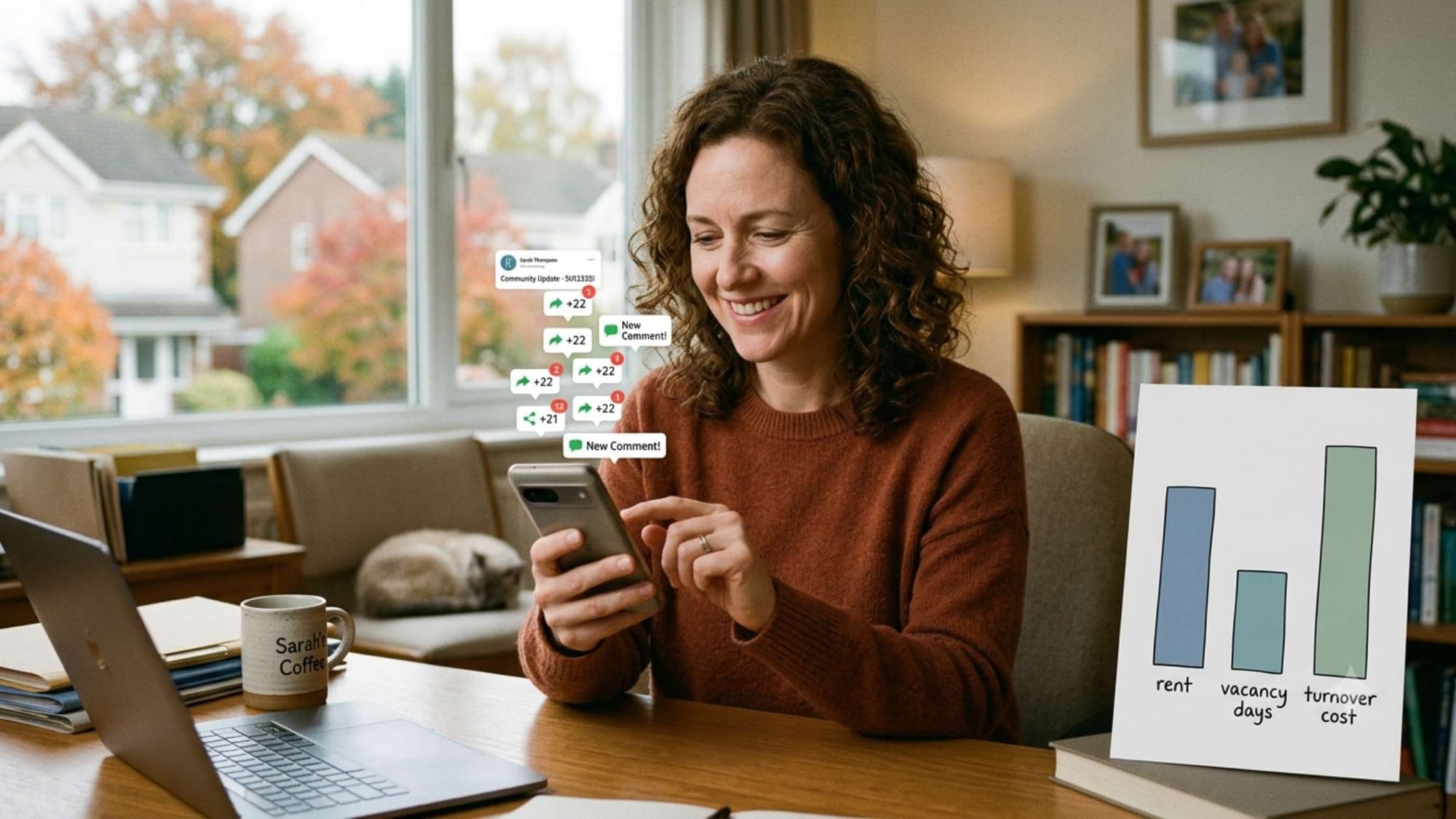
Step 1: Publish a real cost of vacancy calculation. Most owners have never actually done the math on what an empty unit costs them per week. Take a real, anonymized example, average rent, average days vacant, turnover cleaning cost, and lay it out as a simple graphic.
Picture a property manager in a mid sized Ohio market walking through the exact numbers publicly. Five hundred dollars average rent, twenty one average vacancy days, a three hundred dollar turnover clean, adding up to roughly nine hundred and fifty dollars lost per turnover. That specific number, not a vague warning about vacancies, is what got the post shared across three different local landlord groups the same week.
Step 2: Host a webinar for accidental landlords. Think of someone who inherited a parent's house, or kept their starter home as a rental after moving for a new job. They did not choose to become a landlord, and they are quietly overwhelmed.
A management company in a growing suburb ran a session called My Parents Left Me A House, Now What. Fourteen people signed up, and five of them signed a management contract within a month, people who had never once searched Google for a property manager because they did not know that was a category they belonged to yet.
Step 3: Film the two a.m. maintenance call. Not literally at two in the morning, but recreate the sequence. Show what actually happens when a pipe bursts overnight, so an owner can see exactly what they are paying for instead of just being told to trust it.
Picture a twenty four unit downtown loft building. A pipe bursts at 1:50am. The video shows the tenant's call coming in, the dispatch text going out, and a technician arriving by 2:40am, with the timestamp visible the entire time. That fifty minute number becomes the whole pitch to a hesitant owner.
Step 4: Build a referral loop with agents at the exact right moment. The moment someone closes on an investment property is the single best moment to reach them, not three months later.
A single agent in a mid sized suburban market who closes forty investment property sales a year is worth more to a property manager than a thousand dollars of ads, because every one of those closings is a person who needs a property manager within days, not months.
Step 5: Publish a quarterly local rent report. Pull real numbers from your own portfolio and the surrounding market, average rent by unit type, days on market, renewal rates.
A hundred and twenty unit portfolio is plenty of data to publish something genuinely useful. Average one bedroom rent up four percent, average vacancy down to nine days from fourteen. Once local news or other agents start citing that number, they are citing it with your name already attached.
Ideas That Keep Tenants Happy And Renewing
Step 6: Throw a resident event that matches the neighborhood, not a template. Skip the generic pizza party and build something that feels like it belongs to that specific community.
A sixty unit complex in a warm climate market swapped its usual pizza night for a taco truck parked in the courtyard. Attendance roughly tripled compared to the pizza nights, according to the property manager who tried it, simply because it felt like an actual neighborhood event instead of an obligation to show up to.

Step 7: Introduce your maintenance team like real people. A short video or a simple page with photos and a one line bio for each technician does more for trust than any promise written into a lease.
One management company put up a single page titled Who Is Coming To Your Door, with photos and a sentence about each of their three technicians. Service requests submitted calmly through the portal, instead of an anxious phone call, went up noticeably once tenants already recognized the face that would show up.
Step 8: Partner with local businesses on a move in welcome box. New tenants feel welcomed into a neighborhood, not just handed a set of keys, and the local businesses get free exposure to every new resident.
A property manager in a college town partnered with the coffee shop across the street and a pizza place two doors down for a simple welcome envelope left on the counter at move in. Both businesses started referring their own customers back the moment someone mentioned they were apartment hunting.
Step 9: Pay tenants to refer their friends. A modest bonus costs far less than most paid advertising, and tenants tend to refer people similar to themselves, which quietly improves who ends up in your units.
A two hundred dollar bonus split between the referring tenant and the new tenant after sixty days is small enough to avoid attracting fraud, but big enough that a happy resident mentions it to a coworker before ever opening Zillow.
Step 10: Send a personal renewal message instead of a form email. A short video from the property manager, using the tenant's actual name and a specific detail, changes the entire feeling of a renewal notice.
A tenant who reported a slow leak back in March, before it became a real problem, gets a renewal message in October that mentions it by name. That kind of detail turns a renewal into an easy yes instead of a moment to start comparison shopping.
Ideas That Make The Whole Brand More Visible Locally
Step 11: Sponsor something small and specific, not something generic. Small, well chosen events tend to get picked up by local social pages and neighborhood groups for free.
A dog adoption day held in a managed complex's courtyard, run in partnership with a local shelter, got shared by two neighborhood Facebook groups and a local news Instagram account without a single dollar spent on promotion.
Step 12: Film your amenities like a travel video, not a listing photo. Property amenities are one of the few real estate categories where purely aspirational video content performs extremely well on Instagram Reels and TikTok, because it sells a feeling, not a transaction.
A rooftop deck at golden hour, thirty seconds long, no dialogue, just the view and the sound of the city below. On a property management account that had barely cracked a few hundred views on anything before, that is the kind of clip that finally clears ten thousand.
Step 13: Build a renter's survival guide as a resource hub. This kind of content ranks well in search and builds trust with someone long before they ever apply for a unit.
A simple page titled What Actually Counts As Normal Wear And Tear, with real photos and real examples, starts ranking on its own within a few months for exactly the searches a nervous first time renter types at midnight.
Step 14: Show up in person with a reason to stop. A booth with a small, specific giveaway turns a passing stranger into an email address you can actually follow up with.
A folding table at a Saturday farmers market with one sign, scan for a chance at a free month of reserved parking, collected more real local email addresses in four hours than a boosted Facebook post managed in two weeks.
Step 15: Keep a real content calendar instead of posting when you remember to. None of the fourteen ideas above matter if they only get posted once and forgotten.
A company juggling owner updates, tenant reminders, and five separate social accounts finally mapped it onto one shared calendar, one owner focused post and one tenant focused post every week, scheduled a month out instead of decided each morning. That single change is what made an owner webinar and a resident taco truck night actually reach people, instead of disappearing the same day they happened.
If Step 15 sounds like the hard part, it usually is, and it is the exact problem we broke down in I Used Claude and Circleboom to Create 100 Social Media Posts for Real Estate Agencies. The same approach, grouping content by topic and scheduling it across platforms with Circleboom, works just as well for a property management company's mix of owner focused and tenant focused posts.
And if any of this has you rethinking what your own website says about your brand before a single visitor even reads a word, that is worth a look too. We covered exactly that in 10 Boutique Real Estate Agency Websites Worth Studying, and How to Become One, and most of what makes a real estate brand feel boutique instead of generic applies just as directly to a property management company.
None of these fifteen ideas require a bigger budget than running the same ad everyone else is running. They require picking a specific person, an accidental landlord, a nervous new tenant, a stranger at a farmers market, and building something that person will actually remember.
That is the whole difference between marketing that gets scrolled past and marketing that gets forwarded to a friend.