
The best real estate Twitter accounts for you are usually not the ones on a published list. They are the accounts that cover your segment, post about your market, and still hold a live audience when you check them this quarter.
The best real estate Twitter accounts sort into five layers: market-data publishers, industry newsrooms, trade associations, investor communities, and operator voices inside your own niche. Circleboom searches X accounts by keyword, follower tier, engagement level, and location, then returns a ranked, exportable shortlist you can act on without opening a single profile.
→ best real estate Twitter accounts
The five-signal rubric further down is what separates a follow worth keeping from a follow that goes quiet in a month.
How this list was built: the layers below group real estate accounts on X by what each one gives a reader, and every named account is an organization or figure whose presence in the space has held for years. Follower counts move weekly, so none are quoted here. Where a layer has no strong name in your city, the search workflow at the end rebuilds that layer for your own market.
The five layers of real estate accounts worth following on X
Real estate on X is not one conversation. It is five, and most published round-ups flatten them into a single ranking, which is how a residential agent in Tampa ends up with a feed full of Manhattan office-tower deals.
| Account layer | Example accounts | What you get | Best for |
|---|---|---|---|
| Market-data publishers | Redfin, Zillow, ATTOM Data | Price, inventory, and days-on-market reads | Agents who quote numbers to clients |
| Industry newsrooms | HousingWire, Inman, The Real Deal | Deal news, brokerage moves, policy shifts | Anyone selling into the industry |
| Trade associations | NAR, Mortgage Bankers Association, NAHB | Primary survey data you can cite | Content that needs a real source |
| Investor communities | BiggerPockets | Financing threads, deal structures, mistakes | Investors and investor-facing agents |
| Operator voices | StripMallGuy, Keith Wasserman | Live deal reasoning from people doing it | Commercial and multifamily operators |
Two of those layers are national and stable. The other three are where a borrowed list fails, because newsrooms skew toward the markets they cover and operator voices are the most local signal on the platform.
Circleboom fills those three layers by matching a keyword against X profiles and post history, then scoping the result by follower band, engagement tier, and location.
Market-data publishers are for numbers, not opinions
Redfin, Zillow, and ATTOM post the same housing data their research teams publish, usually as a chart with a one-line read. Follow them for the figure you will quote in a listing appointment, not for commentary.
The practical test is whether the account posts its own data or reposts someone else's. A publisher that generates the number is worth a permanent slot. An aggregator that reposts it a day later is not.
Newsrooms and associations solve two different problems
HousingWire, Inman, and The Real Deal tell you what moved in the industry. They are fast, they are opinionated in the headline, and their coverage weights heavily toward the markets where their reporters sit.
Associations do the opposite. They are slow, and they publish primary research. That makes them the layer to reach for when a post needs a citation rather than a hot take.
Brand positioning sits next to this layer. The 10 boutique real estate agency websites worth studying show how smaller firms turn the same public data into a point of view.
Investor communities and operator voices carry the real texture
BiggerPockets threads read like a working group: financing structures, tenant problems, and the mistakes people admit to after the fact. That admission rate is what makes the layer valuable.
Operator accounts go one level further. Figures like StripMallGuy or Keith Wasserman narrate deals as they think through them, which is the closest thing on X to watching someone work. It is also the layer with the shortest shelf life, because operators rotate asset classes when the rate environment turns.
Why borrowed lists of real estate accounts go stale
A published round-up is a snapshot of one writer's feed on one date. Nothing in it updates when an account changes focus, sells the business, or simply stops posting.
Real estate makes that decay worse than most industries. Agents move brokerages, investors rotate asset classes after a rate move, and a market-commentary account that felt essential during one cycle reads as noise in the next.
The lead-generation stakes are real. In its 2025 technology survey, the National Association of Realtors found that 39 percent named social media as their top lead source. That beat both CRM and the local MLS.
A feed tuned to the wrong segment quietly spends that channel.
Building your own real estate Twitter accounts to follow list takes about twenty minutes and stays yours. Copying one takes two minutes and starts decaying the same afternoon.
While you build, the Twitter real estate hashtags agents actually post under will show you which tags the accounts you want are already using.
Is follower count the right way to rank real estate accounts?
No. Follower count is the weakest of the five signals that matter, and ranking on it is the reason most published lists look identical to each other.
The rubric, in priority order:
- Segment fit. Residential, commercial, mortgage, proptech, or local market data. Exactly one of those is yours.
- Sustained topical presence. Has the account posted on the subject across years, or once during a news cycle?
- Follow ratio. Followers divided by following. A high ratio means people follow without being followed back.
- Engagement tier. Does the audience reply and repost, or just sit there?
- Geographic overlap. For transactional work, a smaller account whose audience sits in your metro beats a larger one whose audience does not.
Follower count is absent from that list because the other four already contain it. An account clearing segment fit, sustained presence, a strong follow ratio, and a live engagement tier is influential by definition, whatever number sits on the profile.
Circleboom exposes four of those signals as filters. The fifth, sustained presence, comes from historical matching against bios and past posts. Its Search Twitter Bios and Profiles view runs that matching against profile text alone when a bio keyword is the cleaner filter.
The manual version is worth seeing once before you automate it. How to find Twitter influencers for free walks the same logic through native search, limits included.
The real estate accounts every list misses
Selective posters are the systematic blind spot. A broker who closes eight deals a year and posts twelve times about them will never rank in a live-activity search, yet those twelve posts are often the most useful thing in the segment.
Live search is anchored to who is talking now. Historical search is anchored to who has been talking for years. Those return different account sets, and the second set is where credibility without volume lives.
Deep X Account Search runs the keyword against historical bios and post history rather than recent activity, returning up to 5,000 accounts per query. The trade-off is honest: some of those accounts have moved on, so a keyword match from three years ago is a lead, not a verdict.
The practical move is to run both. Live search gives you the accounts posting this week, historical search gives you the ones who established the space, and the overlap between the two is the shortlist worth keeping.
The non-US blind spot
There is a second gap worth naming. Most lists cover one country, usually the United States, which leaves every other market building from scratch. Property is national in its regulation and local in its practice, so a UK letting agent or a Canadian mortgage broker gets almost nothing usable from a US round-up beyond the data publishers.
The location filter closes that gap in one move, because it works on free text rather than a fixed country list. Searching "letting agent" scoped to Manchester behaves identically to searching "realtor" scoped to Phoenix.
How to find the best real estate Twitter accounts with Circleboom
To build your own list, search a segment keyword against X account bios and post history, scope the result to a follower band and a location, then keep only the accounts that clear the rubric above. Circleboom is an official X Enterprise Developer company. Every profile in the result arrives through sanctioned API access rather than a scraper, so the search never puts your own account at policy risk.
You can find real estate influencers on X in two phases.
Short demo: the keyword-to-shortlist path that replaces scrolling a hashtag hoping an influential account floats past.
Set the search around your segment, not the industry
- Log in to Circleboom Twitter and connect your X account.

- Open the Advanced X Search menu and choose Find Influencers.
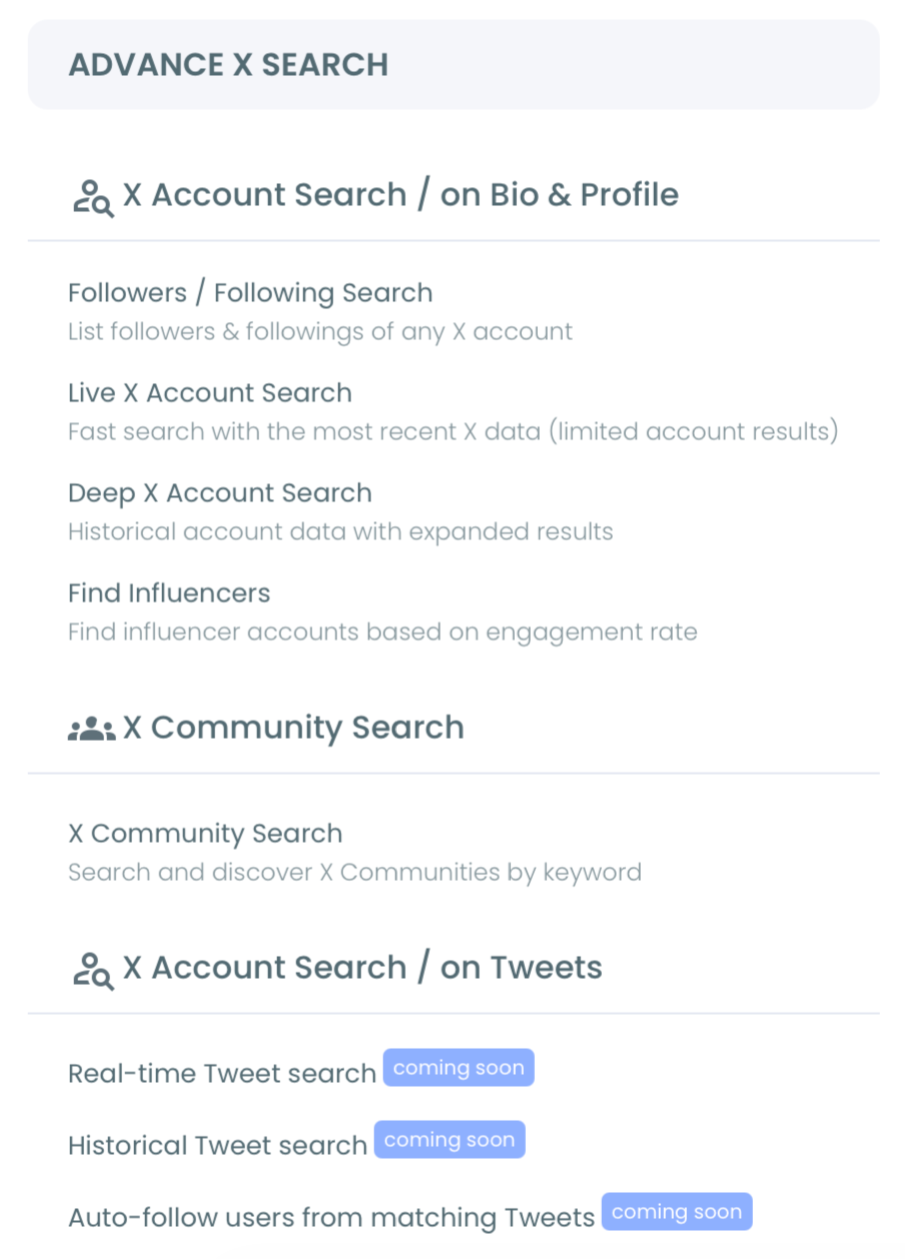
- Enter the keyword your segment uses, not the phrase "real estate." Search "multifamily," "1031 exchange," "mortgage rates," or "Austin realtor" instead. Circleboom matches that keyword against names, bios, profiles, and post history in one pass.
Filter for reach you can verify, then save the shortlist
- Choose your engagement tiers. High, mid, and low influencer tiers are all active by default, and deselecting low is usually the first narrowing worth making.
- Set the follower range and the location field. A 5,000 to 50,000 band returns micro-influencers with real reply volume; 50,000 to 500,000 returns the mid-tier that partnerships usually target.
- Sort by follow ratio, add the keepers to an X List, and export the rest as CSV for your outreach sheet.
That order works because each step removes a different wrong answer. The keyword drops off-segment accounts, the engagement tier drops dormant ones, the follower band drops celebrities whose audience you will never reach, and the ratio sort lifts genuine authority to the first page you read.
At a glance: keyword, then engagement tier, then follower band, then location, then follow ratio, then list.
What changes once the list is yours
A self-built list changes what the feed is for. Instead of a general real estate stream, you get five layers, each answering a question you actually have.
The second change compounds. Every search adds accounts you can re-filter later, and the export gives you a dataset rather than a memory. Circleboom returns up to 5,000 matching profiles per search with follower count, following count, follow ratio, join date, and engagement classification on every row, so a pass six months from now starts from evidence.
The list is also a content brief
The third change is about what you write. Reading five to eight accounts inside your exact segment shows you the recurring arguments and, more usefully, the questions nobody in the segment is answering. That gap is the most reliable content brief there is, and it only appears once the feed is narrow enough to see a pattern in.
Keep the shortlist in a private X List rather than following everything. X allows up to 5,000 accounts per List and 1,000 Lists per account, and a List timeline shows only posts from the accounts on it. That isolation is what a segment feed needs.
Circleboom's Twitter List Manager pushes accounts into those lists in bulk straight from the search result.
The method travels outside real estate too. The best Twitter accounts to follow for knowledge get built the same way: by signal, not by name recognition.
Summary
The best real estate Twitter accounts are not a fixed set of names. They are five layers of coverage, filled with accounts that clear segment fit, sustained presence, follow ratio, engagement tier, and geographic overlap for your specific market.
Copy the two stable layers from anyone's round-up. Build the other three yourself, then rebuild them the next time your market turns.
→ best real estate accounts on X
Common questions about real estate accounts on X
Can I find real estate accounts on X by city?
Yes. The location filter narrows an influencer search to a free-text place, so "realtor" scoped to Austin returns accounts whose profiles put them there. Pair it with a bio keyword when the metro name is also a common first name or brand.
How many accounts should a real estate feed follow?
Fewer than most people expect. Five to eight accounts per layer covers a market, and anything past roughly forty produces a feed you skim rather than read.
Do these accounts still help if I only work with local buyers?
Yes, but the weighting flips. National data publishers and associations become background reading, while operator voices and local newsrooms carry most of the value, since those are the accounts your clients are also seeing.