
Most shop owners post on social maybe twice a month. A tire rotation reminder. A happy birthday to a longtime tech. Then nothing for six weeks.
The local service businesses that actually pull customers from social post three times a week, minimum. That gap is basically the whole game. The shops winning here aren't running secret strategies. They're doing the small-business basics most owners know about but never actually execute on.
The good news is you don't need a paid ads budget, a viral reel, or a camera crew to close that gap. You need the right platforms, a short list of content types, and the discipline to show up on a schedule.
Let's go through all three.
Pick two platforms, not five
Shop owners try to be everywhere. Facebook, Instagram, TikTok, X, LinkedIn, YouTube, Nextdoor, whatever someone mentioned at the last chamber of commerce meeting. It ends up like six bays with one tech. Nothing gets finished.
Pick two. For most independent shops, the two that matter are Google Business Profile and Facebook.
Google Business Profile is technically not social media, but it drives more phone calls than anything else for local service businesses. When someone types "mechanic near me," your Business Profile is what shows up. Shops that post weekly updates, photos, and offers there outrank the ones that set it up in 2019 and forgot about it. Most of your competitors are in the second group.
 Arif Akdogan
Facebook is where your actual customer demographic lives. People who own older cars and need repairs most often aren't scrolling TikTok at midnight. They're on Facebook over morning coffee. Community groups and neighborhood pages are where someone posts "does anyone know a good mechanic?" You want to already be the shop they see.
Instagram is worth adding as a third if your shop has visual stories to tell and your bays are clean. If your idea of a photo is a blurry phone shot of a battery, skip it for now.
Running even two platforms takes real time, though. If that math doesn't work for you, digital marketing services for auto repair shops handle the whole rotation end-to-end. More on that further down. For now, let's look at what actually goes on those platforms.
What to actually post
Four content types. Use them on rotation and you'll never run out of ideas.
Before and afters. The single highest-performing posts for repair shops. Corroded battery terminals scrubbed clean. A rusted rotor swapped for a fresh one. A filthy cabin air filter next to a new one. A phone and decent lighting is all you need. These work because they show people what you do and make the money feel worth it.
Maintenance tips. Short practical posts about things car owners should know. What that dashboard light actually means. When to replace brake fluid versus when it can wait. Why coasting in neutral is worse for your transmission than people think. Tips get saved and shared, which is what the algorithm rewards.
Customer testimonials. Not screenshots of Google reviews. Text a customer who just had a good experience, ask if you can record a quick 30-second video of them saying what they liked, and edit it down to 15 seconds. If they don't want to be on camera, a quote with a photo of their car (with permission) still works. Real faces beat five-star graphics every time.
Seasonal content. Winterize your car. Summer AC check. Road trip prep. Back-to-school inspection specials. People who just saw the first frost are already thinking about their car. Your job is to show up in their feed at that moment with the right service to pitch.
Rotate through those four. Don't overthink it.
Consistency beats everything else
Where most shop owners actually lose is here. They post four times in a motivated week, then disappear for a month. The algorithm punishes that.
Platforms reward accounts that post on a predictable schedule. Three times a week, every week, every month, for a year. Boring. But it works.
If batching content into a social media scheduler once a week is the only way you'll keep up the rhythm, do that. The tool matters less than the consistency it lets you protect.
On timing, Facebook and Instagram reach peaks weekday mornings between 7 and 9 AM and again in the early evening between 6 and 8 PM. Weekends are good for before-and-afters and customer stories. Weekdays skew toward tips and seasonal posts. The exact time matters less than the fact that you're posting at all. A mediocre Tuesday 8 AM post beats a great post you never made.
And don't chase virality. The shops winning on social media aren't the ones with a viral reel. They're the ones whose name shows up in the feed every week, quietly building recognition in the local area, until the day a driver hears a weird noise and already knows who to call.
The real problem
Everything above is true and none of it helps if you don't do it.
You close at 6 PM. You've been on your feet all day. There's paperwork, a tech who called out for tomorrow, and a parts order that didn't come in. Sitting down to edit a reel of today's brake job is the last thing on the list. This is why shops stay stuck at two posts a month. It's not motivation. It's time.
This is where specialized providers come in. The ones built for auto repair run the content calendar, the posting schedule, photography prompts, and Google Business Profile updates for you. You send a few photos from the bay during the week. They turn those into posts that go out on the right platform at the right time.
The reason specialized beats generic here is language.
A provider that knows auto repair knows the difference between a tie rod and a ball joint. They know what "seasonal" means for a shop in Minnesota versus Arizona.
They already have templates for the four content types above. You don't have to teach them the business, which is the whole point.
One tool worth knowing: Circleboom Publish
Everything in this post, the two platforms, the content rotation, the posting schedule, requires you to actually sit down and do it.
That's where most shops fall apart. Not because the strategy is wrong, but because opening three different apps, formatting the same post three different ways, and remembering to hit publish at 8 AM on a Tuesday is just friction. And friction kills consistency.
Circleboom Publish removes most of that friction.

It connects all your accounts: Facebook, Instagram, Google Business Profile, X, LinkedIn, Pinterest. You manage everything from a single dashboard. You write the post once. You pick which platforms it goes to. You set the time. Done. No switching tabs, no reposting manually, no logging into each account separately. One workflow covers the whole rotation.
For shops running the two-platform approach, that's already a win. For shops that eventually add Instagram or want their Google Business Profile updates going out alongside their regular posts, it's what makes that actually sustainable.
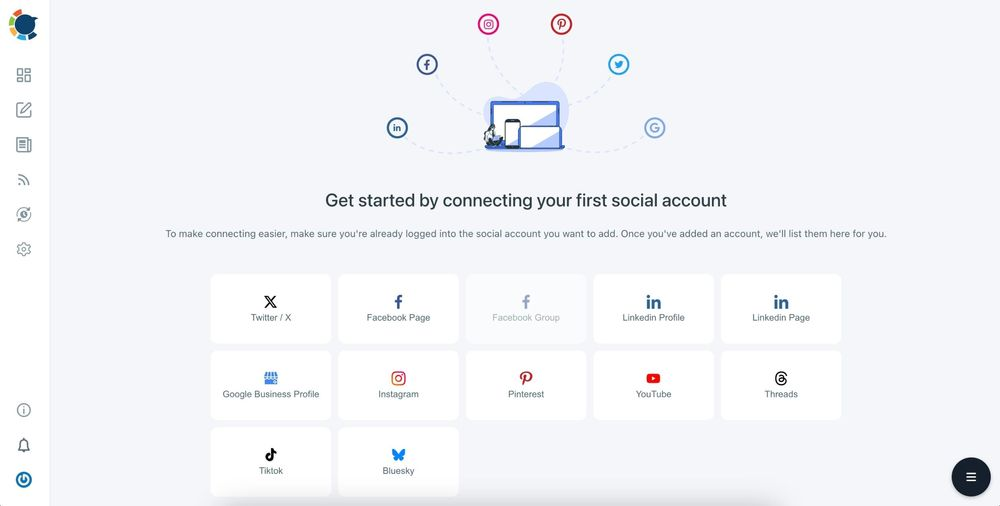
The scheduling queue is where the consistency problem gets solved. Block out an hour on Sunday. Write your three posts for the week. Drop them into the queue with the times you want. Walk away. Monday morning's maintenance tip goes out at 7:45 AM whether you're under a car or dealing with a parts supplier. The schedule holds without you holding it.
On timing, earlier in this post we said weekday mornings between 7 and 9 AM tend to work well. That's a general baseline. Circleboom Publish takes it further by analyzing when your actual followers are most active and letting you schedule posts for those specific windows.
Instead of posting at 8 AM because that's what a blog told you, you're posting at the exact time your audience is most likely to see it. For a local shop with a specific customer base, that difference adds up over time.
Google Business Profile Scheduler is worth calling out specifically. Most social tools ignore GBP entirely. Circleboom Publish handles it the same way it handles the rest: write the update, set the schedule, done. Since GBP is where a lot of your inbound calls actually start, being able to keep that active without a separate workflow matters.
 infocircleboom.com
Circleboom Publish is not an auto-repair-specific tool, so it won't write your content for you. You still need to take the photo of the corroded battery terminal, write the caption, and have a seasonal offer ready when the first frost hits.
But everything after that, formatting, timing, publishing across platforms, Circleboom Publish handles. Which means the part you actually have to do gets smaller, and the part that requires discipline gets automated.
That's what makes it worth mentioning in a post about consistency. The shops that show up three times a week, every week, for a year aren't necessarily more motivated than the ones that don't. They've just removed enough of the manual steps that showing up stopped being a decision they had to make every time.
Wrapping up
The shops winning customers on social media aren't more talented or creative than the ones losing them. They're more consistent. That's actually it.
Pick two platforms. Rotate through before-and-afters, tips, testimonials, and seasonal content. Post three times a week, on a schedule, for at least a year. Either do it yourself or hand it to someone who specializes in your industry.
Do that and you won't need to spend a dollar on paid ads to see more calls come in.