
An adult account that follows you does not just sit in your follower count.
It can see everything you post, reply under your posts, and message you, and none of that stops until you actively close it.
Removing the follower ends the relationship. Blocking ends the access.
Those are different problems, and most people reach for the wrong one.
Removing: takes them out of your count, leaves them free to follow again and keep reading. Blocking: closes follow, visibility, replies and messages at once, permanently, with no batch undo. Circleboom builds the list either way, pulling accounts through official X API access and letting you filter and review before anything executes.
→ block adult accounts on Twitter
Which one you want depends on whether the accounts come back.
Deciding whether this is a metrics problem or an access problem
Before you block anything, work out which problem you actually have, because the two need different actions and the wrong choice is expensive in opposite directions.
If the accounts arrived in a batch after a post got distribution, are sitting dormant in your follower count, and are not interacting with anything, this is a metrics problem.
They are dragging your engagement rate by adding to the denominator, and removal fixes that at zero risk.
If one of them turns out to have been real, they can follow again and nothing was lost.
If the accounts are replying under your posts, sending messages, or reappearing within days of every removal, this is an access problem.
Removal does nothing for any of those, because none of them require a follow relationship.
Only blocking closes them.
Removal is for your numbers. Blocking is for your boundaries.
Most accounts have the first problem and reach for the second because it feels more decisive.
If yours is genuinely the first, you can remove the accounts from your follower list instead and skip the permanence entirely.
Why the manual route stops working around account sixty
Blocking one adult account on X is trivial: open the profile, three-dot menu, block, confirm.
Four actions, maybe fifteen seconds.
Blocking four hundred is the same four actions four hundred times, and nothing you did on account one makes account two faster.
There is no memory in the native flow, no way to act on a set, no filter, no selection.
The arithmetic is what defeats people.
Four hundred accounts at fifteen seconds each is over an hour of clicking, spent entirely inside the interface that is currently the source of the problem.
Most people stop somewhere around sixty and mute the notification tab instead, which hides the problem without closing anything.
That is why bulk tooling exists for this and why it works the way it does.
X's API offers no bulk block endpoint, so any tool doing this at scale executes through a browser extension, sequentially, inside X's own interface.
That is a platform constraint rather than a limitation of any particular product.
Video walkthrough: reviewing a blocked-account list after a bulk operation to confirm exactly what was caught.
https://www.youtube.com/watch?v=19oaJrtXXs4
How to block adult accounts that follow you on X
The flow separates building the list from executing it, which is what makes a bulk block reviewable rather than irreversible by accident.
Connect the account and open the follower list
- Log in to Circleboom Twitter and connect the X account receiving the follows.

- Open the Follower and Following menu and select Fake/Bot Followers, which returns the accounts in your own follower base that cross the suspicion threshold across several signals at once.
- Sort by Joined descending so a recent wave reads as a cluster rather than as scattered rows.
Filter down to a set you would defend
- Whitelist everyone you recognise before applying any filter. The label persists across every Circleboom feature and every future session, which makes it the cheapest protection available and it only has to be set once per account.
- Stack Fake/Spam with Eggheads, a Tweet Count ceiling and a Follow Ratio maximum. No single signal is enough; the intersection is what separates a network account from an unusual human.
- Use Find in Bio and Name for the phrases the wave repeats. Adult promotion accounts have to advertise in the bio, so text matching is more precise here than any behavioural score.
- Read one full page by hand. A filter catching accounts you would not block individually is a filter set too wide, and this is the last free moment to find that out.
Queue the block, then execute it
- Select the reviewed rows, open Add to List and choose Add to Mass Block List. Nothing is blocked yet. The accounts are staged in a queue you can still inspect.
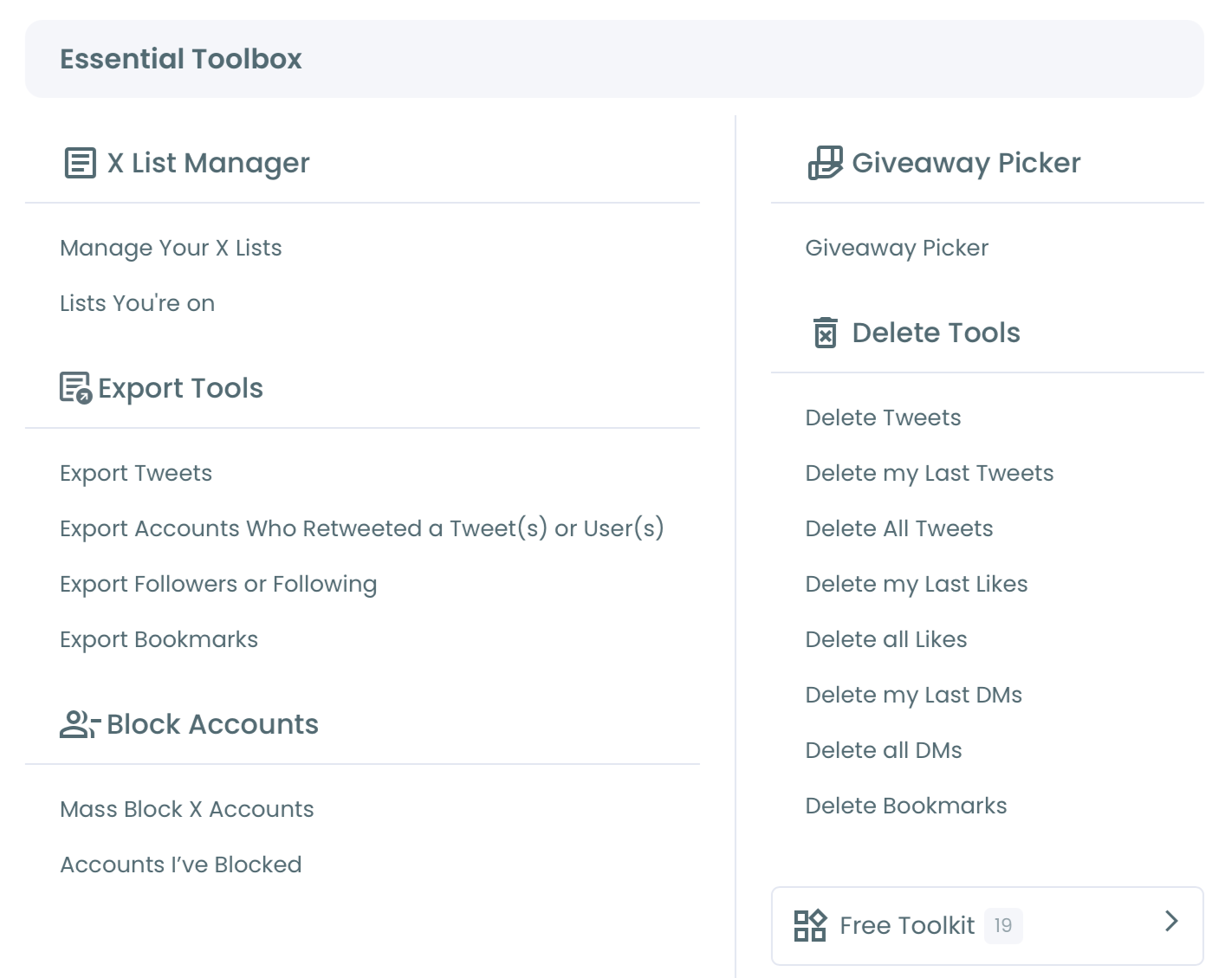
- Open Mass Block X Accounts under Essential Toolbox, review the queue, then start the Twitter X Mass Blocker Chrome extension with the browser left open.
That sequence exists because blocking has no batch reversal.
Whitelisting, filtering, reading a page and reviewing the staged queue are four separate chances to catch a mistake while catching it still costs nothing.
After the extension starts, the only way back is a separate Mass Unblock extension working through your blocked list.
What blocking actually closes
It is worth being precise about this, because the difference between blocking and the softer options is the whole reason to accept the permanence.
According to X's own blocking documentation, a blocked account cannot follow you, cannot see your posts, and cannot send you a Direct Message.
You also cannot follow an account you have blocked, which occasionally matters if the block was a mistake.
Muting closes none of that.
A muted account still follows you, still sees your posts, still counts in your total and still drags your engagement rate.
X's mute documentation is explicit that muting changes your timeline rather than their access, and it does not notify them.
Removing the follower sits between the two.
It ends the follow, which fixes the count, and leaves everything else open.
Mute changes what you see. Remove changes your numbers. Block changes what they can do.
If the third one is what you need, you can block the adult accounts in bulk on X rather than working through them one profile at a time.
Circleboom operates as an official X Enterprise Developer company, so all three paths run inside X's documented rate limits.
When a quota is reached, processing pauses for one to twenty minutes and resumes on its own rather than pushing through.
Aggressive bulk activity is exactly what X's automated restriction systems are built to catch.
Why reporting them first is usually a detour
Most people report before they block, on the assumption that adult content is self-evidently against the rules.
X's Adult Content Policy permits consensually produced adult media as long as it is marked sensitive.
An account posting marked content has not violated that policy, however unwelcome the follow is, so a report filed on those grounds is pointed at a rule the account is complying with.
The rule these accounts do break is platform manipulation and spam: mass registration, inauthentic identity, automated behaviour at scale.
Reported there, the report at least points at a real violation.
Even so, enforcement timing is not yours to control, and the accounts retain full access to your posts and replies while you wait.
Report the worst of them, then block, and treat the report as a contribution rather than as a plan.
Blocking fake followers on X covers the same sequencing from the other direction.
What the review pass catches that the filter does not
The number worth knowing before you start is that roughly a quarter to a third of any raw flagged list will fall away under review.
That attrition is not the scoring being wrong.
Classification is probabilistic, built on the intersection of several weak signals, and it is deliberately tuned to return candidates rather than verdicts.
What falls away is mostly dormant real accounts: people who followed you years ago, never posted, never uploaded an avatar, and happen to match three of your four filters for entirely ordinary reasons.
On a removal pass that attrition barely matters, because a wrongly removed follower can refollow.
On a block pass it matters enormously, because a wrongly blocked reader loses access permanently and will never mention it to you.
That asymmetry is the whole argument for reading a page manually before selecting.
It is ten minutes against a permanent decision, and it is the only step in the workflow that finds a filter set too wide.
Checking which accounts you have blocked after any run gives you the audit view.
It is worth opening once even on a run you felt confident about.
What happens after the queue starts
The part nobody sets expectations for is the execution phase, and it behaves differently from everything before it.
Building the list is fast.
The retrieval finishes in minutes and the table handles a couple of thousand rows without complaint.
Execution is slow by design.
The Chrome extension blocks sequentially, one account at a time, inside X's ordinary interface, because there is no bulk endpoint to call.
When the rate limit lands it stops for one to twenty minutes before continuing, and it does that as many times as the queue length requires.
A few hundred accounts typically finishes inside an hour. A queue of a couple of thousand runs across most of an afternoon.
None of that is time you have to sit and watch.
But the browser has to stay open, and closing it mid-run simply stops the process with the remainder unblocked.
The one thing not to do is run parallel sessions to speed it up.
Simultaneous bulk activity across multiple tabs or accounts is precisely the pattern X's automated systems flag, and the account it restricts is the one you were trying to protect.
The pauses are not the tool being slow. They are the tool keeping your account out of trouble.
Once the queue is reviewed you can start the bulk block on Twitter and leave it working in a background tab.
Which action fits your situation
If they arrived once and sat still, remove them.
You get the metric correction with none of the permanence, and a real account caught by mistake reverses itself.
Removing inactive and spam followers on Twitter covers this branch in detail.
If they came back after removal, block them.
Repeat arrivals mean the accounts are being actively driven at you rather than sitting dormant, and only blocking closes that loop.
If they are interacting rather than just following, block them immediately and skip the removal step.
Replies and messages do not depend on a follow relationship, so removal is not addressing the thing that is actually happening.
The effects of muting or blocking a person on Twitter sets out exactly what each action closes.
If you are unsure, remove first.
It is the reversible option, and if the same accounts reappear you will have your answer within a week.
→ block the adult accounts following you on X
Common questions about blocking adult accounts
Will they be notified that I blocked them?
No notification goes out.
The block becomes visible only if that account tries to view your profile, and automated accounts are not looking.
Can I undo a mass block if I go too wide?
Not in one action.
Reversal runs through your blocked list using a separate Mass Unblock Chrome extension, which is why the review step before execution carries the weight.
How many accounts can I block in one session?
There is no fixed ceiling, but the pacing is real.
Large queues run for hours with automatic pauses, and the browser has to stay open the whole time.
How to block a Twitter follower covers the single-account path if you only need a few.
Does blocking stop new adult accounts from finding me?
It stops those specific accounts.
New ones will still arrive the next time a post of yours gets distribution, because visibility is the targeting criterion rather than anything about you.
Is blocking safe for my own account standing?
Yes, when the pace is controlled.
Circleboom pauses rather than pushing through rate limits, which is the behaviour that keeps an account clear of X's automated flags.
Running parallel sessions to go faster is the thing that causes problems.
)