
There is no single button, and the reason is not that the tooling is missing.
It is that "all" describes three separate populations sitting in three different places on your account, and a single sweep would either miss two of them or catch people you did not mean to catch.
Doing this properly takes three passes. Each one is short, and skipping any of them is why the problem comes back.
One pass: clears whichever population you happened to look at, and leaves the other two. Three passes: followers, following, and the accounts that interact without doing either. Circleboom pulls all three through official X API access into the same filterable table and stages them into one block queue.
→ block NSFW accounts on Twitter in bulk
The third population is the one almost every guide forgets.
The three populations, and why they need separate passes
Accounts that follow you. These sit in your follower list and are the ones everyone thinks of. They cost you engagement rate by adding to the denominator, and they can see everything you post.
Accounts you follow. Old follow-backs from a growth phase, accounts followed for one post and forgotten, and accounts that were fine when you followed them and have since been abandoned or repurposed.
These shape your feed and sit on your public profile as a judgment about your own judgment.
Accounts that interact without either. Replies under your posts, quote posts, Direct Messages, likes.
None of that requires a follow relationship, which is why removing a follower does nothing about it and why this population is invisible to any follower-list cleanup.
Each population needs a different starting view, and they overlap far less than you would expect.
On most accounts, the set of NSFW accounts following you and the set you follow share almost no members.
A single sweep is not thorough. It is one third of the job done confidently.
Why blocking rather than removing, for this specific case
Removing a follower ends the follow and nothing else. The account can still see your posts, reply, message you, and follow you again tomorrow.
For a dormant account that arrived in a batch and does nothing, that is fine and blocking is over-engineering.
For the population that interacts, removal is not addressing the problem at all, since none of those actions require a follow.
Blocking closes all of it at once.
According to X's own blocking documentation, a blocked account cannot follow you, cannot see your posts, and cannot send you a Direct Message.
The cost is permanence. There is no batch undo, so reversal means going through your blocked list with a separate Mass Unblock Chrome extension, account by account.
That asymmetry is the whole reason the filtering and review steps below are not optional.
Why reporting them is not one of the three passes
Most people try this first, and it is the least productive route available.
X's Adult Content Policy permits consensually produced adult media as long as it is marked sensitive.
An account posting marked content is compliant on that axis, so a report filed on those grounds points at a rule the account is following.
The rule these accounts do break is platform manipulation and spam, covering mass registration, inauthentic identity and automated behaviour at scale.
Reported there, it at least points at a real violation.
Report the account, not the content.
Even then, enforcement timing is not yours to control, and the accounts retain full access while you wait. Report the worst of them and treat it as a contribution rather than as one of the three passes.
Video walkthrough: running a one-click cleanup across the fake and bot accounts inside a following list.
https://www.youtube.com/watch?v=nIeKns5Y4R4
How to block all NSFW accounts on Twitter, pass by pass
Same filtering discipline in each pass. Only the starting view changes.
Set up once, protect once
- Log in to Circleboom Twitter and connect the X account you are cleaning.
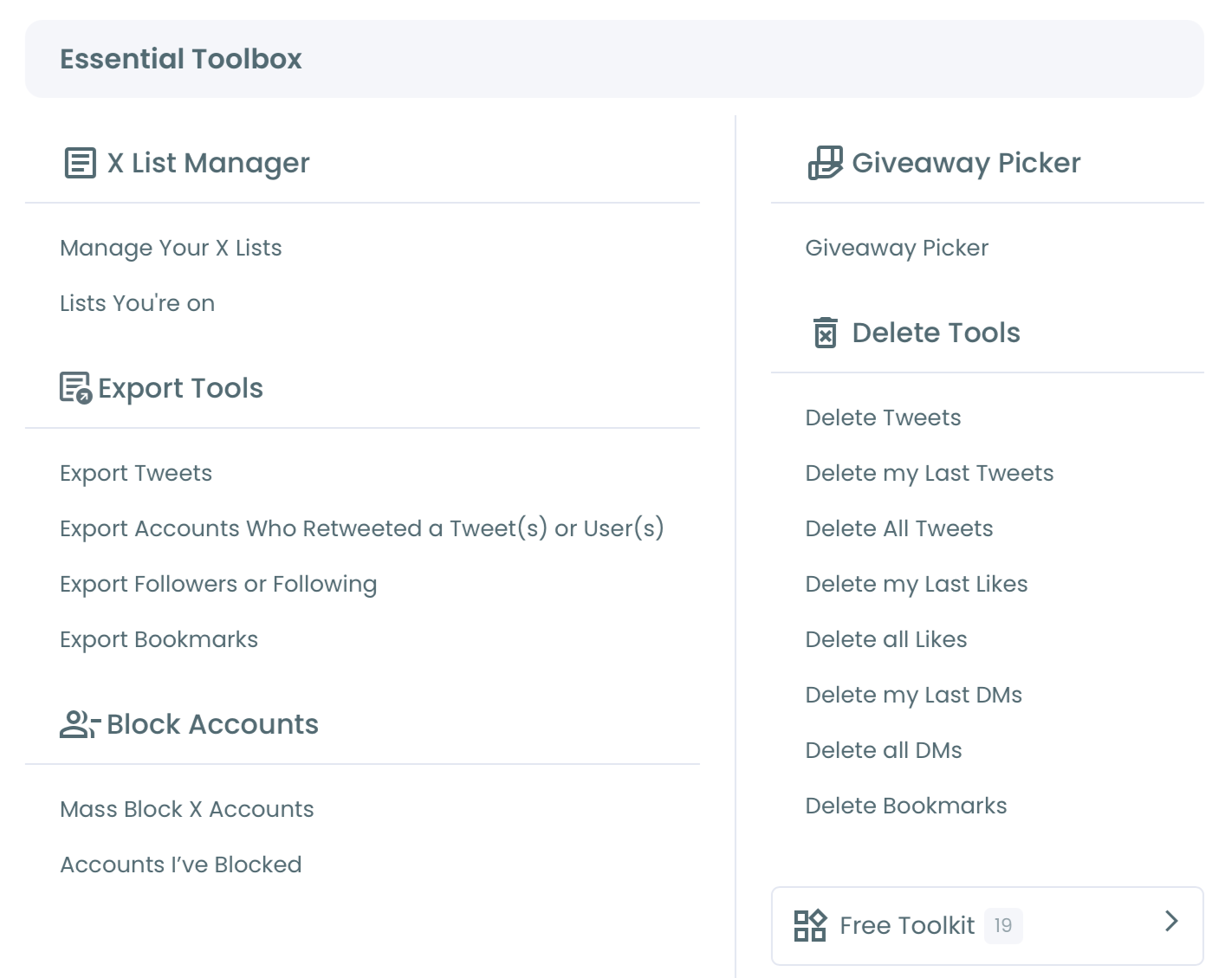
- Open the Essential Toolbox menu, where Mass Block X Accounts and the rest of the moderation tooling sit.
- Whitelist everyone you recognise before running any pass. The label persists across every Circleboom feature and every future session, so one careful pass here protects all three sweeps and every cleanup you run afterwards.
Pass one, your followers
- Open Fake/Bot Followers under the Follower and Following menu and sort by Joined descending, which shows whether you are looking at one wave or years of accumulation.
- Stack Fake/Spam with Eggheads, a Tweet Count ceiling and a Follow Ratio maximum, then use Find in Bio and Name for the phrases the network repeats. Adult promotion accounts have to advertise in the bio, so text matching is the most precise filter available here.
- Read a page, then select and choose Add to Mass Block List. Nothing is blocked yet.
Pass two, your following
- Open Fake/Bot Following and apply the same filter stack. Expect a different-looking list, because the accounts you followed skew older and more established than the ones that followed you.
- Select and add to the same block queue, which accumulates across passes rather than resetting.
Pass three, the reposters
- Open Mass Block X Accounts and switch to the retweeter tab. Paste the URLs of the posts that attracted the wave, add each to the Block Cart, and retrieve. This catches the accounts interacting with you that never followed and that you never followed.
- Review the staged queue, then start the Twitter X Mass Blocker Chrome extension with the browser left open while it works through the combined list.
Running the passes in that order matters because the whitelist is set once and protects all three, and because the queue accumulates.
You are not running three separate block operations, you are building one list from three sources and executing it once.
What the block cart is actually doing
The retweeter pass is the least understood part of this and the most precise, so it is worth being clear about the mechanics.
Enter a post URL and Circleboom queues that post into the Block Cart.
Add several, and the cart accumulates the reposters across all of them into one combined set before retrieval.
The cart shows a running total, and Circleboom labels that number as theoretical on the panel itself: duplicates, locked, suspended, bot and spam accounts all mean the listed figure will not match what X shows you.
Treat it as an upper bound rather than a count.
Each URL you queue consumes a token, as does each follower or following search against an external account.
That is worth planning around, because exploratory pulls get expensive quickly and the retweeter sets are where the token buys the highest-quality list.
Precision is why this pass is worth the tokens.
An account that reposted a specific post of yours took an action toward your content, which is far stronger evidence than sitting in somebody's follower list.
And the resulting set needs much less filtering.
When the cart is ready, you can block the combined set on X in a single run.
What the review pass catches
Expect roughly a quarter to a third of any raw flagged list to fall away under review.
And the stakes are higher here than on a removal pass because blocking does not reverse.
What falls away is mostly dormant real accounts:
- People who followed you years ago, never posted, never uploaded an avatar, and match three of your four filters for entirely ordinary reasons.
- Small brand handles that tweet quarterly.
- International users who read and never write.
Each individual signal describes those people.
No profile photo describes privacy-minded users. Zero tweets describes read-only accounts, which are the majority on the platform. A recent join date describes everyone who arrived this month.
What no real person matches is the intersection of four signals at once, which is why the scoring is built that way and why the output is a candidate list rather than a verdict.
A wrongly blocked reader loses access permanently and will never tell you it happened.
Ten minutes of reading against that outcome is the only quality control in the workflow.
Why the three populations barely overlap
This is the part that surprises people who assume one thorough sweep should be enough, and understanding it is what stops you from stopping after pass one.
The accounts that follow you were selected by a scrape of visible handles.
Your handle went into a target list because something of yours travelled, and a fleet processed that list.
None of those accounts chose you, and none of them have any relationship to what you follow.
The accounts you follow got there through completely different routes:
- Reciprocal follow-backs during a growth phase.
- A single good post years ago.
- An account that was legitimate at the time and has since been abandoned, sold or repurposed into something else entirely.
The accounts that interact are a third mechanism again.
Reposting, replying and liking are engagement-farming behaviours aimed at visibility, and the accounts doing it are working the post rather than the poster.
Three different selection mechanisms produce three largely disjoint sets.
On most accounts the overlap between the follower population and the following population is in the low single digits, which means clearing one leaves roughly two thirds of the problem exactly where it was.
That is also why the problem seems to come back so fast after a partial cleanup. It did not come back. It was never gone.
Three mechanisms, three populations, three passes. One queue at the end.
Because the queue accumulates across all three, you only execute the bulk block on X once, at the end, rather than three separate times.
Is blocking hundreds of accounts safe for your own account?
Yes, at a controlled pace, and the pace is not optional.
X has no bulk block endpoint, so execution runs through the Twitter X Mass Blocker Chrome extension, which performs each block sequentially inside X's own interface.
When the rate limit is reached, the process pauses for one to twenty minutes and resumes on its own.
The browser has to stay open. Closing it mid-run stops the process and leaves the remainder unblocked.
And running parallel sessions to go faster is the single most reliable way to get the account you were protecting restricted instead.
Circleboom handles this as an official X Enterprise Developer company, inside X's documented limits rather than around them.
Is Circleboom safe covers the compliance side in more detail if that is the hesitation.
Answering the objection before you start
The hesitation people raise is that blocking hundreds of accounts feels disproportionate, even when each individual block would not.
It is worth separating the action from its scale.
Blocking one NSFW bot is uncontroversial.
Blocking four hundred of them is the same decision made four hundred times, and the only thing that changed is that you stopped paying the manual cost each time.
The accounts did not become more sympathetic in aggregate.
What genuinely deserves hesitation is the source list rather than the count.
A filtered segment of confirmed spam accounts from your own follower base is low risk.
An unfiltered external follower list is where real people get caught, and that is a decision about scope, not about blocking.
Set the filters, protect what you recognise, read a page, and the operation is proportionate at any size.
If it still feels heavy, removing the followers instead handles the metrics half with none of the permanence.
And a mass unfollow pass handles the feed half the same way, leaving blocking for the accounts that genuinely need the boundary.
→ run all three passes into one block queue
Common questions about bulk blocking
Can I really block them all in one operation?
You can execute one queue built from all three sources, which is as close to "at once" as the platform allows. How to mass block followers on Twitter covers the follower pass on its own.
Will they be notified?
No. The block becomes visible only if that account tries to view your profile, and automated accounts are not looking.
How long does a large queue take?
Hours rather than minutes above a few hundred accounts, because of the rate-limit pauses. The browser stays open, but you do not have to watch it.
What if I want to block a whole network preemptively?
That is a fourth option and a riskier one. Blocking everyone a certain account follows works, and an external list always catches more real people than your own does.
Is there an automated version that runs continuously?
Not through Circleboom, and I would be cautious of anything that offers it. Twitter auto block covers why unattended blocking on probabilistic signals goes wrong.