
A bookmark list with five hundred entries saved across two years looks like a research archive. In practice it is an inaccessible pile, because finding anything specific means scrolling through hundreds of saved posts with no organization, no expiry, and no way to tell what is still relevant. X gives you exactly one way to clear any of it: open each saved tweet and unbookmark it, one at a time.
Clearing a bookmark list that has outgrown its usefulness does not have to mean hundreds of individual taps. The list can be exported, reviewed, and reset in a single working session.
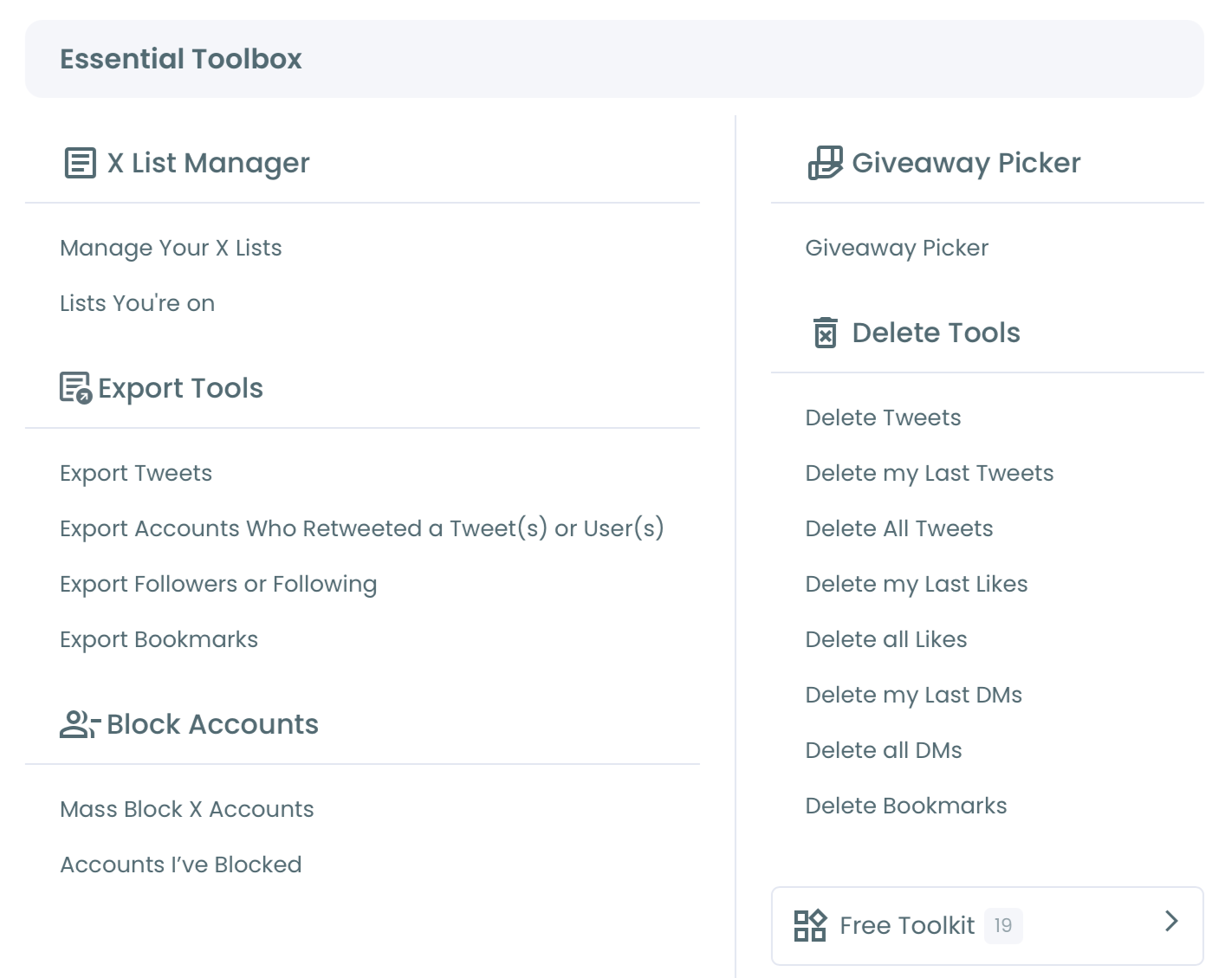
Circleboom's Delete Bookmarks removes saved tweets in bulk, designed to run as the second step after Export Bookmarks so nothing valuable is lost while the in-platform list resets to a fresh, usable inbox.
→ bulk delete your Twitter bookmarks
Why bookmark lists become unusable
X lets you save a tweet with one tap and gives you no tools for managing what happens after that. There is no bulk delete, no folders, no expiry, and no way to distinguish a bookmark saved last week from one saved two years ago for a project that ended long ago. The only native cleanup path is opening each bookmark individually and removing it, which is exactly as slow as it sounds for any list with real size.
This is why unbookmarking everything on X manually is a problem people specifically search for a way around. The native interface was built for saving, not for the maintenance that a growing collection eventually needs.
The practical effect is that bookmark lists stop being useful long before they stop growing. There is no hard cap stopping the list from expanding indefinitely, so the collection just keeps accumulating until it becomes an archive nobody actually searches through anymore, sitting there because clearing it manually feels like more work than it is worth.
Which bookmarks are safe to delete
A bulk delete does not have to mean clearing everything. A few distinctions help separate the bookmarks worth removing from the ones worth keeping a little longer.
- Saves from a completed project or research phase. If the bookmark collection was built around a specific investigation, campaign, or topic that has since wrapped up, those saves have served their purpose and are safe to clear.
- Dead bookmarks from deleted or suspended accounts. A bookmark pointing to content that no longer exists occupies space without providing any accessible value. These are unambiguous candidates for removal.
- A backlog older than your normal reference window. Bookmarks saved months or years ago that have never been revisited are unlikely to be revisited going forward either.
- Anything still actively referenced in ongoing work. Bookmarks supporting current content planning, a live research project, or evidence you may need later should be exported and preserved, not deleted, until that work concludes.
The first three categories are strong candidates for a bulk delete. The fourth is the reason export-then-delete, rather than delete alone, is the right sequence whenever the collection has mixed value.
How to bulk delete your Twitter bookmarks
Because Circleboom is an official X Enterprise Developer, the entire export and delete sequence runs through sanctioned API access, so cleaning up your bookmarks never puts your account at risk.

1. Export your bookmarks first: From the same bookmark management view, run Export before deleting anything. The CSV captures the tweet text, a link to the original post, and engagement data at the time of export. This step matters specifically because some bookmarked tweets may have already been deleted by their original author, making the export the only remaining record of that content.

2. Open Delete Bookmarks and review the list: Navigate to Delete Bookmarks. Every saved tweet loads into a table with impressions, likes, retweets, quotes, bookmark count, replies, and creation date visible per row. All bookmarks are pre-selected by default, so review the list before taking any action.
3. Apply filters to narrow what gets removed: If only part of the collection needs clearing, use Filter Options to narrow by date range, engagement thresholds, keyword, language, or media presence. This isolates the stale or low-value segment without touching bookmarks that still serve a purpose.
4. Click Delete Selected or Delete All: Use Delete Selected (N) to remove just the filtered or manually chosen subset, or Delete All to clear the entire loaded list. The action is permanent, so confirm the selection count matches what you actually intend to remove before proceeding.
That sequence, export first, then filter, then delete, turns a backlog that felt too large to deal with into a single working session instead of an indefinitely postponed chore.
What clearing the list changes
Once the export-then-delete cycle runs, the in-platform bookmark list goes back to functioning as a working inbox instead of an accumulating archive. New saves have context again, since they are not buried under hundreds of older, unrelated entries from completely different projects and time periods.
Dead bookmarks get cleared along with everything else in the same pass. A save pointing to a tweet that has since been deleted by its author occupies a slot in the list with no accessible content behind it, and a bulk delete removes those alongside the genuinely outdated saves without requiring you to hunt down and identify each broken bookmark individually.
The export itself becomes a standing archive that exists independent of the platform. Once a bookmark is preserved in a CSV, the in-platform copy becomes disposable, which is what makes repeating the export-then-delete cycle periodically a sustainable habit rather than a one-time rescue operation.
X built saving, not lifecycle management
Bookmarking on X is a one-directional action: you can add to the list easily, and the platform stops there. There is no equivalent investment in helping you manage what you have already saved, no review prompts, no aging system, no bulk tools, nothing that treats a bookmark as something with a lifecycle rather than a permanent fixture.
That asymmetry is why bookmark collections grow into something unmanageable. Saving is frictionless and unlimited; clearing is manual and slow. Any tool that is easy to add to and hard to remove from will eventually accumulate past the point of usefulness, and bookmarks on X are a clear example of that pattern playing out at the platform level.
The mistake to avoid
The most common mistake is deleting the entire bookmark collection without exporting first. Deletion through this feature is permanent, and Circleboom has no way to undo it once it runs. Any bookmark that turns out to have had ongoing value, a source you needed again, a reference you forgot about, is gone for good if it was not exported beforehand. Run the export every time, even when you are confident most of the list is disposable.
The second mistake is deleting everything indiscriminately when the collection actually has mixed value. A bookmark list built over years usually contains some genuinely useful saves mixed in with the clutter. Filtering by date, keyword, or engagement to isolate the stale segment, rather than running Delete All on a list you have not actually reviewed, prevents losing content that still matters.
Common questions
Does deleting a bookmark delete the original tweet too?
No. Deleting a bookmark only removes the save record from your own account. The original tweet remains exactly as it was on X, unaffected by anything you do in your bookmark list.
Can I recover bookmarks after deleting them?
No. Once a bookmark is deleted, there is no recovery path through Circleboom or through X itself. The export run before deletion is the only way to retain the content afterward.
Can I delete only some bookmarks instead of clearing the whole list?
Yes. Apply filters to narrow the list to a specific date range, keyword, or engagement level, then use Delete Selected to remove just that subset while leaving the rest of the collection untouched.
What's the best way to export my bookmarks before running a bulk delete?
Exporting bookmarks as a CSV from the same bookmark management view captures tweet text, links, and engagement metrics in a structured file you can review or search later, independent of whatever happens to the original content on X.
Your next move
A bookmark list you have not touched in months is not a reference tool anymore, it is a backlog. Export what might still matter, filter out what clearly does not, and clear the rest in one action instead of letting it keep growing past the point of usefulness. Export it, filter it, clear it.