
X's tweet export API caps at 3,200 tweets per account, which is the practical ceiling for any bulk export workflow. Circleboom delivers up to that 3,200 in a structured CSV (full text, dates, engagement counts, media URLs, tweet IDs) in one pass, through official X Enterprise API access.
The fast way to export Twitter posts from any public X account is Circleboom's Export Tweets workflow: connect, search the target account, run the export, download the CSV. The 3,200-tweet API ceiling is hard, the data quality inside it is complete.
→ export Twitter posts
The walkthrough below covers the API ceiling, the field set you actually get back, and what to do when 3,200 tweets is not enough.
Why X doesn't make this easy natively
X's product side offers two adjacent paths that don't actually solve the "export Twitter posts" problem. The first is the native archive download, which exports your own account's complete tweet history but takes 24 to 48 hours and arrives in HTML and JSON that requires technical parsing before it becomes spreadsheet-usable. The second is the manual copy-paste route, which works for one or two tweets and breaks immediately past that.
Neither path helps with the most common bulk-export use case: getting another user's tweets into structured data for analysis, reporting, or content review. The Twitter posts export workflow inside Circleboom is built around that gap, with an API-backed extraction that runs in minutes and produces CSV output ready for any analysis tool.
The Pew Research Center's Bots in the Twittersphere study is one of many research projects that used third-party export tools to assemble its dataset. The methodology is standard for any quantitative analysis of tweet content; the question is which export tool produces usable data quickly.
How Circleboom exports Twitter posts
Circleboom is an official X Enterprise Developer company. The Export Tweets feature runs through sanctioned X API endpoints, with no scraping, no unofficial workarounds, and no risk to the connected account.
The workflow is simple. You enter the target username, the system pulls up to 3,200 of the most recent tweets through the X API, and the result populates a structured table you can preview before downloading. The CSV includes per-tweet fields for content, timestamp, like count, retweet count, reply count, media URLs, and tweet ID. Each tweet is one row.
The 3,200 ceiling is not a Circleboom limit; it's a hard X API constraint that applies to every tool in this category. The way to go beyond it for your own account is the X archive route described above, which Circleboom's DM and tweet cleanup tools also process. For other users' accounts, 3,200 is the upper bound regardless of which tool you use.
For comparison shoppers evaluating which tool to commit to, the export tweets extensions roundup covers the safety and feature differences. The short version: tools that operate outside sanctioned API access risk account suspension for the user running them, which is the structural reason Enterprise-grade tooling matters here.
How to export Twitter posts (step-by-step)
The full workflow runs in two phases: configure the export and download the CSV.
Configure the export
- Log in to Circleboom Twitter and connect your X account through official OAuth.

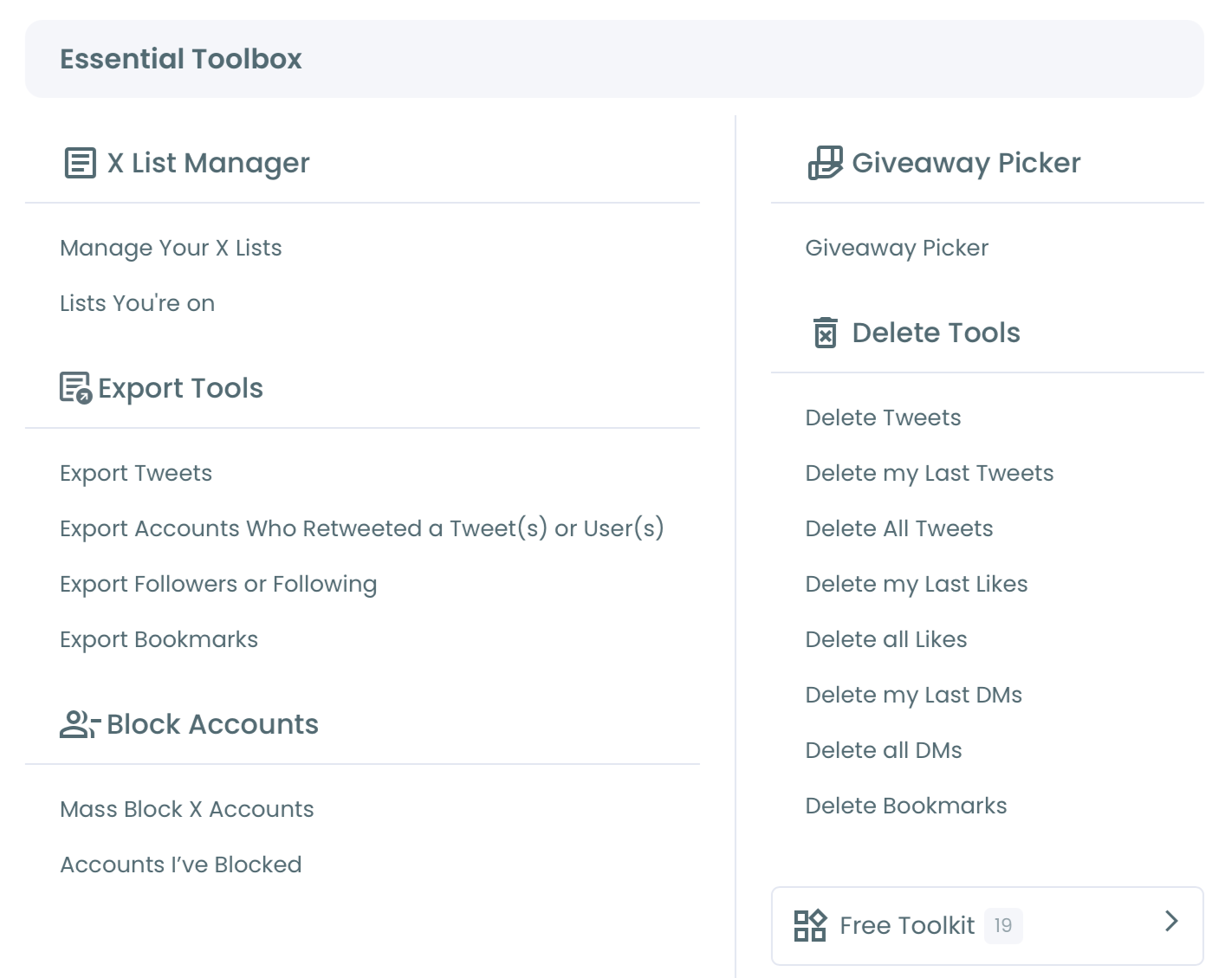
- Navigate to the Essential Toolbox menu and open the Export Tweets sub-tool.
- Enter the target username. Either your own handle or any public X account; private accounts are not exportable.
Download the data
- Preview the dataset. Circleboom surfaces the most recent tweets first, with engagement data attached. Scan for completeness before exporting.
- Run the CSV export. The download is a single file containing all retrieved tweets, ready for Excel, Google Sheets, or any data analysis tool.
- Open in your analysis tool of choice. The structure is standardized (one tweet per row, columns for each field), which means the same downstream workflow works for any export.
That sequence is what makes the export usable. The login earns sanctioned API access, the username step bounds the request to a specific account, and the preview confirms the dataset matches expectations before the file lands on disk. Skip the preview and you might download an unexpectedly small dataset if the account has fewer than 3,200 tweets or has restricted visibility on some posts.
Video walkthrough: the full export workflow from username to downloaded CSV.
What the export actually contains
The CSV output is wider than the typical "tweet text in column A" expectation.
- Tweet text (full content, no truncation).
- Date and time stamp (UTC).
- Like count at time of export.
- Retweet and reply counts at time of export.
- Media URLs for any attached images, videos, or GIFs.
For accounts where the export will feed an analysis project, the backup my tweets workflow explains how to schedule recurring exports so the dataset stays current. Tweet engagement counts shift over time, and a one-shot export captures only a snapshot.
For users who need the data in Excel specifically rather than generic CSV, the export all tweets to Excel or CSV walkthrough covers the spreadsheet-side formatting tips that matter.
If the goal is exporting your own tweets and getting them in front of a personal backup tool, the can I download my tweets FAQ-style explainer covers the user-side options including the X archive route.
Is it safe to export Twitter posts in bulk?
Yes, when the export runs through sanctioned API access. The account-suspension risk that scraping tools carry does not apply to Enterprise-grade tooling. The X API itself rate-limits requests on its end, so the speed of the export is bounded by what the platform considers safe.
For users running exports on accounts other than their own, the boundary is public-visibility. Public accounts are exportable; protected accounts are not. There's no workaround for protected accounts that doesn't violate platform terms, and the official Enterprise developer tooling stays strictly inside what's publicly accessible.
For users running exports on their own account, the boundary is the 3,200 tweet ceiling. The complete-history alternative is the X archive download, which Circleboom can also process for downstream cleanup workflows.
For users wanting to extend the export discipline to related data types, Circleboom also offers the retweeters export tool for tweet-level audience analysis and the Twitter bookmarks export tool for personal-library extraction.
What to do next (decision tree)
The right next step depends on what you're trying to accomplish.
- If the goal is to analyze your own tweet history, run the Export Tweets workflow on your handle, then complement with the X archive if you need older tweets beyond the 3,200 cap.
- If the goal is to analyze another account's tweets for research or competitive intelligence, run Export Tweets on the target handle and accept the 3,200 ceiling as the upper bound.
- If the goal is to back up tweets in case of account loss, schedule recurring exports rather than relying on the X archive alone. Tweet engagement counts shift over time and a snapshot becomes stale quickly.
- If the goal is to feed an external analysis tool with structured data, run the export once, point your tool at the CSV, and validate against the preview before committing to a large analysis.
→ Start your Twitter posts export
Common Questions About Exporting Twitter Posts
Can I export more than 3,200 tweets from one account?
Not through the API alone. The 3,200 ceiling is a platform-side cap that applies to every export tool. The X archive route is the only way to access older tweets from your own account; for other accounts, 3,200 is the upper bound.
Does the export include replies and retweets?
Yes, depending on the dataset scope. The default export captures original tweets, replies, and retweets attributed to the account, with column flags identifying each type.
How long does an export take?
Usually under five minutes for accounts with 3,200 tweets at the cap. Smaller accounts complete in under a minute. The bottleneck is X's rate limit, not Circleboom's processing.
Can I export tweets from a protected account?
No. Protected accounts are visible only to approved followers and are out of scope for any export tool that stays inside platform terms.
Will the export include tweets that have been deleted?
No. Once a tweet is deleted from the account, it is no longer accessible through the API. The export captures only what is currently live on the account at the time of the request.