
Most advice about how to find high quality Twitter followers is really advice about getting new ones. The segment worth finding already sits inside the follower list you have, and it does a job almost nobody asks it to do: it protects the rest of your audience the moment you start a cleanup.
What the audit gives you.A definition of follower quality that goes past the follow ratio.The order to run the audit in, so nothing valuable gets removed.A way to measure whether your audience composition actually improved.
Circleboom reads your follower list on X through official API access and scores every account on follow ratio, activity, account age, and profile completeness. Start by learning to find high quality Twitter followers.
Why your follower count hides your best followers
A follower count is one number describing a group that behaves nothing like a group. Pew Research studied the tweeting behavior of US adults on X in its behaviors and attitudes of US adults on Twitter report. The most active 25 percent by volume produced 97 percent of all tweets from that population.
Read that back against your own audience. Most of the accounts following you are structurally quiet, and quiet is not the same thing as worthless.
The trouble starts when you treat the list as one flat mass. You cannot tell which relationships are load-bearing. You cannot tell whether a growth spurt was real, and you have no reference group to measure the rest of the audience against.
Every quality-versus-quantity Twitter followers argument stalls at exactly this point, because nobody has the segment in front of them. The debate stays abstract because the data stays unsorted.
That is the gap Circleboom fills. Before you decide what to remove, you want a list of the accounts you would never remove.
You want high quality followers on X as a named, exportable segment rather than a hunch. The same logic sits behind a good Twitter follower checker run: the point is composition, not headcount.
What actually makes a follower high quality on X
Follow ratio is the entry signal, not the verdict. Circleboom classifies an account as high quality when several positive signals line up at once, which is why the list is not simply your biggest followers sorted by size.
The signals that carry weight:
- Follow ratio. More followers than accounts followed, which points to non-reciprocal, earned growth.
- Tweet activity. A real posting history rather than a dormant shell.
- Account age. A join date that suggests an established presence, not a two-week-old profile.
- Profile completeness. A real bio, a real name, a filled-out account.
- Behavioral consistency. Usage patterns that match a genuine human account.
An account with 80,000 followers, zero tweets in three years, and a following count of 40,000 does not clear that bar. An account with 600 followers, a real bio, four years of history and a healthy ratio usually does.
Why your biggest followers are not automatically your best
The high quality list is not a list of your biggest followers. It is a list of your most credibly real ones.
That distinction changes what the segment is good for. A list of big accounts is a reach fantasy. A list of real, active, established accounts is a relationship map, and relationship maps are the only follower data that survives contact with an actual outreach plan.
Circleboom scores every follower on your X account against that composite model and returns the top band as a working list you can filter, whitelist, and export.
If you want the underlying number by itself, the Twitter Quality Score view gives you the account-level metric. If you want the segment, open your high quality Twitter followers directly.
How to find high quality Twitter followers in Circleboom, step by step
Watch the segment build: high and low quality bands splitting out of one follower list in the same dashboard pass.
The flow, in order.
Connect the account and open the audience menu
- Log in to Circleboom Twitter and connect your X account with official OAuth.

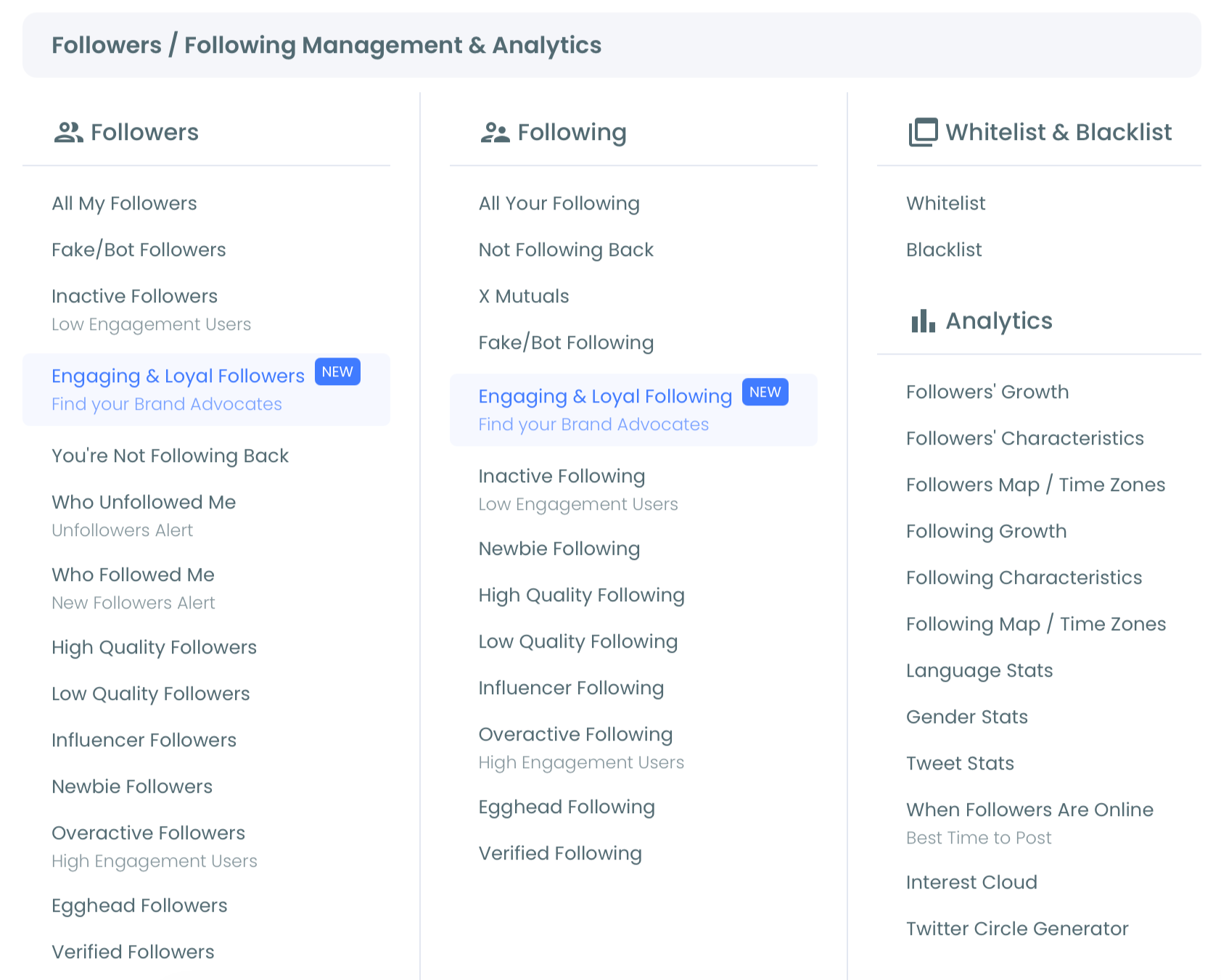
- Open the Follower & Following menu and pick High Quality Followers from the follower segments.
Narrow the segment down to accounts that matter to you
- Sort the table by Follow Ratio to get a first read on the band, then re-sort by Followers to see who carries reach inside it. Both column headers are sortable in either direction.
- Open Filter Options and layer activity on top of ratio. Set a minimum Tweet Count, set the Engagement dropdown away from Inactive, and add a Location or Language filter if your audience is regional. This is the step that removes the high-ratio-but-dead accounts a pure ratio sort will hand you.
Protect the segment, then act on it
- Select the filtered rows and choose Add to List, then Whitelist. Whitelisted accounts are excluded from bulk operations everywhere else in Circleboom, which means your best followers cannot be caught in a later cleanup pass.
- Export the segment as CSV or push it into a Twitter List so the audit becomes a working file rather than a one-time screenshot. Export runs on a token system and the remaining count sits next to the button.
That order is what keeps the audit honest. The login earns official API access before anything reads your list. The ratio sort gives you a fast first pass, the activity filter kills the false positives that ratio alone produces, and the whitelist locks the result in before any removal feature can reach it.
Quick recap:
- Connect with official OAuth.
- Open High Quality Followers under Follower & Following.
- Layer engagement and tweet count on top of follow ratio.
- Whitelist the survivors before any cleanup pass runs.
Whitelist first, then clean
The sequence is the part most audits get backwards. People run the fake-and-bot pass first, then the inactive pass, then wonder why a customer or a quiet partner disappeared from their follower list.
Bulk removal has no way to know that the account with 90 followers and one tweet a month is the person who signs your invoices.
Building the whitelist first fixes that. Circleboom is an official X Enterprise developer, so every read and every removal runs inside X's own rules. Compliance does not protect you from your own filters, though. Only the whitelist does.
Once the protected segment is locked, the destructive passes become safe to run in order. Fake and bot accounts go first, then dormant accounts, then the residual weak-signal band in Low Quality Followers.
Each pass now skips everything you protected, which means you can be more aggressive with the filters than you would dare to be on an unprotected list. That is the practical payoff: the whitelist buys you permission to actually clean.
For the mechanics of reading the same table from the opposite end, the walkthrough on how to sort Twitter followers by popularity covers the sorting behavior in detail.
Is a high follow ratio always a good sign?
No, and treating it that way is the most common mistake in this whole workflow. A high ratio tells you an account grew without mass-following people back. It tells you nothing about whether that account still posts, still reads its timeline, or has any connection to your niche.
Two failure modes show up constantly. The first is the abandoned authority account: a strong ratio built years ago, no activity since. The second is the off-topic giant: real, active, credible, and completely irrelevant to what you publish.
Ratio also runs the other way. A low ratio often just means the account follows a lot of people because it uses X to read rather than to build an audience.
X's own authenticity policy draws the line at follow churn and indiscriminate mass-following, not at simply following more accounts than follow you back. Keep that distinction in mind before you remove anyone, and cross-check with a pass to validate Twitter followers rather than trusting a single column.
The composition math most audits skip
Run the arithmetic before you touch anything, because it changes what a successful cleanup looks like.
Take an account with 10,000 followers where the high quality band comes back at 900 accounts. That is a 9 percent quality share. Say the audit then removes 2,000 fake, dormant, and weak-signal accounts, and the band holds at 900 because it was whitelisted.
The follower count now reads 8,000, which looks like a loss on the profile page. The quality share is 11.3 percent, which is the number that actually moved.
That is the whole reason to measure the proportion rather than the count. A cleanup always makes the vanity number worse. It only makes the composition better if the protected segment survives intact, and the only way to know that is to have recorded the band size before you started.
Keep the two figures somewhere you will find them again: the band size in absolute accounts, and the band as a percentage of total. Those two numbers, tracked across a few cleanups, tell you more about audience health than any dashboard chart.
What the segment is worth after the audit
Three uses justify the time, and only one of them is reporting.
The follow-back queue is the most immediately useful. Cross the high quality classification with accounts you have not followed back and you get the strongest reciprocation list in your entire audience.
These are credible, active accounts that already chose you. Circleboom shows the Follow action inline on exactly those rows, so the queue works without an export.
The second use is measurement, which the section above covers. The third is documentation.
An audience breakdown stating what proportion of your followers clear quality thresholds reads far better in a media kit than a headline number, and the exported CSV is the evidence behind it. The full list and export your high quality followers and friends on Twitter workflow covers that file end to end.
What to do when the band comes back almost empty
A very small high quality band is information, not a failure, and it usually means one of three things.
The first is age. A young account has not had time to attract followers with long histories and settled ratios, so the band stays thin until the audience matures. Nothing to fix there beyond waiting.
The second is acquisition source. Follower counts built through giveaways, follow-for-follow rounds, or engagement pods fill up with accounts that fail the ratio test by design, because those accounts follow enormous numbers of people. The band being empty is the model correctly describing what you bought into.
The third is filter overreach. Set the tweet-count minimum too high and you will strip out perfectly credible people who post monthly. Drop the threshold, re-read the count, and see whether the band recovers before you conclude anything about your audience.
Work through those in order before assuming the segment is broken. In practice the second cause is the most common, and it is also the one that explains a bad engagement rate better than any algorithm theory.
The remedy is not another cleanup. It is changing what brings people in, then re-measuring the band a few months later to see whether the new arrivals hold up better than the old ones.
Your audit checklist
Run the segment before you run anything destructive, and the rest of the cleanup takes care of itself.
- Pull the high quality band and note it as a percentage of total followers.
- Layer tweet count and engagement filters on top of the ratio sort.
- Whitelist everything that survives the filters.
- Follow back the high quality accounts you have been ignoring.
- Re-check the percentage after the cleanup and keep the number.
The audit takes an afternoon once and about ten minutes every time after that. Open the segment and see who is actually in your audience.
→ Find high quality Twitter followers and friends
Questions readers ask before running the audit
How many of my followers should be high quality?
There is no universal target, because the proportion depends heavily on how you grew. The number matters as a trend line rather than a benchmark: run it once, clean up, run it again, and watch whether the share moves in the right direction.
Will whitelisting someone change anything on their end?
No. Whitelist status is a Circleboom-side flag that excludes an account from your bulk operations. The account holder sees nothing, receives no notification, and their relationship to your profile is unchanged.
Can I get restricted for following back a large batch at once?
Circleboom paces the requests for you, processing 50 follow actions every 15 minutes up to 400 per day, then resuming automatically the following day. That pacing exists so the activity reads as normal to X rather than as a burst.
Does the high quality list update on its own?
The list reflects public account data as of the last sync with X, so re-running it after a period of growth gives you a fresh read. Followers who went dormant since the last pass will move out of the band on the next scan.