
A defensible Twitter follower-count operation in 2026 audits the headline number against four signals (real-account verification, engagement-rate threshold, recency-of-activity threshold, topic-relevance match) and reports the audited base as the working number.
Most accounts find that 50-70% of the headline count passes the audit; the gap is fake-follower drift, dormant accounts, and topic-mismatched legacy followers.
The audit runs from one Circleboom dashboard, takes 5-15 minutes for accounts up to 10,000 followers, and surfaces the working number for engagement-rate, reach, and conversion calculations.
What this guide gives you.The four audit signals that separate organic from inflated counts.The recalibration that surfaces the real engagement rate.The quarterly cadence that catches drift before it compounds.
Built on Circleboom's verified Enterprise developer access on X. Start with the Twitter Follower Quality workspace.
Why the Headline Follower Count Is Almost Always Inflated
The "follower count is the audience" framing collapses to misleading metrics for most accounts. Three structural reasons explain why.
The first is fake-follower accumulation. X removes some fake accounts on its own; the rest persist for months or years. A 10,000-follower account often carries 800-1,500 fakes that have not been culled. The article on how do I gain more followers on Twitter organically covers the upstream growth side.
The second is dormant-follower accumulation. Real accounts that went inactive (no posts in 90+ days, no logins in 6+ months) appear in the count but cannot engage. Dormant followers cap engagement rate by structural design. The article on has Twitter reduced organic reach for small to mid accounts covers a related distribution-mechanics angle.
The third is topic-mismatch accumulation. Follow-for-follow patterns and growth-hack runs from prior years leave followers in the list whose topic alignment never existed or has since shifted. They do not engage with the operator's actual content area.
The Four Audit Signals
These are the signals the workflow operates on.
- Real-account verification. Profile photo, bio, post history, account age compose into a real-account score.
- Engagement-rate threshold. Follower has engaged with operator content in the past 90 days OR shows above-baseline engagement on similar accounts.
- Recency-of-activity threshold. Follower has logged in and posted/reposted in the past 30 days.
- Topic-relevance match. Follower's bio and recent posts overlap with the operator's topic area.
The four signals compose into the audited base. Followers passing all four are the real-engaged subset.
How to Audit Your Followers Step by Step
The setup runs from one Circleboom dashboard. Five phases match the audit flow.
Hands-on demo: how to analyze your Twitter followers' interests as part of the audit.
The flow, in order.
Phase 1: Connect
- Log in to Circleboom Twitter and connect your X account through the official OAuth handshake.

- Open the Follower & Following menu for the audit workspace.
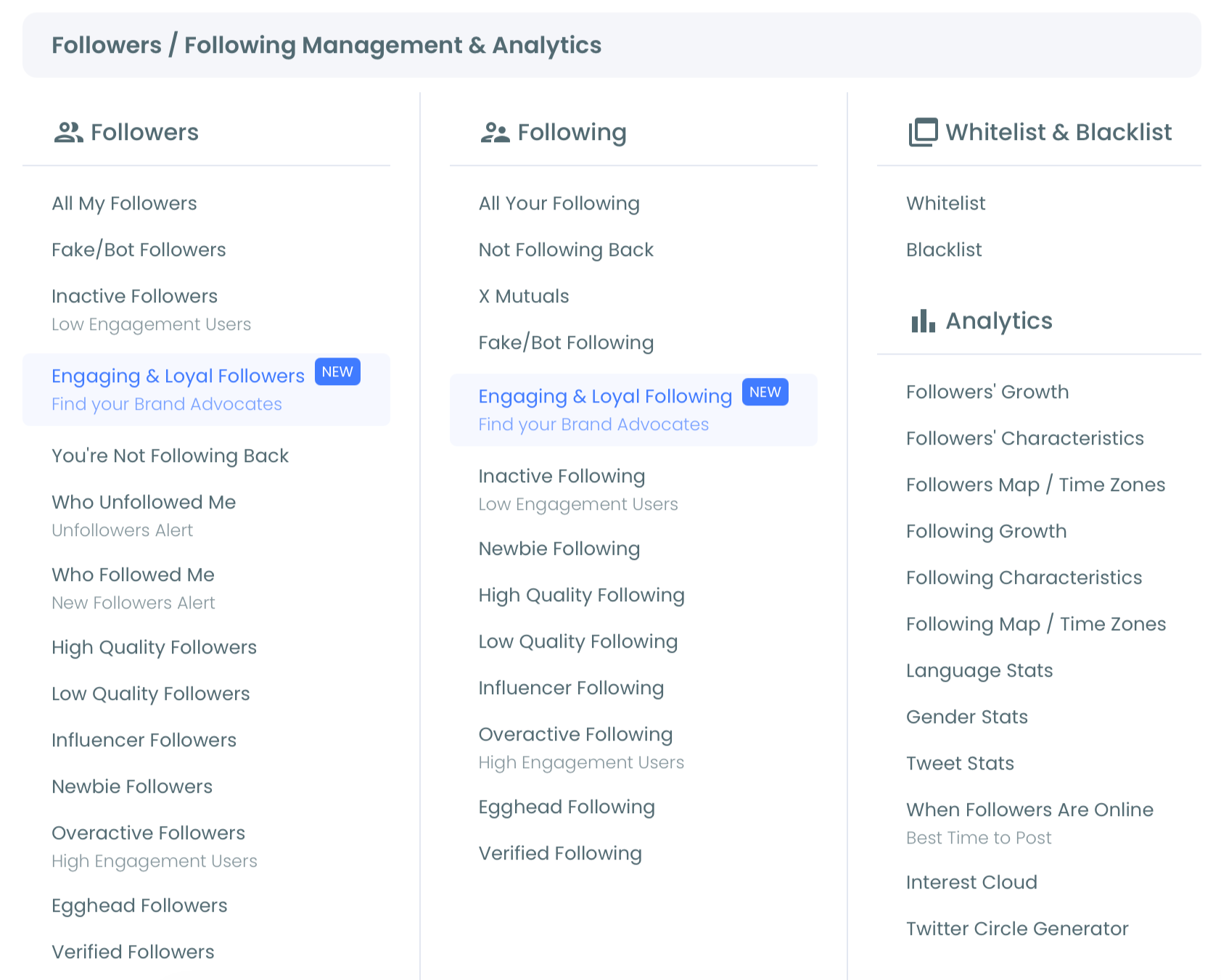
Phase 2: Run the four-signal audit
- Run the Twitter Follower Quality Score to surface the composite signal.
- Filter the engagement-rate, recency, and topic-relevance signals in the dashboard.
Phase 3: Surface the audited base
- Filter to followers passing all four signals to produce the real-engaged base.
Phase 4: Recalibrate metrics
- Recalculate engagement rate, reach per impression, and conversion rate against the audited base rather than the headline.
That sequence produces the audited number. Each phase removes a different gap: connection enables access; audit surfaces signals; filter produces the base; recalibration re-anchors the metrics.
Quick recap:
- Connect through OAuth.
- Run the Quality Score audit.
- Filter to all-four-pass followers.
- Recalibrate engagement rate against the audited base.
What Each Audit Signal Specifically Catches
The real-account signal catches purchased fakes, scrape bots, and dormant placeholder accounts. Typical 10-15% of a follower list fails this signal.
The engagement-rate signal catches followers who never engage with operator content. Typical 20-30% additional fail rate. The article on how to organically grow Twitter followers covers the upstream acquisition side.
The recency signal catches dormant followers. Typical 5-10% additional fail rate.
The topic-relevance signal catches follow-for-follow accumulation. Typical 5-15% additional fail rate.
Common Mistakes Operators Make
The first mistake is treating the headline count as the audience. Engagement-rate calculations against the headline produce artificially low numbers and lead to wrong content decisions.
The second is skipping the topic-relevance check. Audiences drift away from operator topics over time without leaving the follower list. The article on 5 organic ways to grow your Twitter circle covers the alignment-side framing.
The third is running the audit only once. Fake-follower drift accumulates monthly. Quarterly audits catch drift before it compounds.
What to Do Next
The workflow is concrete: audit, filter, recalibrate, repeat quarterly.
- Step 1: Open Circleboom and connect your X account.
- Step 2: Run the Twitter Follower Quality Score.
- Step 3: Filter to all-four-pass followers.
- Step 4: Recalibrate engagement metrics against the audited base.
- Step 5: Schedule the next audit for 90 days out.
→ Open the Twitter Follower Quality workspace
What to Know Before You Start
How long does the audit take?
5-15 minutes for accounts up to 10,000 followers; 30-60 minutes for accounts above 100,000. The Quality Score returns a composite number; per-signal breakdowns are available on demand.
What audited-base percentage is healthy?
70%+ is healthy and signals organic acquisition. 50-70% is typical and signals normal drift. Below 50% signals significant fake or dormant accumulation that the operator should address.
Should I remove failing followers?
Removing fakes is recommended. Removing dormant followers is optional (no active harm). Topic-mismatched followers can stay; some re-engage when the operator's topic shifts.
Is the workflow safe under X's rules?
Yes. All audit layers run through Circleboom's Enterprise developer access. No scraping, no browser scripts, no automation outside platform policy.