
Most accounts treat "know your audience" as a demographics exercise. Age, gender, location, done. That is the wrong dataset. None of it tells you what to post tomorrow, because people do not follow you for their age bracket. They follow you for topics.
Guessing: you post on instinct and read the result after. Circleboom: you read your followers' real interests on X first, then post.
→ Twitter follower interests analytics
The map already exists. Most people just never open it.
Demographics Tell You Who. Interests Tell You What.
There is a reason demographic targeting feels hollow for organic posting. Knowing your audience skews 30-something and urban does not generate a single tweet idea. It describes a crowd without telling you what the crowd wants to hear.
Interest data answers the question demographics dodge. When you can see that your followers keep circling back to three subjects, your next post stops being a guess. The blank compose box fills itself, because the audience already told you what it cares about.
This is the shift from describing your audience to listening to it. One produces a slide in a deck. The other produces a content calendar.
Consider how the two play out in practice. A demographic profile might tell you to "post professional content for a 25-to-40 business audience," which could justify almost anything and therefore guides nothing. An interest cloud tells you that this same audience keeps discussing hiring, runway, and founder burnout, three specific subjects you can write about tomorrow. The first is a description. The second is a brief.
Where Your Followers' Interests Actually Live
Your followers broadcast their interests constantly, in their own posts and bios. The signal is public, scattered, and impossible to read by hand at any real scale. That is the gap a tool closes.
Circleboom is an official X Enterprise Developer company, so it gathers that public signal through sanctioned access, never scraping, and never risking your account. It then runs topic extraction across your whole follower base and sizes each theme by frequency.
The platform itself will not hand you this view. Pew Research has shown how much of X activity clusters around specific topics and communities, a pattern visible in its social media fact sheet. Your audience is one of those clusters. The interest cloud is simply the cluster made legible.
How to Read Your Followers' Interests
Turning that idea into a usable picture takes four steps and a few minutes. The flow runs from login to an exportable cloud.
- Log in to Circleboom Twitter and connect your X account with secure OAuth.

- Open the Follower and Following management and analytics menu to find the audience tools.
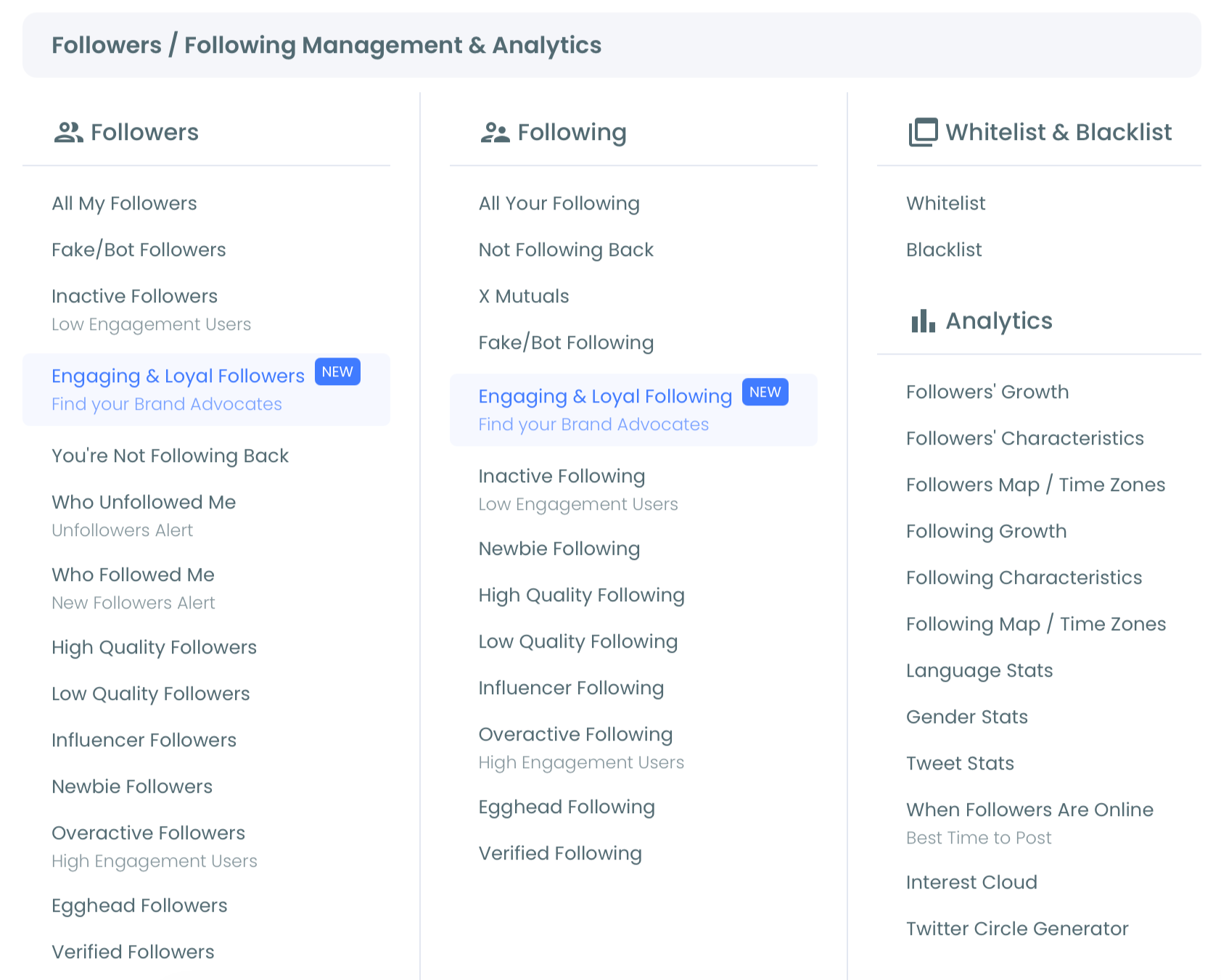
- Run the Interest Cloud and let it analyze your followers' public posts on X.
- Read the bubbles by size, then export the cloud for your plan.
The point is sequence: read the interests before you write, not after you flop. That single reorder is what separates posting at your audience from posting to it.
Watch how interest and demographic signals combine into a content edge:
If You Only Change One Thing
If you take nothing else from this, take the reorder. Open the cloud first, then plan. Everything downstream gets easier once the topics are no longer a mystery.
That one habit ripples outward. You can check interests on Twitter before every campaign, then verify the payoff by exporting your Twitter analytics to see which interest-led posts actually moved. The compounding effect shows up in more followers from your analytics, because relevance is what earns the follow.
Two more reads make the habit stick. Studying your brand advocates tells you whose interests to weight most, and the account analysis view plus your tweet stats confirm whether the cloud's themes are translating into real reach.
The Real Cost of Posting Blind
Guessing is not free, even when it feels harmless. Every post aimed at the wrong topic spends the one resource you cannot refill: your audience's attention. Miss often enough and people quietly stop expecting anything worth reading from you.
The cost compounds in a way that is easy to miss. A flat post does not just underperform; it teaches the algorithm that your account is low-engagement, which shrinks the reach of your next post before anyone sees it. Blind posting is a slow tax on everything you publish afterward.
There is an opportunity cost too. The hours you spend crafting a thread nobody wanted are hours you did not spend on the topic your audience was waiting for. Reading interests first does not just raise your hit rate; it stops you from funding misses with your best effort.
The strange part is how invisible this cost stays. An account can grow steadily and still leave most of its potential on the table, because growth hides inefficiency. You only see the waste when you finally compare what you posted against what your audience actually wanted, and the cloud is the first time those two lists sit side by side.
None of this requires more work. It requires the work to point in the right direction, which is exactly what an interest cloud provides before you write a word.
A Quick Read of Each Interest Tier
Once the cloud loads, read it in three passes instead of one. The biggest bubbles are your proven demand. Treat them as the safe core of your calendar, the topics you can return to without risk.
The mid-size bubbles are the most strategically interesting. They show real interest that is not yet saturated, which means a strong post there can stand out instead of competing with everything else your audience already sees. This tier is where accounts differentiate.
The smallest bubbles are not noise to delete; they are hypotheses to test cheaply. A single reply or quote post is enough to probe whether a minor interest deserves promotion. If it lands, you found an underserved niche before anyone else fed it.
Reading all three tiers turns a static picture into a strategy. You are not just seeing what your audience likes; you are deciding where to be safe, where to stand out, and where to experiment.
What to Do With Your Cloud
Your next move depends on your cadence. Pick the branch that fits:
- If you post daily, build a weekly rotation around your top three interest bubbles.
- If you post weekly, aim each post at one dominant interest and test one mid-size theme a month.
- If you post rarely, make every post count by writing only to your largest bubble until momentum returns.
Whichever branch you are on, the rule is the same: let measured interest pick the topic, and stop letting instinct do a job the data does better.
→ Map your audience interests with Circleboom
Common Questions About Audience Interests
Is interest data really better than demographics for posting?
For deciding what to post, yes. Demographics describe who your audience is; Twitter follower interests analytics tells you what they actually discuss, which is the input you need to choose a topic. Use demographics to refine the angle, not to pick the subject.
Can my followers' interests change over time?
Yes, and that is why the cloud is worth re-running. Audiences drift as they grow and as the platform's conversation shifts, so a cloud from six months ago may already be stale. Refresh it each planning cycle.
Does reading interests require any special X subscription?
No. Circleboom pulls the public signal through sanctioned, policy-compliant access, so you can read your followers' interests without X Premium and without putting your account at any risk.
Isn't checking demographics enough to target my content?
Demographics help you refine tone and timing, but they cannot pick your topic. A 30-something urban audience could be into anything. Twitter follower interests analytics names the actual subjects, which is the one input demographics will never give you.