
The structural challenge is well-known to anyone who's tried: X's DM API only reaches the last 30 days, native UI deletes one message at a time, and bidirectional deletion is not a platform feature. The practitioner workflow that solves these three constraints together combines the X archive route with sanctioned API-grade deletion. The implementation is a single 20-minute session once the archive is in hand.
What this guide gives you.The complete two-phase workflow to permanently delete all Twitter DMs through sanctioned tooling.The keep-list and filter set that prevent accidental over-deletion of important threads.A safety checklist to run before confirming any large DM cleanup.
Built on Circleboom's archive-first DM Cleaner, delivered through official X Enterprise APIs. Start with permanently delete all Twitter DMs.
Why the practitioner workflow exists
X's product side hasn't built a bulk-DM-delete control, and the API surface caps at the most recent 30 days. The Direct Message FAQs from X describe the per-message UX explicitly; bulk-action is outside scope.
The Manage Direct Messages API docs confirm the 30-day window for API-based DM operations. Tools that claim broader bulk-delete coverage through pure-API workflows are either misrepresenting the action or quietly capping at the same 30 days behind the scenes.
The archive route fills the gap. Settings → Your account → Download an archive of your data produces a ZIP with every DM in the account history. Circleboom processes the archive upload to reach the historical tail, which is the precondition for any meaningful "permanently delete all" workflow.
The DM history check workflow covers the conceptual model in more depth. This guide is the operational version: what to configure, what to verify, what to commit to.
What you'll need before starting
Three prep items:
- A Circleboom Twitter account with the X account connected through OAuth.
- The X archive ZIP, requested from inside X. Allow 24 to 48 hours for delivery.
- A finalized keep-list of senders whose threads must survive the sweep.
The keep-list is the most important pre-work. Spending five minutes drafting it before the archive arrives is the difference between a controlled cleanup and a regretted one.
How to permanently delete all Twitter DMs (full workflow)
The flow runs in three phases: archive prep, in-app cleanup, post-cleanup audit.
Phase 1: Archive prep
- Log in to Circleboom Twitter and connect the X account using official OAuth.

- Navigate to the Essential Toolbox menu and pick Delete DMs.
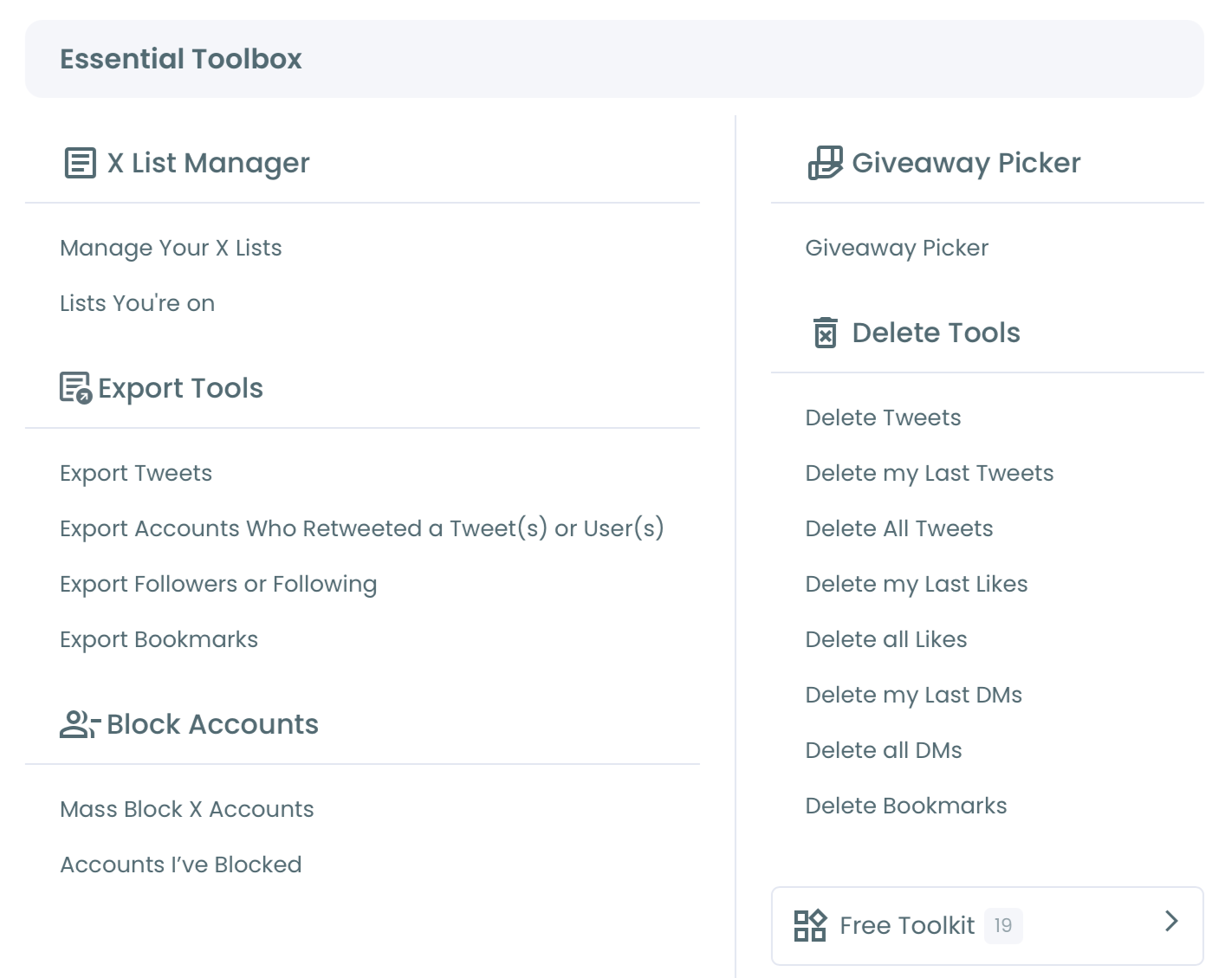
- Request the X archive from inside X. The download link arrives by email within 24 to 48 hours; save it immediately because it expires 7 days after generation.
Phase 2: In-app cleanup
- Upload the archive ZIP to Circleboom. The processor parses your full DM history into a structured, filterable view including all conversations older than the 30-day API window.
- Build the keep-list. Add senders whose threads must survive. Family, current employer, ongoing clients, legal record-keeping, anyone you actively communicate with on X.
- Configure additional filters. Date range, keyword, attachment type, and URL-presence filters can stack on top of the keep-list for surgical cleanups. The default for "permanently delete all" is no additional filters beyond the keep-list.
- Run the filter preview before confirming. Circleboom shows the exact set of conversations the deletion will touch, with counts per filter dimension.
Phase 3: Post-cleanup audit
- Confirm and execute the deletion. The API processes the request through Circleboom's sanctioned access; large operations may take a few minutes.
- Verify against the live X inbox. Open X, scroll through key conversations to confirm the keep-list survived intact and the deletion swept everything else.
That sequence is what makes the permanent deletion safe. The login earns sanctioned API access, the archive lifts the API ceiling, the keep-list protects what should survive, and the preview is the final safety control before the irreversible step. Skip the keep-list and you risk wiping conversations you wanted to keep; skip the preview and you risk an over-broad sweep you cannot undo.
Hands-on demo: the practitioner workflow narrated from upload to confirmation.
The safety checklist before confirming
Four checks worth running before the deletion action runs.
- Keep-list complete. Re-read it. Every sender on the list survives the sweep regardless of every other filter.
- Filter preview matches intended scope. The on-screen count is the number of conversations about to be removed.
- Archive freshness verified. The ZIP should be the most recent download, not a stale archive from months ago.
- Recovery plan acknowledged. The action is final on your side; no undo button exists. The keep-list is the only safety mechanism.
For users whose cleanup goal is partly to manage spam DM influx going forward, the DM notification cleanup approach covers the related "stop the influx" problem. The block direct messages workflowhandles per-sender prevention.
For users who want to extract conversation content before deleting (for personal record-keeping), the Twitter DM downloader workflow covers the export-then-delete pattern.
Is the workflow safe for the account?
Yes. Circleboom is an official X Enterprise Developer company. The deletion runs through sanctioned X API endpoints rate-limited by X itself. There is no account-suspension risk associated with the workflow.
What is final, and worth respecting: the deletion itself. The action removes messages from your account view permanently. No undo button exists, no recovery path for accidentally-deleted threads. The keep-list and the filter preview are the practical safety controls; the irreversibility is the cost of doing the cleanup properly.
For users extending the cleanup beyond DMs into broader account-side content, the Delete All Tweets hub handles tweets, replies, retweets, and bookmarks through the same workflow model. The Twitter archive cleanup tool extends the same archive-based logic to older tweet history.
What to do next (action plan with stakes)
The risk if you don't establish a cleanup discipline: the DM backlog grows unmanaged, the privacy exposure compounds over time, the inbox becomes harder to use as new conversations get buried under accumulated noise. Each of those is a real cost for any account treating DMs as professional or sensitive communication.
The risk if the cleanup is haphazard: important threads get deleted, recovery becomes impossible, the user develops resistance to running cleanups again, the backlog returns to its pre-cleanup state.
The middle path is the practitioner workflow above: archive prep, in-app cleanup with keep-list, post-cleanup audit. Run it once, calendar a quarterly repeat, and the backlog stays manageable from that point on.
For users running the cleanup as part of a broader privacy practice, the quarterly cadence pairs well with adjacent reviews: audit the keep-list against current relationships, reconfirm any new sender exclusions you want to add, and verify the post-cleanup state against a fresh X archive. This is the maintenance pattern that keeps the practice durable rather than one-time.
→ Start your Twitter DM cleanup
What to Know Before You Start
How long does the full workflow take?
20 minutes of working time, plus 24 to 48 hours of archive wait. The wait runs in parallel; the working time is concentrated.
Can I do this without the X archive?
Only the last 30 days. The archive is what lifts the API ceiling for older conversations.
Will the recipient see anything change?
No notification fires. Their copy of the conversation remains intact unless they delete it themselves.
Is there any way to undo?
No. Once the API processes the deletion, the action is final. Run the preview before confirming.
How often should I run this?
Quarterly is realistic. The first sweep is the heavy lift; subsequent runs handle smaller backlogs and take under 10 minutes.