
A defensible Twitter account valuation in 2026 combines four factors: follower-base composition, durable 90-day engagement rate, niche concentration, and monetization throughput. The workflow runs from one Circleboom dashboard, takes 90 minutes for the initial pass, and produces a number that matches buyer-market diligence within 15-25%.
What this guide gives you.The four valuation factors that buyers actually diligence.The five-phase workflow that surfaces each factor.The three failure modes that inflate valuations and fail diligence.
Built on Circleboom's verified Enterprise developer access on X. Start with the Twitter Quality Score workspace.
Why Four Factors Beat Single-Factor Valuations
The "how much is my Twitter account worth" framing collapses to "follower count times $X" for most online calculators. Three structural reasons explain why single-factor valuations fall short.
The first is the bot-dilution gap. Count-only valuations price bot followers identically to engaged followers, which over-states value by the bot percentage. Most accounts carry 12-35% bot weight; the inflation is significant.
The second is the engagement-rate gap. An account at 0.5% engagement rate is worth substantially less per follower than an account at 3%, but count-only valuations skip the rate entirely. The article on tweet activity complete guide to Twitter analytics covers a related metrics-side framing.
The third is the niche-concentration gap. A niche-specific buyer values niche-concentrated audience, not general audience. Generic per-follower valuations miss the niche premium entirely.
The Four Valuation Factors
These are the factors the framework operates on.
- Follower-base composition. Engaging-plus-Loyal segment percentage; bot/inactive segment percentage as a discount.
- Engagement-rate baseline. Durable 90-day engagement rate. 0.5% is low; 1.5%+ is solid; 3%+ is premium.
- Niche concentration. Percentage of followers within the operator's niche.
- Monetization throughput. Inbound DMs per week, link-click rate, paid-conversion data when available.
The four together produce valuations within 15-25% of buyer-market reality.
How to Value the Account Step by Step
The setup runs from one Circleboom dashboard. Five phases: connect, segment, score, audit, compute.
The flow, in order.
Phase 1: Connect
- Log in to Circleboom Twitter and connect your X account through the official OAuth handshake.

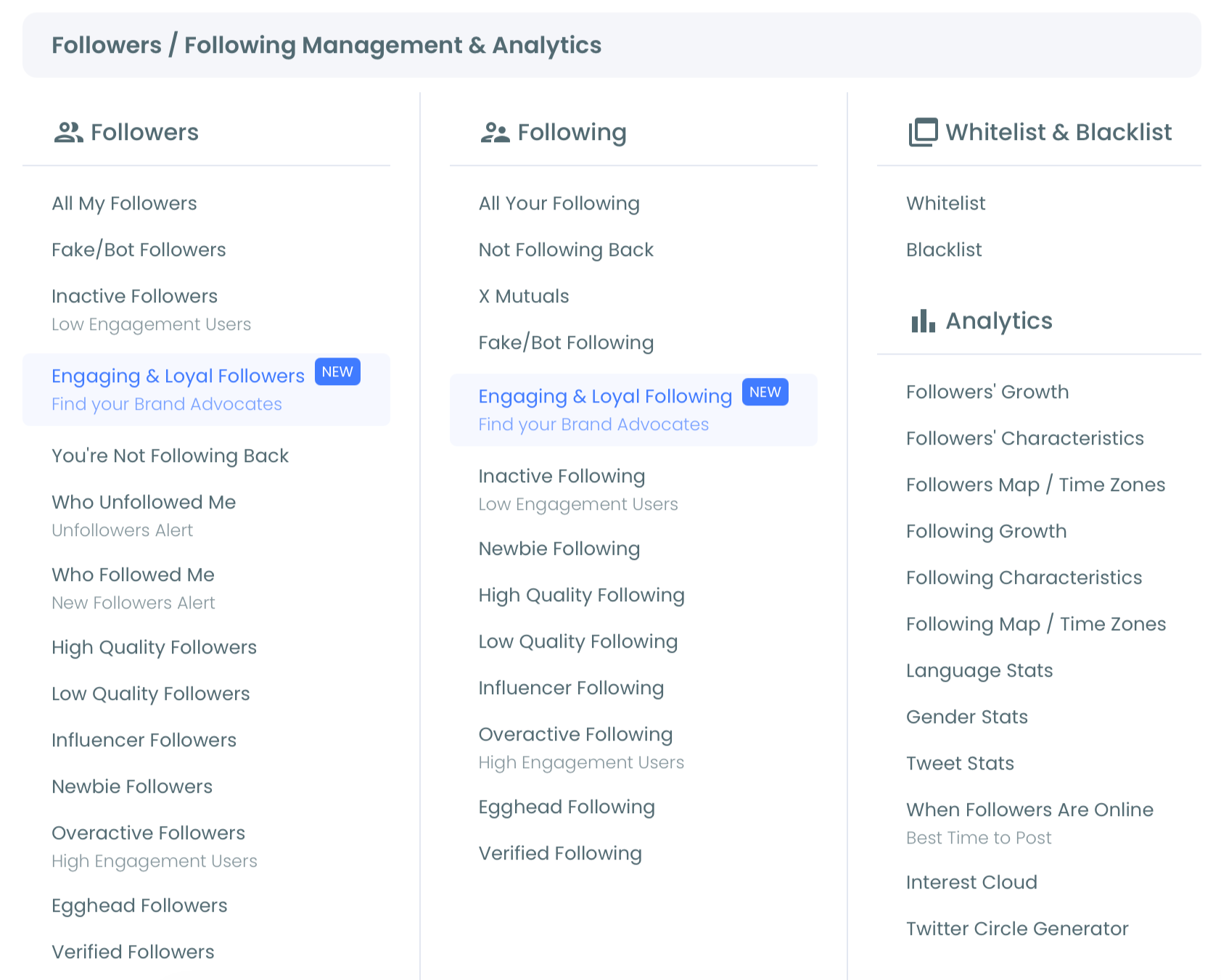
- Open the Followers / Following Management menu for the analytics workspace.
Phase 2: Segment
- Run the Followers segmentation pass to baseline composition.
Phase 3: Score
- Open the Twitter Quality Score for the account-level quality dimension.
Phase 4: Audit
- Open Engagement Analytics for the 90-day rate baseline.
- Document niche concentration through the audience-composition view.
Phase 5: Compute
- Apply the four-factor framework with composition, engagement rate, niche concentration, monetization throughput.
- Compare against comparable transacted accounts in the niche if data is available.
That sequence produces a defensible valuation. Each phase removes a different bias: segmentation removes the bot-dilution gap, scoring removes the quality-blind-spot, auditing removes the engagement-rate gap, niche-concentration removes the generic-buyer assumption.
Quick recap:
- Connect through OAuth.
- Segment the base.
- Score the quality dimension.
- Audit the 90-day engagement rate.
- Apply the four-factor framework.
What Each Factor Specifically Reveals
Composition is usually the largest valuation modifier. Engaging-plus-Loyal at 30% versus 5% is a 3-5x value difference on otherwise identical accounts.
Engagement rate is the second-largest modifier. 3% durable rate versus 1% is a 2-3x value difference.
Niche concentration produces the niche-buyer premium. 60% niche-concentrated versus 20% can be a 2-4x value difference to a niche-specific buyer. The article on find your X Twitter account analytics covers a related analytics angle.
Monetization throughput proves the value layer. Documented inbound DM volume, link-click rates, or paid-conversion history command premium valuations because they prove the audience converts.
Common Mistakes Operators Make
The first mistake is using count-only calculators. The math is clean and the result is wrong; calculators value bot followers identically to engaged followers.
The second mistake is using 30-day engagement-rate windows. The window over-credits spike events and under-credits durable baselines. 90-day windows are what buyers diligence.
The third mistake is skipping the niche concentration factor. A niche-specific buyer values niche audience, not general audience scaled by general engagement. The article on how can I get more followers with Twitter analytics covers a related analytics-side angle.
What to Do Next
The valuation workflow is concrete: segment, score, audit, compute.
- Step 1: Open Circleboom and run the segmentation pass.
- Step 2: Open the Twitter Quality Score.
- Step 3: Pull the 90-day engagement-rate baseline.
- Step 4: Document niche concentration.
- Step 5: Apply the four-factor framework.
→ Open the Twitter Quality Score workspace
What to Know Before You Start
How often should I re-run the valuation?
Quarterly. Composition shifts and engagement-rate baselines stabilize over months; weekly re-runs produce noise.
What about accounts under 5,000 followers?
The four-factor framework applies. Niche-concentrated small accounts can be worth more than general large accounts to the right buyer.
How do I find comparable transacted accounts?
Public marketplace listings, niche-specific brokers, and prior-year sales data when available. The article on value my tweets covers a related per-tweet valuation angle.
Is the workflow safe under X's rules?
Yes. All analytics run through Circleboom's Enterprise developer access. No scraping, no browser scripts, no automation outside platform policy.
)