
A Twitter following checker answers a question the platform refuses to: which of the accounts you follow still earn the slot? X hands you a following list.
It never tells you which follows went quiet, which drag your ratio down, or which you added for a reason you forgot two years ago.
So the list grows. Old campaign follows, dead accounts, and one-off adds from a research week that ended long ago all sit in the same feed, with nothing to tell them apart.
A following checker is only as sharp as the data behind it. X shows an unsorted, undated list; a real checker gives you numbers you can act on. Circleboom works as a Twitter following checker that reads every account you follow on X through official API access and scores each one by engagement, follow ratio, and inactivity in a single filterable table. Audit the whole list first, then decide what to cut.
→ analyze your Twitter following
What a Twitter following checker actually looks at
A raw following list is just names and avatars. A checker adds the columns X leaves out, and those columns are what let you make a decision instead of a guess.
Circleboom enriches every followed account with computed fields pulled from its public profile:
- Engagement tier: active, moderate, or inactive, based on recent posting.
- Follow ratio: followers divided by following, the fastest tell for a weak account.
- Account age: the join date, shown as days since the account was created.
- Tweet volume: total posts, which separates dormant accounts from live ones.
- Quality flags: eggheads with no photo, protected accounts, and fake or spam signals.
Every column sorts. Every field feeds the filter panel.
That is the entire difference between scrolling a list and running it as a Twitter following checker. One shows you who you follow. The other shows you which follows are worth keeping.
Sorting by engagement is usually where people start, because it is the single clearest cut. If you want the longer version of that method, here is how to analyze Twitter followers with the same scoring applied to the other side of your network.
The two jobs hiding inside "following checker"
Here is the part most articles skip. "Following checker" means two completely different jobs, and knowing which one you need saves you from reaching for the wrong tool.
The first job is auditing your own following list. The accounts you follow, scored for quality, ratio, and activity, so you can clean your feed and tidy the public list on your profile.
That is what All My Following does, and it is what this walkthrough covers.
The second job is monitoring someone else's following over time. Watching which accounts a competitor, investor, or prospect newly follows, to catch a signal before it becomes public.
That is a different Circleboom feature, Track Someone's X Account, and it runs on any public account rather than your own.
X does neither natively. It gives you a list with no sorting for the first job, and no history at all for the second.
If your goal is your own feed, you want the audit.
If your goal is intelligence on someone else, you want the tracker.
For the audit path, the starting point is pulling the complete set, so you can check every account you follow on X in one view before you filter anything down.
People underestimate how far the list has drifted. Open the full view and it is common to find several hundred follows you have no memory of adding.
That is exactly why a step to identify all the people you follow on Twitter belongs at the very front of the process.
How to run a Twitter following checker on your own list
To audit the accounts you follow, connect your account, open the following analytics, and sort the table by the signal you care about. Four steps, and the data loads through authorized API access, so nothing you do here puts the account at risk.
- Log in to Circleboom Twitter and connect your X account with official OAuth.

- Open the Follower / Following menu to reach your following analytics.
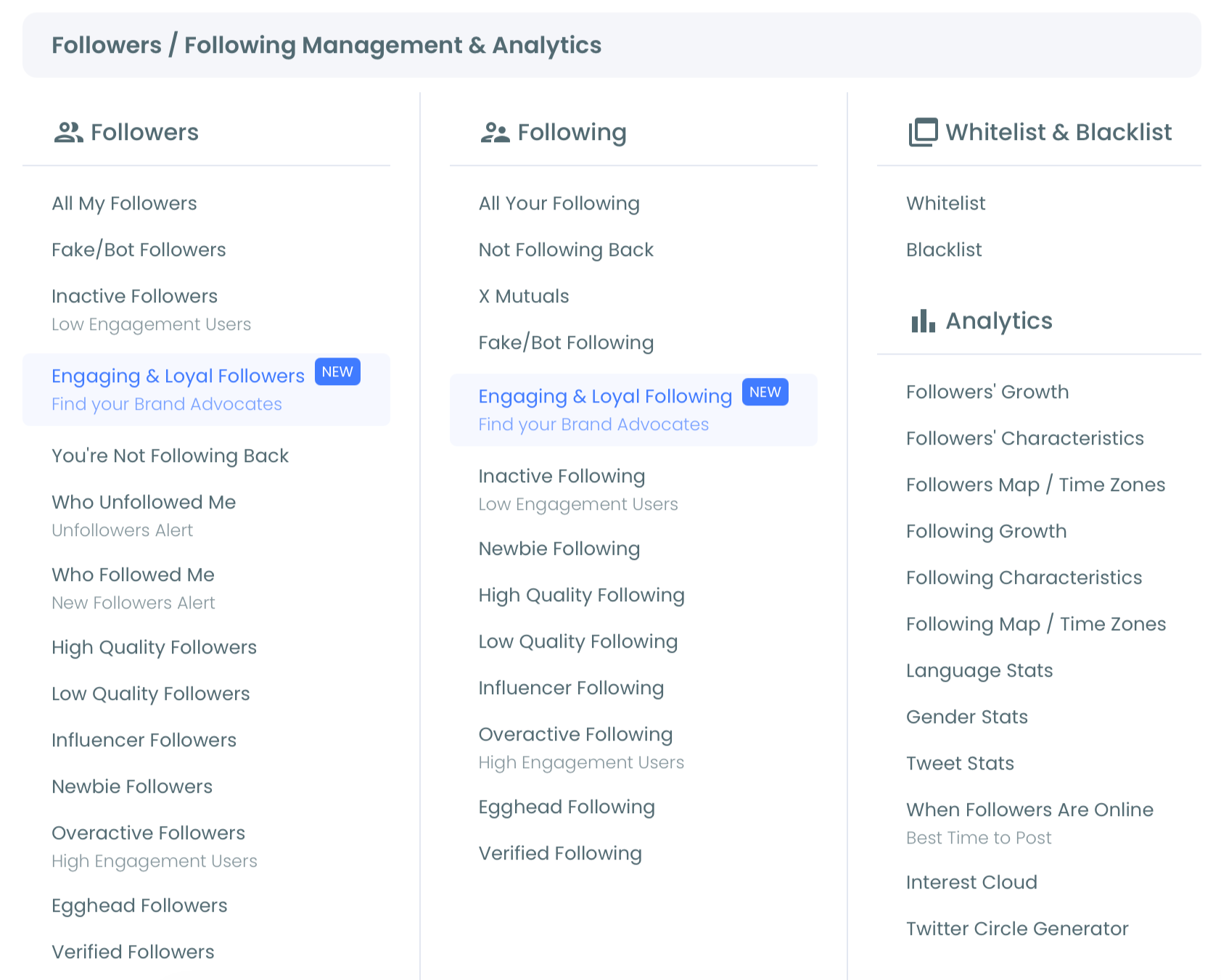
- Select All My Following to load every account you follow into one sortable table.
- Sort or filter the list by follow ratio, engagement tier, or join date, then unfollow, list, or whitelist what you find.
That order works because the login authorizes complete data first, the full list gives you a baseline before you narrow it, and the sort brings the weakest accounts to the top so you act on evidence rather than a hunch. Reverse the order and you end up cutting accounts before you have seen how they rank.
Because Circleboom reads this data as an official X Enterprise Developer, the counts come back complete and the unfollow actions stay inside X's published rate limits, so your account never trips the platform's spam detection during a cleanup.
Watch the following analysis run from connection to a sorted, filtered table:
Reading the table: what to sort first
Once the list loads, the temptation is to start unfollowing immediately. Resist it. The first pass is reading, not cutting.
Sort by follow ratio ascending. Accounts that follow thousands but hold few followers of their own jump to the top, and those are almost always old follow-for-follow adds or low-value accounts.
Then sort by engagement to split accounts that still post from accounts that went dark months ago.
The join-date sort is the quiet one people miss. Accounts you followed years back tend to be the ones whose original reason is long gone, and sorting oldest-first walks you straight through your own history on the platform.
If you want a second opinion on which scoring signals matter most, this comparison of the best followers analyzer for Twitter lines the metrics up next to each other so you can weight them for your own account.
When you only need to eyeball one account's numbers rather than the whole list, the Twitter follower viewer opens a single profile's stats without loading the full table.
What the filter panel lets you build
Sorting handles the obvious cuts. The filter panel handles the ones no single sort can express.
The panel opens as a side drawer with every filter group in it: follower quality, verification status, a bio and name search, follower and following count ranges, tweet count, follow ratio, join date, engagement level, language, and location. Each filter combines with the rest, and an active-filter bar at the top shows the exact segment you are looking at before you touch a single account.
That combination is the real power. No single named segment can express a filter like this: accounts you followed more than two years ago, posting in a language you no longer read, under a hundred followers, and marked inactive.
The filter panel builds that exact view in a few clicks. Then it hands you the matching accounts as a group you can act on together.
Start broad, then layer filters until the list in front of you is only the accounts you are sure about. The narrower the view, the safer the bulk action that follows it.
Why the manual method falls apart
You can, in theory, audit a following list by hand. Open each profile, read the stats, decide, move on. For twenty follows that works. For four hundred it does not.
The math is the problem:
- There is no sort, so you cannot rank by ratio or activity.
- There is no filter, so you cannot isolate inactive accounts.
- There is no export, so you cannot keep a record of what changed.
Every judgment gets made one profile at a time, from memory, with no columns to compare against.
A checker collapses all of that into one view. The same four hundred accounts become a table you sort in a single click, and the weakest hundred rise to the top where you can select them together and act once.
For a fuller walk through the trade-offs between doing it by hand and doing it with a tool, here is the best way to analyze your Twitter followers laid out from first pull to final cleanup.
Follow ratio, and why visitors read it
Your following list is public. Anyone who lands on your profile sees how many accounts you follow against how many follow you back, and that ratio shapes a first impression before they read a single post.
A profile following five thousand accounts with two hundred followers reads as a spam pattern, fairly or not. Cleaning the following list is often the fastest way to correct that ratio, because you control the following number directly while the follower number moves slowly on its own.
The checker makes the correction targeted instead of blunt. Rather than mass-unfollowing to hit a number, you sort by ratio, cut only the accounts that were never adding value, and leave the real connections in place. The ratio improves and the network stays intact.
To read the ratio in the context of your wider profile numbers, Twitter account analysis puts follower growth, posting cadence, and engagement in one place alongside the following count.
Deciding what to unfollow, list, or keep
The output of a following checker is not "unfollow everything weak." It is a decision, and unfollow is only one of three moves.
Unfollow the accounts that add nothing: dead, off-topic, or low-quality follows with no relationship behind them. Move to a list the accounts you want to keep watching but not in your main feed, like competitors or occasional sources.
Whitelist the accounts you never want to lose by accident, such as partners, customers, and key contacts, so no future bulk cleanup ever catches them.
Whitelisting first is the habit that saves people. Before any bulk unfollow, protect the accounts that matter, because a low ratio or a missing photo on its own is weak evidence.
Several weak signals together build a case; one alone does not.
Export is the fourth option people forget. Before a large cleanup, export the segment as a CSV so you have a record of exactly which accounts you touched, which is useful if you ever want to review the decision or feed the list into another tool.
Keep the list clean without starting over
A following list drifts the same way an inbox does. You clean it once, then months of new follows pile back up, and the clutter returns without you noticing.
The fix is not a bigger cleanup later. It is a shorter one, more often. Because the audit runs in a single pass, re-running it takes minutes rather than an afternoon, and each pass only deals with the follows added since the last one.
Keep two habits and the list stays sharp. Whitelist the accounts you value the moment you notice them, so they are protected before any future cut.
And run a quick ratio-and-engagement sort on a light rotation, catching dead follows while there are still a handful of them rather than a wall.
Where this leaves you
If you only want your feed and public list to reflect who you actually care about, run the audit on your own following. If you want to read someone else's moves, use the tracker instead. Most people need the audit first and the tracker later.
The whole job takes one pass: connect, load the full list, sort by ratio and engagement, then unfollow, list, or whitelist each account on evidence rather than memory. Do it once and your feed sharpens the same day.
Put it on a light rotation and it stays that way without the list ever drifting back into clutter.
Frequently asked questions
What does a Twitter following checker show that X does not?
It shows scored, sortable columns for every account you follow: engagement tier, follow ratio, account age, tweet volume, and quality flags. X gives you an unsorted list with none of those signals, so the checker is the difference between guessing and deciding.
Is it safe to unfollow in bulk from a checker?
Yes, when the tool respects X's limits. Circleboom processes unfollows gradually inside X's published rate caps and pauses automatically when a daily limit is reached, so a bulk cleanup never puts the account at risk.
Can a following checker also monitor someone else's follows?
That is a separate job. Auditing your own list uses All My Following; watching another account's new follows over time uses Track Someone's X Account. Pick the one that matches whether the target is your own list or someone else's.