
To find out what your Twitter followers actually talk about, you need a tool that analyzes the content of their tweets and bios rather than guessing from your own engagement metrics.
Circleboom Twitter's Interest Cloud feature does exactly this: it scans your followers' publicly visible content, extracts the topics they discuss most often, calculates topic frequency, and displays the results as a ranked word cloud. The larger words represent dominant interests; the smaller words represent niche or secondary themes.
Circleboom Twitter's Interest Cloud answers the question "what do my followers care about" by analyzing follower tweets and bios, extracting frequent keywords and topics, and presenting them in a ranked visualization. Bigger words mean more frequent topics across your audience; smaller words mean niche or emerging interests. The output is content-strategy input you can use directly, not raw data you have to interpret.
→ See what my Twitter followers talk about
The rest of this guide explains where the data comes from, how to read the cloud, and how to turn the topics into content.
Why Guessing About Audience Interests Fails
Most creators have a working theory of what their audience cares about, built from informal observation: which tweets got replies, which got bookmarks, what comes up in DMs. That theory is usually directionally correct and structurally incomplete.
The tweets that triggered the theory are the ones that performed, but performance and audience interest aren't the same thing. A tweet can perform because of timing, hook, format, or thread effect; the underlying topic may be a small piece of why it landed.
The structural problem is selection bias. You see tweets that performed; you don't see the tweets that didn't post because you assumed the topic wouldn't land. Anyone asking how to check what interests exist on Twitter is implicitly trying to escape that selection bias. The answer is to look at the audience side, not the content side: what do your followers themselves talk about, regardless of what you've posted?
That's where Interest Cloud comes in. The data isn't "what content of yours performed"; that's already in your post analytics. The data is "what topics dominate your followers' own tweets and bios," which is the upstream signal that determines whether new content will resonate before you spend time creating it.
What the Interest Cloud Analyzes
The feature operates on follower-side data, not your-side data. Three signals feed into the cloud:
The first is follower tweets. Circleboom analyzes the recent tweets of accounts that follow you, extracting frequent keywords and topic mentions. This is the largest data source and the one that drives most of the cloud's output.
The second is profile bios. Bios contain self-declared interest signals (job titles, topic tags, descriptors) that don't show up in tweet content but reveal what the follower considers central to their identity. A follower who tweets about everything but lists "marketing" in their bio is a marketing-interested follower; the bio resolves what the tweet content can't.
The third is common keywords. Across the population of your followers, certain words appear at much higher frequency than baseline. Those keywords are the signal of shared interests across the audience, distinct from any individual follower's content. This is the layer that surfaces topics no individual follower talks about constantly but that the audience as a whole talks about often.
The cloud combines all three into a single visualization. Word size reflects topic frequency; larger words are dominant interests, smaller words are niche or secondary. The same data also drives interest targeting strategies for Twitter engagement, which is the action layer on top of the analysis.
Circleboom is listed on X's enterprise customer directory, so the data retrieval runs through authorized Enterprise API access. The follower content analysis is one of the use cases that Enterprise API access actually supports at scale; lower API tiers don't expose enough follower content to make this kind of analysis useful.
Video walkthrough: how to analyze your Twitter followers' interests using the Interest Cloud feature.
How to Find What Your Followers Talk About
Four steps from login to actionable interest data.
Step-by-step interest analysis
- Log in to Circleboom Twitter and authorize with official OAuth.

- Open the Followers/Following menu from the sidebar.
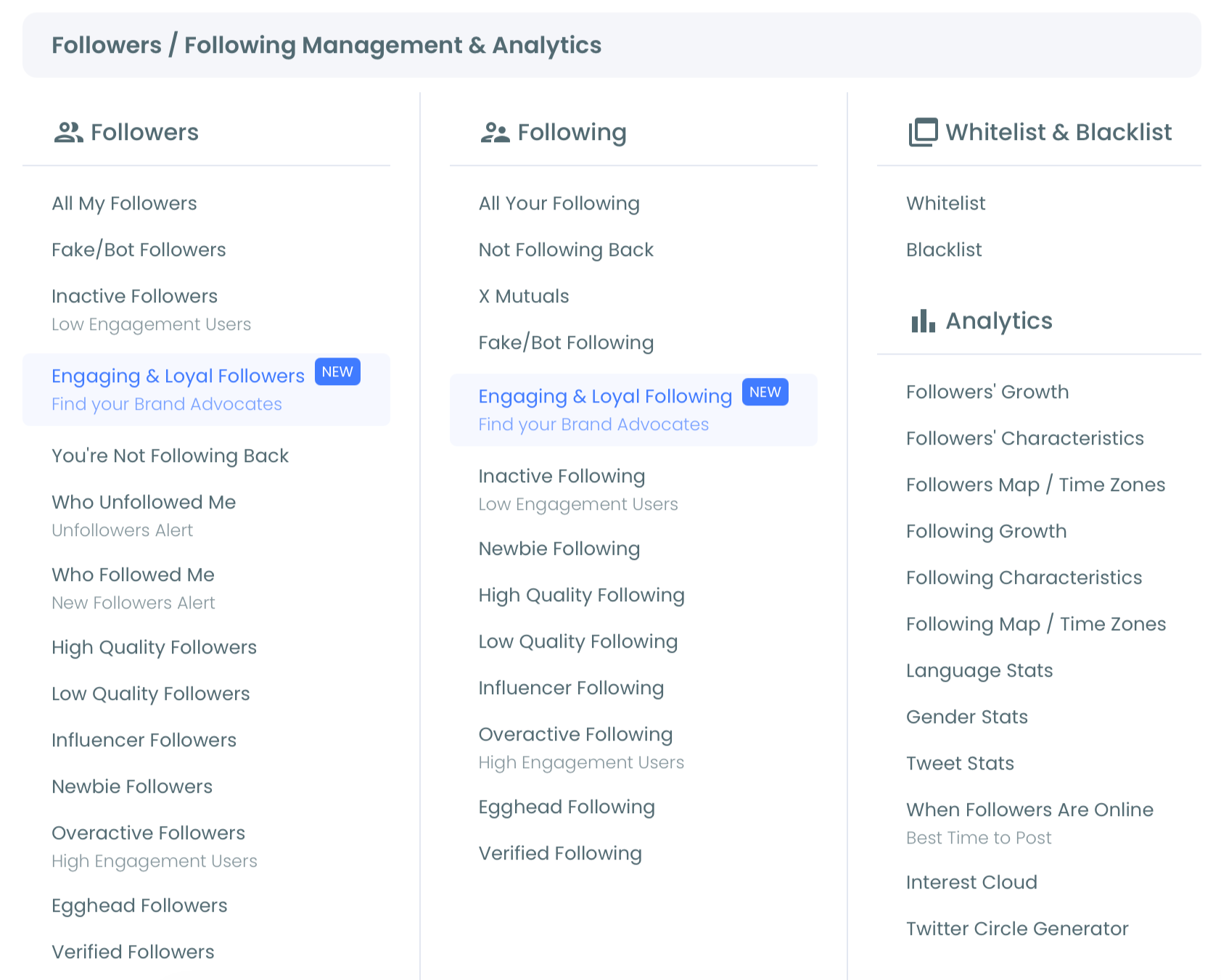
- Navigate to Followers Analytics and select Interest Cloud. The feature runs the analysis on your follower data and generates the word cloud visualization. Larger words indicate higher topic frequency.
- Review the dominant topics and the niche topics, then translate them into content angles. The dominant topics tell you what your audience cares about most; the niche topics tell you where you can find underserved sub-segments. For an in-depth read, you can also identify your most valuable brand advocates and check whether their interests align with the broader cloud.
That sequence is the full operational workflow. Login and menu navigation are the setup; the cloud generation is fast; the interpretation is the human layer that turns data into content strategy.
How to Read the Word Cloud
The cloud isn't a list; it's a visualization with size as the primary signal and proximity as a secondary signal.
Dominant words are your safest content territory. If a word appears large in the cloud, your audience talks about it frequently, which strongly suggests they'll engage with content on that topic. Posts in the dominant-topic zone tend to outperform random posting because they match audience interest directly.
Niche words are your differentiation opportunity. Smaller words represent interests that fewer followers discuss but that may be highly relevant to a specific sub-segment. Niche-topic posts tend to underperform on raw reach but overperform on engagement rate within the interested sub-segment. This is where deep engagement and loyal followers tend to form, because the post signals to a specific audience that you understand what they care about.
Word proximity is sometimes meaningful, sometimes not. Words that appear near each other in the cloud may indicate co-occurring interests (a follower interested in topic A is also likely to be interested in topic B), but the layout is also driven by visual packing constraints. Don't over-read spatial relationships; trust the size signal first.
Frequency changes over time. The cloud reflects current follower content; if your audience evolves, the dominant topics evolve too. Most creators re-run the analysis quarterly, which is enough cadence to catch shifts without over-investing in monitoring. Tracking how the cloud changes alongside Twitter follower growth tracking gives a fuller picture of how your audience is evolving in both size and composition.
The Bottom Line
What your Twitter followers talk about isn't a question you should be guessing at. Interest Cloud answers it directly by analyzing the content your followers produce themselves: their tweets, their bios, the keywords they use most. The output is a ranked visualization that turns a vague intuition ("I think my audience cares about X") into actionable content strategy ("my audience talks about X, Y, and Z at this relative frequency").
Stop running content experiments without an audience signal. Run Interest Cloud once, identify the dominant and niche topics, and align your next month of content with what your audience already talks about. The engagement lift from posting on-interest topics is the largest single ROI lever in audience-side content strategy.
→ Analyze my Twitter audience's interests now
Frequently Asked Questions
Does Interest Cloud read every tweet from every follower?
No. The feature samples recent follower content (tweets and bios) at a depth sufficient to produce reliable frequency rankings. Sampling, rather than full-history scraping, is what makes the analysis fast and what keeps it within authorized API usage patterns. For most accounts, the sample is representative enough that the dominant topics are clearly identified.
Will the cloud work for accounts with very small followings?
Smaller audiences produce thinner clouds. With under 100 followers, the cloud may surface only a few dominant words and miss the niche layer. With 500–1,000 followers, the cloud is meaningfully useful. With 5,000+ followers, the cloud reaches its full informational density.
How often should I re-run the analysis?
Quarterly is the right cadence for most accounts. Audience composition shifts as you grow and as your content focus changes; checking every three months catches the shifts without over-monitoring. Some creators re-run after major content pivots or follower-count jumps; both are reasonable triggers.
Can I use the cloud's topics directly as content prompts?
Yes, and this is one of the most common workflows. Pull the top 5–10 words from the cloud, write tweets or threads on each topic, and watch engagement rates on the on-topic posts. Most creators see meaningfully higher engagement on topics drawn from the cloud than on topics they guessed at.
Is this safe for my account?
Yes. The analysis runs through authorized Enterprise API access, which is the same API surface X exposes for its own analytics clients. No scraping, no unofficial methods, no rate-limit risk. Running the analysis is a read-only operation on follower content; it doesn't affect your followers, doesn't notify anyone, and doesn't trigger any platform flags.