
Closing your inbox on X used to be a one way decision. Nobody outside your followers could reach you, and the people you actually wanted to hear from landed in a message request pile you never opened.
X Numbers changes that trade. X started rolling out X Numbers on September 22, 2026, and the idea is simple: you get a private code inside XChat, you hand it to the people who should be able to reach you, and their messages arrive in your main inbox without a follow and without a request.
The name is the confusing part. An X Number is not a phone number. Nothing about it is tied to your carrier, your SIM, or the number in your account settings. It is an in app contact code that X generates for you, and you can burn it and get a new one whenever you want.
That last detail is what makes it interesting. For the first time on X, access to your inbox is something you can revoke without changing who follows you.
What an X Number Actually Is
Think of it as a door code for your XChat inbox.
By default, XChat follows your message settings. Mutual follows can reach you, and everyone else either goes to message requests or gets blocked at the door depending on how you have things configured. Turn on an X Number and you create a second path in. Anyone holding your current code can message you even if you do not follow them and even if your inbox is closed to strangers.
Those conversations do not sit in message requests. They go straight to the main inbox, which is the whole point.
X Numbers are here.
— XChat (@chat) September 22, 2026
Share yours with anyone you want to contact you, even if you don't follow them. It's an optional way for people to message or call you, without you needing to accept requests or follow them back. pic.twitter.com/HkObZSQMhm
People with your code can also call you, but that part still obeys your call settings. If you have calls limited to people you follow, or turned off entirely, an X Number does not override it. The code opens messaging; calling stays under separate control.
Reports on the length of the code do not agree. Some coverage described a code of 10 digits, other write ups described 8, and X's own Help Center has not pinned the format down publicly. Functionally it does not matter much, since the code is meant to be shared directly rather than remembered.
One thing worth knowing: X's Help Center lists no subscription requirement for creating an X Number. That puts it in a different category from X Money, which stays limited to Premium subscribers.
How to Turn On X Numbers
The controls live inside Chat, not in your main privacy settings, which is why plenty of people have not found them yet.
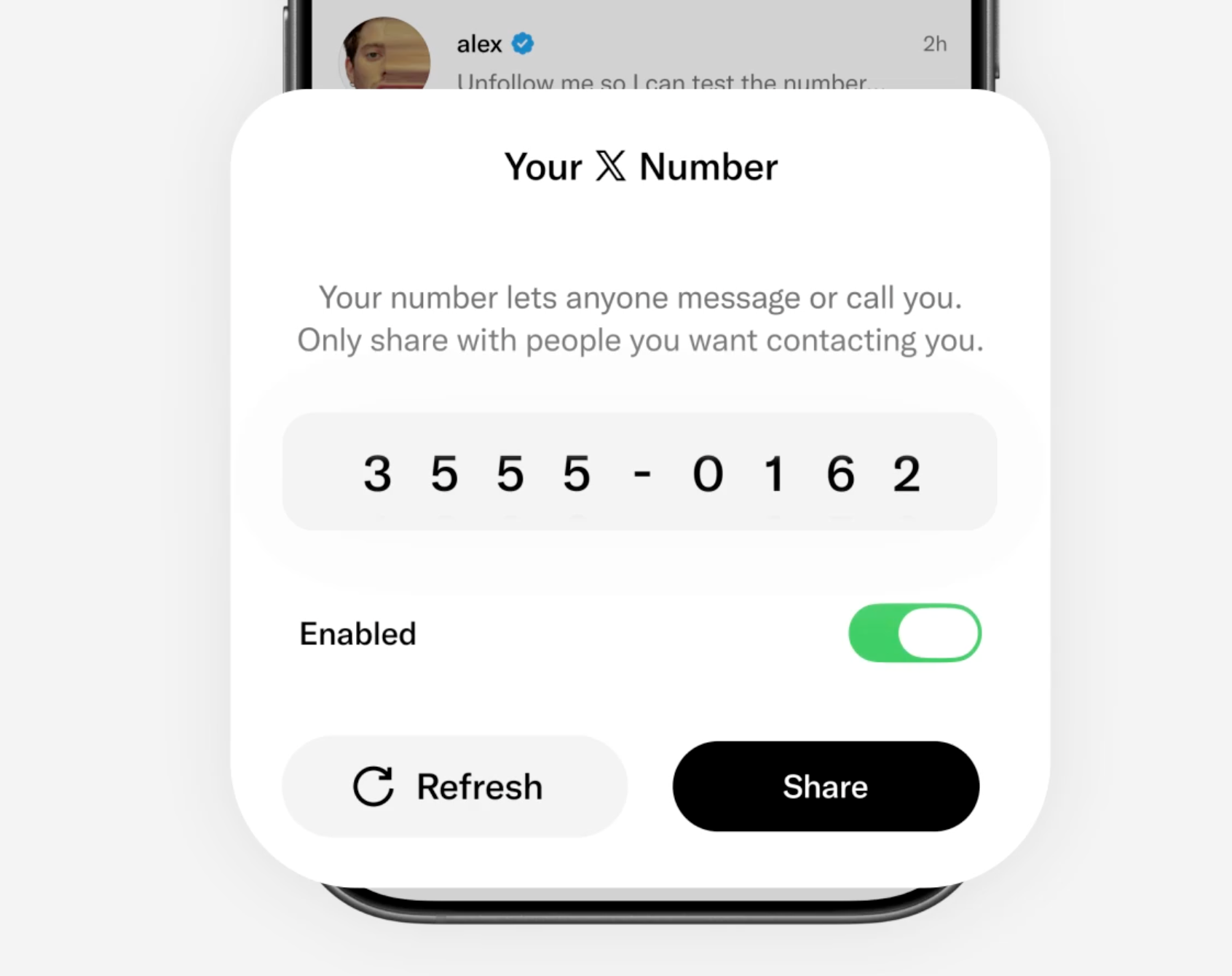
Open Chat, enter your Chat PIN if you are prompted for it, open the inbox dropdown, and select Number. Everything you need sits in that one sheet.
Enable or disable. Flipping it on generates your code. Flipping it off stops the code from working immediately, and anyone who only had that code can no longer start a new conversation with you.
Share. You pass the code to whoever should have it. There is no invite flow and no approval step. Possession of the code is the permission.
Refresh. Tap refresh and X replaces your code with a new one. The old code stops working for new contacts. This is the spam valve, and it is the reason X Numbers are more forgiving than publishing an email address.
Hide from others. This is the setting most people will want to check first, and it is covered in the next section.
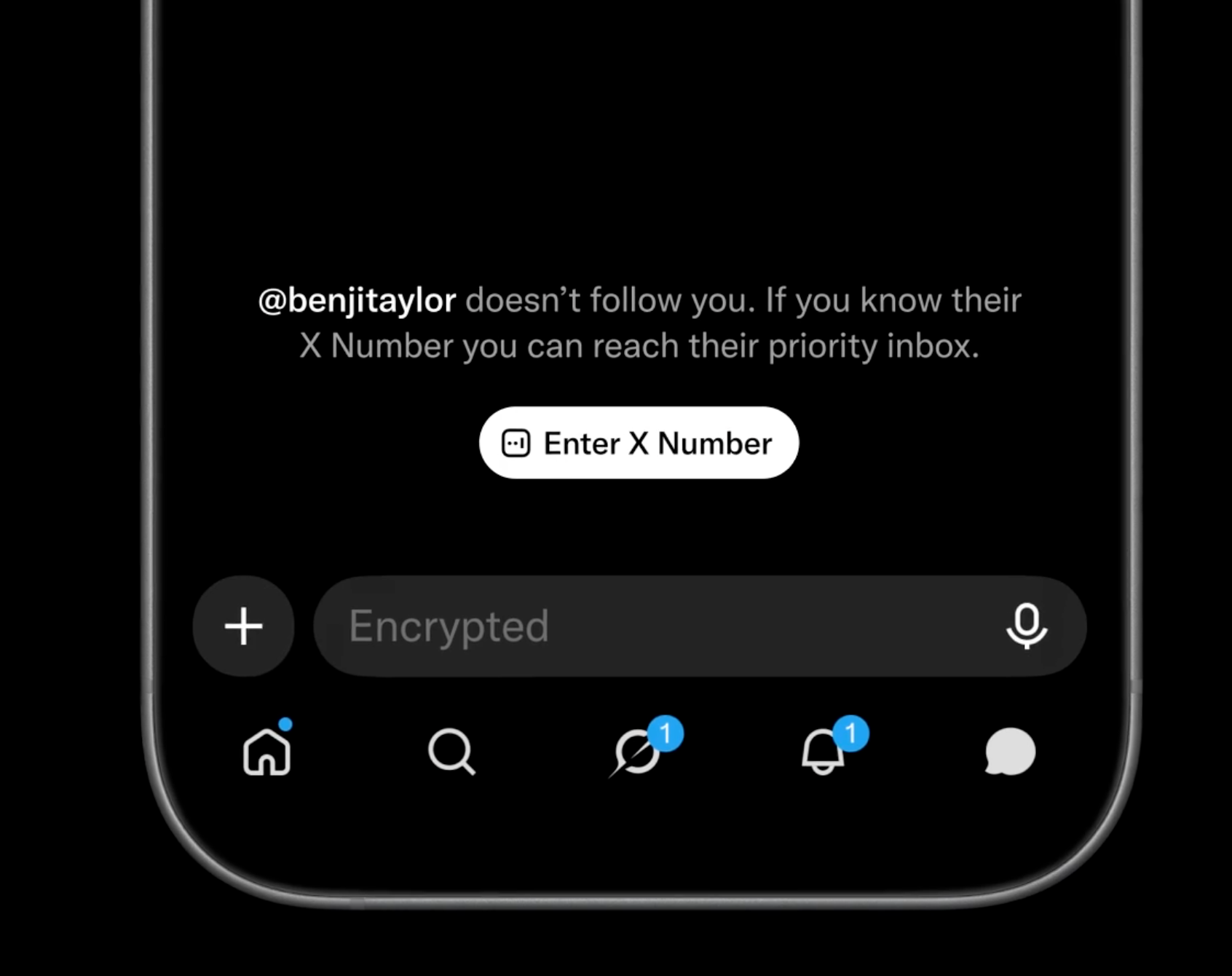
One quirk catches people out. Turning your X Number off, or refreshing it, does not remove the X Number prompt that other people see when they try to message you. Someone attempting to reach you still gets asked for a number either way. All the setting controls is whether entering a code actually lands in your inbox, which means nobody can tell from the outside whether you have the feature switched on.
The Privacy Settings Worth Checking Before You Share Your Code
Enabling an X Number without touching anything else leaves a few defaults in place that you probably do not want.
Your code is visible to people you have messaged. By default, anyone in your existing chat history can see your X Number and pass it along. A code that spreads through screenshots is not much of a gate. Turn on Hide from others in the X Number sheet if you would rather keep it out of view.
Enhanced call privacy is off by default. With it off, XChat calls run peer to peer, and a peer to peer call can expose your IP address to the person on the other end. When you have handed your code to people you do not know personally, that matters. Turn Enhanced call privacy on in Chat settings before you start taking calls from strangers.
Narrow your call settings if you only want messages. Plenty of use cases for X Numbers are text only. Setting who can call you to something tighter than Everyone gives you the inbox access without the ringing phone.
Refreshing is not blocking. If someone abusive already has your code, refreshing cuts off new contacts but does nothing about the conversation already open. Block that account separately. The two controls do different jobs.
Why X Built a Number for a Product Built to Kill Numbers
There is an obvious irony here, and it is worth sitting with for a second.
XChat was pitched on the promise of no more phone number swaps. Sign in with your X account, bring the network you already have, skip the awkward exchange of digits with someone you just met. That was the pitch when XChat rolled out earlier in 2026.
X Numbers recreates the phone number pattern, just without the phone number. You still hand someone a string of digits so they can reach you. The difference is that this string is disposable, it is not attached to your identity anywhere else, and losing control of it costs you a refresh instead of a SIM swap.
Seen that way it is less a contradiction than a correction. Follow graphs are a bad model for who should be able to contact you. The person sitting across from you at a conference is not someone you follow. The reporter who needs to verify a quote by Friday is not someone you follow. Mutual follows and existing XChat contacts keep their access when you turn an X Number on, so the code is purely additive: a way to let specific people in without loosening your settings for everyone.
📌 The practical shapes this takes: a code on a conference badge that gets refreshed the day the event ends, a creator opening a line to a paid community, a support channel a business runs for one campaign and then closes, a journalist taking tips without publishing an email address that gets scraped forever.
The Encryption Caveat Nobody Should Skip
X Numbers is an access control feature, not a security feature, and the distinction matters because of what sits underneath it.
XChat's end to end encryption has not been independently audited. There is no published protocol specification, the client and server code are closed source, and researchers looking at it have flagged real structural problems. X holds the encryption keys. There is no forward secrecy, so a compromised private key exposes past messages and not just future ones. Recipient public keys carry no out of band verification, which leaves room for a server side key substitution attack. Metadata is not encrypted at all. And adding Grok to a conversation removes encryption for as long as it is in the chat.
Matthew Green, the Johns Hopkins cryptographer, put it plainly to TechCrunch: until XChat gets a full audit from someone reputable, he would not trust it more than he trusts unencrypted DMs. Security analysts have echoed that assessment since the encrypted chat launch.
None of that is a reason to avoid X Numbers. It is a reason to be clear about what you are getting. The code controls who can knock on your door. It says nothing about who might be listening once the door opens. For sensitive conversations, an audited messenger is still the right place to have them.
FAQ
Is an X Number the same as my phone number?
No. An X Number is a private code generated inside XChat and it has no connection to your phone number, your carrier, or the phone number on your X account. Sharing your X Number does not reveal your phone number to anyone.
Do I need X Premium to use X Numbers?
X's Help Center lists no subscription requirement for creating an X Number. That makes it different from X Money, which is restricted to Premium subscribers. Availability is still rolling out, so not every account has the option yet.
Can someone guess my X Number and message me?
The code is several digits long and X has not published the exact format or whether rate limiting is applied to failed attempts. Brute forcing is not the realistic risk. The realistic risk is your code being shared or screenshotted by someone you already gave it to, which is what the Hide from others setting and the refresh button exist to handle.
What happens to existing conversations if I refresh my X Number?
Conversations already open stay open. Refreshing only stops the old code from being used to start new ones. If you want to cut off someone you are already talking to, block that account instead.
Can people tell whether I have an X Number enabled?
No. The X Number prompt appears to people trying to message you whether the feature is on, off, or refreshed. Only the code itself determines whether a message reaches your inbox.
Does an X Number let people call me too?
Yes, but only if your call settings allow it. The code opens your message inbox. Calls remain governed separately, and you can tighten who is allowed to call you without affecting messages at all.
Final Thoughts
For years the only inbox controls on X were blunt: open to everyone, open to followers, or closed. X Numbers adds the option that was missing, which is letting in the specific people who should be able to reach you and nobody else.
The feature is worth turning on. It is also worth spending two minutes in the settings sheet first, because Hide from others and Enhanced call privacy both default in the wrong direction for anyone handing a code to strangers. And keep the encryption picture in mind: X Numbers decides who gets through, not how protected the conversation is once they do.
A contact method you can revoke in one tap is a genuinely better deal than a phone number. That is the real story here, whatever the name suggests.