
Bulk scheduling has become a core part of managing Twitter accounts.
With faster content cycles, increased competition, and shorter attention spans, posting consistently is no longer optional. Whether you are managing a personal brand, a business account, or multiple profiles, staying active requires a structured approach.
But there is a growing concern.
Bulk scheduling is powerful, yet it comes with risks if done incorrectly. Many users hesitate because they are unsure whether scheduling large volumes of tweets could trigger limits, cause inconsistencies, or even affect account safety.
That’s why the real question is no longer how to schedule tweets in bulk, but how to do it safely and securely.
Circleboom Twitter: A Safe Way to Bulk Schedule Tweets
One of the safest ways to bulk schedule tweets is by using Circleboom Twitter.
Circleboom Twitter is an official X Enterprise Developer, which means it works directly with X’s official API. This is a critical difference compared to many tools that rely on unofficial methods or scraping-based systems.
Working with the official API ensures:
- Actions stay within platform limits
- Scheduling remains stable and reliable
- Automation does not create risky behavior patterns
This becomes especially important when dealing with bulk actions.
Circleboom’s bulk scheduling feature allows users to upload a CSV file and schedule multiple tweets at once. Instead of creating posts one by one, you can prepare your entire content plan in advance and execute it in a single workflow.
 infocircleboom.com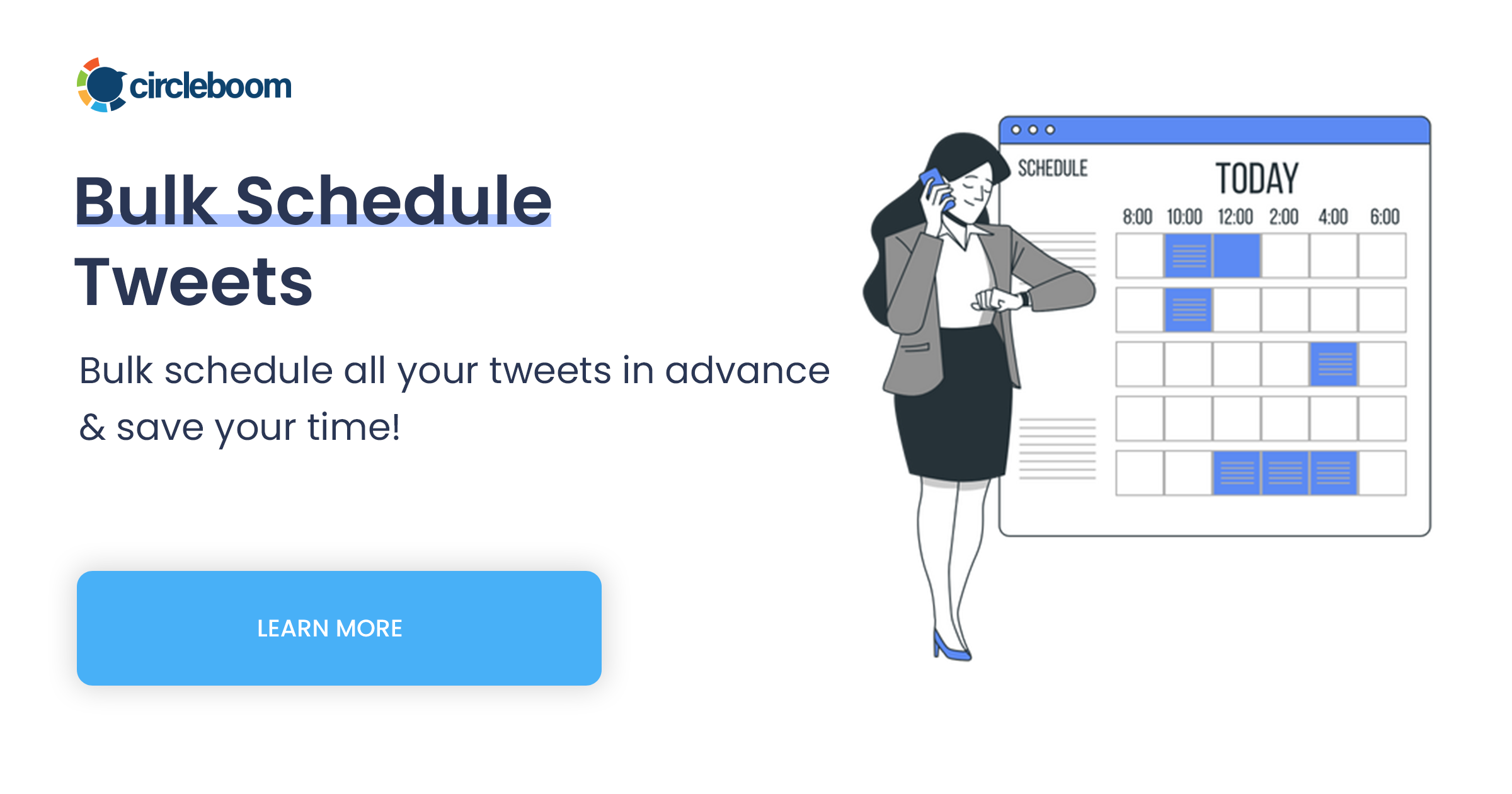
From one dashboard, you can:
- Upload multiple tweets
- Assign posting times
- Review and validate content
- Schedule everything in bulk
This transforms bulk scheduling from a risky shortcut into a controlled and secure system.
How to Bulk Schedule Tweets Safely in 2026
Step #1: After logging in to Circleboom Twitter, click Bulk Schule.
This opens the bulk scheduling interface and allows you to import multiple tweets at once instead of creating them one by one.

Step #2: Upload your CSV file
Upload your CSV file by dragging it into the upload area or selecting it from your computer.
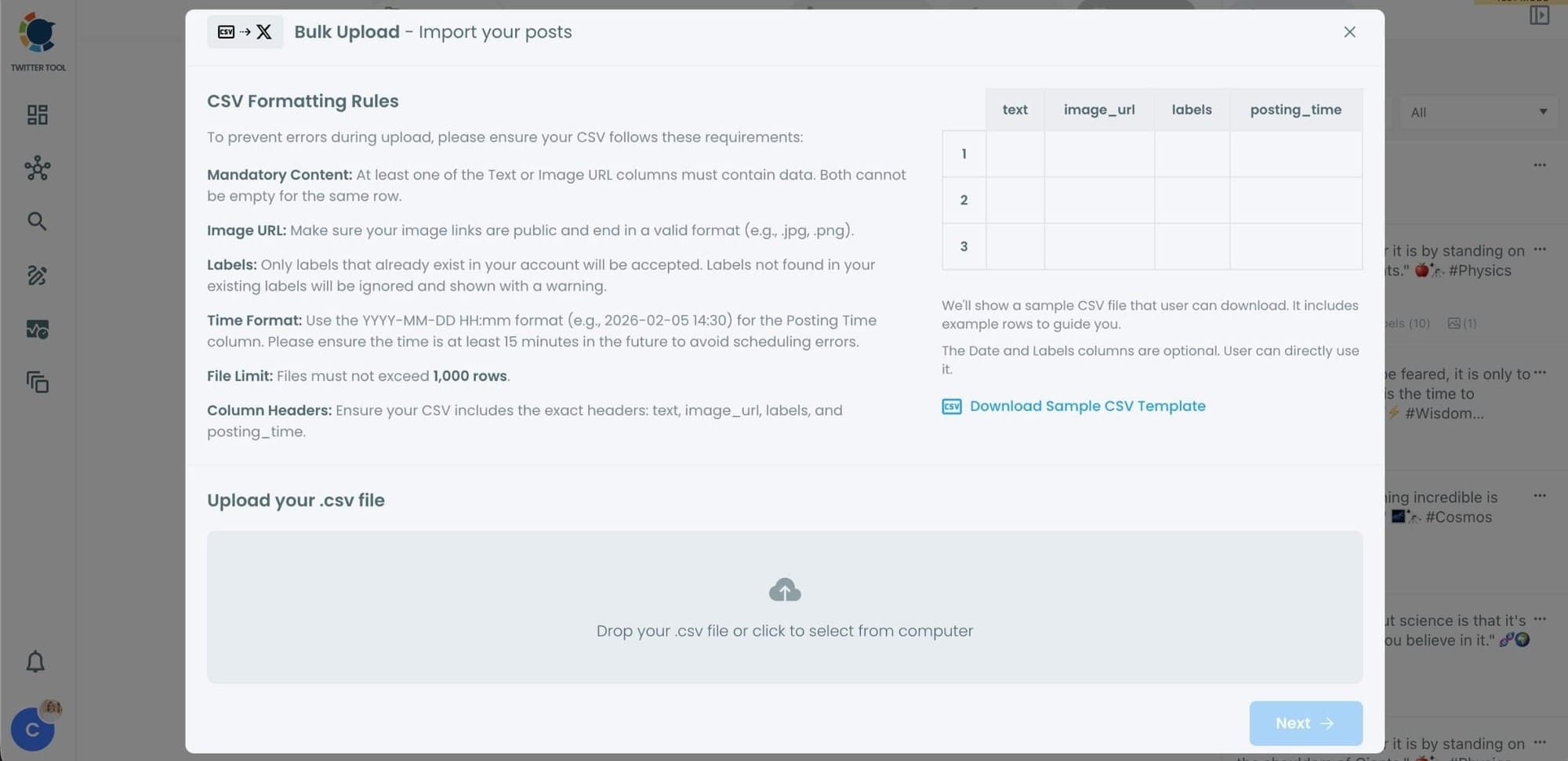
Before uploading, make sure your CSV file follows the required format.
Your file should include the correct column headers, and each row should represent a single tweet.
You can include tweet text, image URLs, labels, and posting times.
Preparing the file in the correct format prevents errors during scheduling.
Step #3: Review your imported tweets
After uploading the CSV file, Circleboom shows all your tweets in a preview list.
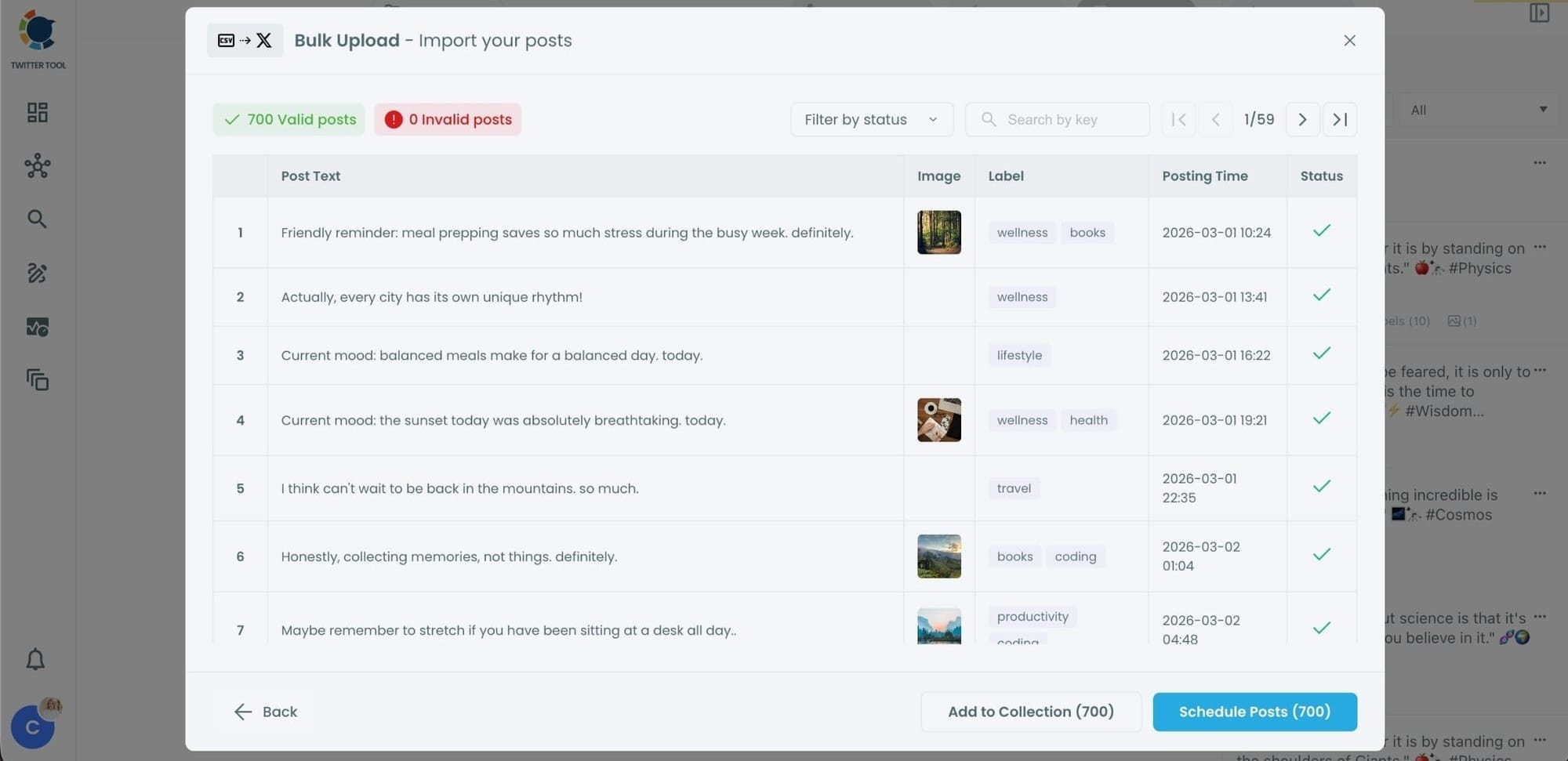
At this stage:
- Valid tweets are marked clearly
- Invalid tweets are shown with the reason for the error
- You can also add tweets to Collections if you want to organize or reuse them later
This step helps you catch and fix problems before anything is scheduled.
Step #4: Schedule all tweets at once
Once everything looks correct, click Schedule Posts.
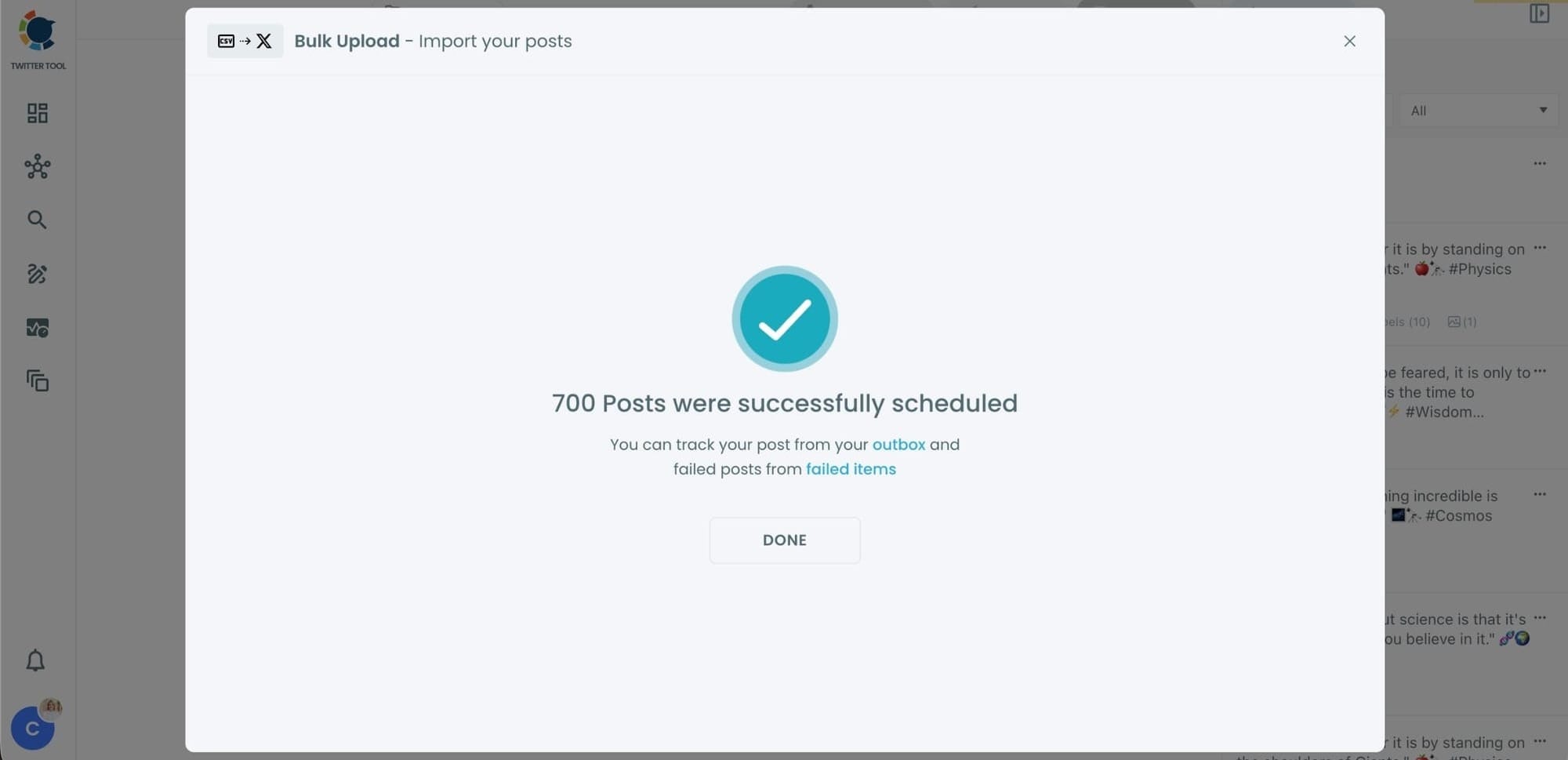
Circleboom automatically schedules all valid tweets based on the posting times in your CSV file.
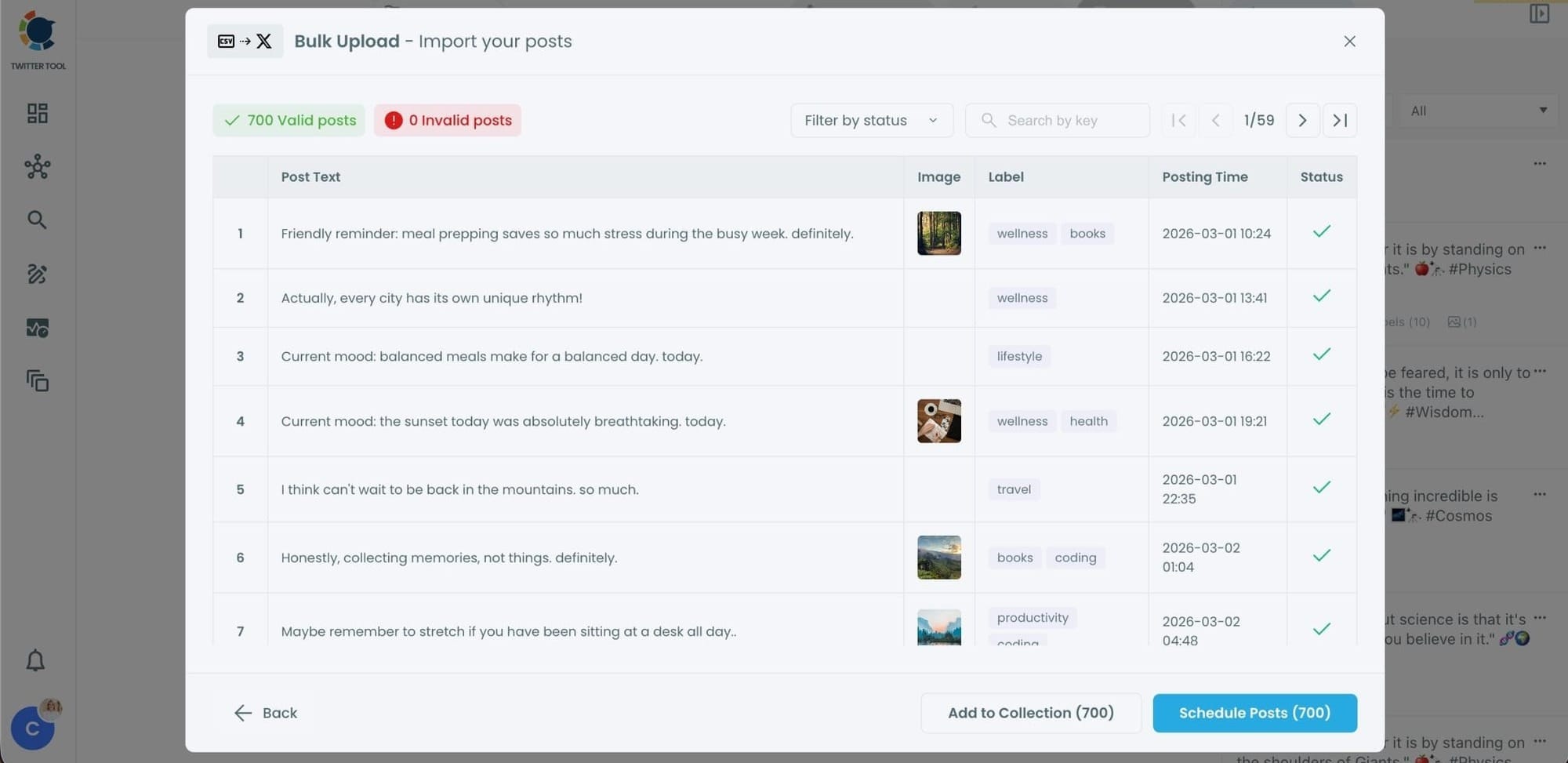
Even hundreds of tweets can be scheduled in seconds, without manual work.
Step #5: Manage scheduled tweets from the Outbox
After scheduling, all your tweets appear in the Outbox and calendar view.
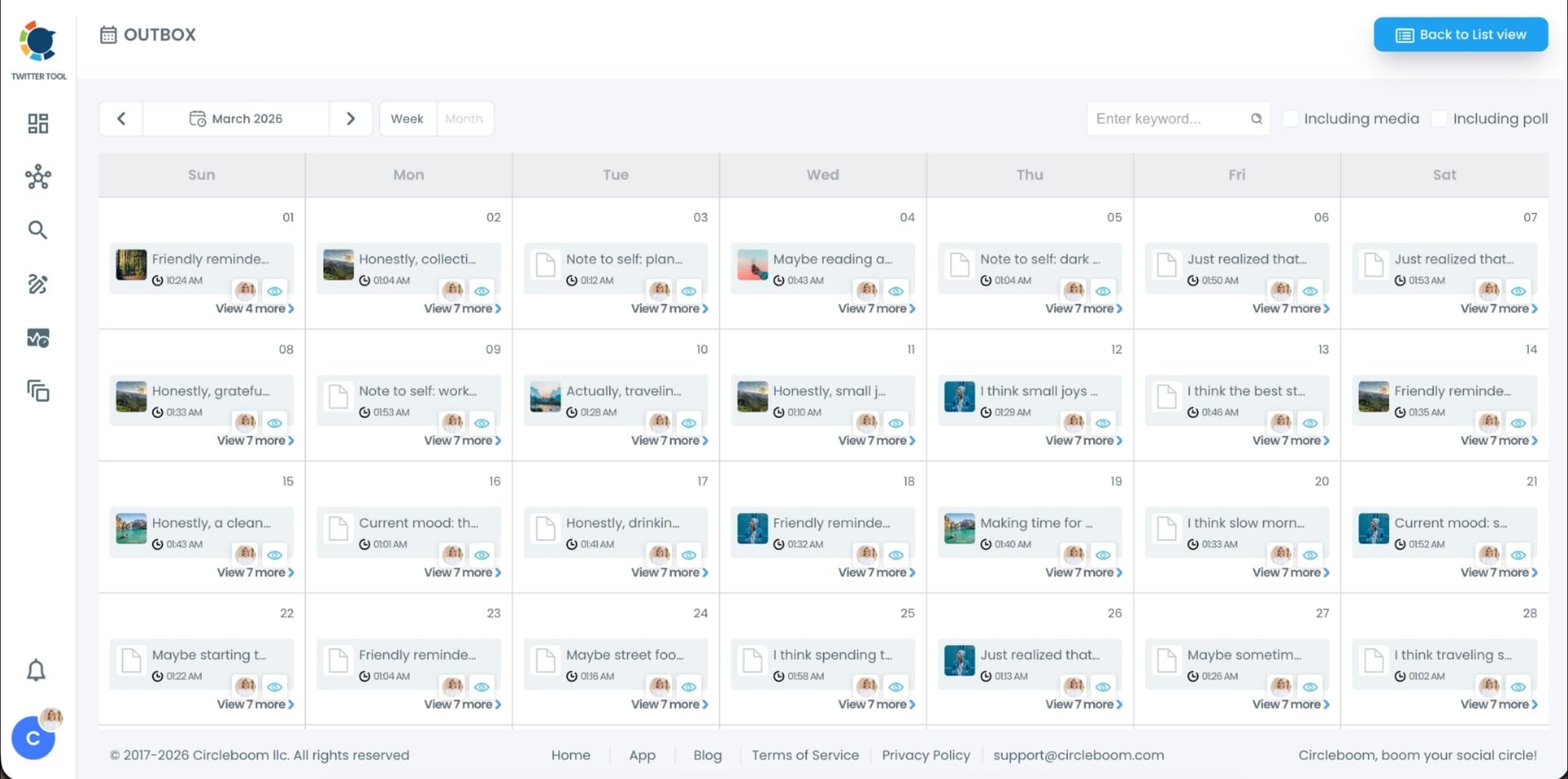
From here, you can:
- See all scheduled tweets by date and time
- Make changes if needed
- Edit or remove scheduled posts
- Keep track of your content easily
This gives you full control even after bulk scheduling is completed.
Watch the ultimate Twitter / X Automation here ⬇️
Why Safety Matters When Bulk Scheduling Tweets
Bulk scheduling involves performing multiple actions within a short period of time. Without proper control, this can lead to issues.
Twitter/X systems are designed to detect unusual or spam-like behavior. If posting patterns appear unnatural, accounts may face:
- Temporary restrictions
- Limited reach
- Action limits
This is why the tool you use matters more than the feature itself.
Unsafe tools often:
- Ignore API limits
- Schedule posts in unnatural patterns
- Lack validation systems
In contrast, safe bulk scheduling aligns with platform rules and mimics natural activity patterns.
What Makes Bulk Scheduling “Safe” in Practice
Safe bulk scheduling is not just about scheduling many tweets. It is about how those tweets are scheduled.
A safe system should include:
- Official API integration
Ensures all actions comply with platform rules - Controlled scheduling logic
Prevents unrealistic posting frequency - Validation systems
Detects errors such as missing fields or invalid formats before publishing - Structured workflows
Allows users to review and adjust content before scheduling
Circleboom Twitter integrates all of these elements into its bulk scheduling process. Instead of pushing content blindly, it provides a controlled environment where every post is checked and scheduled properly.
 Arif Akdogan
Preparing Your Content for Bulk Scheduling
Before uploading tweets, preparation plays a key role in achieving good results.
Bulk scheduling works best when content is planned in advance rather than created randomly.
A typical preparation process includes:
- Writing tweets in batches
- Organizing posting times strategically
- Using public image URLs for media
- Structuring everything in a CSV file
This CSV file acts as a content system.
Each row represents a tweet, and each column defines its components. Once prepared, this file allows you to schedule large volumes of content with minimal effort.
The more structured your preparation is, the more effective your automation becomes.
Best Practices for Bulk Scheduling in 2026
Even with the right tool, following best practices is essential for long-term success.
Some key recommendations include:
- Maintain realistic posting intervals
- Avoid repetitive or duplicated content
- Mix content types (text, visuals, threads)
- Align posting times with audience activity
- Focus on content quality, not just quantity
Bulk scheduling should support your strategy, not replace it.
The goal is to create a consistent and natural presence, not to flood timelines.
How Bulk Scheduling Changes Your Workflow
Bulk scheduling is not just a feature. It changes how you approach content management.
Instead of:
- Posting daily
- Reacting to content needs
- Repeating the same actions
You move toward:
- Planning content in advance
- Executing everything in one workflow
- Letting automation handle distribution
This shift creates several advantages:
- More consistent posting
- Better time management
- Easier scaling across multiple accounts
It allows you to focus on strategy, engagement, and growth rather than manual execution.
Final Thoughts: Automation Should Work With the Platform, Not Against It
Bulk scheduling is one of the most effective ways to stay consistent on Twitter in 2026.
However, the key is not just automation. It is safe automation.
Using tools that operate within platform rules, like Circleboom Twitter, ensures that your content is published reliably without risking your account.
By combining structured preparation, controlled scheduling, and official API access, bulk scheduling becomes a sustainable system rather than a risky shortcut.
The goal is simple:
Not just to post more,
but to grow consistently without putting your account at risk.