
A competitor follower analysis on Twitter tells you how a rival's audience is composed: how much of it is human and active, which markets it sits in, and what its bios say. Those panels do not tell you who reads the rival's posts or who would buy from you, and the followers you already share are counted in a separate panel, two accounts at a time.
What this page settles.What each audience panel says about a rival's followers.The claim each panel cannot support.Why the list of accounts a rival follows is a different kind of evidence.
Circleboom describes the followers of up to 5 accounts on X side by side, using records retrieved through official X Enterprise APIs. Start with a competitor follower analysis.
What a competitor follower analysis on Twitter measures
A competitor follower analysis measures the composition of the accounts that follow a rival, not the behavior of the rival's content. Its unit is the follower list: who is on it, described as a group.
That separates it from two neighbors. Post analytics describe what an account publishes and how people respond. Follower tracking describes who joined or left a list over time. A follower analysis sits between them and answers one question: what kind of audience did this account gather?
The general method is the same for any public account. You retrieve the list, classify the accounts on it and summarize them. Circleboom's blog has a broader piece on how to analyze someone's Twitter followers if the account you care about is not a competitor.
The competitive version adds a second column. With Circleboom's X Competitor Analysis & Benchmark Report tool, you can place a rival's followers on X next to your own, or next to other rivals, in identical panels. A number only becomes good or bad once it has a peer beside it.
That is why I treat a competitor follower analysis on Twitter as a comparison first and a lookup second.

Why can't you read a competitor's full follower list on X itself?
X shows another account's follower list, but the list stops loading after a point and cannot be filtered, sorted or exported. You can open it. You cannot read it as a whole.
That gap is the reason an analysis tool exists at all. It is also where the first limits appear, and they are better known before you pick accounts.
Three kinds of account are off limits or restricted:
- Protected accounts. Only public accounts can be analyzed. X's page on public and protected posts explains what protecting an account restricts, and an analysis tool working through official access respects it.
- Accounts above 3,000,000 followers. Circleboom's report cannot analyze an account over that threshold, whether it is a competitor or your own.
- A sixth account. One comparison holds up to 5 accounts in total. More than 5 means a second report.
The middle limit is the one teams meet late. The largest names in a category are often the first accounts a team wants to study, and some of them will not fit. Plan the peer set around rivals of comparable scale, which usually makes for a fairer comparison anyway.
What does each audience panel say about a rival's X followers?
Each panel answers one narrow question about the follower list, and each one has a claim it cannot carry. The table pairs them.
| Panel | What it says | What it does not support |
|---|---|---|
| Human vs Fake/Bot | The share classified as suspected fake or bot from account signals | A verified judgment about any single account |
| Active vs Inactive | How many followers post regularly, by average tweeting frequency | Whether those followers read the rival's posts |
| Quality tiers | A High, Medium and Low split from activity, follow ratio and account age | An instruction about whom to ignore |
| Verified by badge | Verified followers split into Blue, Gold and Gray | Topic relevance or audience fit |
| Geography and time zone | Which countries and time bands are represented | Demand or purchasing intent in those markets |
| Language and gender | Group-level breakdowns calculated from profile data | Any individual follower's language preference or identity |
| Bio keywords | The most common words in followers' bios | Confirmed buying intent |
Quality panels describe composition
The quality panels tell you how much of a rival's list is made of accounts that post and look human. They are review signals. A person who rarely posts may still read everything, and a suspected bot flag is a prompt to look at the account.
Audience quality deserves a study of its own, so this page stops at one use: check that the list is worth describing before you describe it.
Market panels describe representation
Geography, time zone, language and gender show which groups are present among a rival's followers. A concentration in one country means that country is represented. It does not prove people there want what you sell.
Bio keywords describe how followers label themselves
The bio keyword cloud is the closest the report comes to interests. It lists the words followers use about themselves, which makes it a strong source of content angles and search terms. Those words remain self-descriptions.
A panel that comes back flat is still a finding
Some panels will show almost no difference between the accounts you compare. In the sample report from Circleboom's documentation, built on four public accounts, verified followers landed between 2.1% and 2.7% for all four accounts, and active followers between 36% and 38%.
A flat panel ends an argument. It tells you the rivals do not differ on that measure, so the comparison should move to the panels that do separate them.
Why a share and a count of Twitter followers tell you different things
A share tells you what an audience is like, and a count tells you how many accounts that means. The two can point in opposite directions, so a follower analysis needs both.
Take an illustration with round numbers. A competitor has 50,000 followers and 40% are inactive, which leaves 30,000 active followers. Your account has 35,000 followers at 85% active, which is 29,750. The follower counts are far apart. The active audiences are nearly even.
The reverse also happens. A smaller percentage of a larger list can still be more accounts than a bigger percentage of a small one.
Circleboom's report handles this in two ways:
- A Percentage / Values toggle switches applicable charts between shares and raw values.
- The audience drill-down rows show both at once, in the form of a percentage with an account count beside it.
Quote a share to describe a rival's audience. Quote a count to size anything you plan to do about it.
How Circleboom reads a competitor's followers on X
Circleboom retrieves each account's follower list through official X API access and calculates the audience panels from those records. Every account in the comparison is pulled in the same run, so the columns share one date.
The setup is short. You open Circleboom Twitter, go to the Monitoring menu and choose X Competitor Benchmark Report. Under Account Handles you enter your own account plus up to 4 competitors, or up to 5 other public accounts. Then you select Start Competitor Analysis and choose a single report or a monthly schedule.
Sourcing matters for this kind of analysis. Circleboom appears on the list of official X Enterprise Developers, so the report can state where its records come from.
Scraping-based collection can miss accounts or return incomplete fields, and a follower make-up calculated from a partial list misleads quietly.
Two reading rules follow from how the data is pulled:
- The run is a snapshot. Audience composition describes the follower list as retrieved on the run date. A later run produces a new dated result and keeps the old one.
- Classifications are Circleboom's analysis. The quality and demographic figures are calculated from official records. They are not verdicts issued by X.
With those two rules in mind, the analysis of a competitor's followers is evidence you can defend when someone asks how the numbers were obtained.
A rival's following list on Twitter is a chosen list, not an audience
Flip the report's toggle from Followers to Following and every audience panel redraws for the accounts the competitor follows. Same panels, different population, and a completely different meaning.
Nobody chooses their followers. Every brand chooses whom it follows. So the Following view describes decisions, and it should be read as a hand-picked list.
Three panels do most of the work in this view:
- Verified share. A following list heavy with verified accounts points to deliberate relationship building.
- Quality tiers. A chosen list can sit far higher in the High tier than the same brand's followers do.
- Bio keywords. The cloud shows what the list was chosen for.
Circleboom's documentation illustrates the contrast with that sample of four large public brands in one category. On the follower side, 2% to 3% of accounts were verified. On the following side of the same brands, 25% to 47% were verified and 65% to 86% sat in the High tier.
The bio keywords in that sample were more telling still. One brand's following list was led by words such as editor, writer, author and news. Another's was led by event and tournament terms.
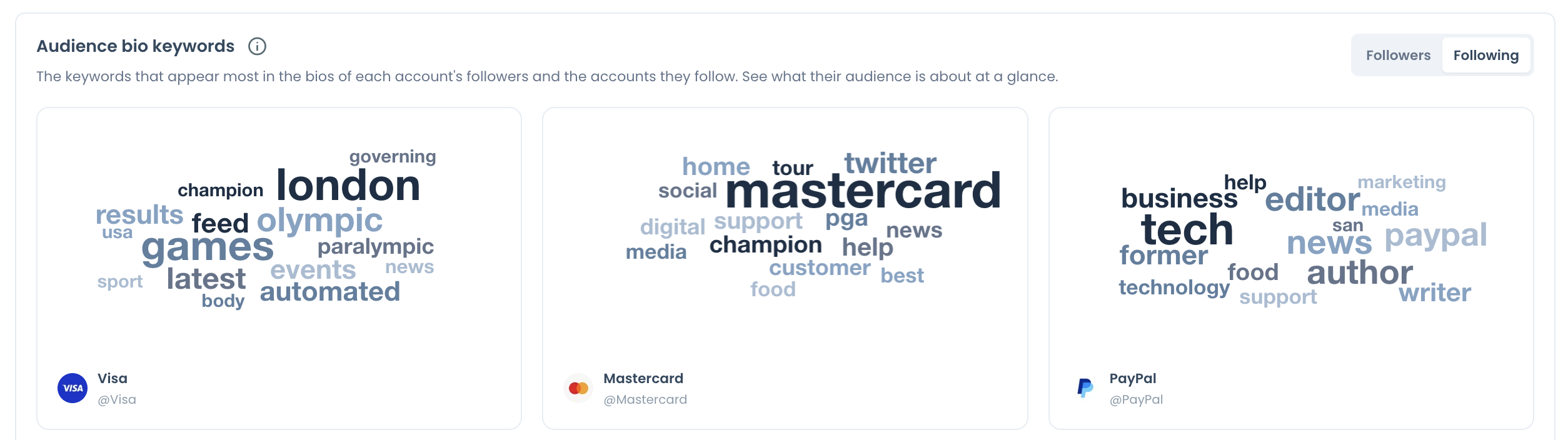
What the keyword clouds of a following list reveal
Read those two clouds as strategy. A following list dominated by media and editorial bios indicates investment in press relationships. A list dominated by event and property accounts indicates a sponsorship portfolio. No engagement metric contains either fact.
The reading comes with a warning: following-side percentages must never be reported as audience data.
They describe the accounts a brand follows. They say nothing about the people who follow the brand, and mixing the two in one slide is an easy way to misread this report.
Check the following side against the follower side
The cross-check is the follower side of the same account. In the sample, followers were 75% to 81% English by profile language, while the accounts those brands followed were 96% to 98% English. The two sides usually differ sharply, and that contrast is the evidence that one is an audience and the other is a selection.
The toggle changes the audience block only. Posting, engagement and reach sections describe the account's own posts and stay identical in both views.
Outside a benchmark, the same two-sided read works for any public account. A separate Circleboom post covers how to analyze somebody's followers and following on Twitter.
For the plain account-by-account list of whom a rival follows, use the Twitter Following List Viewer.
What competitor follower numbers leave out on X
A competitor follower analysis describes a list at one moment. Four things sit outside its audience panels, and knowing them prevents the usual overclaims.
Shared followers have a panel of their own, two accounts at a time
The audience panels compute no overlap between accounts. Two audiences can look alike in every one of them and still be different people. Counting the accounts two profiles have in common is the job of the report's Common Audience panel.
Pick any two of the compared accounts there and it shows how many followers and how many followings they share, with view common followers and view common followings links. It never returns one figure across the whole set. For the method behind it, one post explains how to find the intersection of followers between two Twitter accounts.
Shown in practice: two usernames in, the common followers out, for a pair that is not in a benchmark report.
The tool in that clip is Circleboom's Twitter account comparison, which returns the shared accounts as a filterable list. Use it when the two accounts are not in a report together.
New followers are not in a single run
One run is a snapshot, so it cannot show who followed a rival last week. Watching arrivals is a tracking task, and Circleboom covers it separately in how to check someone's new followers on X.
Attention and intent are not in any panel
No panel records whether a follower saw a post, and no panel records what a follower wants to buy. Activity shares measure posting. Bio keywords measure self-description. Treat both as reasons to look closer.
A follow ratio is not in the report
The report contains no follower-to-following ratio metric. If a write-up quotes one from this report, the figure came from somewhere else.
When a competitor follower analysis on X settles an argument
Three situations justify the run, and each has a pattern to look for in the output.
A rival's follower count is quoted as a verdict. Someone says the competitor has three times your audience. Look for a wide spread in bot and inactive shares across accounts of similar size. If the spread is narrow, the follower gap is real and the discussion moves to content.
An account is about to be paid for or sponsored. Money is moving against a follower number. Look for a large audience with a small High tier, or an audience concentrated in a market the campaign does not sell into.
A new market or language is on the table. Look for a competitor whose country or language mix does not match its home market. That usually means the competitor built something there on purpose.
I use these three as a filter before spending tokens. If none applies, the follower count on the profile is probably all the team needs this month.
Action checklist for reading a competitor's Twitter followers
Use this order the next time a rival's follower count is quoted at you:
- Pick up to 5 public accounts of comparable scale, each under 3,000,000 followers.
- Read the quality panels once, to confirm the list is worth describing.
- Read geography, language and bio keywords, and write down what each one cannot prove.
- Convert every share you plan to act on into a count.
- Flip to Following last, and label everything from that view as the rival's choices.
The numbers are strong evidence about composition. They stay strong when you stop them there.
→ Begin a competitor follower analysis on X
Questions about reading a competitor's X followers
Is it safe to follow a competitor's followers in bulk, and how many per day?
It is safe when the selection is filtered and the pace is gradual. Follow actions in Circleboom run at a pace of 50 every 15 minutes under a daily safety limit of 400, and whatever is left in the queue carries on automatically the next day. You select the accounts and confirm the batch yourself.
Can I download my competitor's followers as a spreadsheet?
Yes. With Circleboom, you can download the follower list of any public X account as a CSV, with one row per follower and columns for profile data, quality flags and bio. The benchmark report also has a page on exporting a competitor report's followers.