
Skip the backup and the cost stays invisible until the day it isn't. The bookmark row sits in your list exactly where you left it, the preview goes blank, and the post you saved for a reason is gone with no record of what it said. X sends no warning when that happens.
What a bookmark backup actually buys you.A local CSV of every saved post, carrying the author, the full text, the link, and the engagement counts as they stood at capture time.A record that survives the original post being deleted, the account going private, or the account being suspended.A file you can sort by date, filter by author, and rank by engagement, none of which the bookmarks tab on X offers.
Circleboom reads your saved posts through the official X API and writes them into a spreadsheet you keep on your own disk. Start where the tool lives: backup Twitter bookmarks.
Why a Twitter bookmark is a pointer, not a copy
A bookmark on X stores a reference to a post, never the post itself. The row in your saved list is a lookup instruction: fetch this post ID, render whatever comes back. When the thing on the other end stops resolving, the instruction still runs, and it returns nothing.
That is the asymmetry nobody mentions when they tell you to bookmark more. You feel like you are collecting. You are actually collecting addresses.
Circleboom closes the gap by turning those addresses into content you own. The sane time to save a copy of your X bookmarks is while every one of them still resolves.
The habit that creates the exposure is the one everyone has. You see something useful mid-scroll, you tap the bookmark icon, and you move on with the quiet assumption that the thing is now yours. It never was. You filed a shortcut.
The volume makes it worse. Most people save steadily for years without ever pruning, and the saved list quietly becomes the largest untended pile of research they own. If you have never checked how far yours has grown, the Twitter bookmarks limit is a useful reality check before you start.
Everything you can do to that pile inside Circleboom, including the export, lives in one place: the Twitter Bookmarks Manager.
What happens to your bookmarks when a post gets deleted on X?
The bookmark stays in your list and the content behind it goes away. There is no notification, no tombstone, no "this post is no longer available" archive of what the text used to be. The row keeps its slot and stops carrying anything.
Four separate events produce that same blank result:
- The author deletes the post.
- The author switches the account to protected, so the post exists but you can no longer read it.
- X suspends or the owner deactivates the account, which takes every post with it.
- The post is removed under X's rules, leaving the reference pointing at nothing.
Only the first of those is under anyone's control, and it is not yours. The other three happen entirely outside your view.
Why the loss stays invisible
The decay is cumulative, which is what makes it easy to miss.
Take a purely illustrative case: a list of 600 bookmarks saved over three years, drawn from a few hundred different accounts. If even a small share of those accounts go quiet, go private, or go away, the dead rows in your list number in the dozens, and every one of them looks identical to a working row until you click it.
You never get a running total of that loss. The counter at the top of the bookmarks tab keeps reporting how many references you hold, not how many of them still lead anywhere.
X's own help page confirms the design intent behind the feature. Bookmarks is described there as a private timeline for saving posts for quick access. That is a reading convenience, not a preservation promise, and treating it as an archive is a reader assumption rather than a platform commitment.
There is also no undo path once a bookmark's target is gone. People who go looking end up at the same conclusion as our write-up on whether you can recover deleted bookmarks on Twitter. Recovery is not the mechanism. Capture ahead of time is.
How to backup Twitter bookmarks with Circleboom
To back up your saved posts, connect your X account to Circleboom, open the bookmarks view, refresh the data, narrow the selection with filters if you want a subset, then run the export and confirm the CSV. The whole sequence runs through six actions grouped into three phases, and the file lands on your machine at the end of it.
Connect your X account and open the saved posts view
- Log in to Circleboom Twitter and authorize your X account.

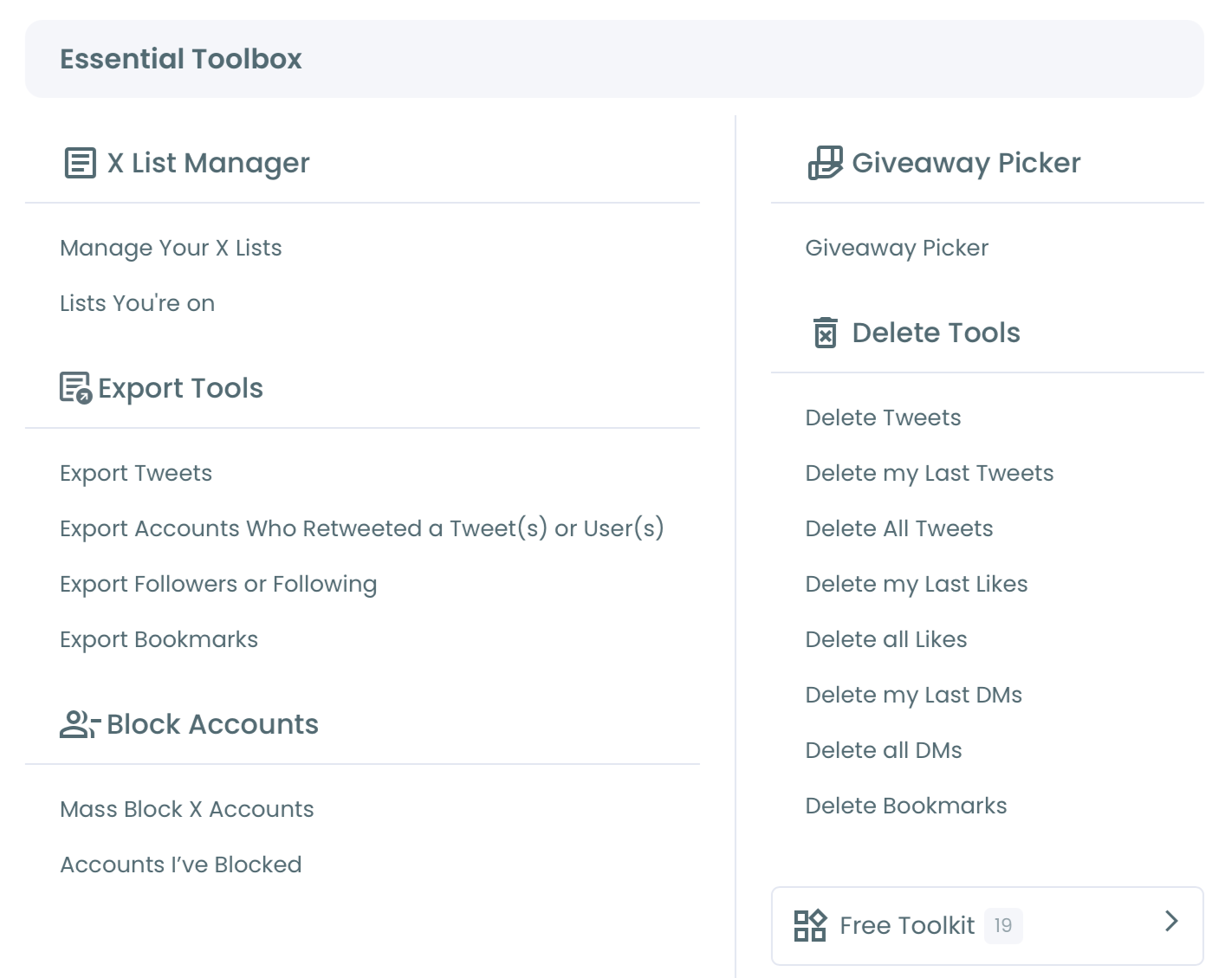
- Open our Essential Toolbox menu and go to the Export Tools group, where the bookmark view sits.
Refresh the list before you trust it
- Read the header count at the top of the page, which reports how many bookmarks Circleboom currently holds for your account.
- Click "Sync My X Data for fresh insights" so the table reflects your current saved list rather than the state at your last visit.
Narrow the selection, then run the export
- Open Filter Options if you want a subset. Every bookmark arrives pre-selected, and the panel lets you cut by post type, date range, language, keyword, username, hashtag, media presence, and minimum or maximum counts for retweets, likes, replies, quotes, bookmarks, and impressions.
- Click Export and confirm. The button shows your remaining token balance before the run, tokens are consumed when you confirm, and the CSV is generated.
That order is deliberate. Sync comes before filter because filtering a stale table hides bookmarks you added since your last session. Filter comes before export because the export is token-based, so every row you did not need is capacity you spent for nothing.
Reading the token balance on the button before you confirm is the last cheap check in the sequence.
The sequence in one line: connect, sync, filter, export, confirm the file.
On-screen proof: the bookmark export running end to end, from the sync click to the downloaded file of saved posts.
https://www.youtube.com/watch?v=qoKeTxLTbGY
What the export preserves, and what it leaves behind
The CSV is a text and metadata record, not a media archive. That distinction is the single most useful thing to understand before you run one, and almost nobody states it plainly.
Each row carries the author's display name, username, and location, the full text of the saved post, a link back to the original, the creation date and time, and six engagement counts: impressions, likes, retweets, quotes, bookmarks, and replies.
Where the media and thread boundary sits
What the row does not carry is the picture, the video, the GIF, or the linked page. Those stay on X and on the wider web.
If the post you saved was mostly an image, the CSV preserves the caption and the address while the visual keeps living on someone else's server. Our walkthrough on how to download all media from Twitter bookmarks covers the second half of that job.
Thread context is the other boundary. A bookmark points at one post, so a saved reply arrives in the file as one row without the posts above and below it. When you review the CSV later, the link column is what walks you back to the surrounding conversation, assuming it still exists.
I still run the export first and chase media second, because text is the part that vanishes without a trace. A deleted image at least leaves you a filename and a memory. A deleted post leaves nothing at all. Running a backup Twitter bookmarks pass early is how you hold the words.
Why the source of the data decides the quality of the backup
Accuracy here comes from where the list is read. Circleboom is named in X's Enterprise customer directory, so it retrieves your saved posts on X through the same permissioned bookmark access the platform grants its own developers.
The difference shows up as completeness. A scraper reads whatever it managed to scroll past before it stalled, timed out, or hit a rendering change. A backup that silently drops rows is worse than no backup at all, because you stop checking.
The same export logic applies well beyond saved posts. If you are archiving your own account rather than other people's, Export Tweets produces the equivalent file for the posts you wrote.
Back up first, then decide what to clear on X
The backup is also the thing that makes a bookmark cleanup safe to attempt. A saved list that has run for years stops working as a reference long before anyone admits it, because finding one specific post means scrolling past hundreds you have forgotten.
Clearing it is the obvious fix and the scary one, since deletion has no undo. That fear is exactly what the CSV removes.
Once the file is on disk, the in-app list becomes disposable. You can empty it, restart with a deliberate saving habit, and still hold everything you ever kept in a format that searches faster than the app ever did.
The order is the whole trick: export, verify the file opens, then clear. Our step-by-step on how to delete bookmarks on X covers the second half of that cycle.
Running the pair on a rhythm turns bookmarks back into what they were meant to be. The saved list works as an inbox for the current month, and the growing pile of exports works as the archive.
There is a second benefit that only shows up on the second run.
Because each CSV carries the engagement counts as they stood at capture time, two exports taken months apart give you a before and after on the same posts. That is not something the bookmarks tab can show you, and it costs nothing extra to keep.
The bottom line
A bookmark is an address, an export is a copy, and the gap between the two is where saved research quietly dies.
Nothing about the X bookmarks tab tells you when a post behind one of your rows stops existing, so the only reliable moment to capture the content is while everything still resolves.
One run gives you a searchable CSV with the author, the text, the link, the date, and the engagement counts for every post you kept.
Run it before a cleanup, before a research phase closes, and any time the list has grown past the point where you could name what is in it. For a fuller picture of what a saved-post archive is good for once you have one, our piece on how to extract Twitter bookmarks picks up where this leaves off.
→ export your bookmarked posts
Bookmark backup questions worth answering
Does exporting my bookmarks remove them from X?
No. Export and delete are separate actions on the same page, and running the export leaves your saved list exactly as it was. You choose separately whether to clear anything afterward.
What file format do I get?
A CSV, which opens in Excel, Google Sheets, Numbers, or any data tool that reads a spreadsheet. One row per saved post, one column per field, so keyword search and sorting work immediately without any cleanup step.
If a bookmarked post gets deleted after I export, do I still have it?
Yes, in the sense that matters. The CSV holds the text, the author, the date, and the engagement counts as they stood when you ran the export, so the content survives even though the link goes dead.
How often should I run the backup?
Once is better than never, and a repeat run after any heavy saving period is better still. The export captures the list at retrieval time, so anything you bookmark afterward is not in that file. In my own habit, I re-run it whenever a research push wraps up rather than on a calendar.