
Run your username through Circleboom's free Shadowban Test to check if you are shadowbanned on Twitter: the result is five separate restriction verdicts instead of one vague guess. It takes one search, and you never log in.
What one search tells you.Whether your account still appears in search suggestions and search results, or has gone dark in one or both.Whether your replies are locked out of conversations entirely or tucked behind a "Show more" barrier.Whether a weak early-engagement seed is quietly capping how far the algorithm carries every post.
Circleboom evaluates any public X account against five named shadowban restrictions and returns a verdict for each one through official X API access. Find out where you stand: check if you are shadowbanned on Twitter, free and without logging in.
What a Twitter Shadowban Looks Like in Practice
A shadowban rarely announces itself. Your account works, posts publish, notifications arrive, and still the numbers sag: impressions sink, replies stop landing, and people who type your handle into search swear you no longer exist.
Native X analytics will confirm the drop without explaining it. Fewer impressions could mean tired content, bad timing, a quieter audience, or an account-level restriction, and the dashboard treats all four the same way.
X never uses the word shadowban, but it openly limits distribution without removing content. The platform's own list of specific cases where a post's reach may be limited is as close as it gets to defining one.
A sagging graph alone proves nothing, though. Platform-wide shifts produce the same picture. On that front, has Twitter reduced organic reach for small to mid accounts is a fair question with separate evidence.
That ambiguity is why testing beats theorizing. Before you rewrite a single hook, see if your Twitter account is shadowbanned and let the verdict tell you which problem you are solving.
Which of the Five Shadowban Types Is Hitting You?
"Shadowbanned" is five different problems wearing one name, so Circleboom's Shadowban Test grades an X account against five distinct restriction types and scores each one separately. A summary banner sits on top; the five individual results sit under it, each expandable into a plain-language explanation of what that restriction does.
The separation is the useful part. A filtered reply needs a different fix than a search blackout, and a binary yes-or-no answer hides that difference completely. For the manual warning signs, how can you determine if your tweets are being hidden from others covers each one.
The verdicts come from approved access, not guesswork. Circleboom is listed on X's Enterprise customer directory, so the test reads account visibility through sanctioned API calls instead of the scraping tricks that break whenever X changes its markup.
Run a Twitter shadowban check on your handle now, then find your failing check below. Each section maps the symptom you are seeing to what the restriction limits, what tends to trigger it, and the move that answers it.
Search Suggestion Shadow: new people cannot find you
The symptom: your followers interact normally, but anyone who does not already follow you says your handle never comes up in search suggestions or "People" results. The account stays reachable for existing connections and invisible to the broader public.
The cost is growth, specifically. Every post keeps landing with the audience you already have and stops reaching the audience you wanted next. Circleboom's explanation calls it a visibility ceiling, and that is the right image.
The move: measure your recent activity against X's published search rules and restrictions, cut anything that could read as spam behavior, and retest until the check clears.
Total Search Blackout: your posts vanish from search entirely
The symptom: hashtags stop pulling traffic, and even an exact phrase from one of your own tweets returns nothing, no matter which filter settings the searcher uses.
This is the heaviest search restriction in the set. It removes the account's tweets and hashtags from search results altogether, which closes nearly every road a stranger could take to your content.
Because a blackout is often tied to account health rather than a single post, treat it as an account problem. Circleboom's Tweepcred calculator shows where your reputation score stands, a sensible first reading before you start repairs.
Reply Lock: your replies post, but nobody else sees them
The symptom is the cruelest one, because everything looks normal from your side. Replies appear published and threads look intact, yet other users see none of it, which mutes your voice in every public conversation.
Sudden activity spikes and automated-looking behavior are the usual triggers, and X typically applies this lock as a temporary measure while it evaluates whether the account is authentic.
Slow down first: pause the posting bursts or rapid-fire engagement that likely tripped the flag. If your account also carries a temporary marker, Circleboom's remove Twitter temporary label page covers clearing that flag too.
Reply Visibility Filter: your replies hide behind "Show more"
The symptom: your replies still exist, but they sit collapsed under the "Show more" barrier at the bottom of conversations, where almost nobody clicks. Followers see your posts normally; strangers reading the thread miss you.
X applies this filter when it flags recent activity as potentially disruptive or low-value. It is selective rather than total, which makes it easy to miss for weeks.
Audit your reply habits for anything that repeats at scale: identical responses, link-heavy replies, high-volume bursts. For the reader-side view of collapsed conversations, why Twitter doesn't show all replies and how to see them shows what everyone else experiences.
Early Engagement Seed: your first viewers set your ceiling
This one is not a penalty at all, which is why it surprises people. When you post, X shows the tweet to a small seed group of your followers first; if they engage, distribution widens, and if they scroll past, it stalls.
Inactive followers poison that math. They occupy seats in the seed group, engage with nothing, and hold your seed strength low on every single post you publish.
A cluttered follower base can cap your reach even when no restriction is active. Treat a flagged seed check as an audience-hygiene job: prune the dead weight so your first viewers are accounts that still engage.
How to Check If You Are Shadowbanned on Twitter, Step by Step
To check if you are shadowbanned on Twitter, open Circleboom's Shadowban Test, enter a username, and read the summary verdict plus the five individual check results it returns. The public tool runs without an account, and the six steps below split into two short phases: running the test, then acting on the result.
Run the test on any public username
- Open the Shadowban Test page. No login, no password, no account connection: the public tool takes any public X username as it is.
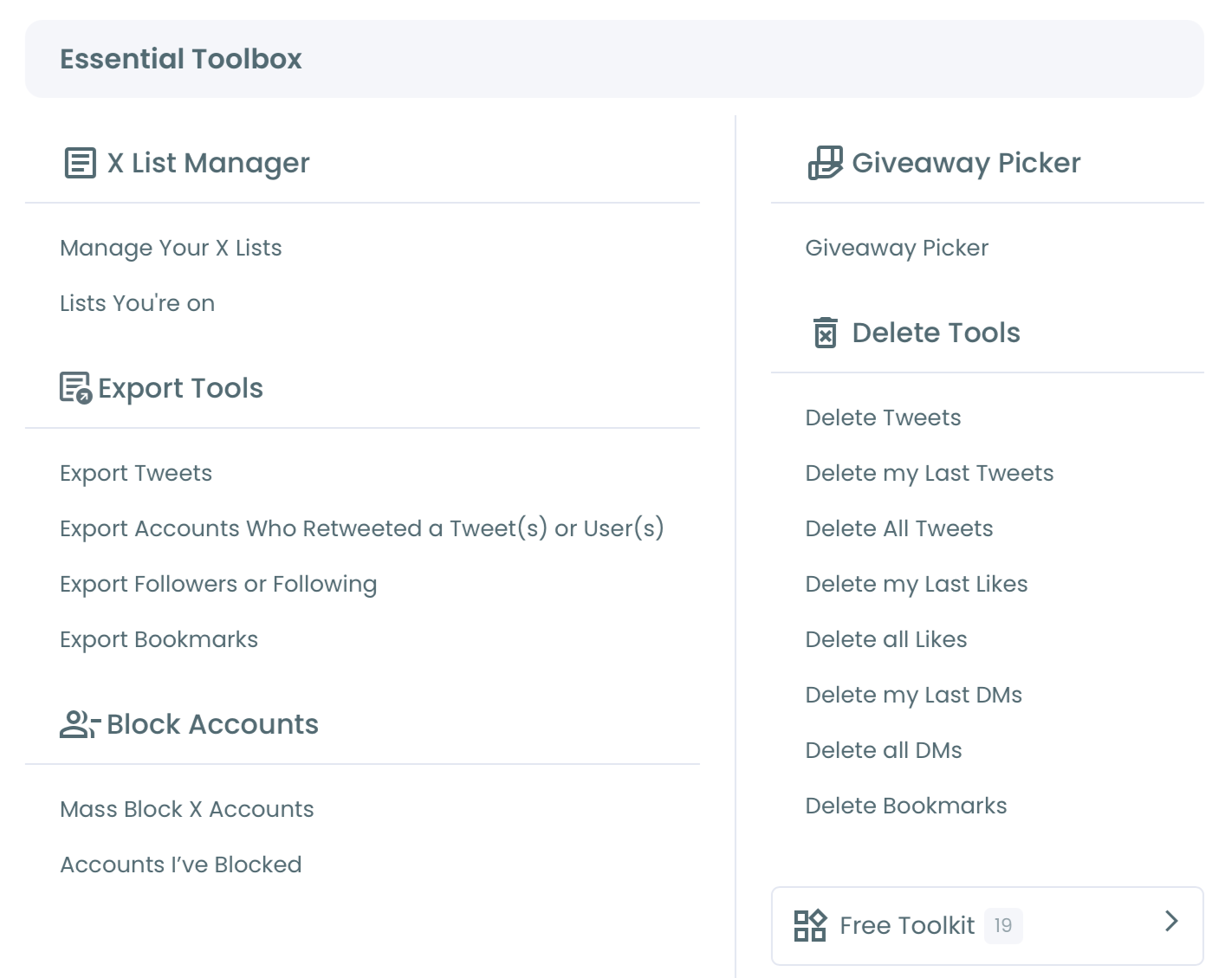
- Find the same tool inside your dashboard if you already use Circleboom, since logged-in users reach the Shadowban Test through the Essential Toolbox menu.
- Type the username into the input field and click Search. The @ prefix is already provided, and handles take letters, numbers, and underscores.
Read the verdict and act on the failing check
- Read the summary banner first. A clean account returns "Fantastic! The account has no shadow bans in any country." If issues were detected, the banner names which restriction types were found.
- Scan the five individual results below the banner. Each check carries its own pass-or-issue status, so one flagged line never taints the other four.
- Expand whichever check flagged and match it to its section above. The expansion explains what the restriction limits, and the matching section gives you the move that answers it.
That order is the discipline: the summary stops you from panicking over nothing, and the per-check results stop you from fixing the wrong layer. Reading top-down turns a scary word into a short to-do list.
At a glance: open the test, enter the username, hit Search, read the summary, expand whatever failed.
The result screen rewards a slower second pass, and the Twitter shadowban test guide walks through the tool in more depth if you want it.
See the test live: one username goes in, the summary banner lands on top, and five separate restriction verdicts line up under it.
https://www.youtube.com/watch?v=_nixCbnNl5U
What a Clean Result Tells You
A clean sweep across all five checks is information, not an anticlimax. It rules out account-level restrictions, so a falling reach graph now points at content, timing, or audience quality instead of a hidden penalty.
The pairing I run into most often is a clean test next to a slowly bleeding impressions graph. In that case, the boring suspects deserve the attention the shadowban theory was stealing: posting windows, content mix, and follower quality.
Retest regularly instead of once. A baseline of clean results makes the day a verdict flips unmissable, and repeat runs cost nothing on a free tool.
The moments worth an immediate rerun:
- A drop in impressions, replies, likes, or profile visits that repeats across several posts.
- Reports from other users that your posts no longer appear in search.
- Any plan to overhaul your content strategy in response to a decline.
- A recent stretch of fast growth, high-volume posting, or automation experiments.
Name the Restriction, Then Fix It
One free search replaces the guessing: five named restrictions, five verdicts, and a specific next move for whichever one flags. That beats a week of asking mutuals whether they can still see you.
When a check does fail, pair the verdict with how to get rid of shadowban on Twitter and work the recovery from the right end.
Diagnosis first, repair second, retest last. The account that knows which restriction it carries can fix the right thing; the account that only suspects one fixes everything and learns nothing.
→ Check your shadowban status on Twitter
What to Know Before You Start
Can I run the shadowban test on someone else's Twitter account?
Yes. The tool checks any public X username, so you can test a client's account, a competitor's, or a friend who swears they have gone invisible. Nothing connects your identity to the search, and the account owner is never notified.
How long does a Twitter shadowban last?
Most restrictions are temporary. Reply Lock in particular is typically a short-term measure X uses while it evaluates account authenticity, and restrictions tend to lift once the behavior that triggered them stops. Retest regularly and treat your first clean result as the recovery marker.
Is it safe to check if you are shadowbanned with a third-party tool?
Yes, with this one, because there is nothing to hand over. Circleboom's public Shadowban Test asks for a Twitter username only, with no login and no password, and its checks run through official X API access rather than scraping, so the test never touches your account standing.
What should I do first if more than one check fails?
I start with the search checks, because they cap discovery for every post you publish, while the reply filters only limit conversations. Repair account health first, then behavior patterns, then audience quality, and rerun the test after each change so you can see which fix moved the verdict.