
Conventional wisdom says your following list is harmless. Follow whoever you like, the thinking goes, since it only affects you. That is exactly backwards. Who you follow is one of the most consequential settings on your account, because it programs your feed and signals your judgment, and almost no one ever audits it.
Ignore it: a bloated list of dead and bot accounts quietly degrades your feed. Check it: Circleboom scores your following on X by quality, so you prune what is dragging you down.
→ Twitter following list quality check
The list you never review is the one shaping everything you see.
Your Following List Is a Setting, Not a Souvenir
Most people treat their following list like a scrapbook: things they added over the years and never revisit. The platform treats it as a live control panel. Every account in it is an instruction about what to put in your feed.
That reframing changes the stakes. A souvenir can be cluttered without consequence. A control panel full of broken switches actively produces a worse result. X builds your timeline largely from who and what you follow, as its timeline recommendation guidance describes, so a list full of dead accounts is a panel wired to noise.
The fix is to stop treating the list as a record of the past and start treating it as a tool you tune. A quality check is the first turn of the dial.
The Hidden Cost of "Harmless" Follows
Every dead or bot account you follow has three quiet costs. It pollutes your feed with nothing, it wastes one of your finite follow slots, and it makes your account look less discerning to anyone who checks who you follow.
None of these costs announce themselves, which is why the list rots unnoticed. You do not get an alert when an account you followed goes inactive or turns into a spam bot. It just sits there, counted in your following number, contributing nothing and dragging quietly. Multiply that by a few hundred accumulated over years, and a meaningful slice of your following is dead weight you are still carrying.
A quality check makes those hidden costs visible. Once you can see the share that is fake or inactive, "harmless" stops being a credible description.
What the Quality Check Actually Scores
Circleboom sorts your following across four signals, and each maps to a decision rather than a vibe. Human versus fake flags bots and spam. Active versus inactive flags the accounts that went dark.
Ordinary versus overactive flags machine-speed posters, and ordinary versus verified shows your badge share. The point of four signals instead of one is precision: a single "good or bad" verdict would hide the nuance, while the breakdown tells you exactly which kind of problem you have. An inactive-heavy list needs different pruning than a bot-heavy one.
How to Run a Following List Quality Check
Turning the idea into a result takes four steps. The flow runs from login to a readable breakdown.
- Log in to Circleboom Twitter and connect your X account with secure OAuth.

- Open the Follower and Following menu and open the following characteristics view.
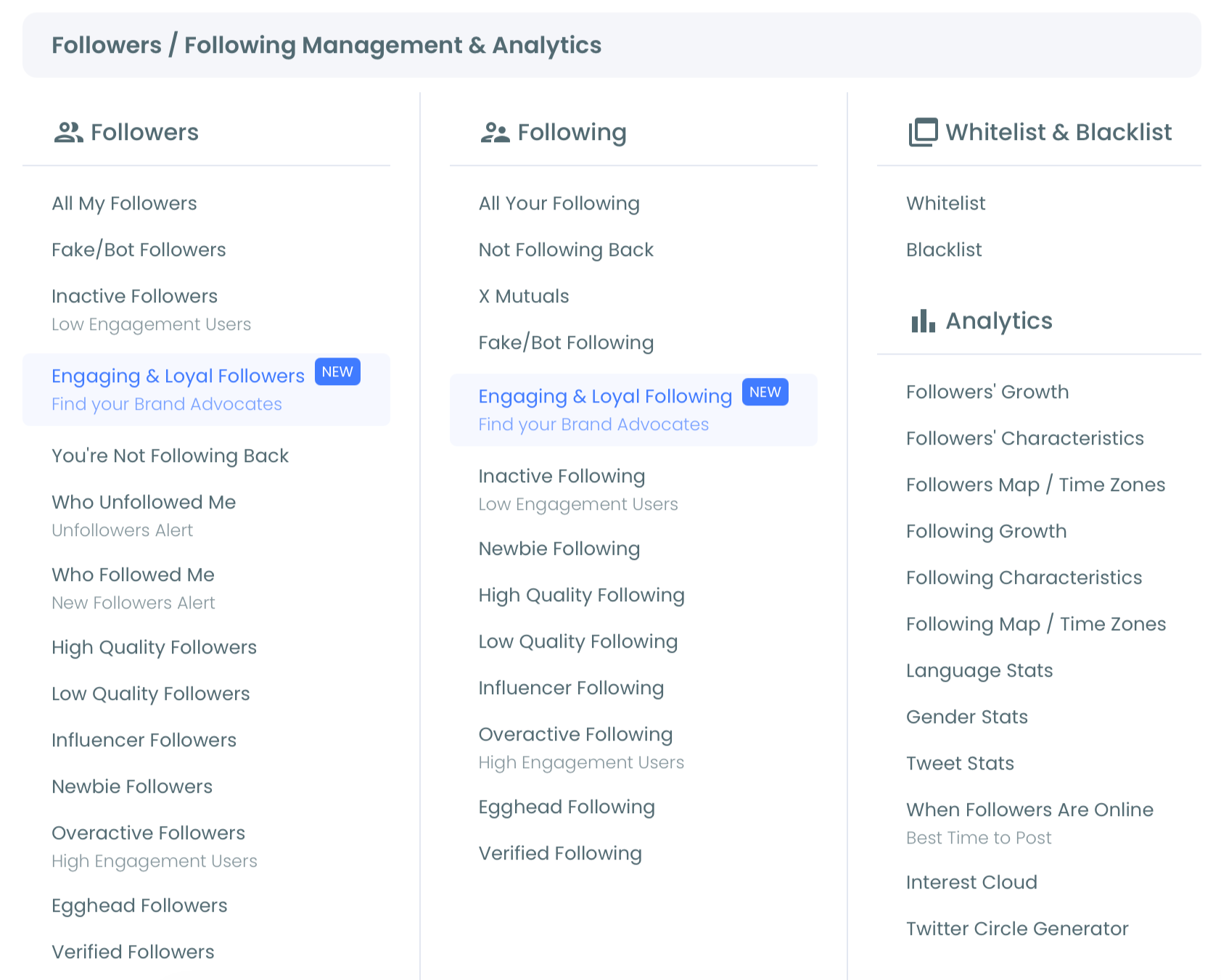
- Read the percentage breakdown of human, fake, active, inactive, and overactive accounts.
- Move into the cleanup tools to unfollow the dead weight the check surfaced.
The breakdown is the part most people skip straight past on their way to unfollowing. Do not. Reading it first tells you whether you have a bot problem, an inactivity problem, or no real problem at all.
Watch how to list your high and low quality accounts:
Read-Only, So There Is No Risk in Looking
One reason people avoid auditing their following is fear of breaking something. That fear does not apply here. Circleboom is an official X Enterprise Developer company, and the quality check is purely read-only, so running it changes nothing on your account.
Looking costs you nothing and tells you everything. Any cleanup that follows is a separate, deliberate choice, and even then Circleboom processes unfollows gradually within X's limits. There is simply no downside to seeing the truth about your own following list.
Why This Is the Audit People Skip
There is a reason the following list goes unchecked while everyone frets over followers. The follower side has drama: bot waves, sudden drops, the visible anxiety of a number you do not control. The following side has none of that. It is quiet, it is yours, and quiet problems are the easiest to ignore.
That asymmetry is precisely why the following audit pays off. Because so few people do it, the dead weight accumulates unchallenged for years, which means the first real check almost always surfaces a surprising amount to fix. The neglect compounds into a big, easy win the moment you finally look.
There is also a comfort factor. Auditing who you follow can feel like admitting you made bad calls, that you followed accounts that turned out to be junk. But a follow from three years ago is not a verdict on your judgment; it is just data that went stale. Reframing the audit as maintenance rather than self-criticism is what gets people to actually run it.
The accounts you follow are the one input to your feed that you fully control. Leaving that input unexamined while complaining about the output is the strangest habit on the platform, and it is the one this check is designed to break.
What to Do With Your Result
Your next move depends on what the breakdown shows:
- If inactive accounts dominate, prune the dead profiles first; they are the easiest, safest wins.
- If fake and bot accounts dominate, treat it as a hygiene problem and clear them with the quality tools.
- If the list is mostly healthy, do nothing but note your baseline and re-check in a few months.
Whichever branch you land on, the principle holds: a following list is a setting you tune, not a souvenir you hoard. The deeper context in the best way to analyze your followers and tools that analyze both followers and following helps you read the result. To rebuild the good side, who to follow on Twitter and a deeper follower analysis point you toward better accounts, while clearing inactive accounts you follow handles the dead weight. If you would rather keep the list private while you work, hiding who you follow covers that too.
→ Score your following list now
Common Questions About Following Quality
Does who I follow really affect anything besides my feed?
Yes. Beyond shaping your timeline, your following list is a visible signal of judgment, and it counts against your 5,000-follow ceiling. A list full of bots reads as indiscriminate and wastes slots you could use on accounts worth following.
Is a high following count a bad thing?
Not by itself. The count matters far less than the composition. Ten thousand carefully chosen, active accounts are fine; a thousand that are mostly dead or fake are a problem. The quality check looks at composition, which is the number that actually matters.
Can I just unfollow everyone and start over?
You could, but that throws away the good accounts with the bad. A quality check lets you keep the healthy majority and remove only the dead weight, which is faster and far less disruptive than rebuilding a following list from scratch.
Will checking my following quality flag my account?
No. The check is read-only and runs through sanctioned access, so it never touches your account state. Even the optional cleanup afterward stays within X's rate limits, keeping everything compliant and safe. There is genuinely no scenario where looking at your own following composition puts your account at risk, which is what makes skipping the audit so hard to justify.