
Most following lists were never built deliberately. They accumulated, a follow-back here, a research phase there, a follow-for-follow campaign from years ago, an account followed for a reason nobody remembers anymore. Nobody audits the list because X gives you nothing to audit it with, just an endless scroll with no summary of what the list is actually made of.
That accumulated, undifferentiated mass is not unauditable. It is a dataset, and a dataset has a composition that can be measured before you decide what to fix.
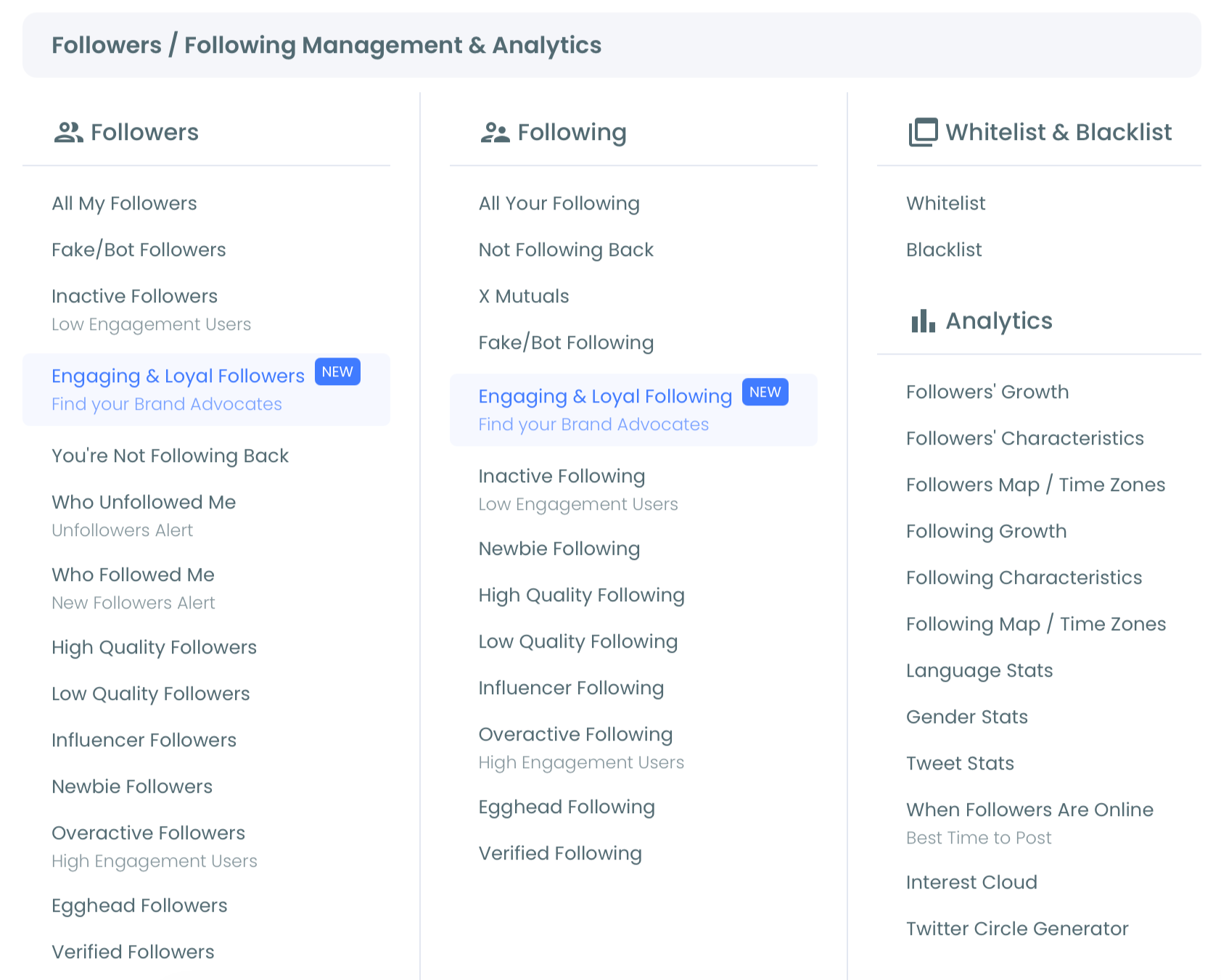
Circleboom's Following Characteristics gives you a composition breakdown of your following list across quality and behavioral dimensions, and All My Following gives you the full filterable dataset to actually act on whatever that breakdown reveals.
→ audit your Twitter following list
Why following lists drift without anyone noticing
X shows you a following list and nothing else. No composition summary, no quality breakdown, no indicator of which accounts are still active and which have gone quiet years ago. Viewing who you actually follow on the native interface means scrolling through the raw list with no analytical layer on top of it at all.
The decisions that built the list rarely survive the reasons behind them. An account followed for a research project that ended two years ago is still in the feed. An account followed back as a courtesy is still in the feed. An account followed during a follow-for-follow phase is still in the feed. None of these decisions get revisited because nothing ever prompts a review.
The compounding cost is a feed and a public network identity shaped by accumulated decisions rather than current intent. The following list is publicly visible, and it determines a meaningful share of what content actually reaches you. Left unaudited, both of those keep drifting further from what would actually serve you today.
What an audit actually reveals
An audit is not a vague impression of "too many accounts." Following Characteristics breaks the list down across four independent dimensions, and each one points to a different kind of problem.
- Human versus Fake/Spam. This shows how much of your following list consists of accounts showing bot-like or spam signals rather than genuine human activity.
- Active versus Inactive. A high inactive proportion means a meaningful share of your following list has gone quiet, contributing nothing to your feed despite still occupying a following slot.
- Ordinary versus Overactive. A large overactive segment means some followed accounts are flooding your feed with posting volume disproportionate to their actual relevance.
- Ordinary versus Verified. This shows how much of your network carries X's verification status, a rough signal of network composition rather than a quality judgment on its own.
These four numbers point to different next steps. If inactive accounts dominate, the fix is Inactive Following. If fake or spam signals dominate, the fix is Fake/Bot Following. The breakdown tells you which cleanup to run first instead of guessing.
How to audit your Twitter following list
Because Circleboom is an official X Enterprise Developer, every account retrieved and classified during the audit runs through sanctioned API access, so the review itself never puts your account at risk.
1. Run Following Characteristics for the diagnosis: Open Following Characteristics. Circleboom retrieves your full following list and classifies every account across the four dimensions, presenting the result as a single "Following in a nutshell" dashboard with percentage breakdowns for each category.
2. Identify which segment is the biggest problem: Read the percentages. A dominant inactive proportion, a high fake/spam share, or a heavy overactive segment each points toward a different dedicated cleanup feature as the most efficient next step, rather than starting with a feature that addresses a smaller part of the issue.
3. Open All My Following and apply filters: Go to All My Following for the complete, unfiltered dataset. Use Filter Options to combine criteria, engagement classification, follow ratio, tweet count, join date, language, location, and bio keywords, to build the exact segment the diagnosis pointed you toward, or a custom combination no single named segment covers.
4. Whitelist what to protect, then act on the rest: Before any bulk action, identify and whitelist partners, customers, and accounts you value regardless of their quality score. Select the remaining filtered accounts and use Unfollow, Add to List, or Export depending on what the audit calls for.
That sequence moves from a high-level read of the whole list to a precise, evidence-based action on exactly the segment that needs it, instead of guessing which accounts to remove or following an inconsistent gut feeling.
What an audit changes
Once the composition is visible, following decisions stop being reactive guesses and start being grounded in an actual baseline. You know whether the dominant issue is inactivity, low quality, or simple following bloat before you touch a single account, which means the cleanup that follows actually targets the real problem instead of the most visible one.
The public-facing side of the network benefits too. Who you follow shapes how others read your judgment when they review your profile, and an audited, intentional following list reads differently than one accumulated without any review. Before a professional introduction or any period of increased visibility, this is a straightforward way to confirm the public network looks the way you want it to.
Running the audit periodically, rather than once, also turns it into a feedback loop. Re-checking Following Characteristics after a cleanup confirms the composition actually improved, and re-running it after any period of rapid following, a campaign, an event, a research sprint, shows exactly how much low-quality accumulation that period produced. The same logic applies on the follower side too, where a quick audit of your real follower base follows the same diagnose-then-act pattern.
X gives you the list, never the diagnosis
X knows exactly who you follow. It has every signal needed to classify those accounts by activity, quality, and behavior. None of that gets surfaced back to you. The following list exists purely as a raw, unannotated scroll, with all the diagnostic potential sitting unused on X's side of the platform.
This is the same gap that shows up everywhere X gives you raw data without an interpretation layer. A list of names is not the same thing as an understanding of what that list represents, and the platform consistently stops at the former without ever providing the latter.
The mistake to avoid
The most common mistake is acting on a single weak signal instead of stacking several together. A low follow ratio alone, or a missing profile photo alone, is weak evidence that an account is worth removing. Multiple weak signals appearing together, inactive engagement combined with a low follow ratio combined with no bio relevance to your niche, build a genuinely strong case. Treat any single filter result as a starting point for review, not a verdict on its own.
The second mistake is running a bulk cleanup before whitelisting the accounts you actually want to keep. Partners, customers, and key contacts may score poorly on generic quality metrics while still mattering enormously by context. Whitelist them before any filtered segment gets touched by Unfollow, so a quality-based cleanup never accidentally removes a relationship that matters for reasons the metrics cannot see.
Common questions
How often should I audit my following list?
A quarterly check is a reasonable baseline for most accounts, with an additional check after any period of rapid following, a campaign, an event, or a research phase where a lot of new accounts were added quickly. Following Characteristics takes seconds to run, so there is little cost to checking more often if your following count moves quickly.
Does running the audit unfollow anything automatically?
No. Following Characteristics is a diagnostic dashboard, not an action. It shows you the composition of your following list; nothing changes until you take a separate action, such as filtering in All My Following and choosing to unfollow, list, or export a specific segment.
Is unfollowing reversible if I change my mind?
No. Once an account is unfollowed through Circleboom, the relationship is removed, and there is no automatic restoration. You can manually re-follow the account afterward, but nothing brings the relationship back automatically. This is exactly why whitelisting valuable accounts before any bulk action matters.
What should I actually unfollow first if I don't know where to start?
Reviewing who is genuinely worth following back versus who to remove starts with whatever segment the Following Characteristics breakdown shows as dominant. If inactive accounts make up the largest share, start there. If fake or spam signals are highest, start with that segment instead of guessing.
Your next move
Your following list has a composition whether you have looked at it or not. Run the diagnosis, see which segment is actually the problem, then go act on exactly that segment with the filters and protections that make the cleanup precise instead of reckless. Diagnose it, filter it, act on it.