
Yes, you can download an entire Twitter profile, with one caveat: no single button dumps a whole account at once. You assemble it from a few structured exports, and Circleboom produces each one as a clean CSV.
Download entire Twitter profile data in two tracks. Manual: X's own archive returns your own account only, and it takes about 24 hours to arrive. Circleboom: download your entire Twitter profile from any public account, pulling the tweets, the follower list, and the following list as separate CSV files through the X Enterprise API.
→ Export any public X profile as CSVs
What downloading an entire Twitter profile really means
"Entire profile" sounds like one file. It is really several datasets that live behind different parts of X.
The posts are one thing. Who follows the account is another.
Who the account follows is a third. Add the people who retweeted a post, plus your own bookmarks, and you have the full picture.
X gives you a partial route through its own account archive, but only for the account you are logged into, and only after a wait. That route does not help when you need a competitor, a client, or an influencer as data.
The word "entire" is where most people set the wrong expectation. No tool hands you every reply, every like, and every direct message of a stranger's account in one download, because X does not expose that data publicly.
What you can assemble is the public profile: the posts the account chose to publish, the audience around it, and the accounts it chose to follow. That is the version of "entire" that is real, and it is usually the version you actually need.
To download an entire X profile for any public account, you pull each dataset on its own and combine them. If you have ever wondered can I download my tweets at all, the tweet export handles that piece, and the account exports handle the rest.
The datasets that add up to a full profile
Three files carry most of the weight, and two more fill in the edges. Together they let you export a full Twitter profile without touching a scraper.
- Tweets: Export Tweets pulls up to the 3,200 most recent public posts as a 15-column CSV.
- Followers: the account export tools return the complete follower list with profile data on every account.
- Following: the same tools return the full following list, so you can see who the account pays attention to.
- Retweeters: a separate export lists the accounts that boosted a given post.
- Bookmarks: for your own account, your saved posts export too.
The mechanics of how to download all tweets from a user are the same for your account and a rival's. Both run on the same public timeline endpoint, so nothing changes when the username does.
The audience side runs through export Twitter accounts, which handles followers and following in one place.
You do not have to take all five files. A content audit might need only the tweets.
A partnership check might need only the following list. The point is that the profile breaks into parts, and you take the parts you need instead of hunting for a single export that X never built.
How to download an entire Twitter profile with Circleboom
Four short exports give you the account as data you own. Here is the order that works.
- Log in to Circleboom Twitter and connect your X account with official OAuth.

- Open the Essential Toolbox menu, where the export tools live.
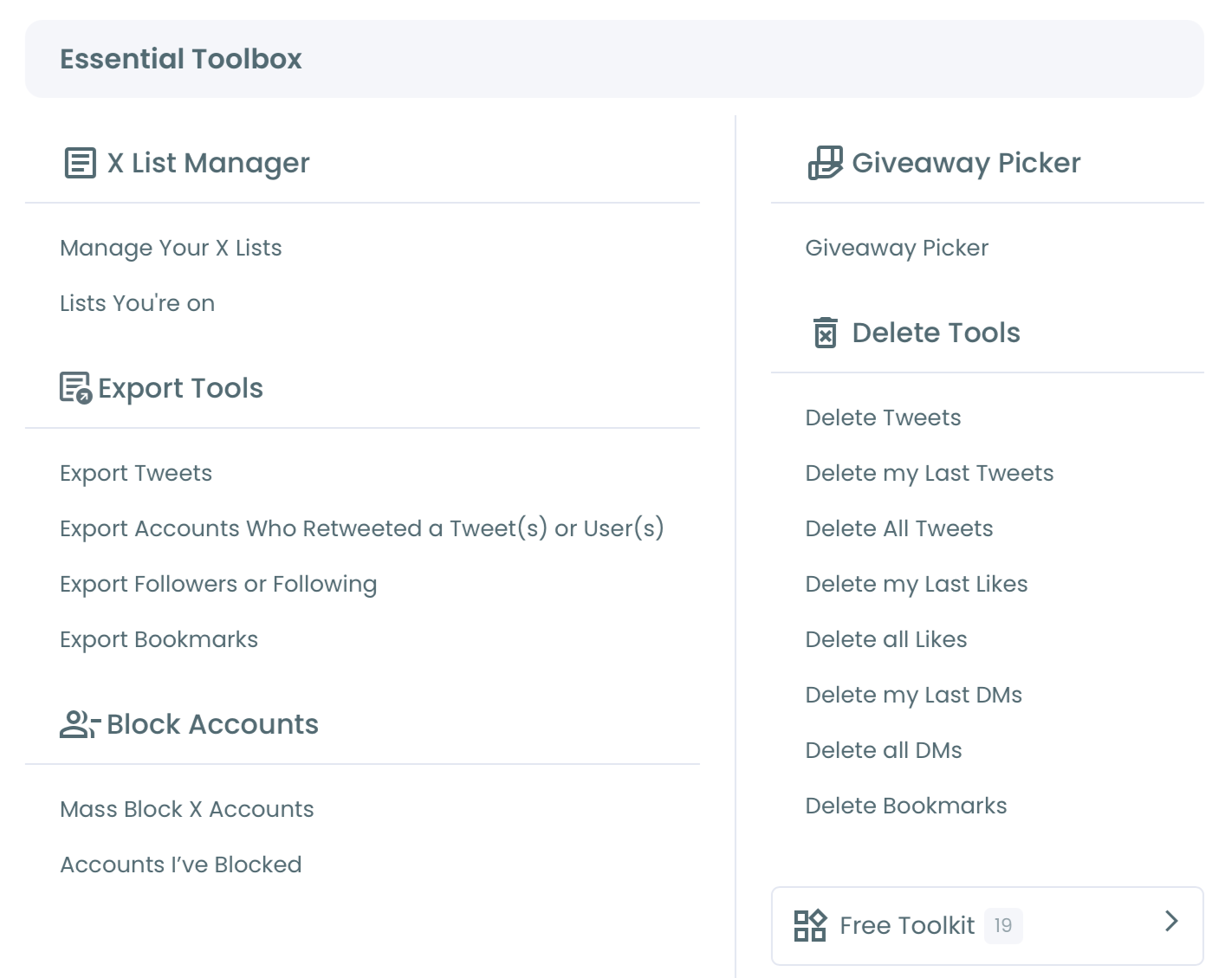
- Run Export Tweets: enter any public username, check the tweet count Circleboom shows, apply filters for date, engagement, post type, language, or keyword, then export the CSV.
- Run the account exports from the same menu, taking the follower list and the following list, then repeat for retweeters if the post-level data matters.
That sequence turns a scattered account into a small stack of files, so you keep the record instead of squinting at screenshots.
Watch a full tweet export run from username to CSV inside Circleboom:
What each CSV file contains
The tweet file carries 15 columns: PostId, Name, Username, ProfileId, CreatedAt, Lang, CountBookmark, CountImpression, CountLike, CountReply, CountRetweet, CountQuote, TweetType, HasMedia, and Text. That is enough to sort a whole history by likes, filter to original posts, or read impression trends over time.
The account files carry a different shape: profile ID, username, display name, location, bio, tweet count, follower and following counts, verification status, and quality flags for fake, inactive, or empty accounts. This is why people searching for Twitter datasets for download often end up building their own from these exports.
Pair the raw file with Twitter account analysis when you want charts instead of columns, and keep the CSV as the source of truth behind them.
Turning the files into answers
A stack of CSVs is not the goal. The answers you pull from them are. Once the files are open in a spreadsheet, the questions X hides become straightforward.
Sort the tweet file by CountImpression and the account's best-reaching posts rise to the top, along with the format and topic behind each. Filter the same file to TweetType of tweet and you strip out retweets and replies, leaving only original content to judge.
Sort by CountLike or CountRetweet and the repeatable hits separate from the one-time spikes.
The account files answer different questions. Filter the follower list on the fake and inactive flags and you learn how much of a follower count is real.
Read the following list and you see whose posts the account watches, which is often a sharper signal of intent than anything the account says out loud. None of this is visible inside X, where the timeline shows content but never lets you sort or filter it.
The export is what makes the profile answerable.
A worked example: profiling a competitor
Say a rival account keeps outgrowing yours and you want to know why. The full-profile export gives you the evidence in three files.
Start with their tweets. Export up to 3,200 posts, sort by impressions, and read the top 20.
You will see the hooks, the posting times, and the formats that carry their reach. Next, export their follower list and filter on the quality flags.
If a large share is fake or inactive, their headline number is softer than it looks. Finally, export their following list and scan who they engage with, because that reveals the network they borrow attention from.
Thirty minutes of exporting and sorting replaces weeks of guessing. The rival's public profile, once locked inside scrolling, becomes a dataset you can measure against your own.
How a licensed export differs from a scraper
Scrapers pull data by imitating a browser, which breaks the moment X changes its layout and risks the account doing the pulling. A licensed export asks X's own systems for the data through an approved channel, so the fields are stable, the format is consistent, and the account stays safe.
That difference matters most when the work has to hold up. A dataset you can defend, sourced through approved access, is one you can put in a client report or a compliance review without a second thought.
A scraped file is one you have to explain. For a one-off curiosity the distinction feels small.
For anything you plan to repeat or share, it is the whole game.
Your own account versus any public account
The split is simple once you see it. X's archive gives you your own account with full history, but you wait about a day and you get a raw, awkward file.
Circleboom gives you any public account, up to 3,200 tweets plus the complete follower and following lists, as a structured CSV you can open right away, with no password from the other account.
Because Circleboom is an official X Enterprise Developer, every row comes from licensed data, so the export stays inside X's rules while you work. For your own deep history past 3,200 posts, X's archive is still the right tool.
For any account, fast, Circleboom is the shorter path.
When a one-click full dump is not possible
A few limits are worth knowing before you start, because they come from X, not from the tool.
- The tweet export caps at the 3,200 most recent posts. Older history is not reachable through this endpoint.
- Protected accounts cannot be exported at all, whatever your follow relationship is.
- Deleted tweets are already gone, so they never appear in a fresh export.
- Impression counts can be partial for some account types, which the CSV reflects honestly.
If your goal is the audience side rather than the posts, the steps to export and save followers on Twitter mirror the tweet flow. You enter a username, review the preview card, and export, with nothing new to learn.
Filters that keep the file usable
A raw export of everything is rarely what you want. Before you run Export Tweets, narrow the set to the segment that matches your question.
Filter by date range to isolate a campaign window. Filter by engagement threshold to keep only posts above a like or retweet count.
Filter by post type to drop retweets and keep original content, or by language and keyword to focus a topic.
The result is a file you can read the moment it lands, rather than one you have to clean for an hour before it means anything.
A scoped export of 400 useful rows beats a raw dump of 3,200.
Filters also keep the account files honest. On the follower and following lists, you can scope by location, by minimum follower count, or by the quality flags, so an outreach list comes out pre-trimmed.
The habit is the same for every file: decide the question first, then export the slice that answers it.
Where the files are delivered and kept
Every export leaves you with two copies. Circleboom emails the CSV to the address on your account, and it also stores the file inside your Circleboom account page.
If the email never lands in your inbox, the account copy is still there to download, so a single export is hard to lose.
That storage matters for the "entire profile" job, because a full profile is more than one file. The tweets, the follower list, and the following list all arrive and save the same way, which keeps the pieces together instead of scattered across downloads and inboxes.
When you come back a month later to compare, the earlier files are waiting where you left them.
A snapshot, not a live feed
An export captures the account as it stood the moment you ran it. Likes and impressions keep moving on X after that, but your file does not update.
Deleted posts stay in a file that was taken before the deletion, and follow relationships that change later will not appear.
This is a feature more than a limit. A dated snapshot is exactly what you want for a before-and-after cleanup record, a client report, or an audit, because it freezes a state you can point back to.
When the current picture is what matters, run a fresh export and compare the two files.
Two snapshots taken a quarter apart tell you more than either one alone.
Download a profile you can actually work with
A profile is only useful as data when you can sort it, filter it, and keep it. Circleboom turns a scattered account into a small stack of CSVs in one sitting: posts, followers, and following, with the option to add retweeters.
When you are ready to pull your entire Twitter profile, start with the tweets and add the lists.
→ Download an entire Twitter profile now
Frequently asked questions
Can I download someone else's entire Twitter profile?
Yes. Export Tweets and the account export tools work on any public account, so you never need the other account's password or permission. Only public data comes back, and protected accounts stay off limits.
How many tweets does the export include?
Up to the 3,200 most recent public posts. That ceiling is set by X's API, not by Circleboom, and it applies the same way to your account and to any other public account.
What format are the files in?
Every export is a CSV. It opens directly in Excel, Google Sheets, or any tool that reads a spreadsheet, and each file arrives by email and stays saved in your Circleboom account.