
Most tools that rank for "Twitter profile downloader" grab images and videos, not posts.
That is a media grabber, and it leaves you with a folder of JPEGs when what you needed was a spreadsheet you could sort by impressions.
The posts themselves are the valuable part. Getting them means using a downloader that reads the profile timeline through X's API and hands back a structured file.
What a working Twitter profile downloader gives you.Up to 3,200 of an account's most recent posts, yours or anyone else's, as long as the profile is public.Fifteen data columns per post, including impressions, likes, retweets, replies, and bookmarks.Filters applied before the file is built, so it arrives scoped to your date range, post type, or engagement threshold.
Circleboom downloads a public X profile's post history through the X Enterprise API and delivers it as a CSV that opens in Excel or Google Sheets. Check the Twitter profile downloader to see a profile's reachable post count before you commit to anything.
How to use a Twitter profile downloader on any X account, step by step
The process, in order.
Connect the account that runs the download
- Log in to Circleboom Twitter and connect your X account. That connection is what gives the download authorized API access instead of a browser scrape.

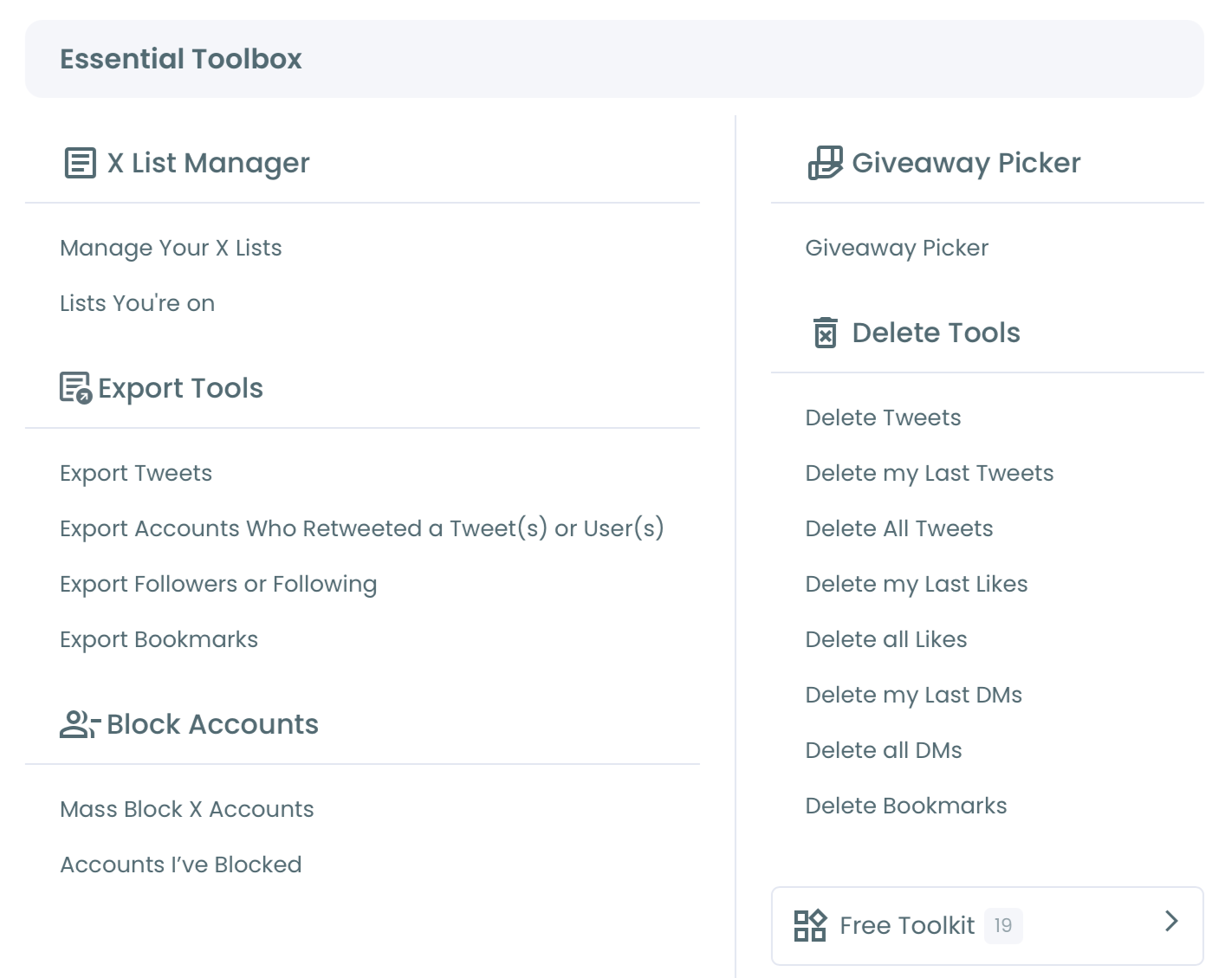
- Open the Essential Toolbox menu and select Export Tweets from the export group inside it.
Point the downloader at the profile you actually want
- Type any public X username into the search field. Circleboom fetches that account's timeline and shows the total post count it can reach, so you learn the size of the job before you commit to it.
- Set your filters before the file is built. Post type, date range, language, keyword, and minimum or maximum counts for likes, retweets, replies, and impressions each narrow the output at the source rather than in cleanup afterwards.
Take delivery and put the file to work
- Approve the export and supply the receiving email address. Circleboom sends the file there and stores a copy on your Circleboom account page, so a lost email is not a lost download.
- Open the CSV in Excel, Google Sheets, or any tool that reads a spreadsheet. Sort on CountImpression or CountLike and the profile's strongest posts rise to the top in one click.
That order matters because every decision that shapes the file happens before the file exists.
The username check tells you how much history is reachable, and the filters decide whether you end up with a working dataset or a 3,200-row dump you still have to clean by hand.
Quick recap:
- Connect the account through the official login.
- Open Export Tweets inside Essential Toolbox.
- Enter the public username and read the post count.
- Filter by date, type, or engagement before exporting.
- Collect the CSV from email or your account page.
Watch the whole download run: the username check, the filter pass, and the CSV that lands in your inbox.
https://www.youtube.com/watch?v=CWcEnT_mKaY
Why downloading an X profile is harder than it looks
X gives you no structured way to export another account's posts.
Your own history has exactly one official route, and X documents it as a data archive you request and wait for. It arrives as a zip file built for completeness rather than for analysis.
That route also stops at your own account. There is no archive request for a competitor, a client, or an influencer whose posting pattern you want to study.
So people reach for browser extensions instead, and those break every time X changes its markup. Our roundup of the best export tweets extensions separates what survives a redesign from what does not.
The manual fallback is worse. Copying a few hundred posts by hand costs an afternoon, and it still leaves you without the impression and bookmark counts, because those numbers are not selectable text on the page.
An API-based downloader sidesteps all of it. You can download tweets from any Twitter profile without installing anything into your browser. The output shape stays the same whether X redesigns its front end tomorrow or not.
The 3,200-post ceiling decides which profiles you can download in full
Before you pick any downloader, check the target profile's total post count against 3,200.
X's own developer documentation on X API timelines sets that ceiling. The timeline endpoint returns at most the 3,200 most recent posts, retweets, replies, and quote posts for an account, and no plan, tool, or workaround moves that number.
The ceiling behaves differently depending on whose profile you are downloading.
For your own account, it is a soft limit. Anything older than the 3,200 mark still exists in the archive X will build for you on request, so the ceiling costs you convenience rather than access.
For someone else's account, it is a wall. No archive request exists for a profile you do not own, which means post 3,201 on a competitor's timeline is unreachable by every tool on the market, including this one.
Work out your reachable window before you plan the analysis
Posting frequency, not account age, decides how far back a download reaches.
An account posting ten times a day burns through 3,200 posts in roughly 320 days, so your reachable window on that profile is under a year. An account posting twice a week has more than three decades of history sitting comfortably inside the same ceiling.
Two accounts opened on the same day can therefore give you wildly different amounts of downloadable history.
That is worth knowing before you promise a client a five-year content audit of a high-volume competitor. The audit is possible for the recent window and impossible beyond it, and the honest version of that answer is better delivered before the work starts.
Run the math first, then plan the analysis. The same reasoning shapes the walkthrough in our guide to downloading tweets from Twitter, which starts from history depth rather than from buttons.
What the Twitter profile downloader puts in your CSV
Each downloaded post arrives as one row with fifteen columns, grouped into three kinds of signal:
- Identity and timing: PostId, Name, Username, ProfileId, CreatedAt, and Lang.
- Engagement: CountImpression, CountLike, CountRetweet, CountReply, CountQuote, and CountBookmark.
- Content shape: TweetType, HasMedia, and the full Text of the post.
TweetType is the column people underuse.
Its three values (tweet, retweet, reply) mean one filter in your spreadsheet tells you how much of a profile's output is original writing, how much is amplification, and how much is conversation.
That ratio is a strategy read you cannot get by scrolling the timeline.
HasMedia does something similar on the format side.
Filter to TRUE, average the impression column, then filter to FALSE and average it again, and you have a defensible answer to whether images earn their production time on that account.
Circleboom retrieves all of it as an official X Enterprise Developer company. That is the practical difference between a download that keeps working and one that dies the next time X tightens access.
Your account stays inside X's rules throughout, because nothing here is scraped.
Ready to see the columns against a real profile? Open the Twitter profile downloader, type a username, and the reachable post count appears before you go any further.
Related downloads that use the same file shape
Export Twitter Accounts gives you the audience equivalent of this file. Same CSV shape, one row per follower or following, with quality flags attached to each account.
Pair the post download with Tweet Stats when you want the performance read inside Circleboom before the numbers move into a spreadsheet.
The browser-based route is just as fragile on the audience side. Our notes on Twitter follower export Chrome extensions go through why.
Match the filters to the question you are answering
Filters are the difference between a dataset and an archive.
A download with nothing applied returns everything the timeline can reach. That is fine for a backup and close to useless for an analysis, because the signal you wanted is buried under a few thousand low-engagement rows.
Decide the question first, then pick the filter that isolates it:
- Campaign review: set the date range to the campaign window and leave everything else open.
- Format audit: filter to original posts only, so retweets stop inflating the counts.
- High-performer library: set a minimum like or impression threshold and keep only what cleared it.
- Language split: filter by Lang when the account posts in more than one.
The threshold filter is the one that changes the most.
Exporting only posts above fifty likes on an account with three thousand posts might return a hundred rows, and those hundred rows are the entire answer to "what works here".
The other two thousand nine hundred are noise you would have spent an hour sorting through.
Filtering hard has a cost worth naming.
A tight filter gives you a clean file for one question and a useless one for the next, so an audit that might branch is better served by a wider export and a narrower spreadsheet filter afterwards.
Keep the export date in the filename either way. A downloaded profile ages the moment it lands, and six months later you will not remember whether the numbers came from March or September.
Who actually reaches for a Twitter profile downloader
Three jobs account for most of the downloads I see, and each one wants a different file.
Competitive benchmarking. The export runs against any public account, not just your own, which turns a rival's timeline into a sortable dataset. Their top twenty posts by impressions, read back to back, is the cheapest content research available.
Client and stakeholder reporting. A CSV of what was published in a period, with performance attached, travels anywhere. Nobody needs a Circleboom login or an X account to open it, which is exactly what makes it usable as a deliverable.
Pre-deletion backup. Deletion on X has no undo, so whatever the file captured beforehand is all that remains afterwards. This is the one case where running the export late is worse than not running it at all.
The filter settings differ across all three. Benchmarking wants a wide window, reporting wants a tight date range, and a backup wants nothing filtered out at all.
Is it safe to download tweets from someone else's X profile?
Yes, as long as the profile is public.
The download reads the same posts any visitor can already see, through the API X publishes for exactly that purpose, so nothing about it depends on credentials you do not have.
Protected accounts are a hard stop. A private profile cannot be downloaded regardless of whether you follow it, and no tool that claims otherwise is reading the API.
Two limits are worth knowing before you rely on the file.
Whether impressions come back at all is decided upstream, by the account type and by how much access X grants for it. Some profiles return zero, others partial.
Every number in the file is also frozen at the moment of retrieval, which makes the download a snapshot rather than a live feed.
Once you have the CSV, the account IDs inside it become reusable. Our walkthrough on how to bulk upload a list of Twitter IDs to a Twitter List covers that next move.
What the downloader returns, and what it will not
A Twitter profile downloader is only useful when it returns posts as data rather than media as files.
Circleboom pulls a public account's most recent 3,200 posts, applies your filters before the file is built, and delivers fifteen columns per post to your inbox and your account page.
Check the profile's post count against the ceiling first. Filter for the question you are answering. The CSV then arrives ready to sort instead of ready to clean.
Kick off the run whenever the profile and the question are both settled.
→ Download an X profile's tweets to CSV
Questions about delivery time and where the file lands
How long does it take to get the CSV after I run the download?
Smaller profiles come back quickly, and larger ones take longer to assemble because the timeline is paginated in batches. The file is delivered to your registered email address and stored on your Circleboom account page at the same time, so you can collect it from either place whenever it is ready.
What happens to posts I delete after I have downloaded them?
They stay in the file. The CSV captures the profile as it existed at retrieval time, so a post you remove from X afterwards still appears in the download with its text and its final engagement counts intact. That is exactly why exporting before a cleanup is worth the two minutes.
Can I download the same profile again later and compare the two files?
Yes, and repeat downloads are among the better uses of the tool. Run the same export on a schedule and keep the export date in each filename. Two dated files give you a before-and-after view of what a profile published and how it performed, which no single snapshot can show on its own.