
Most Twitter growth strategies focus on follower count. High-intent user discovery is a different game entirely.
A high-intent user is someone who is actively engaged with a topic right now. Not someone who followed a hashtag six months ago. Not someone whose bio says they're interested in fitness. Someone who just tweeted "I need a new running watch, my Garmin died." That's a live signal. That person is in motion.
The challenge is that Twitter's search surfaces popular posts, not intent signals. You get what the algorithm decided was relevant, not what's actually happening in the conversation you care about. And by the time you find it manually, the moment has usually passed.
With Circleboom Twitter, you can search tweet content historically to map who has been expressing high intent around any topic, or watch it live as new signals come in. The people behind those tweets show up with full account data so you can evaluate, engage, and act without leaving the tool.
What makes a Twitter user "high intent"?
High intent on Twitter looks different depending on your goal, but the signals are recognizable. Someone asking for a recommendation is high intent. Someone comparing two options is high intent. Someone expressing frustration with their current solution is high intent. Someone describing a specific problem they need solved is high intent.
What these have in common is specificity and immediacy. They're not browsing. They're deciding.
Circleboom Twitter's X Account Search on Tweets lets you target those exact signals at scale by searching tweet content for the phrases and patterns that indicate active decision-making.
 infocircleboom.com
What Is Circleboom Twitter?
Circleboom is an Official X Enterprise Developer. All data is retrieved through X's official APIs, fully compliant with platform rules. No scraping, no third-party workarounds.

Here's what you get for high-intent user discovery:
- AI-powered Smart Search that interprets intent-based queries
- Historical tweet data searchable across custom date ranges up to a year back
- Live tweet monitoring for real-time intent signals as they happen
- Full account profile data for every matching tweet including engagement level and activity status
- Direct follow, list, and export actions built into the search results
How to Find High-Intent Users on Twitter with Circleboom Twitter
Step #1: Log in to Circleboom Twitter and connect your X account.
Circleboom is an Official X Enterprise Developer, meaning all tweet and account data comes directly from X’s official APIs in a safe and compliant way.

Step #2: Open the left menu and go to “Historical Tweet Search”.
You can find it under:
“X Account Search / on Tweets” → “Historical Tweet Search”
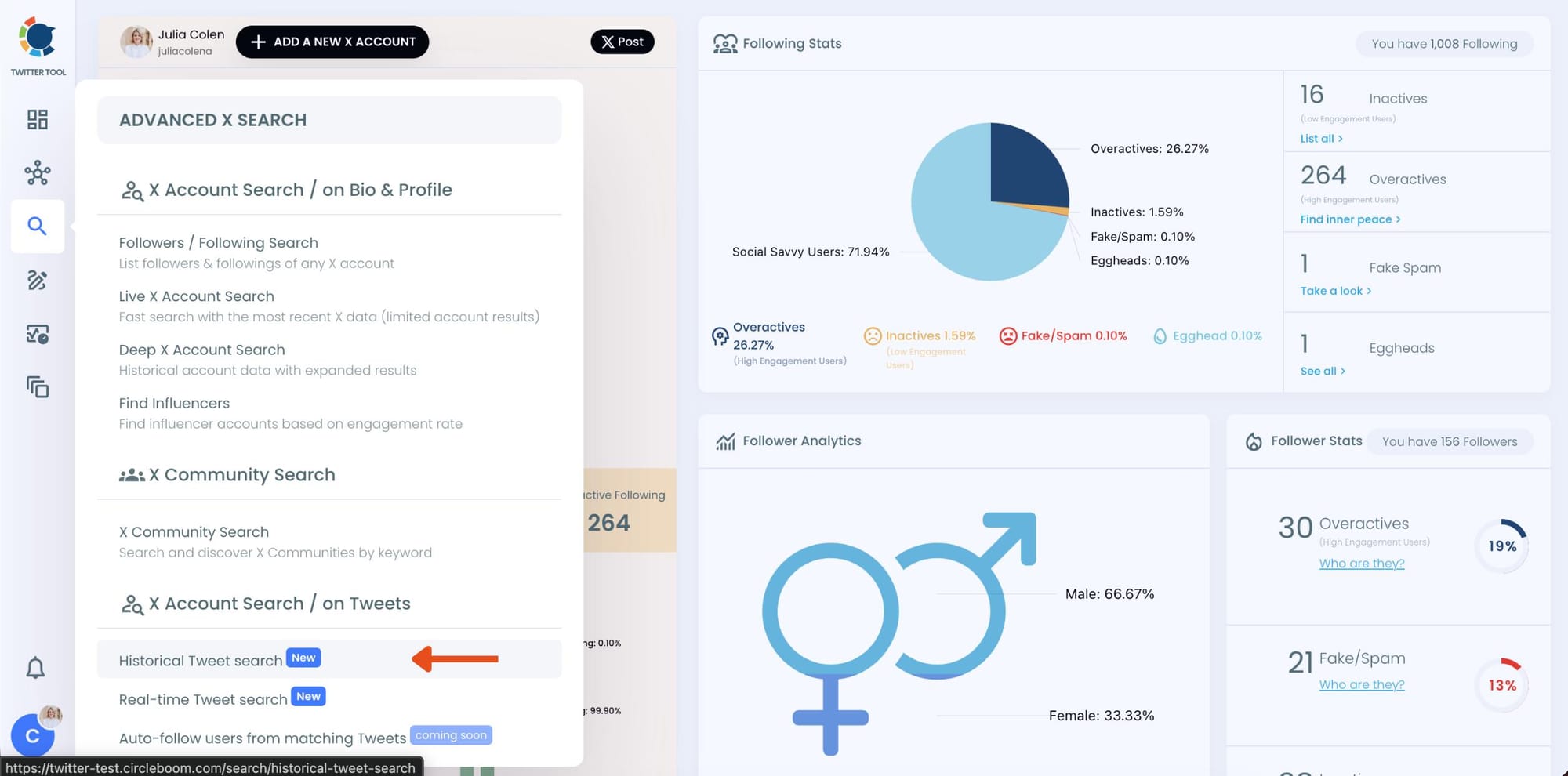
Circleboom also offers “Real-time Tweet Search” in the same section. Historical Tweet Search helps you discover people who tweeted about a keyword in the past across a selected date range, while Real-time Tweet Search continuously monitors new tweets as they happen.
Step #3: Describe the tweets you want to find using AI Smart Search.
Instead of writing complicated Twitter search operators, you can simply type what you are looking for.
For example:
“Find tweets about people looking for a smartwatch or fitness tracker, exclude retweets.”
Circleboom AI automatically understands the intent behind your query, extracts the important keywords, and applies filters automatically.
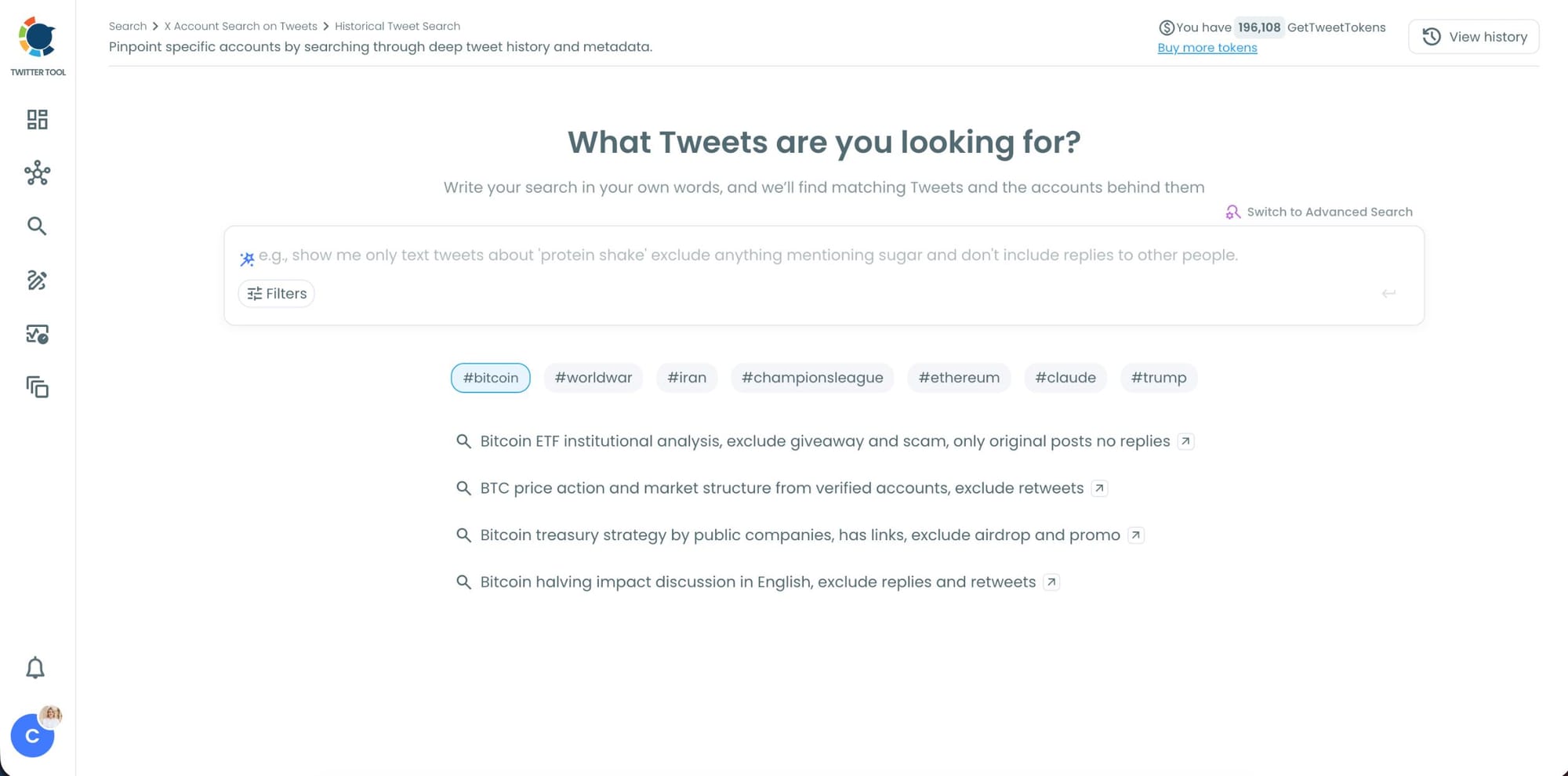
Step #4: Refine your keyword monitoring search with AI suggestions and filters.
Circleboom also suggests ways to narrow your search results. You can focus on intent, comparison posts, replies, or specific languages while filtering out spam, retweets, and noise.
This helps you find more relevant people tweeting about your keyword instead of scrolling through random tweets.
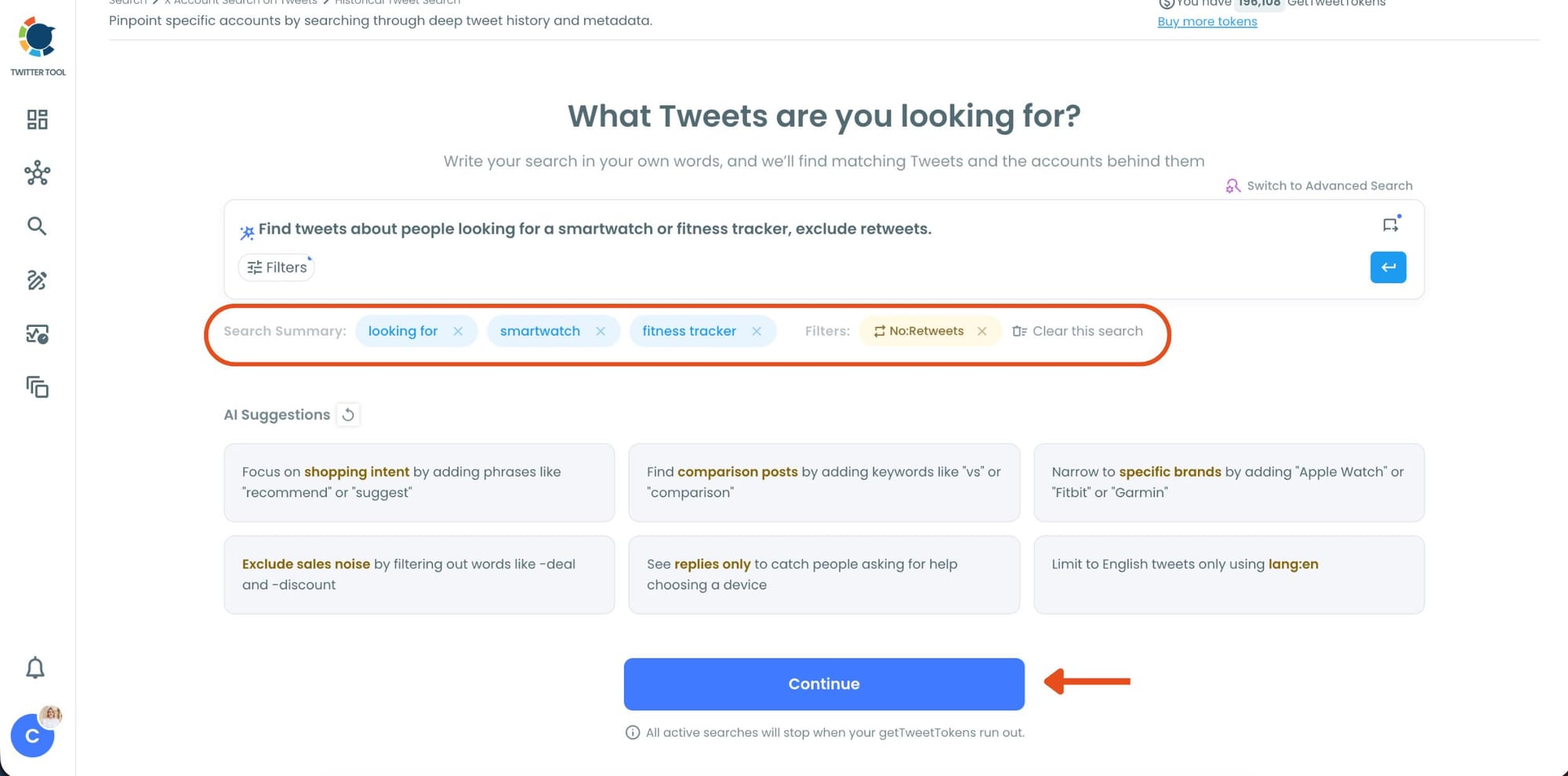
Step #5: Select your historical search date range.
You can monitor tweets from the last 30, 60, or 90 days, search across the last year, or define your own custom date range.
This makes it possible to discover people who tweeted about your topic weeks or even months ago, not just recent tweets.
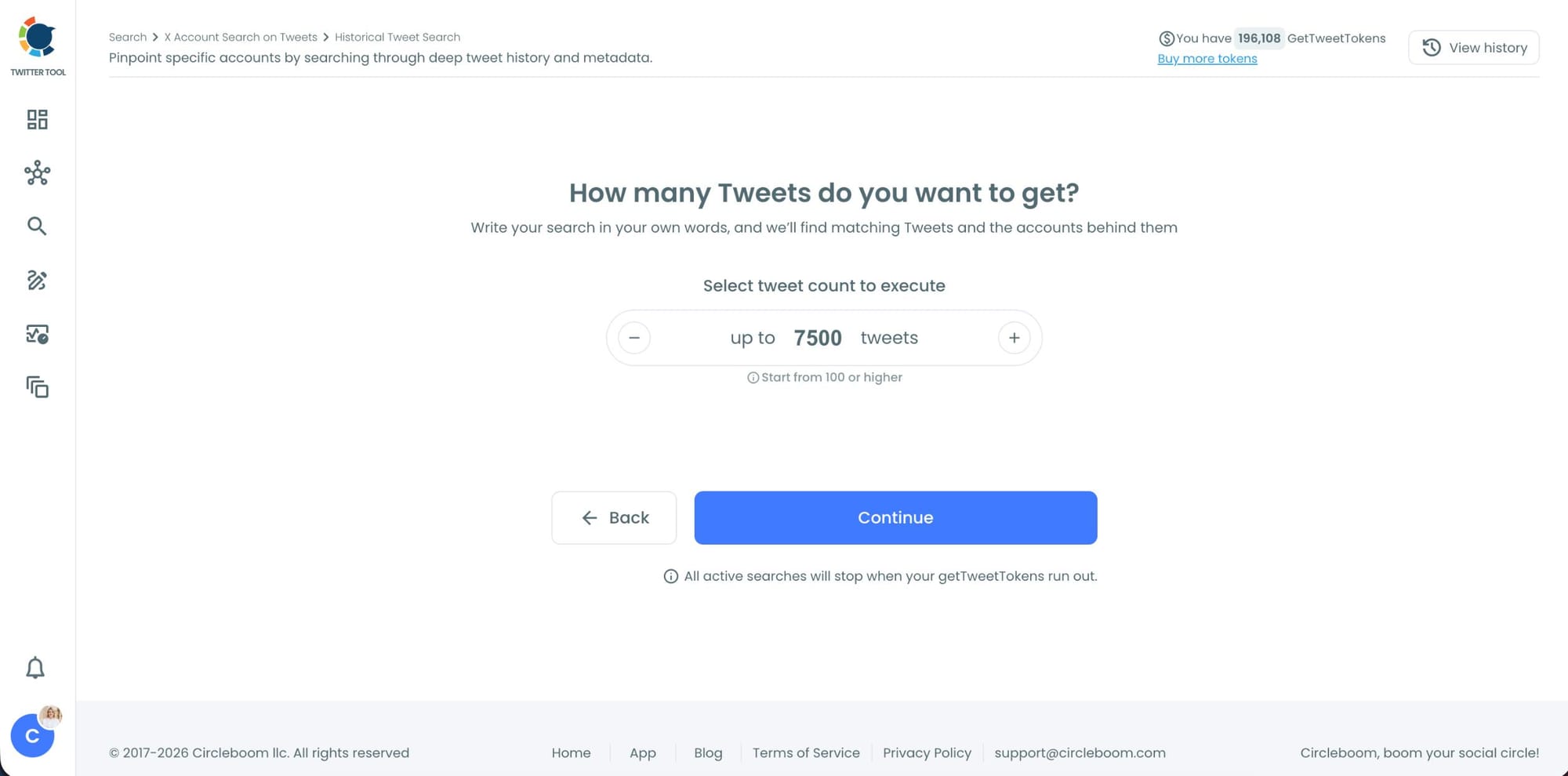
Step #6: Choose how many tweets Circleboom should collect.
Before the search starts, Circleboom lets you select the tweet volume you want to analyze.
Once you click “Continue”, Circleboom scans historical tweet data and starts collecting matching tweets together with the accounts behind them.
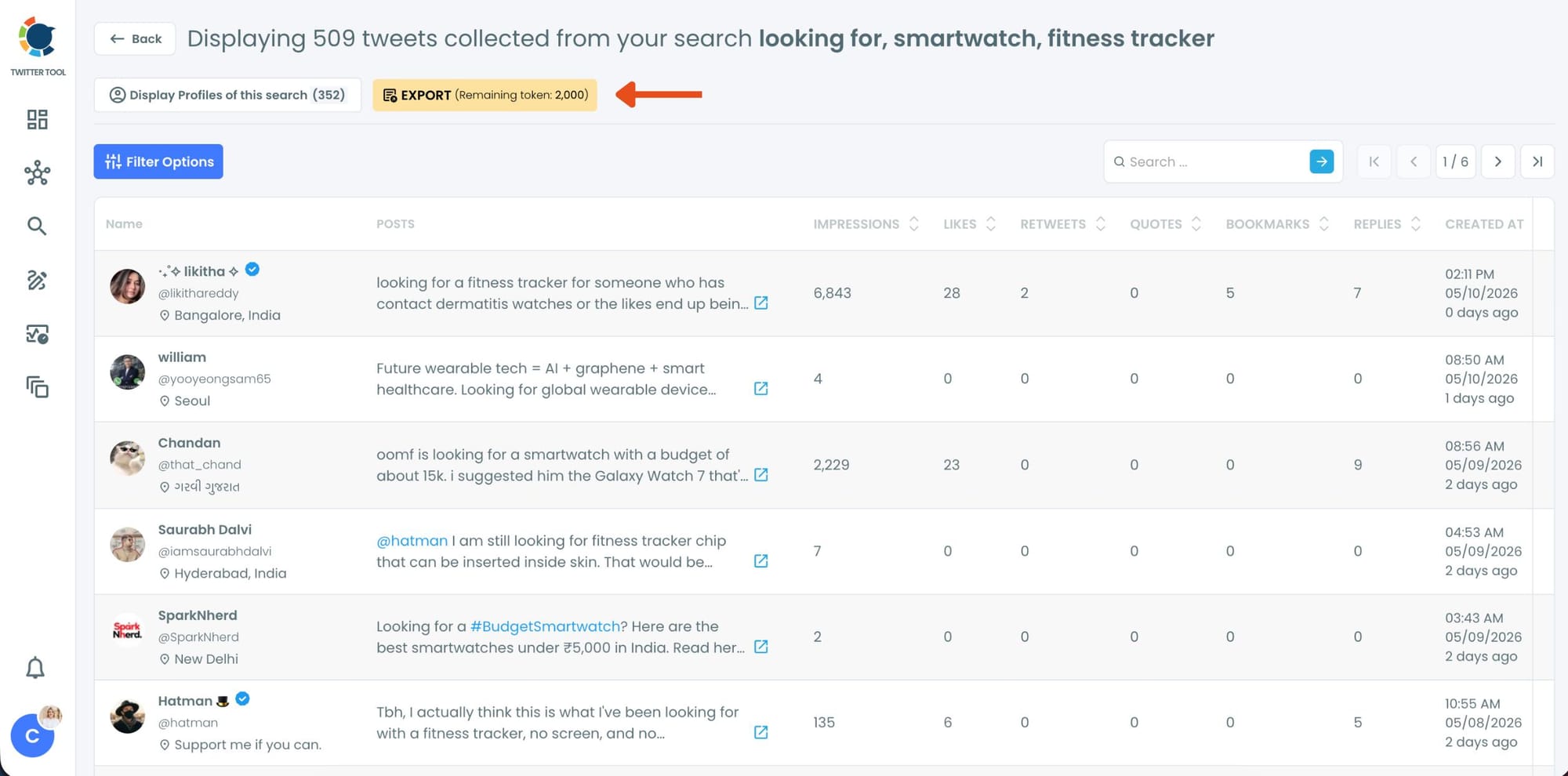
Step #7: Analyze the matching tweets and discover the accounts behind them.
Tweet View displays the matching posts together with impressions, likes, retweets, replies, bookmarks, and posting dates so you can quickly understand which conversations are getting attention.
You can also switch to Profile View to focus on the people behind those tweets.
Profile View displays follower count, following count, account age, tweet count, follow ratio, and engagement activity levels so you can evaluate account quality before interacting with them.
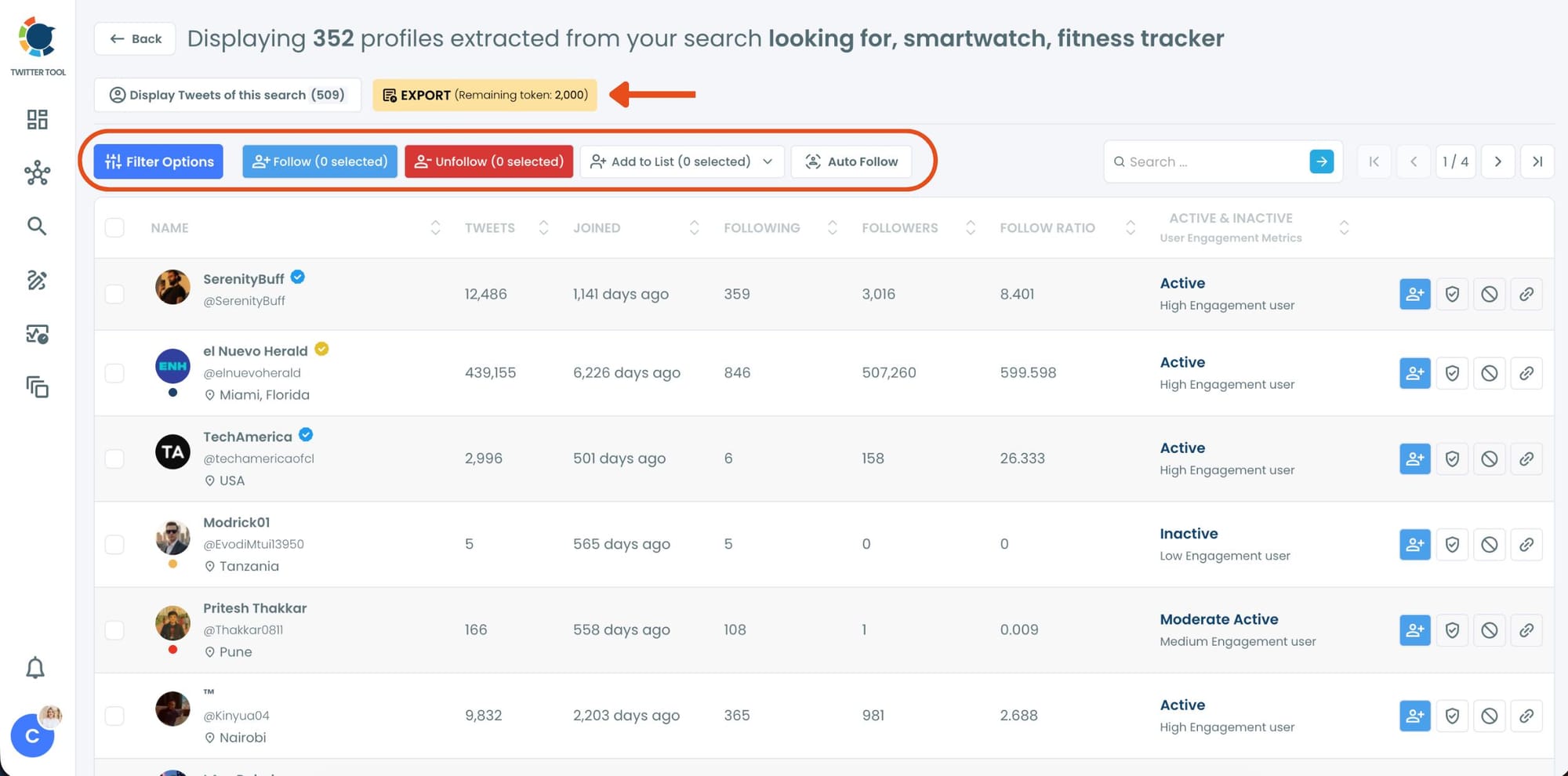
From there, you can directly follow accounts, unfollow them, add selected users into Twitter/X Lists for ongoing monitoring, auto-follow matching users, or export the collected profiles and tweets as CSV files.
The Difference Between Interest and Intent
This distinction matters more than most people account for.
Interest is passive. Someone follows a fitness account, likes an occasional post, maybe reads articles in the space. They care about the topic in a general sense but they're not doing anything with it right now.
🟢 Intent is active. They just posted something. They're looking for something specific. They have a problem that needs solving today, not eventually.
Twitter is full of both. The vast majority of keyword monitoring tools and native search results surface interest-level signals: accounts that match a niche, content from established voices, posts that performed well. High-intent signals are buried in there but they require different search logic to surface.
📌 Intent-based queries focus on the verb, not the noun. "Looking for," "need a," "can anyone recommend," "tired of my current," "comparing X and Y," "which is better for." These phrases, combined with your topic, surface the users who are actively in motion rather than passively interested.
How to Write High-Intent Search Queries
The AI Smart Search in Circleboom Twitter interprets your query and extracts the relevant terms automatically. This means you don't need to know operator syntax. You describe what you're looking for and the AI structures the search.
For high-intent discovery, the most effective queries combine a topic with an intent phrase.
Recommendation seekers. "Find tweets asking for recommendations on project management software, exclude retweets and ads." This surfaces people who have explicitly asked their network for help choosing a tool.
Problem expressers. "Find tweets from people frustrated with their current email marketing platform." This surfaces users who have announced they're ready to switch.
Comparison evaluators. "Find tweets comparing two CRM tools, English only." People in active comparison mode are the warmest leads on the platform.
Budget-qualified buyers. "Find tweets about looking for a smartwatch under $200." A stated budget combined with a product category is the clearest purchase intent signal that exists on Twitter.
Once the AI builds the search, it also surfaces suggestions to sharpen it further: narrow to replies only to find direct conversations, exclude sales and promotional posts to remove noise, filter by language, or focus on accounts with verified status.
Historical vs Live: Which One to Use
Historical search is for building a list.
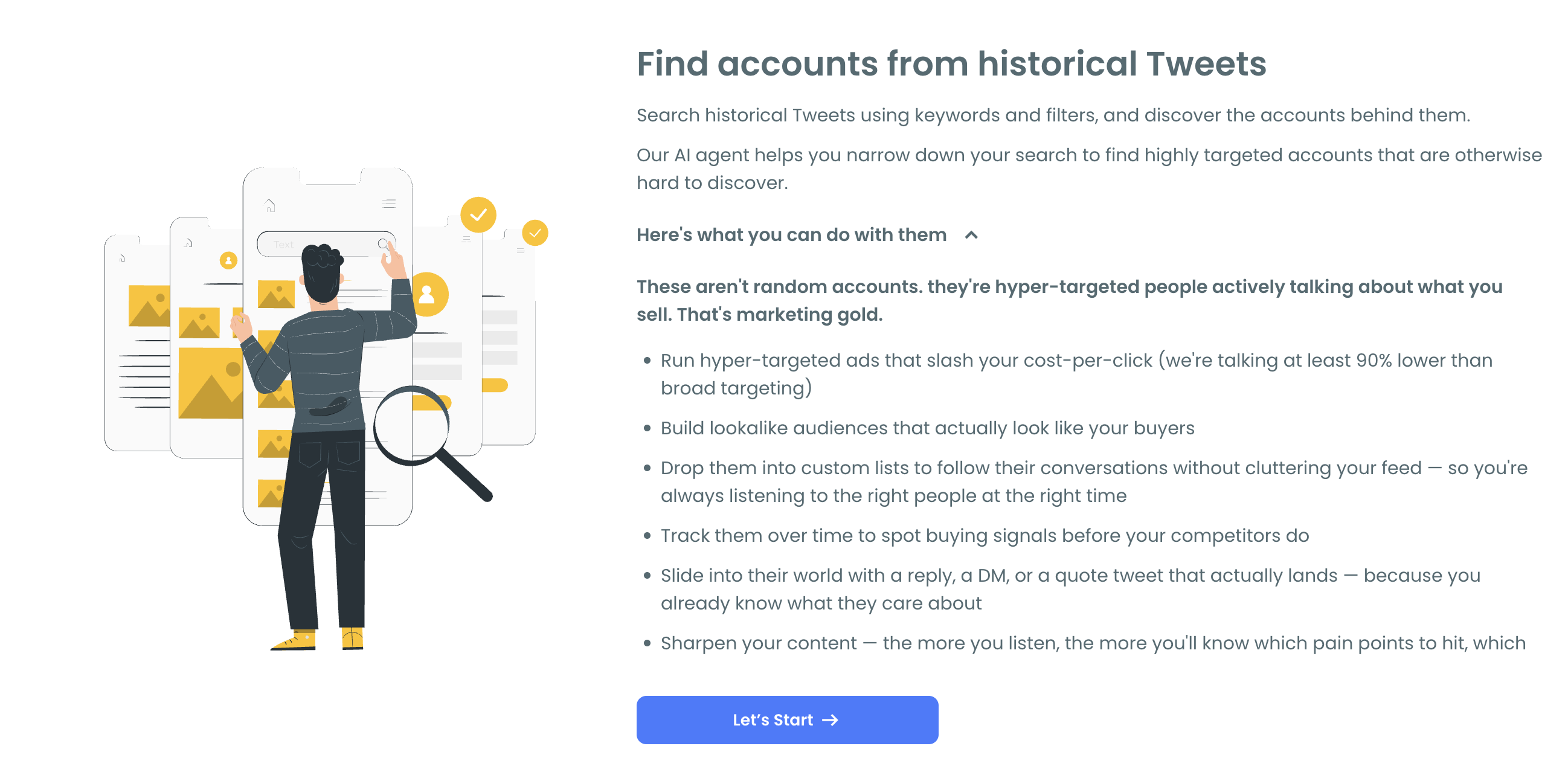
You want to know everyone who has expressed high intent around your topic in the last 30, 60, 90 days, or up to a year. The search scans past tweet data and returns matching posts alongside the accounts behind them.
This is the right mode when you want a comprehensive starting point: a pool of people who have already raised their hand, even if the specific moment has passed.
Real-time search is for timing.
You want to reach someone while they're still in the moment of deciding. When a high-intent tweet comes in right now, you want to be among the first to respond. Real-time search runs continuously and surfaces new matches as they happen.
The most effective approach is both. Historical search gives you the base list. Real-time search keeps it fresh. Together they ensure you're neither missing past intent nor arriving late to current intent.
⚠️ High-intent signals have a short shelf life. Someone who tweeted "looking for a project management tool" three days ago is already further along in their research than someone who tweeted it an hour ago. Real-time search is the mode that captures the highest-value window.
What to Do Once You Find Them
Finding high-intent users is only useful if what comes next is worth doing. Here's what each action path looks like in practice.
Reply to the tweet directly. You found this person through a specific tweet. You know exactly what they said and what they need. A reply that addresses their specific situation, without a sales pitch, is the highest-quality interaction available on Twitter. It signals that you're knowledgeable and helpful before you've asked for anything.
Follow the account. Following puts you in their feed. If your content is relevant to the same topic they just tweeted about, there's a natural reason for them to notice you and follow back. It's a low-friction first step that keeps the door open.
Add to a private Twitter List. Not everyone converts immediately. Adding high-intent accounts to a private monitoring list lets you track when they post again about the same topic. You engage when the timing is right rather than forcing a conversation.
Export the full dataset. The profile export contains username, bio, follower count, account age, and activity status as a CSV. For teams running outreach, CRM workflows, or paid targeting, this data feeds directly into the next step without any manual copying. Combine with Circleboom Twitter's Find Influencers feature to layer reach signals on top of intent signals for the highest-value accounts in any dataset.
Frequently Asked Questions
What is a high-intent user on Twitter?
A high-intent user is someone actively engaged with a specific decision or problem right now, not just passively interested in a topic. On Twitter, high-intent signals include tweets asking for recommendations, expressing frustration with a current solution, comparing two products, or stating a specific need with a budget or timeline.
How does Circleboom identify high-intent tweets?
You write an intent-based query and the AI Smart Search extracts the relevant terms and structures the search automatically. The results return every tweet matching that intent pattern from past data or in real time, alongside the accounts behind them.
Is historical search or real-time search better for finding high-intent users?
They serve different purposes. Historical search builds a comprehensive list of users who have expressed intent over a defined time period. Real-time search catches users at the moment of peak intent. The most complete approach is running both: historical for depth, live for timing.
Can I target specific intent patterns like budget or comparison?
Yes. The AI Smart Search supports nuanced intent queries. You can search for tweets that mention a price range, a product comparison, a specific problem type, or a recommendation request. Queries can also exclude sales noise, promotional content, and retweets to keep results focused on genuine user-generated intent.
How quickly do real-time search results appear?
Real-Time Tweet Search surfaces new matching tweets in real time as they're posted. There is no batch processing or scheduled refresh. New results appear as they happen.
Can I export high-intent user profiles for outreach?
Yes. Profile data is exportable as a CSV including username, bio, follower count, following count, account age, and activity status. This can be imported into a CRM, used to build a custom audience in an ad platform, or fed into any outreach workflow.
Final Thoughts
The difference between finding someone who cares about your topic and finding someone who is actively deciding right now is significant. Most Twitter tools and native search return the former. Intent-based keyword search returns the latter.
With Circleboom Twitter, you can build a list of everyone who has expressed high intent around your topic historically, monitor for new signals as they come in, and reach the right accounts at the right moment with enough context to make the interaction worthwhile.
Find high-intent users on Twitter with Circleboom Twitter.
 infocircleboom.com