

A viral tweet leaves behind a list of names, and X will not hand you that list. The retweet counter tells you how far a post travelled; it never tells you who carried it.
Who actually retweeted that viral tweet, and how do you get all of them?
Circleboom exports every account that retweeted a specific X post into a structured CSV file, complete with follower counts, verification status, account age, and quality flags for each row, retrieved through official API access.
→ find retweeters of a viral tweet
What does a retweeter list tell you that the retweet count doesn't?
A retweet count measures distance. A retweeter list measures people.
Those are different questions, and only the second one is useful once the spike is over.
When a post picks up 4,500 reposts, you are looking at 4,500 accounts that read the thing, agreed with it enough to attach their own name to it, and pushed it to their own audience.
Every one of them took an action.
A like is approval. A follow is a subscription. A repost is a public endorsement broadcast to someone else's followers.
That behavioural difference is why retweeter data outperforms almost any other audience list you can build on X.
You are not guessing at interest from a bio keyword. You are reading a record of who already acted.
The practical problem is retrieval.
You can export the retweeters of a viral tweet in one pass with Circleboom. Working from X's own interface leaves you scrolling a partial preview with no filters, no sort order, and no download button.
Why X's native repost view leaves you guessing
X shows a preview of reposters, not a dataset.
The panel loads a slice of accounts, orders them however it wants, and stops. There is no way to sort by follower count, no way to strip out egg accounts, and no export.
Readers hit this wall constantly, which is why why you can't see who retweeted anymore has become such a common search on X. The view changed, the data did not become public in any richer form, and the reposter panel stayed a preview.
X's own documentation on how reposts behave is worth reading if you want the platform-side rules straight from the source, and it is available in the X repost FAQs.
Three things break when your only view is that panel:
- You cannot tell a 200,000-follower account apart from a 40-follower burner without opening each profile.
- You cannot separate genuine sharers from repost-farm accounts.
- You cannot move the names anywhere else, so no CRM, no ad audience, no spreadsheet.
The data exists. The interface just refuses to give it to you in a usable shape.
The gap widens with scale.
On a post with 80 reposts you could open every profile by hand and lose an afternoon. On a post with 8,000 you cannot, so the accounts worth knowing about stay invisible inside a number you can only quote in a report.
That is the real cost of a missing export button. Not effort, but selection: without the file, you end up acting on whichever accounts happened to load first in a panel that never claimed to be ranked.
How to find retweeters of viral tweet posts on X
Watch the export flow end to end before you run it yourself:
Watch: exporting a full retweeter list from any tweet URL
https://www.youtube.com/watch?v=NjIDyzI0HHU
To find retweeters of a viral tweet, paste the tweet's URL into Circleboom's export cart, confirm the token cost, and collect the CSV when processing finishes. The whole flow runs in three phases: connect, queue, collect.
Connect your X account to Circleboom
- Log in to Circleboom Twitter and connect the X account you want to work from.

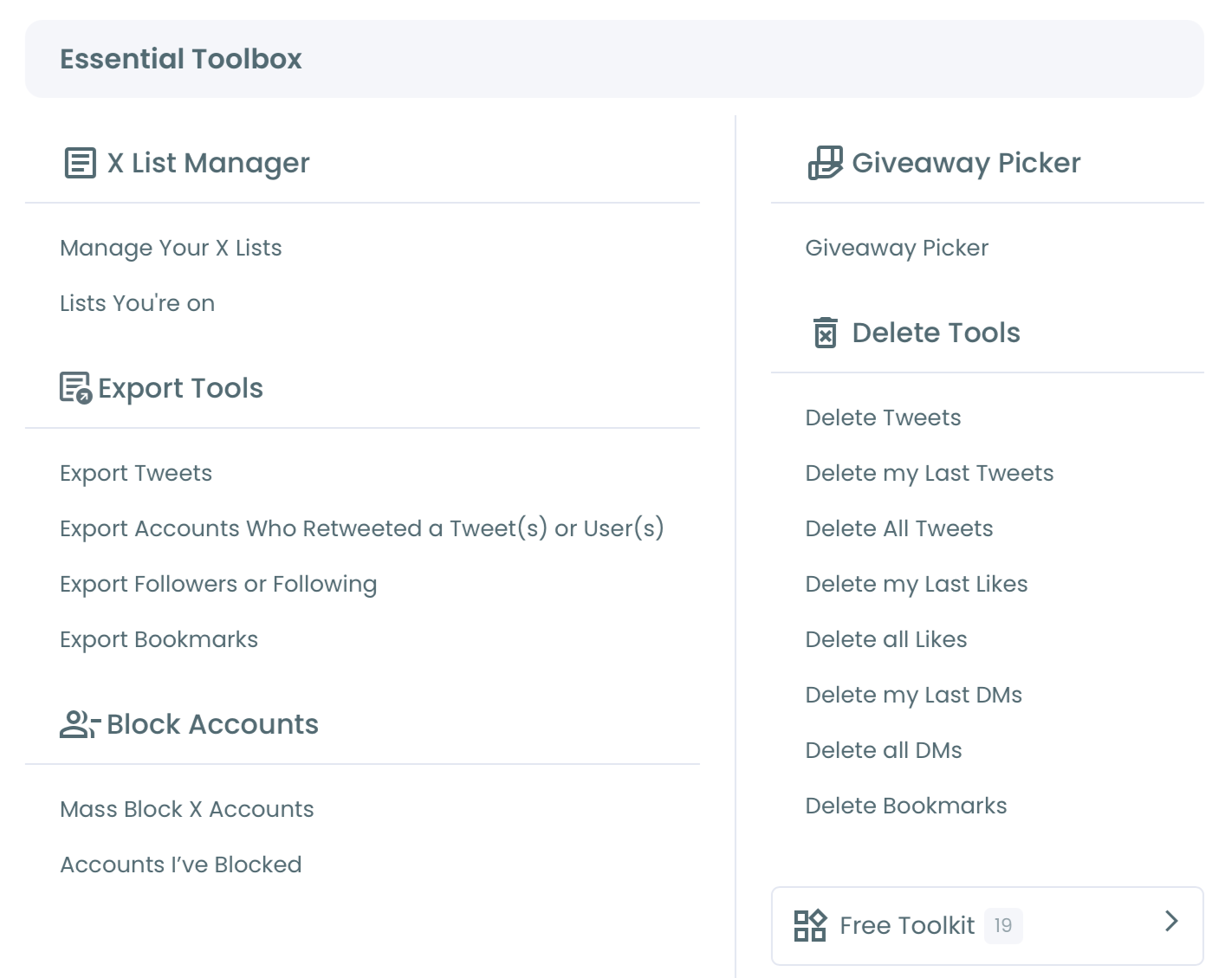
- Open the Essential Toolbox menu, where Circleboom keeps its export utilities.
Queue the viral tweets you want retweeters from
- Select the "Export retweeters of specific tweets" tab. This is the mode built for one post or a handful of posts you name yourself.
- Paste the tweet URL into the input field and click "+ Add to Export List." The queued tweet appears with the author, a preview of the post text, and its repost count.
- Add more tweet URLs if the campaign ran across several posts. Circleboom combines the retweeters into one file, and an account that reposted more than one queued tweet appears once, with a RepostCount column recording how many of your queued tweets it shared.
- Read the Export Cart panel on the right. It totals the retweeters across everything you queued and puts that beside your EngagerX Export Token balance, one token per retweeter.
Confirm the export and collect the file
- Click through to the confirmation modal and press "Export Retweeters." The modal states how many tokens the export will consume and what your balance will be afterwards, so nothing is spent without you seeing the number first.
- Collect the CSV from your Circleboom account page or the emailed download link. Processing runs asynchronously and takes anywhere from 10 minutes to 6 hours depending on how many retweeters are in the job.
That order matters because each phase removes a way the job can go wrong.
The login earns official API access to the reposter endpoint.
The cart shows you the real cost before you commit, and the confirmation modal makes the token spend a deliberate decision rather than an accident.
At a glance: connect, queue the tweet URLs, confirm the token cost, collect the CSV.
What is inside the exported retweeter file
The export is a CSV, not a screenshot, and every retweeting account occupies one row. That row carries far more than a username.
Each row includes the profile ID, username, display name, location, bio, and account creation date. Alongside those sit the numbers you need for ranking: follower count, following count, and total tweet count.
Then come the classification columns, which are the reason this file beats a manual copy-paste job.
Circleboom flags each retweeter of your X post with IsFake, IsInactive, IsEgghead, and IsOveractive markers, plus IsVerified, IsProtected, and Verified_Type, so you can sort a viral tweet's audience by quality before you act on it.
That means a 4,000-row file is filterable in a couple of spreadsheet sorts:
- Sort by IsFake and delete every row it marks.
- Sort by follower count, and the accounts worth a personal reply rise to the top.
- Sort by RepostCount to see who shares your work repeatedly rather than once.
You may want a sense of what "good" looks like before you judge the list. The benchmark sits in what is a good engagement rate on Twitter.
Two ways to pull retweeters: one tweet or a whole account
Circleboom splits the job across two tabs, and picking the wrong one costs you time.
The first tab handles named posts. You paste tweet URLs, the queue accepts as many as you want to combine, and the export covers exactly those posts.
This is the mode for a viral tweet, a launch announcement, or the three posts that carried a campaign.
The second tab works from a username instead.
Circleboom fetches up to the 3,200 most recent tweets from any public account, lists them with their repost counts, and lets you choose which ones to export retweeters from.
A filter panel narrows that list by date, keyword, language, media type, hashtag, or engagement thresholds before you select anything.
Use the second tab when you are studying an account rather than a moment. It answers a wider question: across everything this account published, who keeps sharing it? That is a different investigation from a single spike, and it is how you pull the full retweeter list for competitor research rather than campaign reporting.
Both tabs finish the same way, with an asynchronous job and a CSV delivered to your account page and your inbox.
When to run the export after a tweet goes viral
Run it while the post is still moving, not weeks later.
Two things decay.
Suspensions happen, people quietly undo a repost, and public profiles go private, so the pool the platform is willing to return keeps narrowing after the fact.
The cart total is theoretical for exactly this reason: it reflects what the API reports at query time, and the finished file can come back smaller.
The second decay is social rather than technical. A reply to someone who shared your post an hour ago reads as a conversation. The same reply three weeks later reads as a database query, because that is what it is.
Retweeter data is at its most useful while the conversation it came from is still open.
There is a reporting argument too. If you export each significant campaign tweet as it peaks, you finish the campaign holding a per-post record of who carried each message, rather than one undifferentiated blob you have to untangle afterwards.
What to do with the list once you have it
A retweeter export is raw material. Four uses account for most of what people do with it.
Reciprocate with the accounts that earned it. The accounts that shared your best post are the ones worth following back, replying to, and remembering. This is the group find your brand advocates on X treats as the highest-value slice of any audience. A retweeter file is the fastest way to name them.
Build a monitoring list. Drop the strongest retweeters into a dedicated list with Circleboom's Twitter List Manager so their future posts arrive in one feed. Membership earned by a repost is a stronger signal than membership assigned by a follow.
Mine someone else's viral post. The same flow works on any public tweet, not only your own. Exporting the retweeters of a competitor's best-performing post gives you accounts that already proved topical interest. That is the logic behind the Twitter retweet list extractor approach to targeting.
Run a clean giveaway draw. When the entry mechanic is a repost, a partial preview is not a fair participant pool. Pair the export with the Twitter Giveaway Picker and every eligible entrant is in the draw.
One more use sits slightly outside those four. Some retweeter lists come back thick with large accounts. Find Twitter Influencers then helps you work out which of them matter in your niche rather than which of them simply carry the biggest number.
Is exporting retweeters safe for your X account?
Yes, and the reason is architectural rather than promotional.
Circleboom holds status as an official X Enterprise developer, which means every retweeter row is requested through sanctioned endpoints on an account you authorised yourself. No extension sits in your browser reading pages, and no credentials leave the standard authorisation flow.
That distinction matters for the file as much as for the account. Scraped lists are incomplete by construction, because a scraper sees what a browser session happens to load. An export built on official API access returns what the platform returns.
Two limits are worth knowing before you run a job.
Only public tweets and public accounts are reachable, and the retweeter count shown in the cart is theoretical, since suspended, deleted, or protected accounts can shrink the final file.
The short version
A viral tweet is an event. A retweeter export turns that event into an asset you still own next month.
The count told you the post worked. The list tells you who made it work, ranked by reach, filtered for quality, and portable to wherever you keep your audience data.
Once you have seen your most retweeted tweet and pulled the names behind it, the guesswork about who your real distribution network is disappears.
Run it on the post that is spiking right now, while those accounts still remember reading it.
→ export everyone who retweeted a viral tweet
Common questions about exporting retweeters
Can I export retweeters from someone else's viral tweet?
Yes. Any public tweet from any public X account works, and you never need access to the account that posted it. Paste the tweet URL into the export cart the same way you would with one of your own posts.
How long does the export take to arrive?
Processing runs from 10 minutes to about 6 hours, depending on how many retweeters are in the job. The finished CSV lands on your Circleboom account page and as a download link sent to your registered email address, so check the spam folder if it seems slow.
What happens if the same account retweeted several of my tweets?
It appears once in the file, and the RepostCount column records how many of your queued tweets that account shared. That column is the quickest way to find repeat sharers rather than one-time ones.
Does the export include bot and spam accounts?
It includes them and labels them. The IsFake, IsInactive, IsEgghead, and IsOveractive columns let you filter those rows out in your spreadsheet before you build an outreach or ad audience from what remains.



)