
Two accounts publish the same idea. One posts it as a tweet and it draws replies; the other posts a screenshot of that tweet to Instagram and it draws nothing. That gap is almost never about the idea, and it is not fixed by connecting the accounts more tightly.
Can you still link Twitter to Instagram automatically?
Not through the platforms themselves. Instagram removed native cross-posting with X, so the working route is a publishing tool that holds both connections and converts the content on the way across. Circleboom rebuilds an X post as a designed Instagram card and publishes it to a feed, a Story, or a Reel, with the X side handled by a company listed on X's Enterprise customer directory.
→ link Twitter to Instagram
What linking Twitter to Instagram means today
The phrase covers three different things, and only one of them still works the way people expect.
- Profile linking. Putting your Instagram handle in your X bio and the reverse. Still available, purely a signpost.
- Native auto-share. Instagram's old in-app toggle that pushed posts to X. Removed, with nothing equivalent on the X side.
- Content conversion. Publishing the same idea to Instagram in Instagram's format. This is the one that still delivers, and it needs a tool.
Readers usually arrive searching for the second one and leave with the third, because that is the only definition that still produces a post. Most guides answer the second and quietly describe a setting that no longer exists.
The third definition is where the actual work sits, because Instagram is image-first and X is text-first, and no toggle has ever solved a format mismatch.
That difference is why you share tweets on Instagram as rendered cards rather than as forwarded text. The text has to become a picture, and the quality of that picture decides everything downstream.
If you want the fuller landscape of what each platform still permits, the breakdown on posting from Twitter to Instagram walks the remaining routes end to end.
Why a tweet screenshot underperforms on Instagram
A screenshot loses on three counts, all of them mechanical rather than aesthetic.
Instagram cannot read text inside an image. The platform generates descriptions with object recognition. That is why it shipped alternative text support and asks creators to write their own. Words baked into pixels reach neither search nor screen readers unless you retype them.
The type is too small by the time it renders. A phone screenshot is captured at full screen width and then displayed inside a feed tile at a fraction of that. The tweet body shrinks with everything else, and the reader ends up squinting at body copy inside a scrolling feed.
It reads as imported. Timestamps, reply counts, the follow button, and the surrounding chrome all say the same thing: this was published somewhere else and copied here.
What the three failures cost in practice
The compound effect shows up in the actions Instagram rewards. A post nobody can read at a glance does not get saved, does not get sent to a friend, and does not hold anyone in place long enough to matter.
Those three behaviors are the ones a feed responds to. A screenshot loses all of them at once, not because the idea was weak, but because the reader never finished parsing it.
A converted card removes all three at once. The text is set at card scale rather than screen scale, the caption holds those words in a form search and screen readers can use, and the design reads as your own instead of as a lift from another app.
How Circleboom converts a tweet into Instagram content
Circleboom's Tweet to Instagram feature takes the text of an X post and renders it as a styled visual sized for Instagram, then sends that visual to a connected Instagram account immediately or on a schedule. No screenshot, no cropping, no design tool in the middle.
The output is a card carrying the post text under your avatar and handle, with engagement stats as an optional element. You pick the destination format first, then the look.
Three format choices exist: feed post, Story, and Reel. Composition comes from five layout styles, and color comes from eight themes. A live preview redraws as you change either one, which is where readability problems become visible before they become published.
Circleboom is a verified Enterprise partner of X, so the X half of the workflow reads your posts through sanctioned developer access rather than a scraper. For anyone leaving a weekly conversion routine running unattended, that distinction is the difference between a workflow and a liability.
The feature lives inside the X Post Planner menu, alongside the rest of the publishing tools. When you are ready to link Twitter to Instagram, that is where the workflow starts.
See it live: one tweet becoming a vertical Instagram card, styled and scheduled without a design step.
https://www.youtube.com/watch?v=xi7E6bPz6IY
How to link Twitter to Instagram step by step
To link Twitter to Instagram, authorize a publishing tool on both platforms, select the X post you want to move, convert it into an Instagram-formatted card, and publish or schedule it to the format you chose. The sequence below runs in three phases: connect, convert, confirm.
Connect both platforms once
- Log in to Circleboom Twitter, then approve the X account you post from through official OAuth.
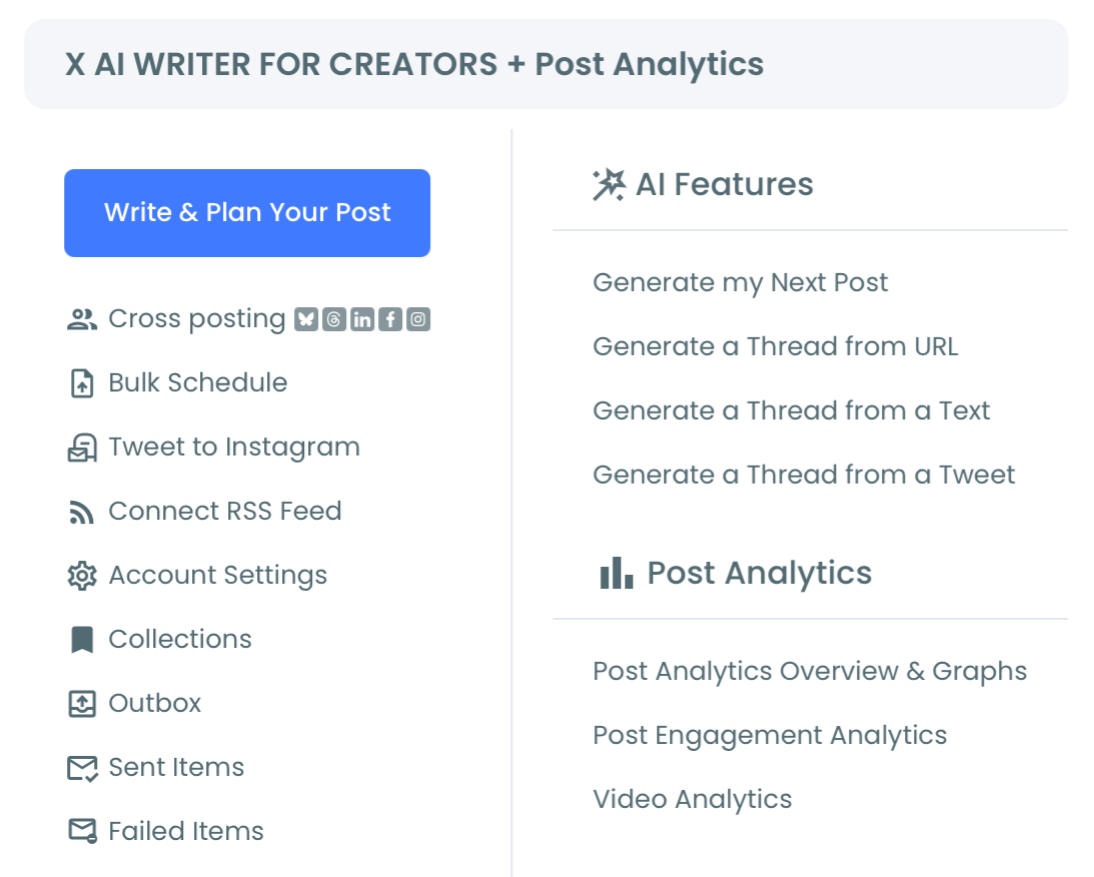
- Go to the X Post Planner menu and locate the cross-platform publishing tools grouped under it.
Convert the post into Instagram format
- Connect the Instagram account you intend to publish to. Nothing converts until at least one Instagram account is authorized, and only one account per platform can receive a given post.
- Select the tweet and the Instagram format. Feed post, Story, and Reel each carry different aspect ratios, so this choice comes before styling rather than after it.
- Set the layout and theme. Standard, Quote, Bubble, Fab, and Nova change the composition; the eight themes cover light, dark, and colored palettes for brand consistency.
Confirm before it goes out
- Check the live preview, then send the card out or queue it. The preview shows exactly what Instagram will display, including whether a long tweet has compressed the type past readability. Published Instagram posts cannot be edited afterward, so this is the last correction point.
Sequencing matters here because each phase constrains the next. Authorizing first prevents styling work that cannot be delivered, and choosing format before theme prevents styling for the wrong canvas. Previewing last catches the one defect no system can judge for you: whether the sentence still reads at card size.
At a glance: authorize both accounts, pick the tweet, pick the format, style the card, preview, publish.
Which tweets are worth converting
The best candidates are posts that already stand alone without a timeline around them. Insights, frameworks, one-line arguments, and quotable observations all survive the move intact because they never depended on surrounding context.
Three categories consistently fail:
- Replies lose the conversation they answered.
- Thread fragments assume the reader saw the earlier parts.
- Long premium posts force the type down until the card becomes a wall.
Cadence is worth deciding up front too. Converting every tweet turns an Instagram grid into a mirror of a timeline, which gives followers of both accounts nothing new. Somewhere around two or three of your best posts a week is usually the right volume.
Performance is the cleanest filter. A tweet that pulled real engagement on X has already proven the idea lands, which makes it a safer bet on a second platform than something untested. I convert on a delay for that reason and let a post run for a day or two before deciding.
For the mechanics of doing this repeatedly rather than one post at a time, turning tweets into Instagram posts and Reels automatically covers the recurring setup.
What the Instagram caption should carry
The caption is the second half of the conversion, and it is the half most people waste. Once the card carries the idea visually, the caption is free to do work the tweet never could.
Three jobs suit it well:
- Restore context. X readers had the timeline; Instagram readers do not.
- Make the words machine-readable. The card's text lives in pixels, so the caption is where those words exist as text.
- Ask the follow-up. A card states a position; the caption can open the comment thread.
The second job is the one worth being deliberate about. Retyping the tweet's core line as caption copy costs a sentence and hands the post something the image alone cannot provide: readable, searchable words attached to the content.
Skip the copy-paste habit of pasting the entire tweet plus hashtags plus a link. Instagram allows 2,200 caption characters, and using a fraction of them well beats filling them.
What happens to links, mentions, and hashtags
Each of the three travels badly, and each fails differently.
Links stop working. Instagram does not make URLs in captions clickable, so a tweet built around a link arrives on Instagram as a dead string of text. The workaround is to point at the profile link rather than paste the URL.
Mentions break attribution. An @handle from X either resolves to a different person's Instagram account or to nobody at all, which turns a credit into a mistake. Replace the handle with the person's name, or with their actual Instagram handle if you know it.
Hashtags follow different conventions entirely. X treats them as light topic markers, while Instagram treats them as a discovery layer with its own vocabulary. Carrying X tags across adds clutter without adding reach.
The fix for all three is the same: edit the text before conversion rather than after publication. A converted card cannot be changed once Instagram has it, and the caption is a poor place to apologize for a link that will not open.
Is it safe to cross-post from X to Instagram?
Yes, when the connection runs through authorized platform access rather than an unofficial workaround. Both platforms publish through documented interfaces, and a tool holding sanctioned credentials on each side is doing what those interfaces exist for.
Two practical risks remain, and neither is about account safety.
A platform connection that silently expires will fail its scheduled posts at publish time, so connections deserve a periodic check. Instagram's own rules still apply as well: captions cap at 2,200 characters, and aspect ratio and content policy govern what the card can contain.
Account-level risk sits lower than most people assume, though. Nothing in the workflow touches follows, likes, or bulk actions on either platform; it reads one post and publishes one post, which is the narrowest possible footprint.
Distribution beyond Instagram follows the same logic. Cross-posting tweets reaches Facebook, Threads, LinkedIn, and Bluesky from one scheduling action. Each destination enforces its own character ceiling before submission.
Connection hygiene is the habit most people skip. A monthly glance at the connected-accounts panel costs a minute and prevents the failure mode where a week of scheduled posts never leaves the queue.
Threads on X are the one structural exception worth knowing. Because threading is native to X only, a cross-posted thread arrives elsewhere as individual posts rather than a connected sequence.
What to do next
Linking Twitter to Instagram is a conversion problem, not a connection problem, and the checklist is short:
- Authorize both accounts once inside a tool that publishes to each.
- Pick tweets that stand alone, and skip replies and thread fragments.
- Choose the Instagram format before styling the card.
- Read the live preview at phone size, not desktop size.
- Publish or schedule, and re-check connections periodically.
Get those five right and the same idea works twice: once as a tweet, once as an Instagram post that nobody can tell was born on another platform.
→ convert tweets for Instagram
Common questions about cross-posting tweets to Instagram
How long does a conversion actually take?
Seconds for the render itself, and under a minute end to end once both accounts are authorized. The slow part is human: deciding which tweet deserves a second platform and trimming the X-specific phrasing out of it before conversion.
Can I edit the tweet text before it becomes a card?
Yes, and you usually should. X shorthand, @mentions, and hashtag conventions rarely translate, so trimming the platform-specific parts before conversion produces a card that reads as written for Instagram rather than forwarded to it.
What happens if my tweet is too long for a card?
The type scales down to fit, which is the most common reason a converted card underperforms. The live preview will show it clearly, and the fix is either a shorter source post or a different layout. The rules for posting a tweet on Instagram professionally go deeper on length discipline.
Is there any way to share X content outside the platform without a tool?
Only partially. X's mobile share sheet can push a post card into Instagram Stories, but it skips the feed, offers no scheduling, and gives you no control over the card's design. The wider question of sharing your own posts outside X carries more nuance than most people expect. The short version: manual routes cap out fast.