The accounts you follow decide what fills your feed, yet almost no one ever audits that list. Over the years it fills with abandoned profiles, bots you followed on reflex, and accounts that went silent long ago. A following list quality check reads the whole thing at once and shows you exactly what you are still following.
What this guide gives you.A clear percentage breakdown of how healthy your following list is.The four signals that separate good accounts from dead weight.A safe path from diagnosis to a cleaner, sharper feed.
Built on Circleboom's quality tools and your real following data. Start with a Twitter following list quality check.
Why Your Following List Needs an Audit
Most people audit their followers and never think about their following. That is backwards, because the accounts you follow are the ones shaping your daily experience on the platform. They are the inputs to your feed, and bad inputs produce a bad feed.
The list also has a hard ceiling. Every X account can follow up to 5,000 accounts before the platform restricts further follows based on your ratio, as its follow limit guidance explains. If a chunk of your slots are wasted on dead or bot accounts, you are spending a finite resource on noise.
An audit turns that vague unease into a concrete number. Instead of suspecting your following is bloated, you see the exact share that is fake, inactive, or low value, and you can decide what to do about it.
What the Quality Check Measures
The check sorts your following across four practical axes, and each one maps to a real decision. Human versus fake separates genuine accounts from bots and spam. Active versus inactive separates accounts still posting from those that went dark.
Ordinary versus overactive isolates the machine-speed posters that flood a timeline, and ordinary versus verified shows how much of your following carries a badge. Together these four signals turn a long, opaque list into a readable composition. A following that is mostly human, active, and ordinary is healthy; one that is heavily inactive or fake is quietly degrading your feed.
How to Run a Twitter Following List Quality Check
The whole process takes a few minutes. Work the two phases in order so you understand the result before you act on it.
Open your following and run the check
- Log in to Circleboom Twitter and connect your X account with secure OAuth.

- Open the Follower and Following management and analytics menu to reach the quality tools.
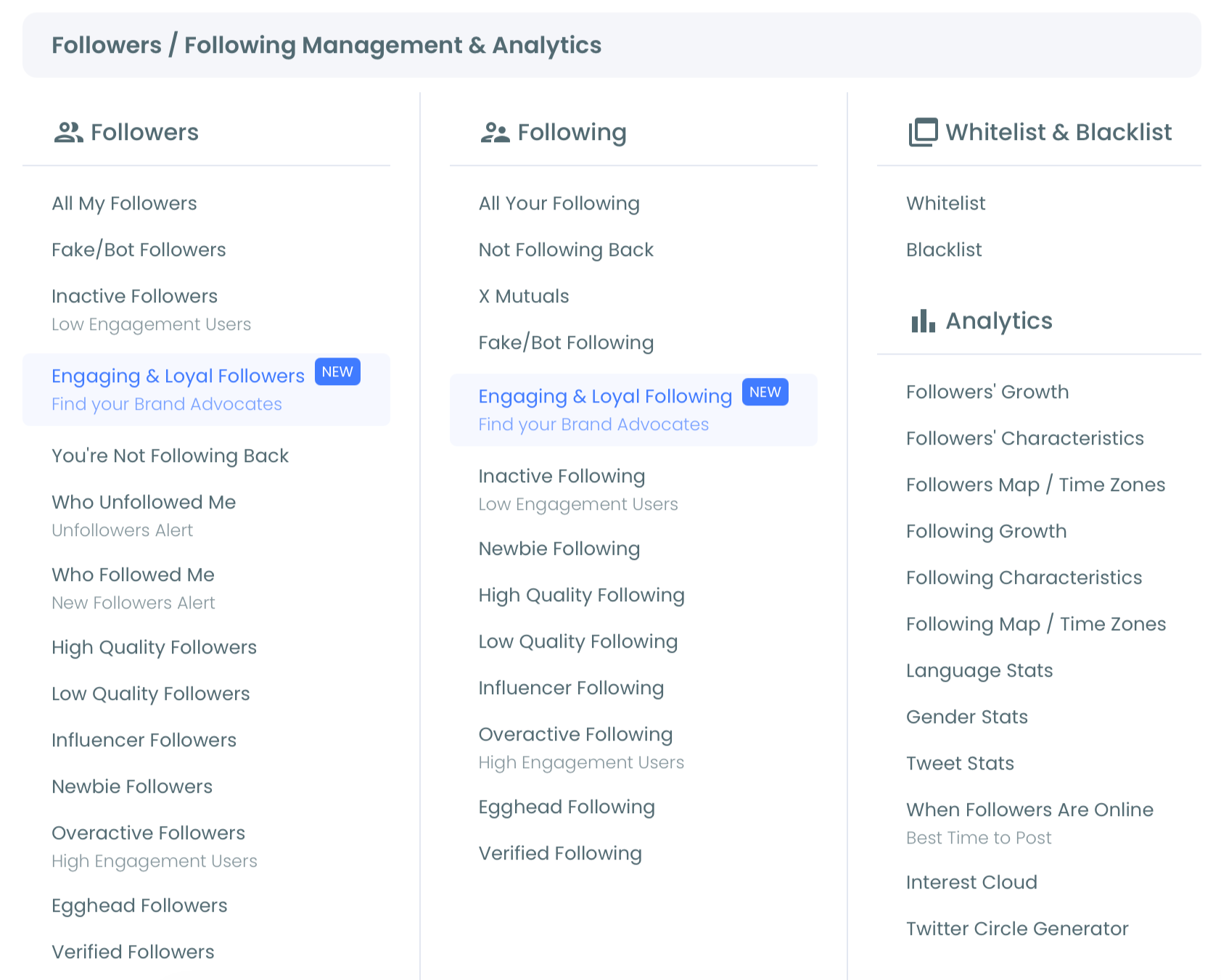
- Open the following characteristics view and let Circleboom classify every account you follow.
Read the result and plan a cleanup
- Study the percentage breakdown to see how much of your following is fake, inactive, or overactive.
- Export the breakdown as a record before you change anything.
- Move into the low-quality view to start unfollowing the accounts dragging your list down.
Working the phases in order keeps the cleanup honest. You see the full composition first, so you are pruning from evidence rather than impulse, and you keep a record of where you started.
Watch how the Twitter account quality score works:
How the Check Stays Safe and Accurate
Circleboom is an official X Enterprise Developer company, so it reads your following list through sanctioned access, never scraping. That matters for two reasons: your account stays safe, and the classifications run on complete, authorized data instead of a partial scrape that would misjudge half your list.
The check itself changes nothing. It is a read-only analysis, so running it carries zero risk. Any cleanup that follows is a separate, deliberate step that you control, and Circleboom processes unfollows gradually within X's limits so even a large purge stays compliant.
Reading Your Score Like a Pro
A raw percentage only helps if you know what good looks like. As a rough guide, a healthy following list sits well above 90 percent human and active. Anything below that is worth a closer look.
Do not panic over a small fake or inactive slice; some decay is normal on any aging account. The number to watch is the trend. If your inactive share keeps climbing run after run, your list is rotting faster than you are pruning it. The fix is a regular cleanup, and the playbook in improving the quality of your Twitter account covers the wider habits. For benchmarking, the best followers analyzer for Twitter shows how the metrics fit together.
Common Mistakes to Avoid
The first mistake is treating the score as the goal. The number is a diagnosis, not a trophy; chasing a perfect score by unfollowing aggressively can cut accounts you actually value. Read the breakdown, then prune with judgment.
The second mistake is unfollowing real accounts that look inactive. Some genuine people post rarely, so check before you cut. The methods in how to analyze Twitter followers and analyzing followers for bots help you separate quiet humans from dead accounts.
The third mistake is doing it once. A following list decays continuously, so a single cleanup ages out fast. Pair the check with the high quality followers and friends view to see what you want more of, and run a deeper account analysis when you need the full picture.
Following Quality and Follower Quality Are Different Jobs
It is easy to conflate the two, but they fix different problems. Your follower quality is about who follows you, and it shapes how credible your audience looks and how clean your engagement rate reads. Your following quality is about who you follow, and it shapes what lands in your feed every single day.
Most people only ever think about the follower side, usually because a bot-follow wave forced them to react. The following side rots more quietly, because nothing ever prompts you to revisit a follow you made two years ago. That silence is exactly why it needs a scheduled check rather than a reactive one.
The good news is that the same dashboard covers both. Once you are comfortable reading your following composition, running the same analysis on your followers takes no new skill. A complete audit looks at both lists, because a healthy account is clean on both sides: a real, engaged audience following you, and a real, active set of accounts feeding your timeline.
Think of it as two halves of the same hygiene routine. The follower check protects how the world sees your account; the following check protects how you experience the platform. Skipping either one leaves half the job undone, and the following half is the one almost everyone forgets.
Your Next Move
You now have a repeatable audit. Run this short loop:
- Check your following composition and note the fake and inactive shares.
- Export the breakdown as a baseline.
- Unfollow the clear dead weight, then re-check in a month.
Do it once and your feed sharpens immediately, because you have removed the accounts that were never adding anything to it.
→ Run your following quality check
What to Know Before You Start
Will the quality check unfollow accounts automatically?
No. The check only reads and classifies your following list. Any unfollowing is a separate step you trigger and confirm yourself, so nothing leaves your following list without your decision.
What is a good following quality score?
As a rule of thumb, aim for well above 90 percent human and active. A small fake or inactive slice is normal, but a large one means your list is overdue for a cleanup. Watch the trend across checks more than any single number.
Does a bloated following list actually hurt me?
Yes, in two ways. It fills your feed with noise from dead and bot accounts, and it eats into your 5,000-follow ceiling. A leaner list gives you a sharper timeline and keeps your follow slots available for accounts you actually want.
How long does the check take to run?
Usually a couple of minutes, since Circleboom does the classification on its side. Larger following lists take a little longer to process, but you stay on one screen and the breakdown appears when the analysis finishes.