
Say a year of complaints about one product returns four thousand matching posts. A minimum like count of fifty cuts that to a readable few dozen, and the entire result now rests on a number nobody explained to you.
Manual: you pick a like threshold from nowhere, run it, get a wall of rows or almost none, then guess again. Circleboom: you run one small probe with no floor at all, sort the Likes column to see where the topic's engagement actually sits, then set the threshold from that reading. Circleboom searches historical X posts by keyword, date, and engagement minimums, and returns the deduplicated accounts behind every matching post.
→ search tweets by minimum likes on Twitter
The floor a niche complaint needs and the floor a launch hashtag needs are not the same number.
How to search tweets by minimum likes on Twitter, from probe to export
The flow runs in three phases, and the middle one is the phase almost everybody skips.
Get the search open before you touch any number
- Log in to Circleboom and point it at the X account you intend to search from.

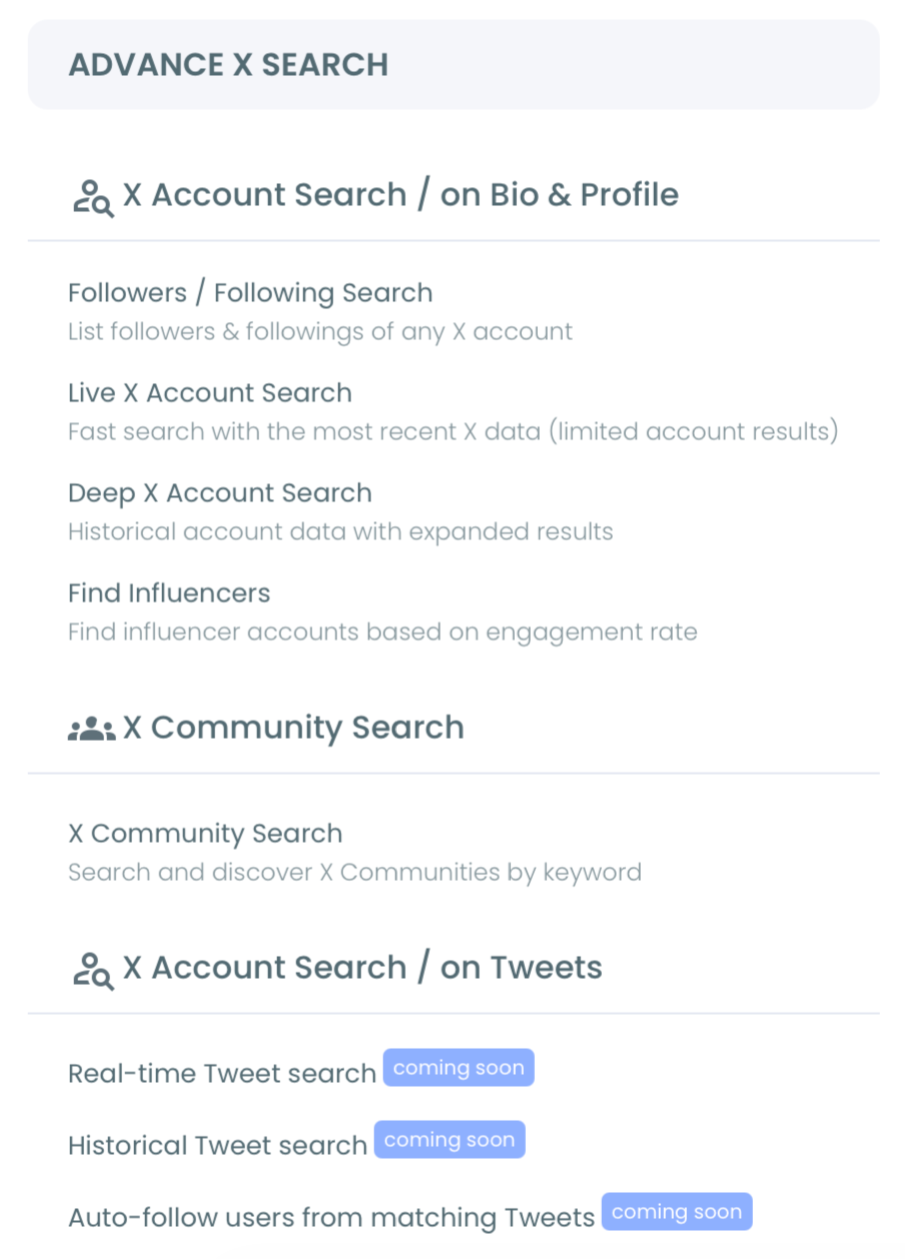
- Move to the Advanced X Search menu. Historical Tweet Search sits in that list.
- Describe the posts in ordinary words, and edit whichever AI variation the panel proposes back to you.
Read the topic's own baseline before you set a floor
- Run a small collection with the engagement minimums left empty, so the first pass shows the topic as it really is rather than as you assumed it was.
- Sort the Likes column both ways. Column headers in the results table sort ascending on the first click and descending on the second, which gives you both ends of the distribution in two clicks.
- Set the minimum likes value from what those two ends showed you, not from a round number you walked in with.
Turn the filtered posts into an account list
- Convert the result into people by pressing Display Profiles of this search, which collapses repeat authors into one row each.
- Export either view as CSV once the set looks right, keeping in mind that export draws on the token balance separately from the search itself.
That order holds up because the like floor is the only control in the panel whose correct value you cannot know in advance. Your keywords, your language, and your date range all come out of the research question you arrived with.
The threshold has to come out of the data.
The whole sequence in one line: probe without a floor, read both ends of the Likes column, set the threshold from that reading, pivot to profiles, export.
Why a round-number like floor keeps failing on X
X hands you the control without the calibration. X Pro carries an engagement filter that returns posts with a minimum number of Reposts, likes, or replies, documented on X's page for advanced X Pro features.
What no interface gives you is the number to type into it.
So people reach for round numbers. Ten, fifty, a hundred, a thousand. Every one of those is a guess about a distribution nobody has looked at yet.
The distribution is the whole problem. Engagement on X is not spread evenly across topics, and it is not spread evenly inside a topic either.
A narrow technical complaint might peak at eleven likes across an entire year of posts. A launch hashtag from a large consumer brand might not carry a single post under two hundred. Fifty returns nothing on the first and removes nothing on the second.
A like floor is a relative measurement wearing the clothes of an absolute one.
Check what a calibrated threshold does when you set a minimum like count on X posts instead of typing the first round number that comes to mind.
The same gap between the control and the judgment runs through the whole panel, which is what our post on the Twitter search engine works through at the level of the query itself.
What a minimum likes filter is actually selecting for
Likes record how far a post traveled, not how closely it matches what you are looking for. Those two things overlap often enough that people stop noticing they are different.
Historical Tweet Search filters posts, but the output most people came for is the account list behind those posts.
A button reading Display Profiles of this search turns matched posts into deduplicated authors, and that pivot is where the cost of a high floor shows up.
Raise the threshold and you are not only removing weak posts. You are removing the accounts that wrote them.
Those accounts skew in one direction. A small audience produces small like counts almost regardless of what it said, so a floor set for readability quietly filters by follower count.
For a prospecting search, that inverts the goal. Somebody with three hundred followers describing the exact problem your product solves is the strongest row in the set, and a floor of fifty deletes them before you ever see the row.
The like threshold removes people, not just posts.
Where a high floor still earns its place
Some searches want reach, and for those the threshold is doing exactly the right job:
- Narrative research wants the posts that shaped an opinion.
- Competitor incident analysis wants the complaints that traveled, not every complaint filed.
- Voice-finding wants reach by definition, which is the job Find Twitter Influencers exists to do.
Content search and profile search answer different questions here. The trade-off between them is laid out in our post on how to search Twitter bios and profiles.
How to read a topic's baseline in one cheap probe
Start with a small collection and no engagement filter on it at all. The first pass is not the deliverable; it is the measurement.
Short demo: how a historical X post search runs from a plain keyword to a finished, readable results table.
https://www.youtube.com/watch?v=xqUwDg3exe4
Sort the Likes column ascending and you see the floor of the topic, the posts that nobody reacted to. Sort it descending and you see the ceiling, the handful that traveled.
The gap between those two readings is your calibration.
A topic where the top row carries forty likes and the median carries two needs a threshold in the single digits. A topic where the bottom row carries ninety needs something in the hundreds before it narrows anything.
Then check the boundary. Read the rows sitting just above the threshold you picked, and ask whether they are still the kind of post you came for.
If the boundary rows are commentary rather than the thing itself, the floor is doing follower-count filtering rather than relevance filtering.
That boundary check is the step I skip when I am in a hurry, and it is the one I end up paying for later.
Why the probe costs less than it looks like it should
One piece of mercy in the interface makes this affordable: a finished search stays on file and can be reopened later at no token cost. Only a fresh collection or an export draws the balance down.
Start the panel and search tweets by minimum likes on X once the probe has told you which number to type.
Anyone building a study rather than a prospect list will find the same measurement discipline in our post on research ideas for using Twitter data.
Does raising the minimum likes on Twitter cost you fewer tokens?
No, not on its own. GetTweetTokens are consumed in proportion to the number of tweets collected, and the count you choose is what sets the collection size.
A tighter floor changes what fills that collection. It does not change the price of filling it.
Where the threshold does protect the balance is downstream. A set you can act on means fewer repeat collections and fewer wasted exports, and export draws on tokens separately from the search that produced the results.
There is one behavior worth knowing before you commit a large pull. If the balance runs out partway through a collection, the search stops at that point and the partial results are still saved and reachable.
All of it reaches you through Circleboom as an official X Enterprise Developer company. That access is why a like threshold applied to a window from two years ago behaves the same as one applied to last month.
Native search behaves differently, and the limits of working without an account are covered in our post on Twitter search without an account. The full control panel sits behind Twitter advanced search.
When likes are the wrong metric to filter on
The engagement minimums are not a single control. Three separate metrics carry their own upper and lower bounds: likes, retweets, and impressions. Each measures something different about the same post.
Likes measure approval. Retweets measure willingness to republish, which is a higher bar and a much better proxy for a post that changed somebody's mind. Impressions measure exposure, which can be high on a post nobody reacted to at all.
That matters because the metric you filter on decides which kind of post survives.
A like floor keeps posts people agreed with. A retweet floor keeps posts people passed on. An impression floor keeps posts the algorithm carried, whether or not anyone cared.
For competitor complaints, the retweet floor is usually sharper than the like floor. People like a complaint they recognize; they repost the one that captured something they could not say themselves.
For research into how a narrative spread, impressions come closer to the question than either of the other two.
Pick the metric that matches the behavior you are studying, then set the threshold on that one.
The results table prints all six counts on every row anyway: likes, retweets, quotes, replies, bookmarks, and impressions. A search filtered on one metric still lets you read the others and check your axis.
Bookmarks deserve a mention here even though they are not filterable. A post with heavy bookmarks and light likes is usually reference material, and reference material is where the most patient audiences sit.
Where the threshold pays off
Five moves turn the like threshold from a guess into a reading:
- Probe first, with the engagement minimums left empty.
- Read both ends of the Likes column before typing any number.
- Keep the floor low, or off entirely, when you are hunting unmet need.
- Raise it only when reach itself is the thing you are measuring.
- Pivot to profiles and export the set before you act on anybody in it.
None of those steps takes long, and together they replace the loop most people run, where the threshold gets nudged up and down until the row count feels comfortable and nobody checks what fell out.
Kick off a calibrated pull and search X posts by like count with a number you can defend.
Leftover questions about like thresholds
What if the minimum likes filter returns no results at all?
Lower the threshold before touching anything else, because it is the only filter in the panel you guessed at rather than derived from your question. If a much lower floor still returns nothing, the issue is upstream in the keyword, the date range, or the language setting. Deleted and protected posts cannot be retrieved at any threshold, so an empty result sometimes means the posts are simply gone.
Does a minimum like count apply to replies as well?
It applies to whatever the replies toggle lets through. Replies are included or excluded as a separate control, so the engagement minimum acts on the set that toggle produces. Replies usually carry far lower like counts than the posts they answer, which means leaving them in while running a high floor tends to strip them out anyway.
Is the account behind a high-like post worth following?
Not automatically, which is why the profile view exists. A post matched your keyword and cleared your threshold; that says nothing about whether the account is still active, still relevant, or still run by the same person. The profile rows carry the follower and following numbers, a follow ratio, the join date, and a classification that separates live accounts from dormant ones. Reviewing those before any bulk action is the difference between a targeted list and a noisy one.