
X's own following page technically shows you everyone you follow. Scrolling through three thousand accounts one infinite-scroll batch at a time, with no search bar that searches anything beyond what has already loaded, no sort, and no way to jump to a specific account, is not really seeing the list. It is wading through it.
A complete list should mean something you can actually search, sort, and use in one view, not just confirm exists by scrolling for several minutes until the page finally stops loading more accounts.
Circleboom's All My Following retrieves your entire following list through the official X Enterprise API in one structured, sortable, searchable table, without the truncation that limits standard API access.
→ see a complete list of everyone you follow on Twitter
Why X's own following list doesn't feel complete
X's native following page loads accounts in batches as you scroll, with no search field that covers the full list, only whatever has already rendered on screen. For an account following a few hundred people, this is mildly annoying. For an account following several thousand, finding one specific account means scrolling indefinitely and hoping you recognize it when it appears.
Viewing your following list through third-party tools is the obvious workaround people reach for, but not every tool actually delivers what it promises. Many scraping-based approaches rely on standard API access, which truncates large following lists at a fixed point rather than returning everything. A tool that quietly stops at the first few thousand accounts and presents that as your complete list is not actually solving the problem, it is just hiding the same truncation behind a nicer interface.
The result is that most people have never actually seen their full following list laid out in one place, searchable and sortable, regardless of how many accounts they follow.
What "complete" actually means here
Not every following list view is equally complete, and the difference comes down to which API tier is retrieving the data.
- Standard API access truncates large lists. Most third-party tools and casual scraping methods hit a fixed limit and simply stop returning accounts past that point, often without telling you the list you are looking at is partial.
- Enterprise API access retrieves everything. Circleboom's official X Enterprise Developer status removes that truncation, returning the full following list regardless of how many accounts it contains.
- Complete means every account, not just the most recent ones. A truncated list typically biases toward your most recently followed accounts. A complete list includes accounts you followed years ago just as reliably as the ones you followed last week.
This distinction matters most for larger accounts. The bigger your following list, the more likely a truncation-based tool is to quietly hide a meaningful portion of it from you.
How to see a complete list of everyone you follow on Twitter
Because Circleboom is an official X Enterprise Developer, All My Following retrieves your entire following list through sanctioned Enterprise API access, the same access tier that removes the truncation limiting standard API tools.

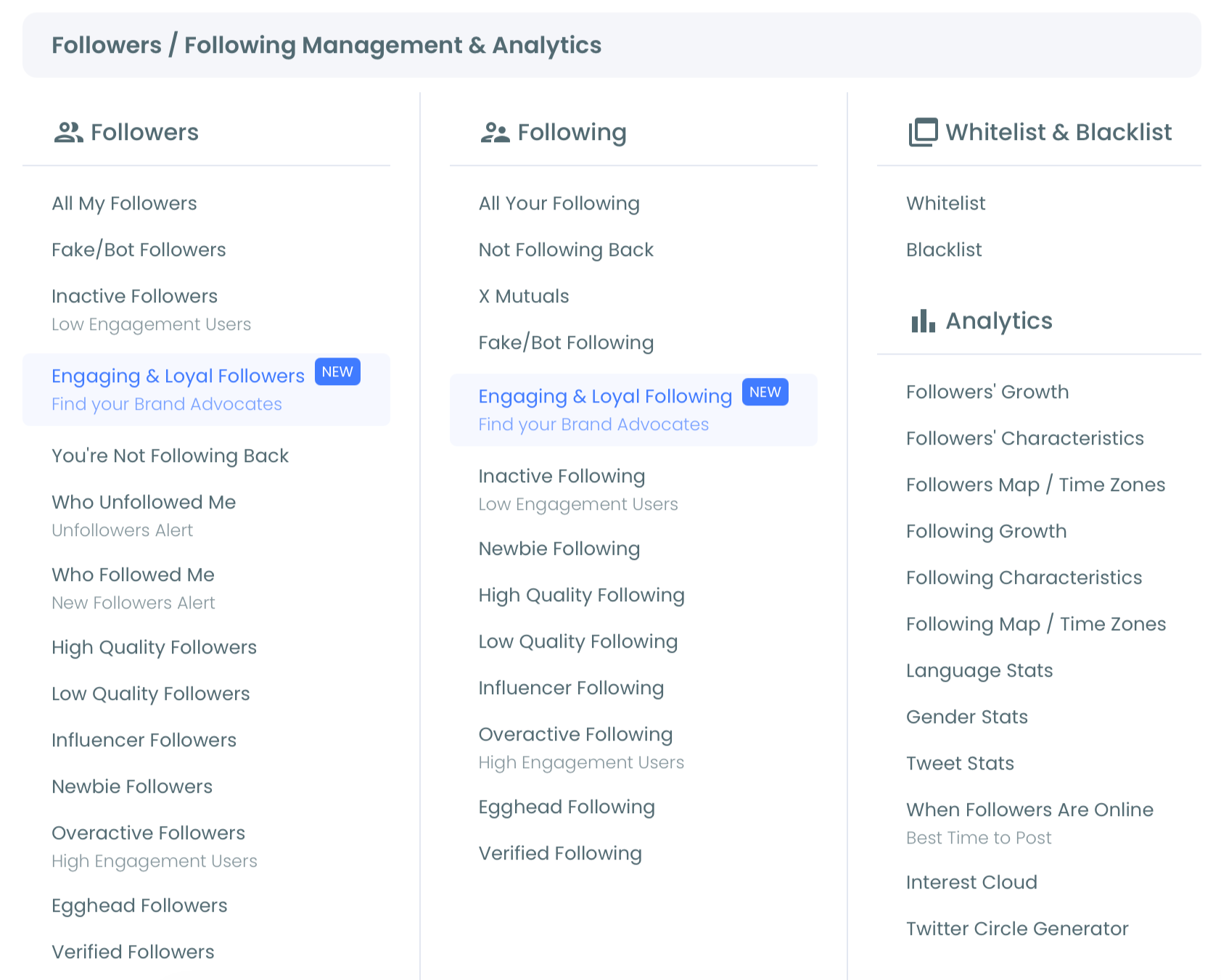
1. Connect your account and open All My Following: Log in to Circleboom Twitter and authorize your account through OAuth. Navigate to All My Following inside the Circle Tool section.
2. Let Circleboom retrieve the full list: Circleboom calls the X Enterprise API and pulls the complete following list, enriching each account with tweet count, account age, follower count, following count, follow ratio, and engagement classification. The full dataset loads into a single sortable table, not an infinite scroll.
3. Search or sort to find specific accounts: Use the inline search bar to find an account by name or username instantly, without scrolling. Click any column header, Name, Tweets, Joined, Following, Followers, or Follow Ratio, to sort the entire list by that field.
4. Export the complete list if you need it outside Circleboom: Click Export to download the full following list as a CSV, including every enriched data field, for use in spreadsheets, reporting, or any workflow outside Circleboom.
That sequence turns "I follow a lot of people and have no idea what that list actually looks like" into a searchable, sortable file in a few minutes, regardless of how large the list is.
What having the real complete list changes
Once the full list exists in one searchable view, finding a specific account stops being a scrolling exercise. Typing a name into the search bar surfaces it instantly, whether it was followed yesterday or five years ago, instead of depending on how far back you are willing to scroll on a given day.
Sorting unlocks a different kind of visibility. Sorting by Joined date surfaces your oldest follows, often the ones most likely to be forgotten or outdated. Sorting by Follow Ratio or Followers surfaces accounts with unusual profiles worth a second look. None of these views exist on X's native following page at all.
The export turns the list into something portable. A CSV of every account you follow, with the full set of enriched data fields, can sit in a spreadsheet, get reviewed at your own pace, or feed into a reporting workflow entirely independent of Circleboom or X.
X treats "the list exists" as good enough
X's following page satisfies the most literal definition of showing you who you follow, the accounts are technically there if you scroll far enough. What it never addresses is usability at any real scale. A list you cannot search, sort, or export is barely more useful than knowing the list exists in the abstract.
This is a pattern that shows up across most of X's own data views: the information exists, but the interface stops short of making it usable. Following count, like count, bookmark count, all of it is technically visible somewhere, but rarely in a form you can actually search, filter, or work with directly.
The mistake to avoid
The most common mistake is assuming a downloaded or exported following list from any tool is automatically complete. If the tool relies on standard API access rather than Enterprise-level access, the list it hands you may already be missing a meaningful portion of your actual following base, especially the older entries that fall outside the truncated window. Confirm the access level before trusting any exported following list as a full record.
The second mistake is treating this view as automatically a cleanup workflow. Seeing the complete list is a visibility step, not a destructive one. Nothing changes about your account just by viewing or sorting it. Cleanup actions, unfollowing, listing, blacklisting, are separate decisions you make afterward, not something that happens automatically just because the full list is now visible.
Common questions
Can other people see who I follow on Twitter?
By default, yes. Your following list is publicly visible to anyone who visits your profile, unless your account is set to protected. Seeing your own complete list through Circleboom does not change that visibility either way.
Is there a limit to how many accounts I can view this way?
No practical limit beyond what the Enterprise API itself supports, which is why this approach avoids the truncation that affects standard API tools. Accounts following tens of thousands of others retrieve the same complete dataset as accounts following a few hundred.
Can I export the complete following list as a file?
Yes. The Export button downloads the full list as a CSV, including tweet count, account age, follower and following counts, follow ratio, and engagement classification for every account, usable outside Circleboom for spreadsheets or reporting.
How is this different from Chrome extensions that claim to export following lists?
Many browser extensions built for this purpose rely on scraping the rendered page or standard API access, both of which can miss accounts on larger following lists. Circleboom's Enterprise API access retrieves the complete dataset directly, without depending on how much of the page has loaded in a browser.
Your next move
You do not need to know how many accounts you follow off the top of your head, or scroll for ten minutes to find one specific name. Pull the complete list, search or sort it the way that actually answers your question, and export it if you need a record outside the platform. Pull it, search it, use it.