
To see all your tweets on Twitter, you have two real paths: pull the most recent 3,200 posts into a structured file, or download your full archive for anything older than that window. Which one you need depends on whether you want a workable dataset or your complete history back to day one.
Circleboom turns your Twitter timeline into a clean spreadsheet, exporting your recent tweets with every engagement metric attached through official X API access.
→ see all my tweets
The catch most guides skip: X caps API access at 3,200 tweets, so knowing which path fits your goal saves you hours.
Scrolling your own profile looks like it shows everything, but it does not. Twitter (now X) lazy-loads your timeline and quietly stops well before your oldest posts. If you want to actually read, audit, or work with every tweet you have ever written, the profile view is the wrong tool. You need a file.
That is where most people hit a wall. The native "Download an archive of your data" option gives you a raw folder of JSON and HTML that takes 24 to 48 hours to arrive and is painful to read. If your real goal is to work with the data, the faster route is to export all my tweets into a spreadsheet you can sort and filter in minutes. Circleboom's guide to downloading all tweets from a user covers exactly this path.
Why You Cannot Just See All Your Tweets on Your Profile
Your profile timeline is capped by the same limit that constrains every third-party tool: the X API returns a maximum of 3,200 of your most recent tweets. This is a platform rule set by X, not a Circleboom limitation, and no plan or workaround extends it.
For a light account, 3,200 posts might be your entire history. For anyone who has been active for years, it is a fraction. That single number is why "see all my tweets" splits into two distinct jobs:
- Your recent history (up to 3,200 tweets) is retrievable live through the API and exports cleanly with likes, retweets, replies, and impressions.
- Your deep history (everything older than 3,200 tweets) lives only in your X data archive, the full account file X generates on request.
Not sure you can download your tweets at all? You can, once you know which of these two buckets your goal sits in.
Understanding which bucket your goal falls into is the actual answer to the question. If you want a spreadsheet to analyze performance or back up recent content, the API path is faster and richer. If you want your complete record for a privacy review or a full reset, the archive is the only source. Circleboom reads both, so you are not stuck choosing a tool before you know what you need.
The Direct Way to See and Save Your Tweets
Circleboom's Export Tweets feature pulls your tweet history and hands it back as a downloadable CSV, ready to open in Excel, Google Sheets, or any analysis tool. Every row is one tweet, with the full text plus impressions, likes, replies, retweets, quotes, and bookmark counts attached.
The important detail for trust: Circleboom is an official X Enterprise Developer company, so your tweets are retrieved through sanctioned API channels, never scraped. Your account stays compliant and your login stays safe while you get the data.
Compared with copying tweets by hand or squinting at a raw archive folder, the difference is stark. Instead of scrolling a timeline that will not load past a certain point, you get a filterable file where you can jump straight to your top performers, a specific campaign window, or every reply you ever posted. You can download all my tweets for any public account too, not only your own, which makes the same tool useful for competitor and influencer research.
Video walkthrough: how Circleboom pulls an entire tweet history into one downloadable file, start to finish.
How to See All My Tweets on Twitter with Circleboom
The flow is short: connect your account, open the tool, filter, and export. Two phases, five steps.
Connect your account and open Export Tweets
- Log in to Circleboom Twitter and connect your X account with official OAuth.

- Open the Essential Toolbox and select the Export Tweets tool from the menu.
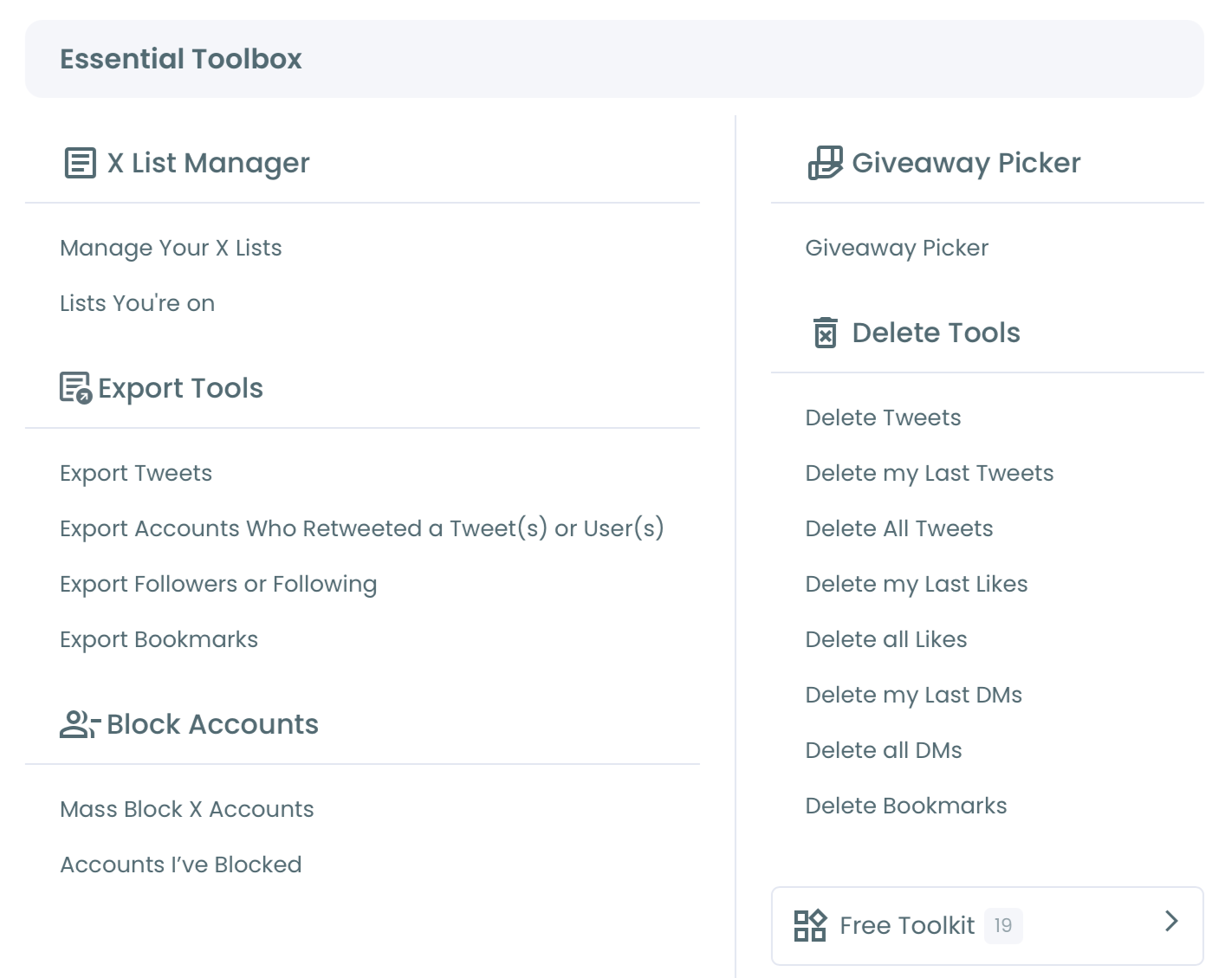
Filter, then pull your tweets into a file
- Enter the X username whose tweets you want, starting with your own handle to see your full recent history.
- Apply filters before exporting so the file matches your goal, narrowing by date range, engagement threshold, post type, keyword, or language.
- Confirm the export and enter the email address where the CSV should land; the file is also stored in your Circleboom account for later retrieval.
That order matters because filtering before export is what turns a raw dump into a usable dataset. Pulling every tweet blind gives you noise; scoping to a campaign window or your highest-impression posts gives you an answer you can act on the moment the file opens.
At a glance: connect, open Export Tweets, filter, run, download. The 3,200 API window is handled automatically.
What About Tweets Older Than 3,200 Posts?
For history that predates the API window, the archive is your source, and Circleboom works with it directly. When you want to view and then act on your complete record, you can upload your archive to delete all tweets or clean specific slices of it with filters.
This is where the two paths meet. Many people who ask how to see all their tweets are really preparing to remove or reset them. Seeing the full picture first is the safe move, whether you keep the record as a backup or clear years of posts you no longer want indexed. If a full reset is the plan, the my tweets workspace and archive tools let you review before anything is permanent.
One rule holds no matter which path you take: export before you delete. A CSV of your tweet history is the only recovery option if a cleanup turns out broader than you intended, because deletions cannot be undone. X's own download your X archive help page confirms the same 24 to 48 hour wait for the native file. That slow round trip is exactly why a fast structured export earns its place in the workflow, and why a Twitter archive viewer matters once the file is in hand.
What You Gain From a Full Tweet Export
Once your tweets sit in a spreadsheet, the value goes past simple backup. Sorting by impression count across your whole recent history shows which formats and topics consistently win, separating reliable performers from one-time spikes.
You can filter to high-engagement posts and build a library of proven content. You can review your tweet-versus-reply-versus-retweet mix to rebalance your output. You can hand a clean performance report to a client without giving them access to any tool. None of that is possible inside X's native analytics, which shows aggregate charts you cannot sort or export.
If your endgame is analysis rather than backup, Circleboom's breakdown of how to export all tweets to Excel or CSV walks through the columns you get and what to do with them.
The Bottom Line
Seeing all your tweets on Twitter comes down to matching the path to the goal: a structured CSV for your recent, analyzable history, or your archive for the complete record beyond the 3,200-tweet ceiling. Circleboom covers both through official API access, so you get the data without risking your account. When you are ready to pull all my tweets into one file, start here:
→ export all my tweets in one file
Frequently Asked Questions
Can I really see every tweet I have ever posted?
Yes, but through two sources. Your most recent 3,200 tweets are available live and export as a structured CSV; anything older lives only in your X data archive, which Circleboom can also process.
Why can I only see 3,200 tweets in the export?
The 3,200 cap is set by X's API, not by Circleboom. It applies to every tool that reads your timeline through official channels. For older tweets, you upload your archive file instead.
Can I export tweets from an account that is not mine?
Yes, for any public account. Circleboom retrieves the data through official X API access, so you can pull a competitor's or influencer's recent tweets for research without needing their credentials.
Does exporting my tweets change anything on my account?
No. Export is read-only; it copies your tweet data into a file and leaves your timeline untouched. Deletion is a separate, deliberate action you control.
How long does the export take and how big is the file?
The API pull finishes in minutes, not the 24 to 48 hours the native archive needs. A full 3,200-tweet export lands as a single CSV, usually a few megabytes even with every engagement column attached, so account age never turns the result into something too heavy to open. You can drop it straight into a pivot table the moment it arrives.
Which filters make the export most useful?
Start with a date range to isolate a campaign or a quarter, then layer an engagement threshold to surface only posts above a certain impression or like count. Adding a post-type filter, original tweets versus replies versus retweets, narrows the file further, so a broad history becomes a focused answer to one question before you ever open the spreadsheet.