
Anyone on X can add your account to a List without following you and without sending a notification. Those placements build up quietly, and the app ships no screen that collects them in one place. The data is public, but you have to assemble it yourself, one profile at a time, unless something does the collecting for you.
How do you see which Twitter lists you've been added to?
Circleboom reads every public X List that contains your account and lays them out as a card grid through official API access. Each card carries the list name, its member count, and its follower count, and one click opens that list on X.
→ see what Twitter lists I'm on
Why X keeps your own list placements out of reach
X built Lists as a reading tool, not as a reputation report. Any account can add any public account to a List. No follow is required, no approval is requested, and no notification goes out.
Your account can sit inside dozens of Lists built by people you have never spoken to.
The result is a one-way mirror.
You can open every List you built yourself in two taps, and you can see the Lists you subscribe to. The set of Lists that contain you is the one view the app never assembles, even though most of those Lists are readable by anyone who finds them.
That gap is worth closing, because list names are the labels other people file your account under. If you have ever wondered are Twitter lists public, the short answer is that most of them are. Those labels sit in plain view for anyone sizing up your account before a deal, a hire, or a collaboration.
Circleboom pulls the scattered data into one screen, so you can see which Twitter lists you've been added to without opening a single profile.
What a list placement tells you that follower counts cannot
A list placement is a judgment somebody made about your account.
Follower counts measure reach. List names measure classification: the topic, industry, role, or community another user decided you belong in. Nobody files an account under a List titled around fintech founders by accident.
Four kinds of information come out of a full read:
- The topics other X users associate with your account.
- The communities that already treat you as relevant.
- The list builders who organize your space and are worth knowing.
- Placements that sit outside the positioning you intended.
When several unrelated people file you under the same topic, that topic is your working positioning, whatever your bio claims.
Reading placements one at a time is the slow route, and it stops being practical the moment the count grows past a handful.
Our walkthrough on how to check what lists you are on Twitter covers the manual path. The workflow below is the version that still works when the number climbs.
How to read a list name without over-reading it
A list name is evidence, not a verdict.
Someone typed it in a hurry, for their own filing system, and never expected you to read it. That makes the individual name weak and the pattern across names strong.
Weight each placement by three things you can see on the card:
- Member count tells you whether you sit in a tight selection of twelve accounts or a dragnet of nine hundred.
- Follower count tells you whether anyone actually reads the list.
- A name that repeats across several separate builders tells you the classification is shared rather than one person's quirk.
A tight list with real followers is worth ten bulk lists nobody subscribes to.
The trap is treating one flattering name as proof and one unflattering name as damage. Neither holds up alone. A single list titled around thought leaders in your field is one person's opinion; six lists clustering on the same niche is a market reading of your account.
Watch for the mismatch case as well. If the names cluster around a topic you stopped covering a year ago, the classification is running on old content, and your recent posting has not moved it yet.
That is useful information about how slowly perception updates, and it argues for consistency over range in what you publish next.
How to see what Twitter lists I'm on, step by step
Watch the list screens in motion: this short walkthrough shows the X List Manager area you will be working inside.
https://www.youtube.com/watch?v=VvGU13mvRoo
Circleboom is an official X Enterprise Developer company, so the entire read runs on permitted calls against the account you connect. Nothing here depends on scraping, browser hacks, or credentials handed to a third party. Open the X List Manager area and check the Twitter lists you're on in a single pass.
The process, in order.
Open your placements inside Circleboom
- Log in to Circleboom Twitter and connect the X account whose placements you want to read.

- Open the Essential Toolbox menu, where the X List Manager tools sit.
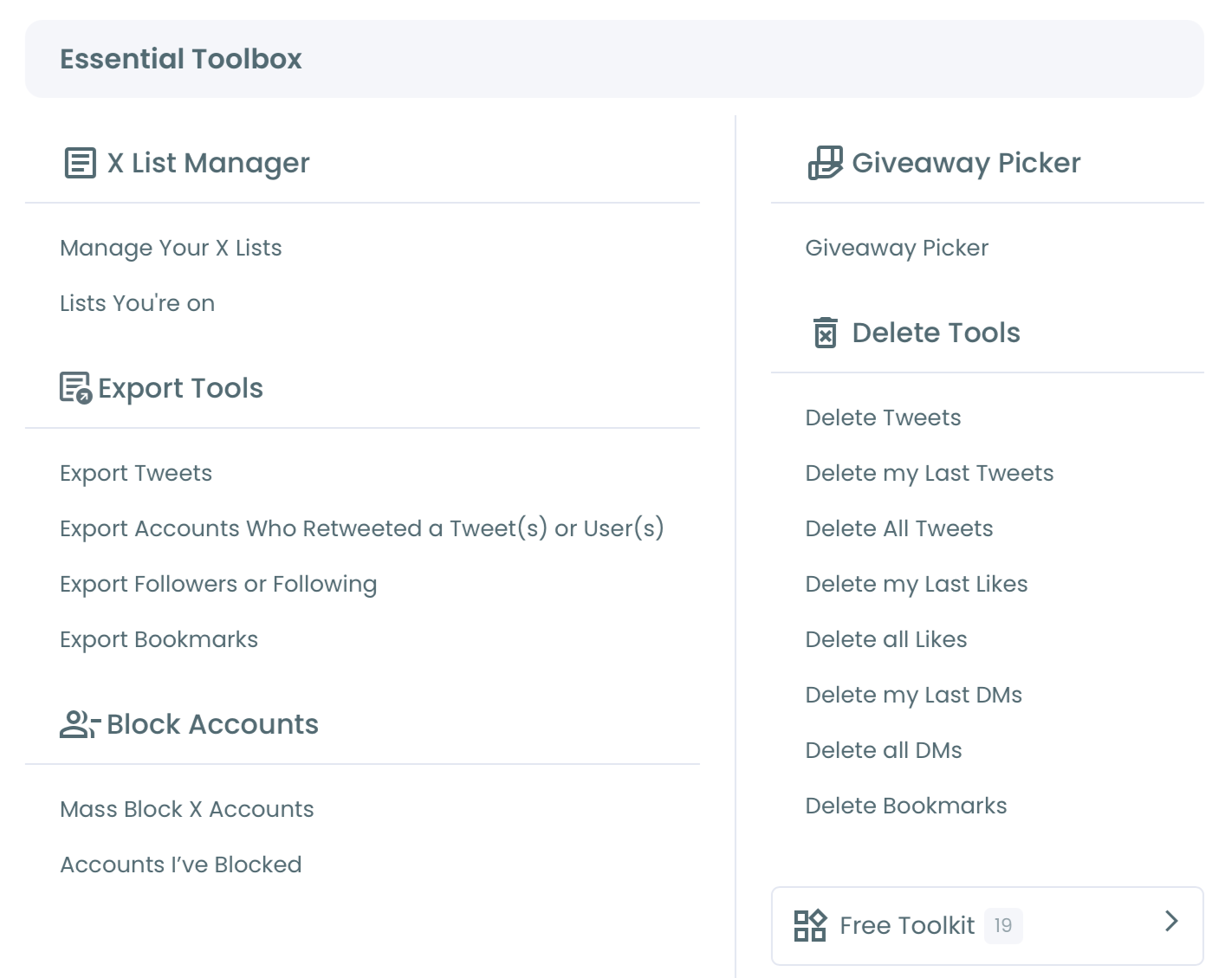
- Select the Lists You're On view to load every public X List that currently includes your account.
Read the grid and act on what deserves it
- Scan the card grid, which gives you each list name, its member count, and its follower count at a glance.
- Click any card to open that list on X, where you can read the full membership and check the account that built it.
That sequence is what keeps the read fast and honest.
The login earns official API access to your own account data. The menu step drops you into the right toolset instead of a search box, and the grid hands you the whole picture before you spend attention on any single list.
Reverse the order, and you are back to guessing from individual profiles.
What to do with the placements you find
Sort the results into three piles: placements that confirm your positioning, placements that surprise you, and placements you would rather not carry.
Confirmations are the easy pile. If a cluster of lists files you under one topic, that is external agreement about what you cover, and it belongs in your content plan.
Compare that topic cluster against Twitter interest targeting data for your actual followers, and you can tell whether the audience you built matches the category strangers assign you.
Turn the surprises into introductions
Surprises are the pile worth the most attention. A list titled around a community you never courted means you already have visible presence there. Those are rooms you can walk into with standing you did not have to build from scratch.
The accounts that built those lists are usually peers, journalists, or researchers in the same space, and following them back is a cheap first move.
When the same peers keep appearing beside you, run those handles through compare Twitter/X accounts to see how much audience you share. Getting grouped together and sharing followers are different facts, and the second one tells you whether the grouping has weight.
Decide what to ignore, on purpose
The third pile is where you decide to do nothing loudly. Spam lists and scraped-together directories exist, and being on one says more about the builder than about you. Treat them as noise unless they are abusive.
If reading placements makes you want to build your own, our notes on Twitter List Manager cover the building side.
List size has ceilings too. Our breakdown of how many accounts you can add on Twitter lists sets out those limits before you plan a system around them.
Is it safe to check the Twitter lists you're on?
Yes, and the read leaves no trace.
The Lists You're On view is read-only inside Circleboom: it displays public list data and never adds, edits, or deletes anything. List builders get no notification that you looked, because there is nothing to notify them about.
The read also costs your account nothing. No follows are sent, no messages go out, and no membership changes anywhere. You are looking at a public record that already existed, arranged so you can read it in one sitting instead of forty tabs.
What the view cannot show you
A few limits are worth knowing before you go looking:
- Private lists never appear, since the API does not expose lists their creators marked private, and no tool can work around that.
- The view is a snapshot of the present rather than a history log, so a list you were removed from last month will not show up.
- Very large numbers of placements may not all appear in a single retrieval.
What you can do about an unwanted placement
Removing yourself is the one thing no tool can do for you, and that is a platform rule rather than a product gap. Only the list owner can remove a member.
You have two real responses. Blocking the builder pulls your account out of every list they own, per X's own documentation on blocking accounts, and reporting works when the list itself breaks platform rules.
Our notes on how do I remove myself from a Twitter list walk through both responses in detail.
Where the manual method breaks down
Checking by hand works right up until the count grows.
The manual route means opening a profile, tapping into its lists, and looking for your own handle, one builder at a time. That only works if you already know which builders to check, which defeats the point of the exercise.
The deeper problem is that the manual path is biased toward the accounts you already follow. The placements worth finding are usually built by people outside your circle: researchers, journalists, and operators tracking your niche who never engaged with a single post of yours. They are exactly the accounts you would never think to open.
A full read reverses the direction. Instead of starting from a builder and looking for yourself, you start from your account and let every public list that contains it come back at once.
The card grid then lets you sort by weight in a couple of minutes rather than an afternoon.
There is a consistency argument too. Doing the same read the same way each quarter gives you comparable snapshots, and comparable snapshots show drift. A manual sweep taken in different moods on different days gives you anecdotes.
Your next move
Reading your placements takes one sitting, and it changes what you know about how X sees you.
Work the checklist in this order:
- Connect the account and load every public list that includes it.
- Note the topic that repeats across the most lists.
- Open two or three lists and follow the builders who cover your space.
- Flag anything spammy for a block-or-ignore decision later.
One pass gives you the map. A second pass a quarter later gives you the direction of travel, and direction is the part that tells you whether your content is landing where you aimed it.
The account you think you run and the account other people file away are rarely the same thing, and the second one is what strangers meet first.
→ Open the grid and view every Twitter list you're on
What to know before you check your list placements
Can I remove myself from a Twitter list?
No. X gives members no way to leave a list they were added to, so only the person who built the list can remove you. Blocking that account removes you from every list they own, and reporting the list is the right move when it crosses platform rules.
Will the list builder know that I looked?
No. Reading your placements is a passive lookup against public data, and nothing is written back to X. The builders see no view counts, no alerts, and no record of the check.
Why do some lists I know about not show up?
Private lists are invisible to any tool, including this one, because the API never returns them. Very recent lists and very recent membership changes can also lag by a short window before they appear in a fresh read.
How often is it worth checking?
Quarterly is a sensible baseline for most accounts, and sooner after anything that moves your visibility: a press mention, a launch, a thread that traveled, or a shift in what you post about. Placements accumulate slowly in quiet months and arrive in clusters after a spike. The check pays off most right after a burst of attention, when new labels are still easy to trace back to the post that earned them.