

Bulk cleanups are blunt by design. A fake-follower sweep or an inactive purge applies one rule to a list that contains your best customers, your loudest supporters, and the account that gave you a break two years ago.
The safe order is to identify what deserves protection first, then clean.
What this walkthrough gets you.A named list of the accounts in your audience that clear a real credibility bar.Filters that cut that list down to the people in your actual market.A whitelist that every future bulk operation in Circleboom will skip.
Circleboom builds the list from your live follower data on X through official API access, so nothing here rests on a guess.
→ Start with your most valuable Twitter followers
The cleanup problem nobody warns you about
Every cleanup feature treats your follower list as a pool of candidates. That is the correct design, and it is also the risk, because a filter tuned to catch dormant accounts cannot tell a retired lurker from a customer who reads without posting.
The accounts most likely to be caught by accident share a profile. They post rarely, they follow few people, their bios are short, and their value to you has nothing to do with any of that.
The damage is quiet, too. Nobody gets a notification saying a customer was removed from your followers, so the loss registers weeks later as a conversation that never happened. Recovering it means asking someone to follow you again, and most people never see the request.
A single protection pass ahead of the cleanup avoids the entire problem.
Protection has to be explicit, because no automatic filter can infer which relationships matter to your business.
Circleboom solves this by giving you the opposite of a cleanup list. Its High Quality Followers segment names the accounts in your audience with the strongest credibility signals, and any account you whitelist from that view is skipped by every bulk removal, block, or unfollow pass you run later.
Order matters more than speed here. Pull your high quality followers on X, protect them, and only then open a cleanup screen.
The same sequencing shows up in Twitter X follower manager: analyze, clean, and control your followers, where analysis always precedes removal.
The signals Circleboom reads before calling a follower valuable
Circleboom scores every follower on a set of signals and puts the strongest results into the high quality segment.
The follower-to-following ratio anchors the score, since accounts with far more followers than follows tend to have grown by relevance rather than by mass follow-back tactics.
Ratio alone would be easy to game, so it never decides on its own. The score also reads:
- Tweet activity.
- Whether the profile looks lived-in.
- How long the account has existed.
- Whether its behavior matches a real person using the platform.
The table then hands you the evidence rather than a verdict. Every row carries the account name and handle, total tweets, join date, following count, follower count, the follow ratio, and an active or inactive marker with an engagement level.
Data quality is the reason those columns can be trusted. Circleboom is listed on X's Enterprise customer directory and reads your follower list through official API access, so the segment reflects real public profile data at the last sync rather than a partial scrape.
X's own platform manipulation and spam policy is explicit about the risk unofficial automation carries. That is exactly the class of tooling this avoids, and it is why the segment can be acted on rather than just read.
One habit makes the segment more useful over time. Note the count and the date each time you open your valuable followers on Twitter, because a single reading is a snapshot and two readings are a trend.
Audience quality moves slowly, which is precisely why it goes unnoticed without a written number to compare against.
Finding the followers that boost your reach on X
https://www.youtube.com/watch?v=Y_JlpQHVDIk
The flow below runs in three phases: get into the segment, narrow it to your market, then lock the result in.
How to find your most valuable Twitter followers, step by step
Open the segment and read the headline number
- Open Circleboom Twitter and connect the X account whose audience you want to review.

- Open the Follower and Following management menu, which holds every audience view Circleboom builds for your account.
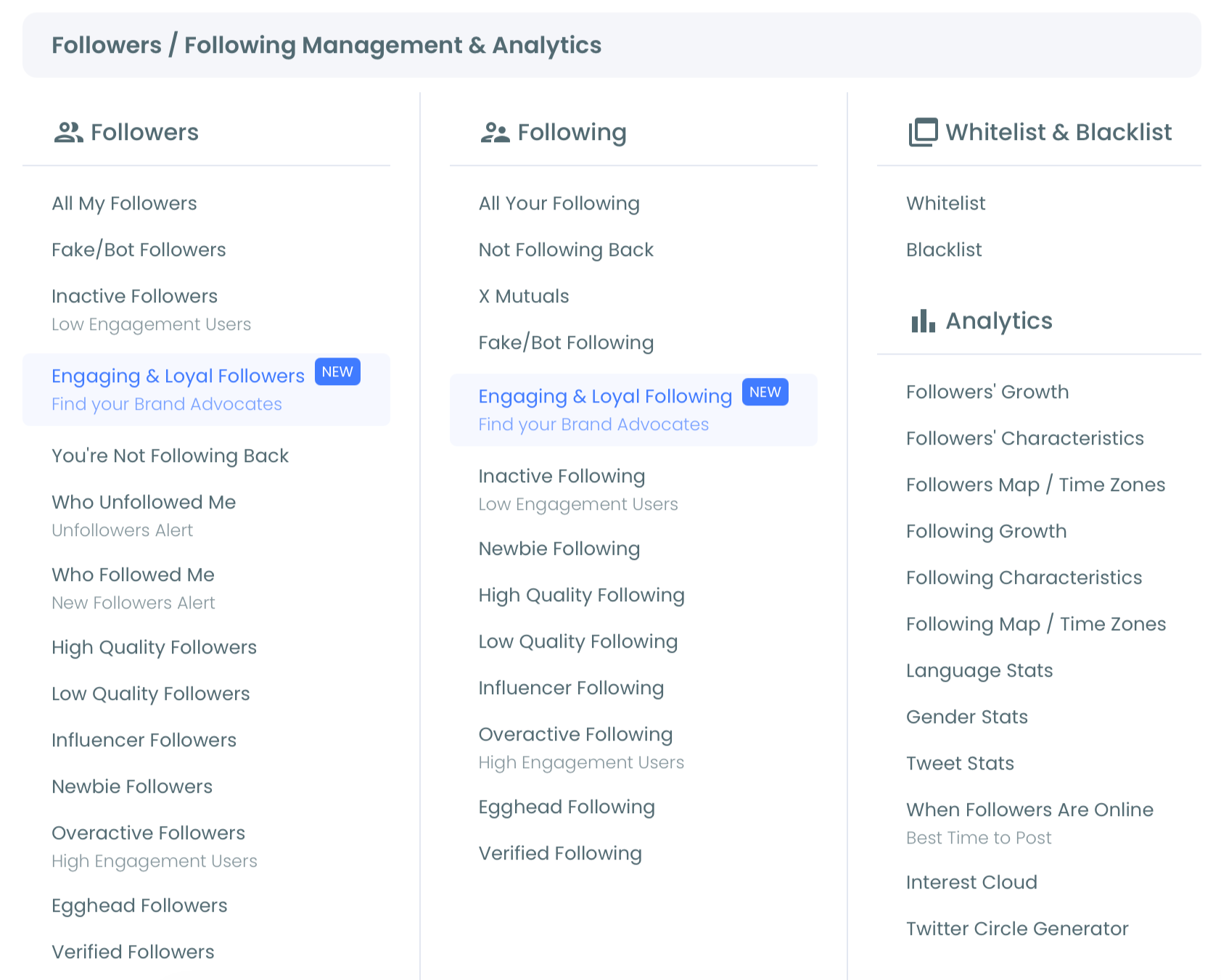
- Choose High Quality Followers. The page title reports how many of your total followers made the cut, and that count is your baseline for every future comparison.
Cut the list down to your actual market
- Open Filter Options to reveal the full filter drawer. Follower Count, Following Count, Tweet Count, Follow Ratio, and Join Date each accept a minimum and a maximum.
- Type a keyword into Find in Bio and Name to keep only the accounts that describe themselves in your language. This is where a general list becomes a relevant one.
- Set Language and Location if your business is regional. A credible account in the wrong country is still the wrong account for a local offer.
- Add an Engagement or Verification filter when you need a stricter cut, then read the active filter bar at the top of the list to confirm exactly which segment you are looking at.
Protect and act on what survived
- Select accounts with the row checkboxes, or use the master checkbox to take the whole filtered view in one click.
- Open Add to List and choose Whitelist so those accounts are excluded from bulk actions everywhere in Circleboom.
- Use Follow or Add to List again for the accounts you want to reciprocate with or group into an X List for daily reading.
- Export the selection as CSV when you need the segment outside the app. Exports draw on a token balance that scales with how much you download, and the button shows what you have left before the file is generated.
The order is doing real work in that sequence. Filtering before selecting means you never whitelist an account you have not looked at, and whitelisting before any cleanup means the protection is already in place the moment a bulk filter starts running.
What the columns tell you at a glance
Read the table as a set of cross-checks rather than a leaderboard:
- Follow ratio tells you how the account grew.
- Tweet count and the active marker tell you whether it is still here.
- Join date tells you whether the history is real or freshly minted.
A pattern worth watching: high ratio, high follower count, low tweet count, recent join date. That combination looks impressive in a single column and falls apart across four.
Readers who want the mechanics of size-based sorting will find them in how to filter your X followers by follower count.
The inverse pattern is the one people miss. Moderate ratio, steady posting, long history, and a bio that matches your niche describes an unglamorous account that is worth more to you than a dormant giant.
Sorting by follower count answers a different question, which is who in your audience has the widest reach. Who has the most followers in your followers list works through that view in detail.
Small accounts complicate the picture in a good way. Reach is not always visible from a follower number, and find the hidden influencer among your X followers covers the case where someone in your audience carries real weight in a niche you do not follow closely.
For the accounts that pass every check, a saved list beats a screenshot. The Twitter List Manager turns the selection into a working feed you can open daily.
When the list has to leave the app, export list of followers on Twitter covers the CSV route into a spreadsheet or a CRM.
How often should you re-run this on X?
Re-run it before every cleanup and after every growth push. Those are the two moments when the composition of your audience actually changes.
Before a cleanup, the run gives you a protected core and a baseline number.
After a cleanup, the same run tells you whether the removal improved your audience or only shrank it, because the share of your smaller follower count that now clears the quality bar is the honest measure.
A growth push deserves the same treatment for a different reason. Fast follower gains attract automation. A spike that adds two thousand accounts with no history is worth checking against the Twitter follower quality view before you celebrate it.
Quarterly is a reasonable default for accounts that grow steadily. Monthly makes sense if you post daily, run campaigns, or work in a niche where bot traffic is heavy.
Keep the record light. A single line in a note somewhere with the date, the total follower count, and the size of the high quality segment is enough to make the next reading meaningful.
What you are watching for is the ratio between those two numbers rather than either one alone. A follower count that climbs while the quality share falls is the signature of growth that will not convert, and it is worth catching early rather than after a campaign underperforms.
One more prompt to re-run it: any time you are about to spend money on the audience. Ad targeting built on a follower list, a giveaway aimed at your existing audience, or a paid collaboration all assume the audience is real, and that assumption deserves a check before the invoice.
What changes once the core is protected
Posting decisions get easier when you know who you are writing for. A protected core is a small, concrete audience you can picture, which is a different thing from a follower count you can only round off.
Reply behavior changes first. When a named list of credible followers sits in front of you, replying to them stops being a random scroll through notifications and becomes a short, deliberate pass through people whose attention you already earned.
Cleanup decisions get faster too. The hesitation that stops most people from ever removing bot followers comes from not knowing what else might go with them, and a whitelist removes that hesitation permanently.
The reporting side benefits last but matters most for anyone pitching. A sentence like "a measurable share of my audience clears a credibility threshold on ratio, activity, and account age" is a stronger claim than a raw number, and it is defensible because the list behind it exists.
Where to go from here
Pick the branch that matches your situation and act on that one.
- If a cleanup is on your calendar, whitelist the high quality segment today and run the removal tomorrow.
- If you are preparing a pitch or media kit, filter by niche, note the share, and export the list as evidence.
- If your goal is engagement, sort the segment by reach, add the top accounts to a dedicated X List, and reply to them like a person.
- If you inherited the account and do not know its history, run the segment once for a baseline, then re-run after your first cleanup.
Every one of those branches is faster with the segment already built. Circleboom keeps the actions behind it inside official API access, so bulk follows and removals run at a pace X expects instead of a pace that gets accounts flagged.
→ Build your high quality follower list
What to know before your next follower cleanup
Does whitelisting protect an account from every bulk action?
Yes, across the platform. A whitelisted follower is excluded from bulk removals, mass block queues, and bulk unfollow passes, so one pass of protection covers every cleanup workflow you run afterward.
Can I check someone else's audience the same way?
The high quality segment reads your own followers. For someone else's audience, Circleboom's Monitoring menu is the entry point, with account comparison and following/follower tracking built for exactly that. The export side of the job is walked through in how to check and export my most followed followers on X.
What happens if I follow back a large batch at once?
Circleboom paces it for you. Follow actions run at 50 every 15 minutes and up to 400 per day. The queue resumes on its own the next day when the daily ceiling is reached, so a big batch finishes gradually rather than in one burst.
Is a small account ever more valuable than a large one?
Often. A 900-follower account in your exact niche that replies to your posts is worth more than a 90,000-follower account that has never read one. That is why the filters for bio keywords, language, and engagement matter as much as the ratio column.



)