
The fastest way to tailor content for Facebook vs Instagram vs Twitter in 2026 is to start with one core idea, adapt the format and length per platform, then cross-publish through one tool that respects each platform's native shape.
The same idea looks different on each platform: Twitter wants a hook plus a thread, Instagram wants a carousel or a reel, Facebook wants a longer-form post with context. Trying to publish identical content across all three produces below-baseline performance on each.
Circleboom's Cross-Posting publishes the same core idea to X, Instagram, Facebook, LinkedIn, Threads, and Bluesky from one composer, with per-platform adaptation handled inline, on Circleboom's verified Enterprise developer access.
→ Run cross-platform content tailoring
Below: per-platform format guides, the adaptation framework, and the cross-publish workflow.
Why Identical Cross-Posting Fails
Each platform's algorithm reads content shape, length, and engagement signals differently. Twitter's algorithm rewards short hooks and threaded replies; Instagram's rewards visual-first carousels and reels; Facebook's rewards longer text posts with link previews. Publishing the same 280-character text across all three produces:
- A baseline-performing tweet (matching Twitter's expected format).
- An undersized Instagram caption (Instagram expects 800 to 1,500 characters).
- A truncated Facebook post (Facebook expects context, not a one-liner).
The result is one platform performing as expected and two underperforming. Operators who notice this pattern often abandon multi-platform posting; the better fix is per-platform tailoring with one tool managing the cross-publish.
The article on content marketing strategies that boost blog traffic covers the same multi-platform principle from the strategy side.
What Each Platform Wants Specifically
Facebook rewards longer text, link previews with rich context, and posts that drive comment threads. Length sweet spot: 80 to 150 words. Image: optional but encouraged. Tone: conversational, informative.
Instagram rewards visual-first content, carousels of 3 to 7 images, and reels under 30 seconds. Caption length: 800 to 1,500 characters. Hashtags: 5 to 10 niche tags. Tone: visual-led, narrative.
Twitter rewards short hooks, threaded replies for longer ideas, and quote-tweets for participation in conversations. Length sweet spot: hook tweet under 200 characters, thread tweets 240 to 280 characters each. Image: optional, often boosting reach.
LinkedIn rewards professional-tone posts of 800 to 1,300 characters with optional native video. Threads and Bluesky read most similarly to Twitter but with their own engagement patterns. The article on Bluesky vs Threads popularity covers the difference between the two newer platforms.
How to Tailor and Cross-Publish (Step by Step)
The flow has three phases: produce the core idea, adapt per platform, cross-publish through one composer.
Hands-on demo: how Cross-Posting publishes adapted content across X, Instagram, Facebook, LinkedIn, Threads, and Bluesky.
The flow, in order.
Open the cross-posting workspace
- Log in to Circleboom Twitter and connect your X account through OAuth.
- Navigate to the X Post Planner menu for the cross-posting workspace.
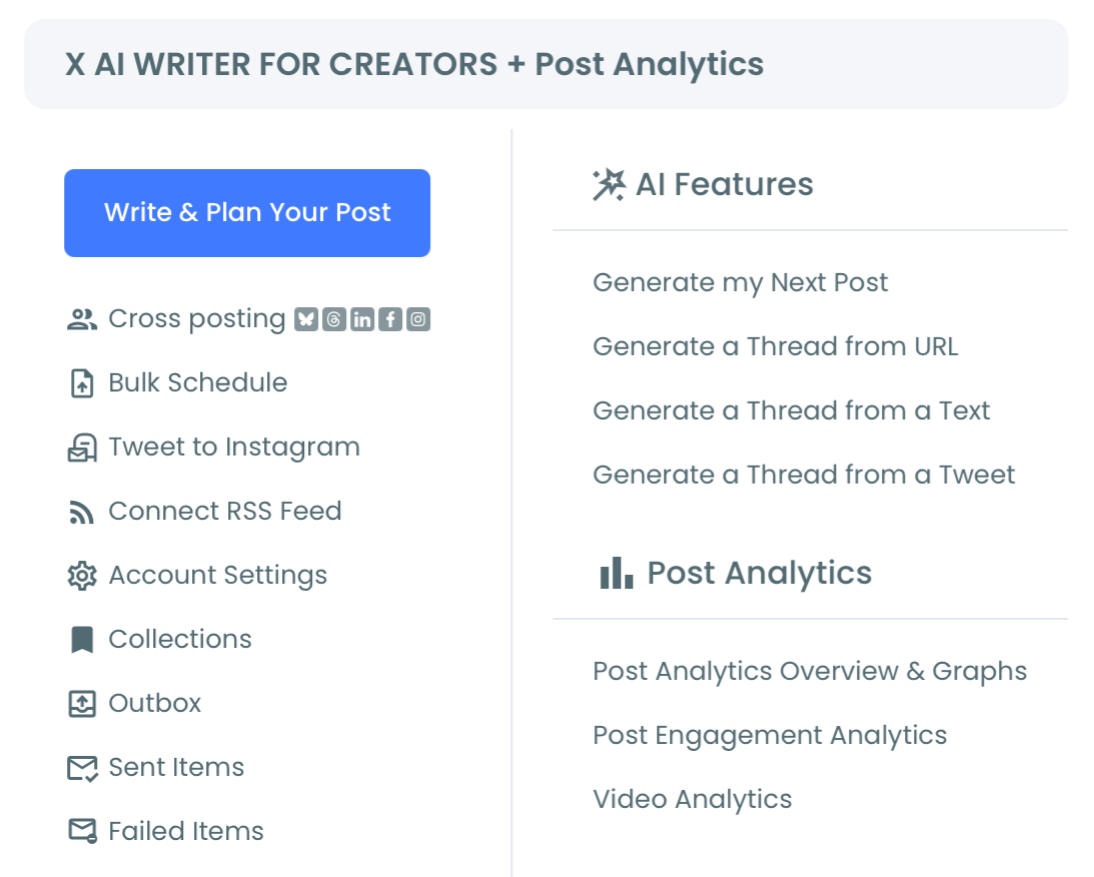
- Connect Instagram, Facebook, LinkedIn, Threads, and Bluesky to the Circleboom dashboard for cross-publish.
Adapt per platform
- Draft the core idea as the source. Keep it platform-agnostic for the first pass.
- Adapt the format per platform using the inline composer: short hook for X, longer caption for IG, narrative for FB, professional tone for LinkedIn.
Cross-publish
- Schedule the adapted versions to publish simultaneously or staggered across the audience-active windows for each platform.
That sequence is what makes multi-platform tailoring sustainable. The single tool handles the cross-publish, which means the operator's marginal cost per platform drops to roughly 5 minutes of adaptation per platform per post.
What "Adapt Per Platform" Looks Like in Practice
The adaptation framework can be templated. For a 1,000-word blog post being promoted across platforms, the per-platform shapes are:
- Twitter: hook tweet plus 4-5 thread tweets summarizing the argument plus link in tweet 2.
- Instagram: 5-image carousel summarizing the same argument visually, with a 1,200-character caption.
- Facebook: 120-word post pulling the strongest insight from the article, with link preview.
- LinkedIn: 1,000-character professional-tone post framing the article's relevance to the operator's professional network.
- Threads and Bluesky: shorter version of the Twitter thread, adapted for each platform's style.
Each adaptation takes 5 to 10 minutes once the core idea is drafted. The cumulative time is 30 to 60 minutes per blog post for cross-platform promotion, which is meaningfully better than producing platform-specific content from scratch.
What to Avoid in Cross-Platform Content
Three failure modes account for most accounts that try multi-platform posting and produce below-baseline results.
- Identical reposting. Posting the same text across all platforms ignores each platform's format expectations and produces underperformance on most platforms.
- Platform abandonment. Giving up on platforms that did not perform on the first attempt without adapting the format. Most platform underperformance is a format issue, not a platform-fit issue.
- Tool sprawl. Using a different scheduler per platform produces three or four times the operator overhead for the same output. The cross-posting tool consolidates the workflow.
The article on cross-posting tweets to Instagram Stories covers the visual-side adaptation directly. The article on how different types of visual content impact engagement covers the format-effect side.
How the Three Platforms Compare on Audience Behavior
Facebook's audience consumes longer-form content and drives comment threads. The platform's algorithm rewards posts that produce conversation, which means posts that ask questions or take positions outperform descriptive posts.
Instagram's audience consumes visually-led content. Reels currently get distribution priority over still images. Carousels still perform well for educational or list-format content. Captions matter for SEO but visual is the lead.
Twitter's audience consumes shorter, faster-cadence content. The platform rewards hooks, threads, and quote-tweet participation in conversations. Single-tweet posts perform fine; threaded content performs better for longer ideas.
The three platforms collectively cover roughly 80% of the social audience for most B2B and consumer brands. Multi-platform tailoring is the cost of accessing all three.
The Bottom Line
Tailoring content for Facebook vs Instagram vs Twitter in 2026 is a 30-to-60-minute-per-post adaptation workflow run through one tool.
Circleboom's Cross-Posting handles the cross-publish; the operator handles the per-platform format adaptation; the result is per-platform performance that respects each platform's expectations.
→ Run cross-platform content tailoring now
 infocircleboom.com
Common Questions About Cross-Platform Content
Should I always tailor or sometimes post identical content?
Tailor. The 5-to-10-minute-per-platform adaptation cost is meaningfully lower than the performance loss from identical reposting. Even simple adaptations (length adjustment, hashtag set, image vs no image) lift per-platform performance.
How many platforms should I post to?
Three to five is typical for most brands. Twitter, Instagram, and LinkedIn or Facebook covers most B2B audiences. Adding Threads and Bluesky extends reach with minimal incremental effort through the cross-posting workflow.
Does Circleboom handle the format adaptation automatically?
The composer surfaces the per-platform fields for adaptation; the operator writes the adapted text. Full automation of the adaptation produces lower-quality output; the manual adaptation step is the quality gate.
Is the cross-posting workflow safe under each platform's rules?
Yes. Circleboom integrates with each platform through the platform's official API or Developer access, and runs through Circleboom's Enterprise-tier access on X for the X side specifically.