
Operators who want their Twitter threads to reach viral distribution face three structural problems: weak hooks that fail to drive thread-clicks, padded arcs that cause reader drop-off, and missing distribution layers that cap the impression base. The replacement is a documented hook-arc-distribution framework run through Circleboom's thread tools.
What this guide gives you.Five hook patterns that produce above-baseline thread engagement.A 5-to-12-tweet narrative arc framework that holds attention.The Cross-Posting and Auto Retweet distribution layer that multiplies reach.
Built on Circleboom's verified Enterprise developer access on X. Start with the Twitter Thread Maker.
Why Most Threads Plateau at Baseline
Three structural problems account for most threads that earn no traction.
The first is a weak hook tweet. Hooks that fail to create a curiosity gap earn the impression but no click into the thread. The algorithm reads the low click-through rate and stops surfacing the thread to additional readers.
The second is a padded arc. Arcs that stretch a 5-tweet idea into 12 tweets cause reader drop-off on the weak tweets, which compresses distribution.
The third is a missing distribution layer. Threads published only to X miss 30% to 60% of available reach that cross-posting to LinkedIn and Threads would capture. The article on auto-generating Twitter threads from any text covers the production-side principles directly.
How to Write Viral Twitter Threads (Step by Step)
The flow has three phases: hook, arc, distribution.
Hands-on demo: how the AI Thread Maker produces structural arcs from any starter idea.
The process, step by step.
Phase 1: Build the hook
- Log in to Circleboom Twitter and connect your X account through OAuth.
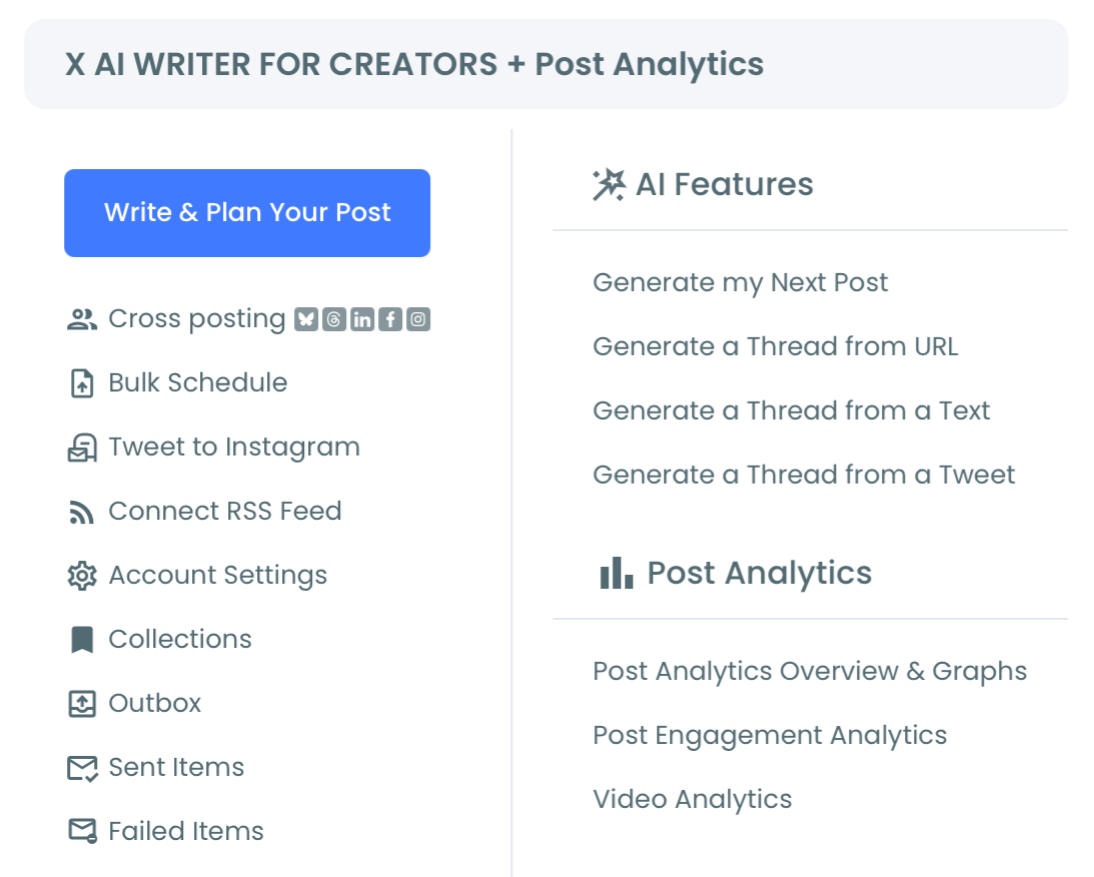
- Open the X Post Planner menu for the thread workspace.
- Draft the hook tweet under 200 characters using one of the proven patterns: counter-intuitive opening, specific-outcome with mystery, confession plus pivot, numbered promise, or question hook.
Phase 2: Build the arc
- Use the AI Thread Maker to produce the 5-to-12-tweet structural arc, then edit each tweet for clarity, voice, and pacing.
- Add the CTA tweet as the closing element: link, follow request, question, or save-prompt.
Phase 3: Schedule and amplify
- Schedule the thread through Bulk Schedule to the audience-active window.
- Enable Cross-Posting to LinkedIn and Threads for the additional reach.
- Set Auto Retweet on the strongest single tweet to recycle into different time-zone windows.
That sequence is what produces threads with structural viral potential. The hook earns the click; the arc holds the attention; the distribution layer multiplies the reach.
Quick recap:
- Connect through OAuth.
- Open X Post Planner.
- Draft the hook with a proven pattern.
- Use AI Thread Maker for the arc skeleton.
- Cross-post and Auto Retweet for distribution.
The Five Hook Patterns
- Counter-intuitive opening. "Most Twitter advice is wrong. Here is what actually works."
- Specific outcome with mystery. "I went from 80 to 4,200 monthly visits. Here is the workflow."
- Confession plus pivot. "I spent 18 months on Twitter and earned zero traffic. Then I changed three things."
- Numbered promise. "5 specific Twitter mistakes I made (and how I fixed them)."
- Question hook. "Why do most Twitter posts drive zero traffic? It is not the algorithm."
Each pattern produces above-baseline engagement on the right topic. The hook is the highest-leverage editorial moment in the thread.
The Arc Framework
The arc has three structural sections.
The setup (tweets 2 to 3) establishes stakes. It makes the reader care about the answer the thread is building toward. Weak setups produce drop-off; strong setups carry the reader into the developing argument.
The developing argument (tweets 4 to 8) carries the load. Each tweet has a specific point, supporting evidence or example, and a transition to the next. Weak arc tweets cause reader drop-off; strong arc tweets compound attention.
The payoff (tweets 9 to 10) resolves the hook's promise. The payoff has to be meaty enough to feel rewarding; thin payoffs trigger backlash and damage the operator's credibility.
The article on generating Twitter threads from articles or news URLs covers the AI-assisted arc construction, and the article on scheduling Twitter threads covers the production-and-scheduling side.
Common Mistakes Operators Make
The first mistake is skipping the hook optimization. Spending 5 minutes on the hook is higher-ROI than spending 30 minutes on the arc; the hook is what controls thread-click-through.
The second mistake is padding the arc. Threads that stretch should be edited shorter, not made longer. A 5-tweet thread that delivers beats a 12-tweet thread that drifts.
The third mistake is publishing without distribution. Threads posted only to X cap their reach at the X audience. Cross-posting and Auto Retweet are the multipliers.
What to Do Next
The workflow is concrete: hook, arc, distribution.
- Step 1: Open Circleboom and draft your hook tweet using a proven pattern.
- Step 2: Use the AI Thread Maker for the arc skeleton.
- Step 3: Schedule the thread to the audience-active window.
- Step 4: Enable Cross-Posting and Auto Retweet for the distribution layer.
→ Open the Twitter Thread Maker now
What to Know Before You Start
How long should it take to produce a viral-potential thread?
About 15 to 30 minutes once the workflow is established. The AI Thread Maker handles the arc skeleton in 2 to 3 minutes; the editorial pass takes 10 to 20 minutes; the distribution setup takes 5 minutes.
Can AI alone produce viral threads?
No. The AI handles structural production; the editorial judgment makes the hook quality and the meaty payoff. Threads with no editorial pass tend to plateau at baseline reach.
How often should I publish viral-potential threads?
Most operators sustain 1 to 2 high-effort threads per week alongside daily lower-effort posts. Publishing more than that compresses quality; publishing less leaves growth opportunities on the table.
Is the production-and-distribution workflow safe under X's rules?
Yes. All thread production, scheduling, cross-posting, and auto-retweet run through Circleboom's Enterprise developer access on X.