Manual draw: a partial list, a scroll, and a winner nobody can verify. Circleboom: the complete retweeter list retrieved through official X Enterprise APIs, ineligible accounts filtered out, and a random selection from the verified pool with the parameters documented.
→ pick a random retweeter on X
Fairness is a property of the participant list, not of the randomizer.
Everyone focuses on the randomness. Random selection is the easy part and any programming language does it in one line. The hard part is knowing you drew from the right list.
The preview problem
X does not show you everyone who reposted a post. It shows a preview: some accounts, in no particular order, with no guarantee of completeness.
That is fine for glancing at who engaged. It is disqualifying for a draw, because a winner selected from a partial list is a winner selected from whoever the interface happened to surface, which is not random in any defensible sense.
The gap widens with scale. On a post with fifty reposts the preview may be close to complete. On one with four thousand, what you can see is a small fraction, and the accounts you cannot see never had a chance of winning.
That is the actual unfairness in most giveaways, and it is invisible. Nobody running the draw feels like they cheated, because they genuinely used a random picker. They just pointed it at the wrong list.
Fixing it means retrieving the complete entry pool before anything is selected, which is what a random retweeter picker is really for. The draw is incidental.
The preview limitation has become more visible lately, and why can't I see who retweeted anymore covers what changed in the interface.
When the goal is the entry list itself rather than a winner, Circleboom's export retweeters view produces it as a file.
A perfect randomizer on an incomplete list produces a biased result every time.
The retrieval problem is covered in how do you view a full list of retweets.
What eligibility actually requires
Most giveaway rules involve more than one condition. Repost this, follow the account, sometimes like it or reply as well.
Checking those manually is where draws quietly break down. Confirming that four thousand accounts each follow you is not a task anyone completes by hand, so in practice it gets skipped, and the rule that was announced is not the rule that was applied.
The conditions that need verifying:
- Whether the account reposted the source post.
- Whether it follows the account running the giveaway.
- Whether it also liked or replied, when the rules required it.
- Whether it is a real, active account rather than a fake or suspended one.
That last one matters more than people expect. Giveaways attract automated entries, because entering costs nothing and the accounts exist to enter things. Drawing a bot as your winner is a public embarrassment that also means the prize goes nowhere.
Circleboom retrieves the full participant list, applies the eligibility filters automatically, removes accounts with fake signals or suspended status, and draws from what remains.
For the underlying extraction, Twitter retweet list extractor covers pulling a complete repost list.
Why documentation beats assertion
The result of a giveaway is not the winner. It is whether your audience believes the next one is worth entering.
Announcing a winner with no visible process invites exactly the reaction you would expect, which is a handful of replies asking how they were chosen and whether anyone can check. Those replies do more damage than they look like, because they are read by everyone considering entering next time.
What makes a draw credible is publishing the parameters alongside the outcome:
- The source post the entries came from.
- The eligibility conditions applied.
- The number of accounts that qualified.
- The method used to select from them.
None of that proves honesty in a cryptographic sense. It does make the process legible, and legibility is what people actually respond to. A draw that shows its working reads differently from one that produces a name.
The participant count carries surprising weight on its own. "Selected from 3,412 verified eligible entries" tells the reader the list was complete and filtered, which is precisely the thing they were unsure about.
It also does something useful for you. A qualified count far below your repost count means the conditions removed most entrants, which is worth knowing before you announce rather than after somebody points out that only a fifth of participants were eligible.
Circleboom produces a shareable result card with the selection parameters attached, which is the artifact that does this work.
How to pick a random retweeter on X
To pick a random retweeter, log in to Circleboom, create a giveaway from the source post, set the participation conditions, let the full participant list be retrieved and filtered, then draw the winner from the verified pool. The retrieval and filtering are what make the draw fair; the randomization is the trivial part.
Six actions, with verification before selection.
Set up the draw
- Log in to Circleboom Twitter and connect the X account running the giveaway.
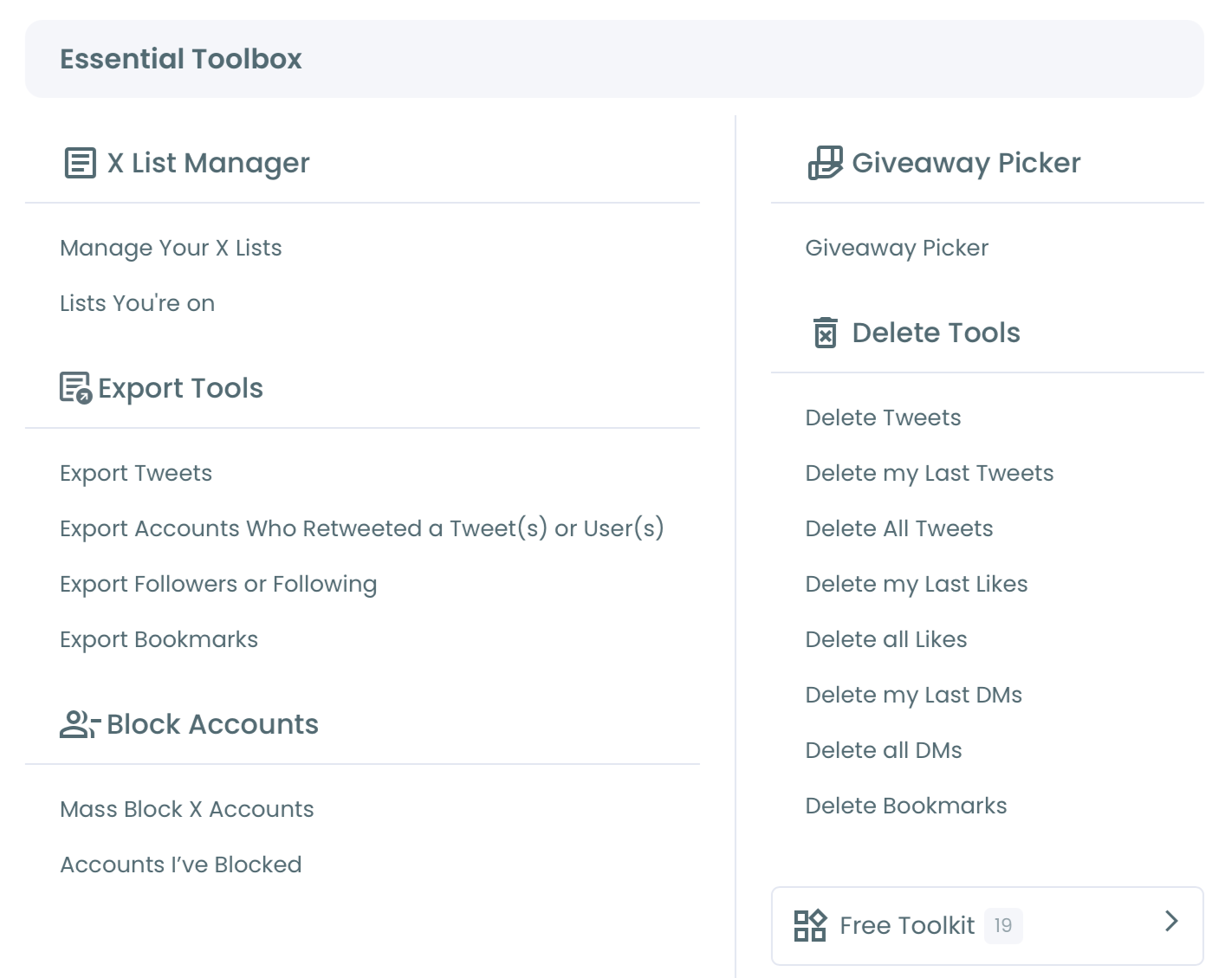
- Open the Essential Toolbox menu and create a new giveaway from the dashboard.
- Point it at the source post whose reposts form the entry pool, and check the token counter before a large retrieval.
Filter, then draw
- Define the participation conditions to match what you publicly announced. Repost, follow, like, reply, or a combination.
- Let the eligible list build while ineligible accounts are removed, then read the qualified count before drawing.
- Draw the winner and save the result card with its parameters, so the announcement carries the process rather than just the name.
That order works because every step narrows the pool before anything is selected, and the qualified count in step five is your check that the rules you announced are the rules being applied. If that number looks wrong against your repost count, the conditions are stricter or looser than you intended, and finding out before the draw costs nothing.
At a glance: source post, conditions, verified pool, draw, publish the parameters.
Short demo: how a full repost list is filtered to verified entries before a winner is drawn.
Where giveaways go wrong beyond the draw
A fair selection does not rescue a badly designed giveaway, and the design problems are more common than the selection ones.
Rules announced after the fact. Adding a condition once entries are in invalidates everyone who entered under the original terms. Set the conditions in the post and do not adjust them.
Prizes that attract the wrong entrants. A generic prize pulls in accounts that exist to enter giveaways. A prize only your actual audience would want does most of the quality filtering before any tool has to.
Follow-to-enter as the only condition. It produces a follower spike that churns within weeks, since people who followed for a prize unfollow once it is awarded. The count moves and the audience does not.
That third one is worth dwelling on, because the follower spike is usually the reason the giveaway was run. If the followers leave, the giveaway bought a number rather than an audience, and the number is the thing that does not matter.
The engagement-quality question underneath this is covered in why are my Twitter followers not retweeting or liking my tweets.
For the structural side of running one well, how to run a successful Twitter contest covers the design decisions that precede any draw.
Drawing more than one winner
Multi-winner draws introduce a decision most people make accidentally: whether an account can win twice.
Drawing with replacement means each selection happens against the full pool, so the same account can theoretically come up more than once. Drawing without replacement removes each winner before the next draw, which is what almost everyone actually intends and rarely states.
Announce which one you are using. A repeat winner in a three-prize giveaway looks like a rigged result to an audience that assumed three different people, even when the process was genuinely random.
Tiered prizes need an order
When the prizes differ in value, the sequence matters and should be fixed in advance.
- Draw the top prize first, from the full eligible pool.
- Remove that winner, then draw the next tier.
- Continue down, announcing the order as part of the rules.
Doing it the other way round, drawing all winners and then assigning prizes, invites the suspicion that assignment was not random even if the selection was. The order is cheap to specify and expensive to argue about afterwards.
There is a related question about runners-up. Prizes go unclaimed more often than people expect, particularly when the winner is an account that entered several giveaways and has stopped checking mentions. Drawing two or three reserve names at the same time, from the same verified pool, saves re-running the whole process a week later.
Set a claim window and say what it is. Something like seven days, stated in the announcement, converts an awkward silence into a documented process with a defined next step.
Decide replacement, order, and the claim window before the draw, not after somebody asks.
The account-quality question applies here too, since a reserve winner drawn from the same pool inherits the same filtering.
What the tool cannot decide for you
Circleboom is an official X Enterprise Developer company, so participant retrieval runs through authorized API access rather than scraping a preview. Two limits are worth being clear about.
The filters catch accounts showing fake or automated signals. They do not catch a determined person entering from several accounts they control, because those accounts can look entirely ordinary from the outside.
And eligibility is only as good as the conditions you set. If the announced rule was repost-and-follow but the draw was configured as repost-only, the tool applies what it was told, and the mismatch is a configuration error rather than a detection failure.
Two habits that prevent most disputes:
- Configure the conditions to match the announcement exactly, and check the qualified count against your expectation.
- Publish the parameters with the winner rather than after somebody asks.
There are also platform rules governing promotions, and X's rules and policies are the reference for what a giveaway is allowed to require of participants.
Draw from the whole list
A lucky retweet picker is only as fair as the list it draws from. Randomness is trivial; completeness and eligibility are the parts that take work, and they are the parts a preview cannot give you.
Retrieve everyone, filter to the announced conditions, read the qualified count, then draw and publish the parameters alongside the name.
The payoff is not this giveaway. It is the next one, where people who watched a transparent draw enter without hesitating. Trust in a repeated programme compounds, and so does the lack of it.
Questions about picking a random retweeter
Why can't I just use the repost list on X?
Because it is a partial preview rather than the complete list. Accounts it does not show never enter the draw, which makes the selection biased regardless of how random the picker is.
How do I verify entrants followed me?
Set following as a participation condition so eligibility is checked automatically against the retrieved list, rather than trying to confirm it manually across thousands of accounts.
Can bots win my giveaway?
Filtering removes accounts with fake or suspended signals, which catches the obvious cases. A person entering from several ordinary-looking accounts is harder to detect.
What should I publish with the winner?
The source post, the conditions applied, the number of verified eligible entries, and the selection method. The qualified count does most of the credibility work.
Do follow-to-enter giveaways grow an audience?
They grow a follower count. Much of it churns once the prize is awarded, so a prize only your real audience wants is a better filter than any rule.