
The keyword “scrape twitter following list” usually comes from a very practical need:
- you want a list of accounts someone follows (for competitor research, influencer discovery, hiring, partnerships, lead building)
- you want to monitor changes over time (who they followed/unfollowed recently)
- you want the list in a usable format (CSV / Google Sheets), not trapped inside the X UI
The catch is that “scraping” on X can mean very different things: some approaches are legitimate and policy-aligned (official API access), and others are brittle, risky, or against platform rules.
This guide breaks it down in a way that’s useful for marketers, analysts, and growth teams: how following data works on X, your options, the real risks, and what to do if you need a clean workflow without living in fear of rate limits or account restrictions.
First: What is a “following list” on X?
A following list is simply the set of accounts a user follows (“friends” in older Twitter language). It’s often used as a proxy for:
- interests and intent (who they learn from)
- community clusters (which circles they’re part of)
- competitor landscape (who your competitor tracks, partners with, hires from)
- buying signals (following a tool account, a category, a niche)
The reason it’s so valuable is also the reason it’s protected: following relationships are part of X’s social graph, and access is not always frictionless.
Why people try to scrape a following list
Here are the most common legitimate use cases:
1) Competitor and market research
You can infer partnerships, tools, creators, and communities a competitor is tracking by analyzing their followings.
2) Influencer discovery
A brand account’s followings often reveal the creators they already pay attention to.
3) Sales and lead research
Founders, VCs, and operators often follow the exact vendors, communities, and trends they’re exploring right now.
You can track the recent following of any account on X. If you follow big VCs, crypto whales, stock traders etc. you can get early signals of a merger, a new project, etc.
 Altug Altug
4) Network analysis
Researchers map communities by analyzing overlap: “who follows the same 200 accounts?”
5) Monitoring changes over time
This is the big one: a static export is useful, but a change log is gold (new follows often signal new initiatives, campaigns, hires, or shifting interests).
The three ways people “scrape” following lists (and what to watch out for)
Option A: Use the official X API (the cleanest, but not always accessible)
X provides an official endpoint to retrieve a user’s following list: GET /2/users/{id}/following.
Pros
- policy-aligned approach
- stable data structure
- designed for automation
Cons
- requires developer setup and authentication
- access may depend on your plan/entitlements and can return permission errors in real-world setups (developers report 403/plan limitations)
- rate limits and scopes can constrain large-scale usage (you’ll still need pagination and careful handling)
If you’re building an internal tool and you need reliability, the API route is the most defensible. But it’s not always the easiest path for non-technical teams.
Keep in mind that the API provides a more accurate real-time data stream than the X interface itself. While the platform UI may experience lag, the API captures and reflects new developments instantaneously.
Circleboom has the official Enterprise API, we don't scrape data from X!
Option B: Use browser-based scrapers/extensions (easy, but higher risk and more fragile)
If you search this keyword, you’ll immediately find “export followers/following to CSV” Chrome extensions and scraping actors that promise one-click extraction.
Pros
- quick and accessible
- often exports to CSV/Excel
Cons
- many rely on UI automation or scraping patterns that can break whenever X changes its frontend
- higher risk of triggering rate limits, temporary restrictions, or account flags (especially when logged in and running repeated extraction)
- unclear data handling (you’re often granting access or running scripts against your session)
This category is why many teams get burned: it feels convenient until one day it stops working, or worse, it creates account friction at the exact wrong time.
You can scrape the full following list of any X account with Circleboom, safe and fast!
Option C: Use “tracking” instead of “scraping” (the most practical for monitoring)
A lot of people don’t actually need a massive historical scrape. They need a clear answer to:
- who did this account follow recently?
- did they follow/unfollow someone specific?
- how is their social graph changing week to week?
That’s a different problem: tracking, not scraping.
This is where Circleboom fits naturally in a non-sketchy way: it offers tracking for the most recent followers/followings with daily or weekly reporting, and even lets you monitor follow relationships (“does this person follow that person”).
If your goal is business intelligence (alerts, monitoring, patterns) rather than “download everything at any cost,” tracking workflows are usually more stable and less operationally risky.
The uncomfortable truth: scraping is often a policy and reliability trap
Two realities can be true at the same time:
- Following data is extremely valuable.
- “Scrape it any way possible” is often the fastest path to breakage or account trouble.
X’s ecosystem is sensitive to automation and abusive behaviors, and policy enforcement can be strict or inconsistent depending on patterns and volume. Even X’s own automation rules highlight restrictions around bulk/indiscriminate behavior.
That’s why the safest question to ask isn’t “can I scrape it?”
It’s “what’s the lowest-risk way to get the insight I want?”
A safer decision framework: choose the method based on your real goal
If you need a one-time export for your own account
Use an official, tool-based export/management workflow rather than scraping random profiles.
Tools designed for follower/following management are generally more stable than ad-hoc scraping. (Circleboom’s follower/following management area is one example of this “native workflow” approach.)
If you need ongoing monitoring of another account’s followings
Don’t scrape repeatedly. Track changes.
Change-tracking gives you the signal without hammering the system and it’s closer to how growth, PR, and research teams actually work.
If you need large-scale data for a product or dataset
Use the official API route and build proper rate-limit handling, caching, and compliance review.
Practical use cases where “track followings” beats “scrape followings”
Here are a few examples that map directly to real workflows:
- competitor suddenly follows 10 AI infrastructure accounts → signals a new product direction
- a founder starts following a cluster of compliance vendors → buying intent
- a creator begins following brands in your niche → sponsorship opportunity
- your target account unfollows a key partner → relationship shift worth noting
These are change signals, not bulk extraction problems.
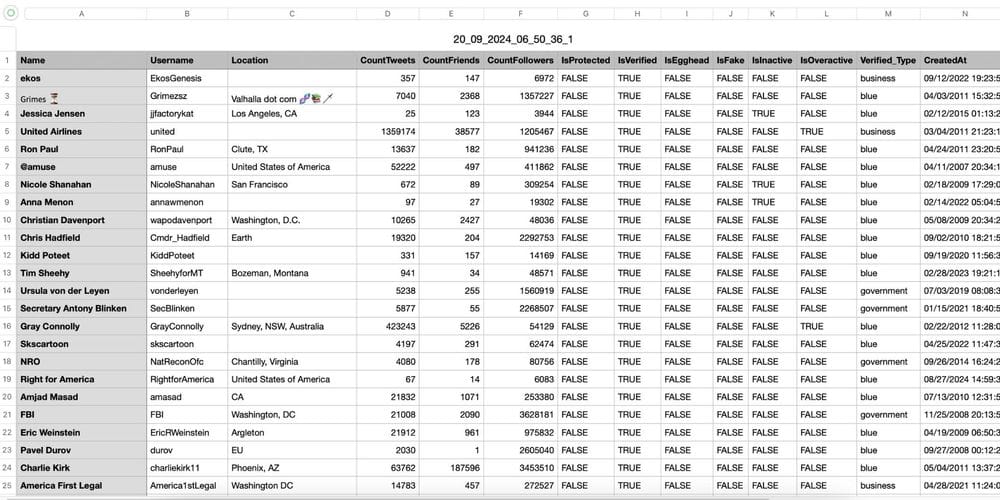
That’s why tracking features (daily/weekly reports, follow relationship checks) can be more valuable than a massive CSV dump you’ll never revisit.
FAQ: scrape twitter following list
Can you scrape someone’s Twitter following list?
Technically, there are tools and methods that attempt it (extensions, scraping services, API), but feasibility and safety depend on access method, volume, and whether you’re using official routes.
Is there an official way to get a following list?
Yes. X documents an official endpoint for retrieving a user’s followings: GET /2/users/{id}/following.
Why do people get stuck with 403 or missing access?
In practice, access can depend on plan/entitlements/scopes, and developers report 403 issues even when documentation suggests availability.
What’s the safest approach if I mainly need insights, not the full dump?
Track changes over time instead of scraping repeatedly. This is where tools that monitor recent followings/followers and alert you (daily/weekly) are a cleaner workflow.