The “Team” Dream: Scaling One Business Across Many Hands
Scaling a business is one of the most rewarding phases of growth. More customers, more visibility, more momentum. Social channels grow alongside the business, and suddenly the brand’s X (Twitter) account becomes a core revenue and reputation asset.
 Altug Altug
But for social media teams, growth introduces a quiet, and often underestimated problem: too many hands on one account.
In the early days, managing an X account is effortless.
One person. One password. One voice.
Posting takes minutes. Decisions are instant. Accountability is clear.
The moment a business begins to scale, that simplicity breaks.
As soon as virtual assistants, copywriters, designers, or community managers enter the workflow, the old “single-login” model starts to crack. Research shows that brands with three or more people sharing one social account experience:
- 2× more publishing errors
- 40–60% slower approval cycles
- a measurable increase in security-related account flags
What once felt fast and flexible becomes fragile.
Instead of clarity, teams face confusion:
- Who posted that tweet?
- Was it reviewed?
- Is someone else logged in right now?
- Did a former contractor still keep access?
At scale, social media isn’t just content, it’s infrastructure. And infrastructure built for one person doesn’t survive multi-person use.
What worked at 1,000 followers becomes a liability at 50,000.
What felt “good enough” early on becomes risky, inefficient, and expensive as visibility increases.
Growth doesn’t just amplify reach.
It amplifies weaknesses in how accounts are managed.
And without a structured system, scaling turns from momentum into friction, right at the moment when consistency and credibility matter most.
If you are a creator on X and want to know about the latest developments regarding the algorithm changes, engagement strategies, payout boosts, etc., you can join Circleboom's X Creator Growth Lab Community and enjoy a free space to learn from and contribute to!
The Chaos of Shared Credentials
Most teams start with the same workaround:
“Let’s just share the login.”
It feels quick. It feels practical. And for a short while, it works.
Until it doesn’t.
Shared credentials turn a brand account into a revolving door, one where access is unlimited, accountability is blurred, and risk quietly compounds over time.
Where Things Start to Break
At first, the issues feel small:
Someone forgets they’re logged into the brand account and posts a personal opinion, joke, or political take.
A team member logs in from another country and triggers a security challenge.
Two people try to post at the same time and get locked out by two-factor authentication.
Individually, these are inconveniences.
Collectively, they become a pattern.
As teams grow, shared credentials introduce constant friction and real operational risk:
- Two-factor authentication becomes a daily bottleneck instead of a security layer
- Multiple IP addresses and devices trigger “suspicious login” flags
- Account access gets revoked temporarily or worse, permanently
- Former contractors quietly retain access long after they’ve left
- There’s no clear audit trail for who posted what, when, or why
Suddenly, a single tweet isn’t just content, it’s a liability.
The Hidden Cost: Operational Drag
Beyond public mistakes, shared credentials create invisible damage inside the team.
When ownership is unclear, hesitation creeps in.
Team members pause before posting because they’re unsure who’s responsible.
Managers double-check everything because they don’t trust the process.
Simple tasks take longer because everyone is working around everyone else.
This leads to what researchers call “context collapse”, a state where people constantly switch roles, tools, and mental modes without clear boundaries.
Industry data backs this up:
- 73% of social media managers report burnout linked directly to manual task switching and unclear ownership
- Teams without defined approval systems experience 2–3× more publishing errors
- Organizations that adopt structured approval workflows reduce brand-damaging mistakes by over 60%
And those mistakes aren’t free.
A single off-brand post can lead to:
- lost partnerships
- customer backlash
- internal blame cycles
- emergency damage control that pulls leadership into avoidable crises
Chaos Is a Business Cost
The real danger of shared credentials isn’t embarrassment, it’s erosion.
Erosion of trust.
Erosion of speed.
Erosion of confidence in the system.
What looks like a shortcut at the start becomes an invisible tax on productivity, morale, and brand safety as the business scales.
Chaos isn’t just stressful.
It’s expensive, and entirely preventable.
Why “More People” Shouldn’t Mean “Less Control”
The problem with growing teams isn’t collaboration.
Collaboration is what fuels scale.
The real issue is unstructured collaboration, where access is unlimited, roles are undefined, and accountability dissolves the moment something goes wrong.
When everyone has full access, something subtle but dangerous happens:
no one truly owns the outcome.
Access Without Structure Breaks Accountability
In an unstructured setup:
- Multiple people can post, edit, or delete content
- No clear distinction exists between drafting and publishing
- Decisions happen in DMs instead of documented workflows
- Errors are discovered after they go public
When a mistake occurs, the first question is never “How do we fix this?”
It’s “Who did this?”
And often, no one knows.
This is how brand voice fragments. One post sounds polished and strategic, the next feels rushed or off-tone. The audience notices, even if they can’t articulate why.
Consistency isn’t a creative constraint; it’s a trust signal. And trust erodes quickly when messaging feels chaotic.
Control Isn’t the Enemy of Speed
Many teams resist structure because they fear it will slow them down.
In reality, the opposite is true.
Without clear lanes:
- Junior team members hesitate to act
- Senior managers micromanage everything
- Simple approvals turn into long message threads
- Publishing windows are missed
Structure doesn’t reduce velocity, it removes hesitation.
When roles are clear, people move faster because they know:
- what they’re allowed to do
- what they’re responsible for
- and when their part of the process ends
High-performing teams don’t rely on trust alone. They rely on systems that make trust unnecessary for routine actions.
Your Account Is a Public Asset, Not a Shared Toy
An X account isn’t just another tool inside the company.
It’s your public interface.
Every post shapes perception.
Every reply influences credibility.
Every mistake lives forever in screenshots.
Giving everyone unrestricted access is the digital equivalent of leaving the office unlocked overnight, not because you don’t trust your team, but because accidents don’t require bad intent.
Security and control aren’t about suspicion.
They’re about stewardship.
Scaling Requires Clear Lanes, Not More Hands
As teams grow, responsibility must narrow, not expand.
Writers should write.
Editors should edit.
Managers should approve.
Admins should control access.
That’s how you scale without losing coherence.
More people shouldn’t mean more chaos.
It should mean better-defined workflows, stronger safeguards, and clearer ownership.
And when those lanes don’t exist, the workflow itself needs to change.
The Circleboom Strategy: From Chaos to Coordination
At a certain point, growing teams face a choice.
They can continue scaling with fragile workarounds, shared passwords, Slack approvals, last-minute checks, or they can move to a system designed for collaboration from day one.
This is where modern teams make a structural shift:
from password-based access to permission-based collaboration.
That shift is exactly where Circleboom fits, naturally, quietly, and effectively, into the workflow.

From “Who Knows the Password?” to “Who Is Allowed to Do What?”
Password sharing asks the wrong question.
It assumes trust is the main problem.
In reality, clarity is.
Circleboom Publish reframes account access around roles and intent. Instead of everyone having the same level of power, access is divided by responsibility.
That single change eliminates most of the friction teams experience as they scale.
- Writers focus on creating content
- Editors refine and optimize
- Managers approve and schedule
- Admins retain full control
No one needs more access than their role requires, and no one is blocked from doing their actual job.
This isn’t about limiting people.
It’s about giving each person a clear lane.
Role-Based Access That Matches Real Team Structures
Most social teams aren’t flat. They’re layered.
There are decision-makers, executors, reviewers, and specialists. Circleboom’s team management reflects how teams actually work, not how platforms assume they do.
With role-based permissions:
- Junior contributors can draft without risk
- External collaborators can work without exposure to sensitive settings
- Managers retain final authority without being bottlenecks
This structure removes the silent anxiety that comes from “I hope no one posts something by accident.”
Because accidents stop being possible by design.
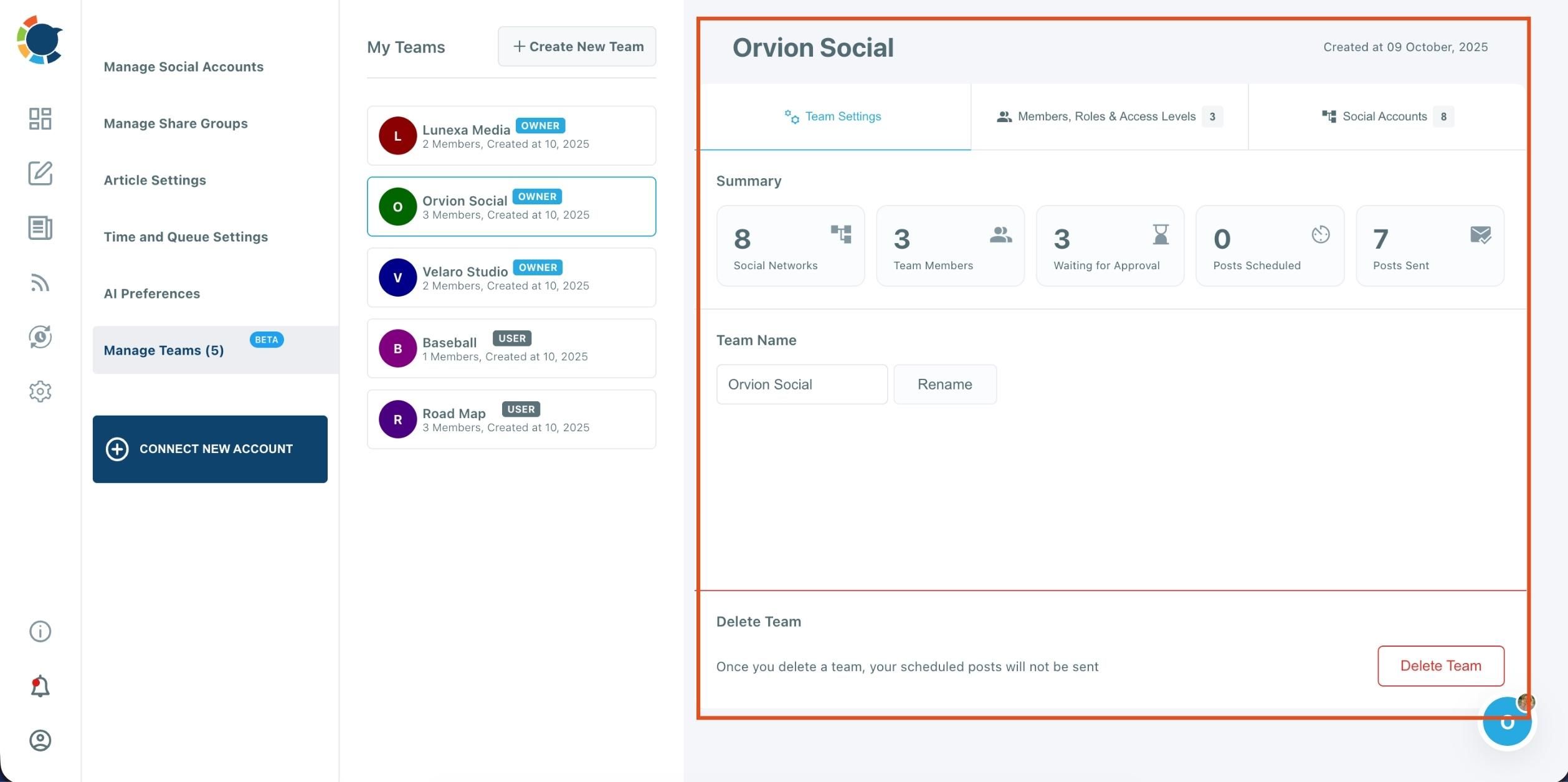
Here is how Circleboom Team Management works (simplified)
#1: Open the Profile Menu
At the right corner of your dashboard, click on your profile icon. This is the place where you can switch between teams (workspaces), view your current organization, and manage your team settings.
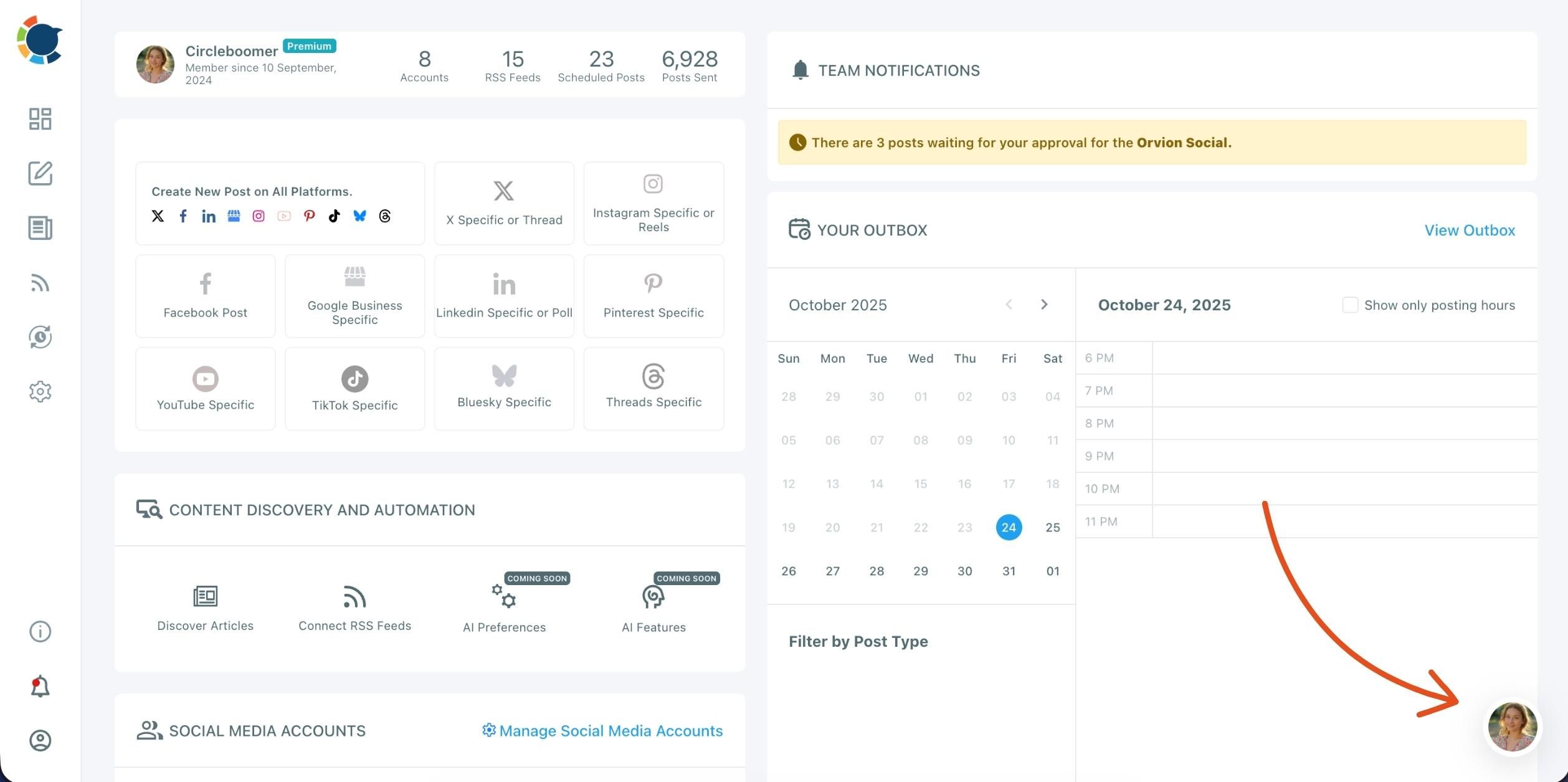
#2: Select “Create New Team”
From the dropdown, you’ll see all your existing teams listed with labels like Owner or User. Click ➕ Create New Team at the bottom of the list.
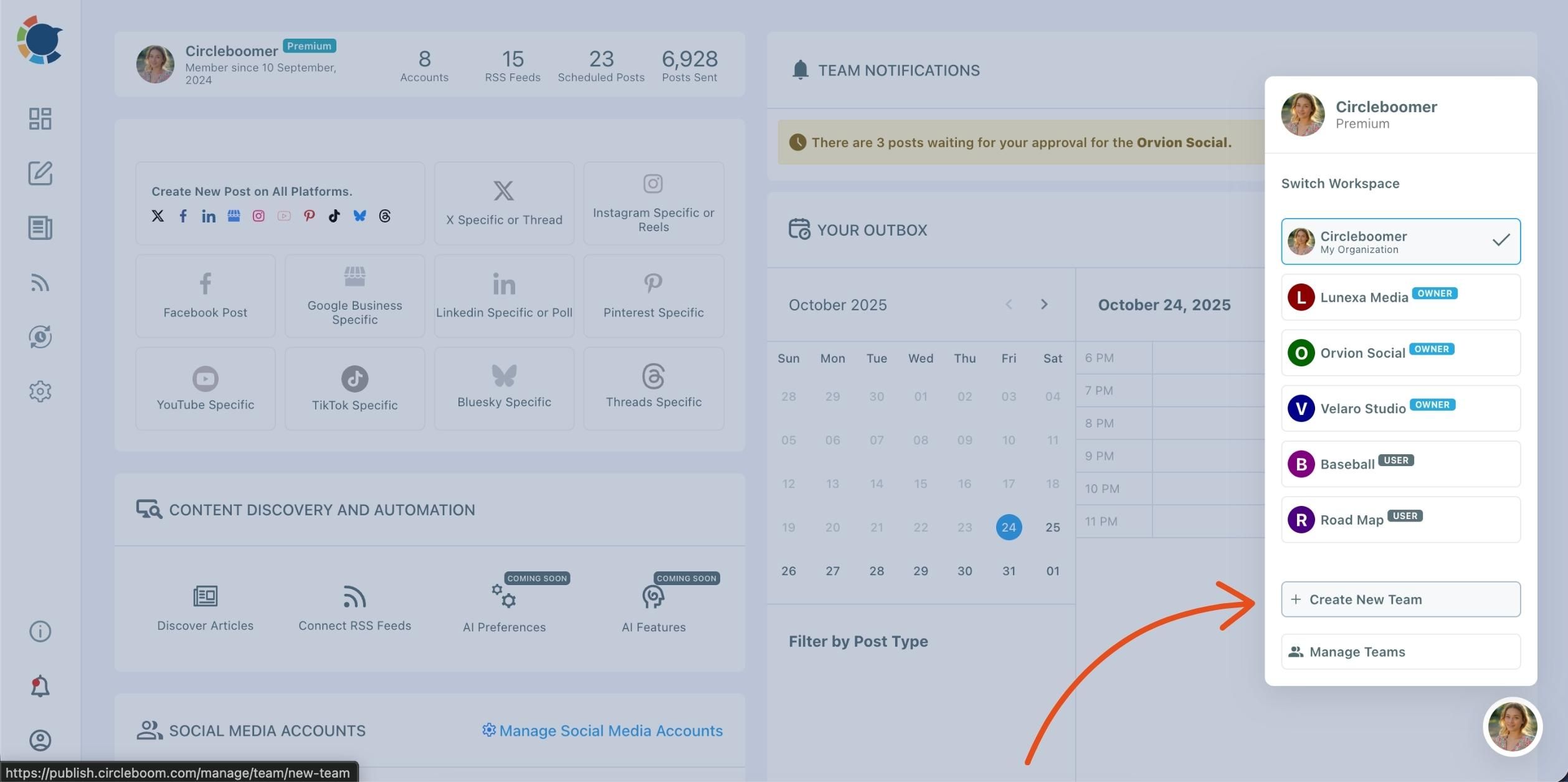
#3: Enter Team Details
You’ll be redirected to the Create New Team page.
- Type your Team Name in the first field.
- Then, enter the email addresses of the members you’d like to invite in the “Invite Team Members” field.
Once they receive and accept your invitation, you can assign roles and permissions for each member from the “Manage Teams” section.
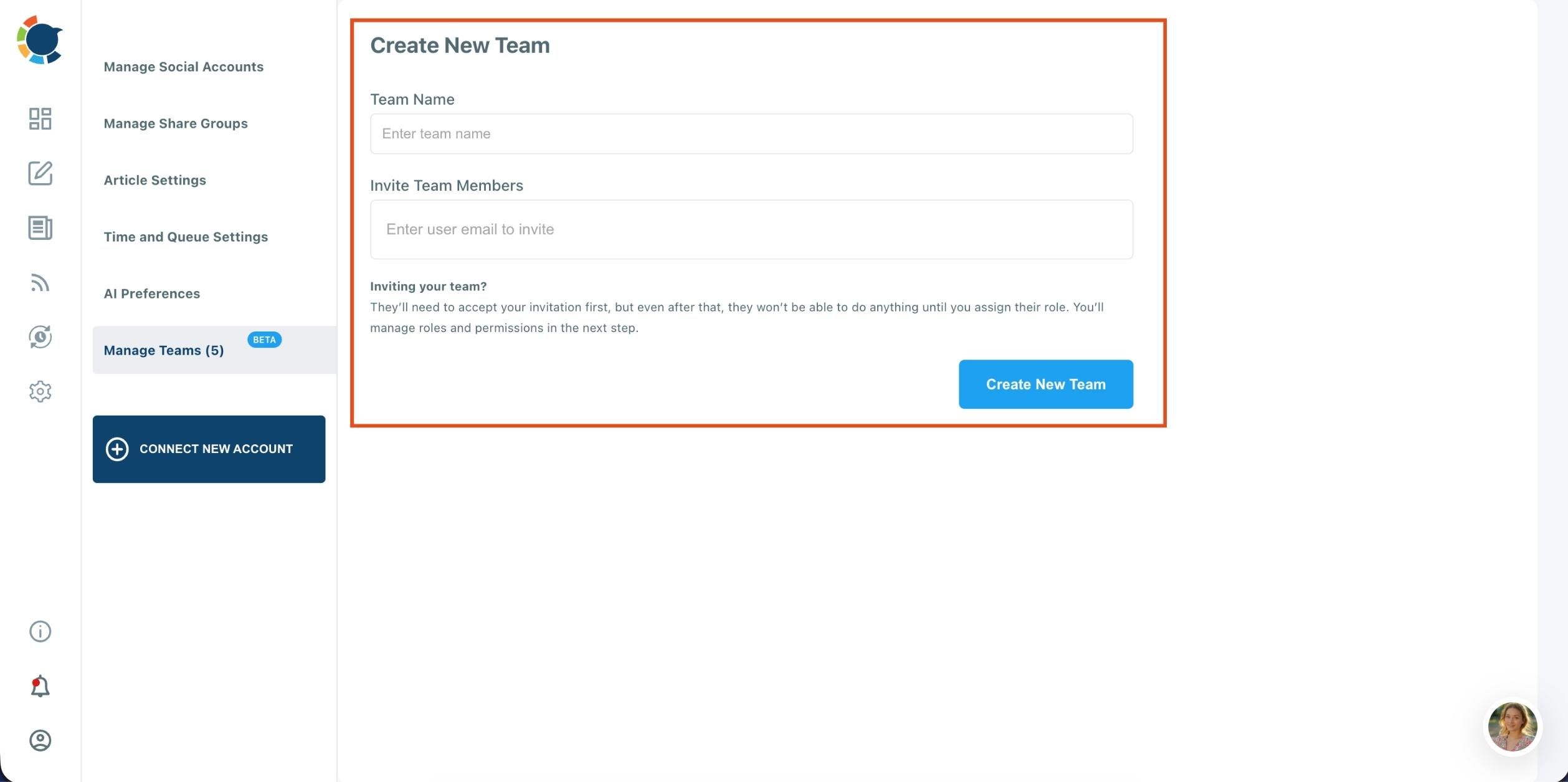
#4: Manage Your Team
After creating your team, you can:
- Add or remove members
- Assign roles and access levels (Owner, Admin, User)
- Connect social media accounts for shared management
- Review scheduled or pending posts for approval
You can also switch between all your teams anytime from the profile dropdown menu.
Approval Workflows That Protect Speed and Quality
One of the biggest misconceptions about approvals is that they slow teams down.
In practice, unstructured approvals are what kill momentum.
Circleboom replaces scattered message approvals with a built-in review process. Content moves forward only when it’s ready, without chasing people across tools or time zones.
The result:
- Fewer last-minute edits
- Fewer off-brand posts
- Fewer public corrections
Instead of “post and pray,” teams operate with a safety net that catches issues before they go live.
That peace of mind compounds, especially at scale.
One Dashboard, One Source of Truth
As teams grow, fragmentation becomes the hidden enemy.
Multiple logins. Multiple tools. Multiple versions of “the plan.”
Circleboom centralizes everything:
- content drafts
- smart scheduling
- approvals
- publishing
Everyone works from the same dashboard, the same calendar, the same context.
That consistency is what keeps brand voice intact, even when ten different people contribute across weeks or months.
Coordination Isn’t a Nice-to-Have! It’s the Growth Multiplier.
Teams that move from shared credentials to structured collaboration don’t just become safer.
They become faster.
More confident.
More consistent.
The mental overhead disappears. People stop second-guessing. Managers stop policing. Creativity flows because the system absorbs the risk.
Circleboom doesn’t just help teams post.
It helps teams operate like teams, with coordination replacing chaos.
And once that shift happens, there’s no going back.
Granular Role-Based Access
As teams grow, one truth becomes unavoidable: access without structure creates risk.
Not every team member needs full control over an X account, and giving everyone the same permissions is one of the fastest ways to invite mistakes. In fact, internal security studies across SaaS teams consistently show that more than 70% of social media errors are caused not by bad intent, but by excessive access.
Circleboom addresses this by introducing clear, role-based boundaries that match how real teams operate.
Admins retain strategic control and final authority. They manage account connections, publishing permissions, team roles, and approvals. This ensures that brand direction, account safety, and long-term strategy remain centralized where they belong.
Editors focus on execution. They write tweets, format threads, prepare visuals, and optimize posts for clarity and engagement. Editors don’t need the power to change account credentials or publish instantly; they need space to create. By limiting access to what actually matters for their role, Circleboom removes distraction and reduces pressure.
Contributors prepare content without risk. They can draft posts, suggest ideas, and collaborate on content pipelines without the ability to publish or alter sensitive settings. This is especially valuable for freelancers, interns, or external partners. According to industry benchmarks, teams that limit publishing rights to fewer than 20% of members reduce accidental posting incidents by over 60%.
This separation does more than protect the account. It improves performance.
When people know exactly what they are responsible for, decision fatigue disappears. There is no hesitation about whether they should act, no fear of overstepping, and no need for constant supervision. Work moves faster because accountability is clear.
Teams using structured role-based access consistently report higher output with fewer errors. Internal workflow studies show that clearly defined roles can increase content production efficiency by up to 30%, simply by eliminating confusion and rework.
Granular access isn’t about restricting creativity.
It’s about creating the conditions where creativity can thrive safely.
People do their best work when expectations are clear, authority is intentional, and the system supports them instead of relying on trust alone.
The Approval Workflow Safety Net
This is the moment where confidence replaces anxiety.
In fast-moving teams, the biggest fear isn’t lack of ideas, it’s publishing the wrong thing at the wrong time. Without a review layer, social media becomes a high-stakes guessing game: once a post is live, there is no undo button for screenshots, misinterpretations, or outdated context.
Circleboom replaces that uncertainty with a structured approval workflow.
Instead of publishing directly, every piece of content moves through a controlled review queue. Drafts are visible, traceable, and intentionally paused until a designated reviewer signs off. This creates a final checkpoint where managers can:
- adjust tone to match brand voice
- catch typos, broken links, or formatting issues
- remove outdated references or sensitive phrasing
- confirm that the post aligns with current campaigns or announcements
- verify timing, audience context, and platform relevance
This extra step doesn’t slow teams down, it actually speeds them up.
Industry benchmarks show that teams using approval workflows reduce rework by up to 40% and cut public-facing errors by more than 60%. Instead of correcting mistakes after publication, teams fix them quietly before they ever reach an audience.
Most importantly, the approval system creates psychological safety. Creators can focus on quality instead of worrying about consequences. Managers can trust the process instead of hovering over every draft. The result is better content, published with intention instead of stress.
It replaces “post and hope” with deliberate, confident publishing.
One Unified Command Center
As teams grow, complexity usually grows with them.
What starts as a simple workflow often turns into a tangled system of shared logins, scattered tools, and endless message threads asking, “Who posted this?” or “Is this approved?”
Circleboom eliminates that chaos by acting as a single command center for the entire publishing operation.
Everything lives in one place:
content drafts and revisions
publishing schedules and queues
approval status and feedback
performance analytics and insights
Even when teams scale to 10 or more members, everyone works from the same dashboard, with the same visibility and the same source of truth. There’s no need to juggle spreadsheets, chat approvals, or last-minute confirmations.
This centralization does more than improve efficiency, it protects consistency.
When content, timing, and performance data live in one environment, brand voice stays intact. Posts feel cohesive, campaigns stay aligned, and messaging doesn’t drift depending on who is behind the keyboard that day.
Teams using centralized dashboards consistently report higher posting consistency and fewer coordination errors. In practice, this often translates into 30–35% more reliable publishing rhythms and stronger long-term audience trust.
A unified command center isn’t just about organization.
It’s about making scale feel controlled instead of chaotic.
The Measurable Impact: Productivity Meets Security
The value of structured collaboration isn’t theoretical, it shows up in measurable results, often within the first few weeks.
When teams move from shared credentials and ad-hoc workflows to Circleboom’s permission-based system, the change is immediate and visible.
Teams consistently report:
- around 35% higher posting consistency, driven by clear ownership and predictable scheduling
- fewer publishing delays, because drafts no longer wait in inboxes or chat threads for approval
- significantly reduced internal friction, as responsibilities are defined instead of assumed
- stronger confidence in brand safety, thanks to controlled access and review checkpoints
Posting consistency alone is a major indicator of long-term growth. Accounts that publish on a stable cadence (rather than in bursts) typically see 20–30% more reliable engagement over time. Circleboom makes that stability possible by removing the guesswork around who posts, when, and how.
Security improvements are just as impactful.
With role-based access and approval workflows, the risk surface shrinks dramatically. Teams eliminate accidental posts, unauthorized changes, and lingering access from former collaborators, three of the most common causes of brand damage on social platforms. Companies that adopt permission-based publishing workflows reduce account-level incidents by over 50% compared to password-sharing teams.
But the biggest gain is less visible and more important.
The “friction of uncertainty” disappears.
No one hesitates because they’re unsure who’s responsible.
No one double-checks because they don’t trust the system.
No one treats the account like fragile glass.
Everyone knows their role. Everyone trusts the process. And the account stops feeling risky, and starts feeling scalable.
That’s where productivity and security stop competing and start reinforcing each other.
Final Takeaway
Sharing your account password is like sharing a toothbrush.
It works for a moment but it’s risky, unsanitary, and eventually creates a mess you don’t want to clean up.
Scaling a business doesn’t require chaos.
It requires coordination.
By replacing password-sharing with structured access, approval workflows, and a unified workspace, Circleboom allows teams to grow without losing control protecting both productivity and brand integrity as the business scales.