
A Twitter account downloader pulls a public account's tweet history off the platform and hands it back to you as a structured file you can sort, filter, and analyze. The account can be your own or anyone else's, as long as the profile is public.
What does a Twitter account downloader actually export?
It exports up to the 3,200 most recent tweets from any public X account as a CSV, with full text plus impressions, likes, retweets, replies, quotes, and bookmarks for each row. Circleboom runs the download through official X APIs, so it is a compliant data pull, not a scrape.
→ Twitter account downloader
The word "downloader" makes people picture a backup, a zip file they save and forget. That framing undersells it. What you actually get is a working dataset, and the difference matters the moment you open the file.
What a Twitter Account Downloader Gives You
A download turns static posts into columns you can query. Each exported tweet arrives with its text and its performance side by side, so the file answers questions the timeline never could.
The CSV carries fifteen fields per tweet, including these core ones:
- Full tweet text and the tweet type (original, retweet, or reply).
- Impressions, likes, retweets, quotes, replies, and bookmarks.
- Post date, language, and a media-present flag.
That structure is why a download beats scrolling. You can sort 3,200 rows by impressions in one click and see your top performers instantly. You can filter to a single month, a single language, or only tweets above 50 likes.
If you have ever wanted to download all tweets from a user and then treat them as evidence rather than nostalgia, this is the format that lets you.
A downloader is an analysis tool wearing a backup's clothes.
How to Read the Columns You Download
Most guides stop at "you get a CSV" and leave you staring at fifteen unlabeled columns. The value is in knowing which ones to sort by, so here is the practical read.
The metadata columns anchor each row. PostId, Username, ProfileId, and CreatedAt tell you which tweet this is, who posted it, and when. CreatedAt is the field you pivot on for time-based analysis, since it lets you group output by week, month, or campaign window.
The performance columns are where the decisions live. CountImpression shows reach, while CountLike, CountRetweet, CountReply, CountQuote, and CountBookmark show the different ways people responded. Bookmarks are the quietest signal and often the most honest, because a bookmark means someone wanted to return to the post later.
Two columns change how you filter. TweetType separates original posts from retweets and replies, so you can measure only your own writing. HasMedia flags whether a tweet carried an image or video, which lets you test whether visual posts actually outperform text on that account. A quick read of your total impressions on Twitter makes more sense once these columns are in front of you.
Why the Native X Archive Is Not Enough
X does let you request your data, but the native route has three hard limits that a proper Twitter account downloader removes.
First, the official X archive covers your own account only. You cannot request a rival's archive, a client's back catalog, or an influencer's posting history. Second, it arrives as a raw, developer-formatted bundle that most people cannot open in a spreadsheet without cleanup. Third, the request can take a day or more to process.
A Twitter account downloader solves the access problem directly. Because the export reads any public timeline, you can download any account's tweet history, not just your own, and receive it already shaped for analysis.
Readers who have asked "can I download my tweets" usually discover the real question is how to download them in a form they can use.
How Circleboom Downloads a Tweet History Safely
Circleboom is an official X Enterprise Developer company, which is the part that separates a safe export from a risky one. The data comes through sanctioned X endpoints under your authenticated account, so nothing about the download violates platform rules or puts your account at risk.
That matters because most "one-click" browser extensions that claim to grab tweets rely on scraping. Scraping pulls partial, unauthorized data and can flag your account. An export of any Twitter account's tweets through official access returns the complete, accurate metric set instead of a thin copy. The Circleboom Export Tweets feature is built on that access.
Connect your account and choose the target
- Log in to Circleboom Twitter and connect your X account through official authorization.

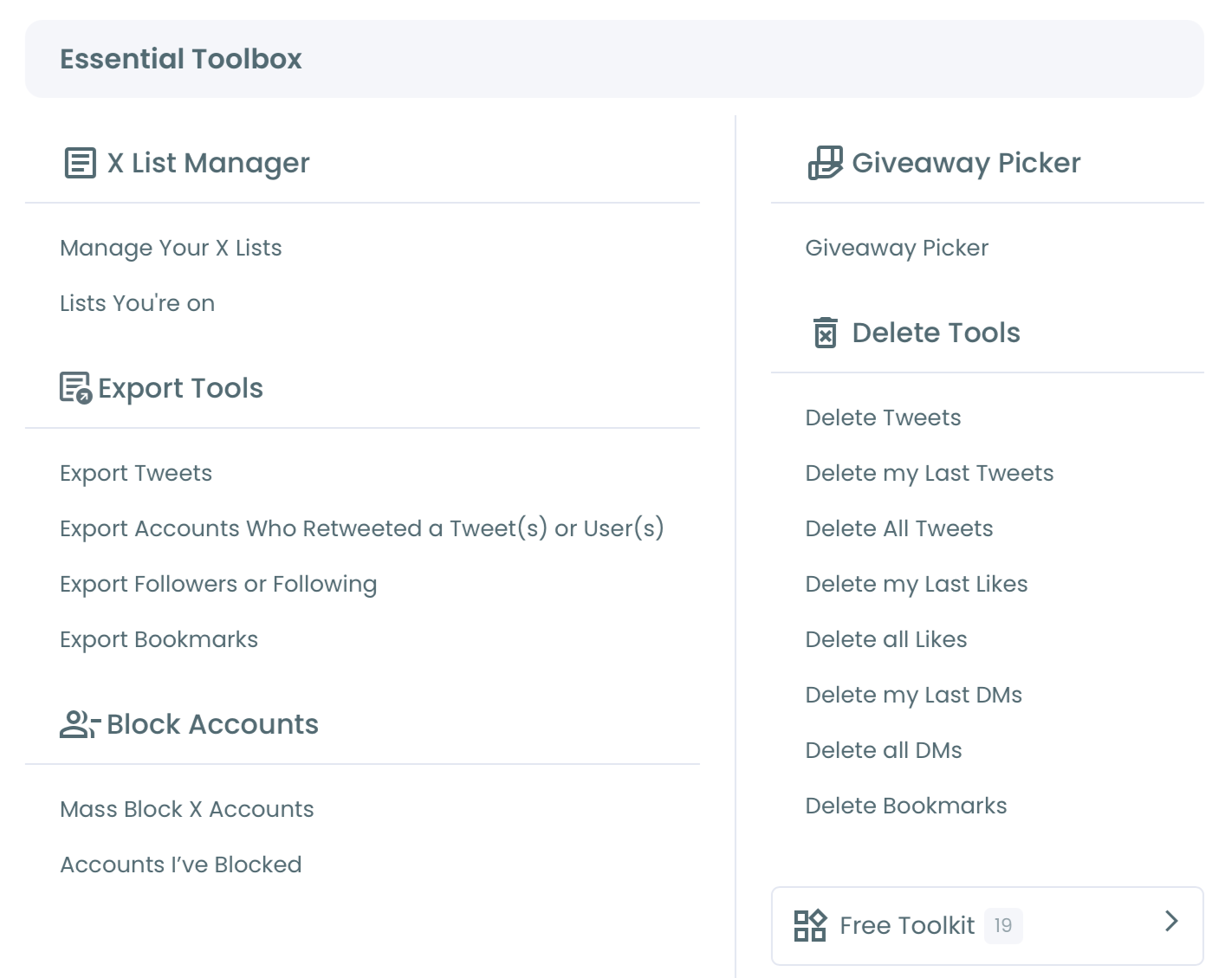
- Open the Essential Toolbox menu, where the export tools live.
- Enter any public username in the search field. Circleboom fetches that account's history and shows the total tweet count so you know the scope before you commit.
Filter, then export the dataset
- Apply filters before exporting so the file is scoped, not raw. Narrow by date range, engagement threshold, post type, language, or keyword.
- Confirm the export and add your email. The CSV is delivered to that address and stored in your Circleboom account page as a backup copy.
That order is what makes the download useful. The login earns official-API access, the username sets the scope, and the filters turn a flat archive into a targeted dataset before a single row leaves the platform. Skip the filtering and you are back to cleaning a spreadsheet by hand.
See it in action: the full path from a username to a downloaded, metric-rich CSV of an account's entire recent history.
What the 3,200 Limit Really Means
Every honest answer about a Twitter account downloader has to name the ceiling. The export returns up to the 3,200 most recent tweets, and that number is set by X's API, not by Circleboom. No plan upgrade lifts it, because it is a platform constraint on the public timeline endpoint.
For most accounts, 3,200 tweets is a deep, meaningful sample. For a decade-old account posting daily, older history beyond that window is only reachable through the native archive tool.
Knowing the boundary up front is part of using the data responsibly. Anyone planning to export all tweets of a Twitter user to Excel or CSV should treat the file as a recent-history snapshot rather than a full lifetime record.
Filters Decide Whether the Download Is Useful
The single biggest difference between a helpful export and a messy one is whether you filter before you download. A raw dump of 3,200 rows is technically a backup, but it forces cleanup later. A scoped export lands ready to read.
Five filters shape the file:
- Date range isolates a campaign, a launch month, or a quarter.
- Engagement threshold keeps only tweets above a like, retweet, or impression floor.
- Post type separates original tweets from retweets and replies.
- Language narrows a multilingual account to one language.
- Keyword surfaces every tweet on a single theme or product.
Stack two or three and the output gets sharp fast. "Original tweets from Q1 above 100 likes" is a different, far more useful file than "everything." The filters run before delivery, so the CSV you receive already answers the question instead of hiding the answer inside noise you have to strip out by hand.
The Jobs a Downloaded Tweet History Does
A structured export earns its keep across several distinct tasks. The same file supports different goals depending on how you slice it.
- Backup before deletion. Export first, then run any cleanup.
- Content performance analysis. Sort by impressions to see which formats win.
- Competitive benchmarking. Run the export against a rival's public account.
- Client reporting. Deliver portable data that needs no login to open.
The competitive angle is the one people underuse. Because the tool reads any public account, you can build a side-by-side view of your output against a competitor's without guesswork.
Consider the math. If a rival posts 20 times a week and you export their last 3,200 tweets, you are holding roughly three years of their strategy in one file. Sort that by impressions and the top 50 rows tell you exactly which hooks their audience rewards.
From there, pair the raw export with a metrics read from Tweet Stats. You can also study a peer's cadence the way a full Twitter analytics for another account workflow would.
Turn the Download Into a Content Decision
A file only pays off when it changes what you do next. The workflow from CSV to decision is short and repeatable.
Open the export and sort by CountImpression descending. The top rows are your reach leaders. Now add a second sort on CountBookmark, and watch which of those high-reach posts also earned quiet saves. Posts that rank on both lists are your genuine winners, not one-time spikes.
Next, filter TweetType to original posts only and scan the text column for the common thread. Maybe your best rows are all questions, all under 15 words, or all posted before noon. That pattern is your content brief, pulled from evidence instead of instinct. Repeat the export monthly and you build a moving picture of what your audience rewards, which is the whole point of downloading the data in the first place.
A Backup You Set Before You Delete
The most overlooked reason to download tweets is protective, not analytical. Deletions on X are irreversible, and a mass cleanup can remove more than you intended.
Exporting first gives you the only recovery path that exists. Once the CSV is in hand, you can prune old posts freely, knowing the full record still sits in a file on your drive and in your Circleboom account page. The download is the safety net that makes an aggressive cleanup a reasonable decision instead of a gamble.
That is the quiet strength of a Twitter account downloader: it preserves the history you are about to change.
Who Reaches for a Tweet Downloader
The tool fits more roles than most people expect, because the underlying need, a portable record of what an account has posted, shows up everywhere.
Marketers pull a competitor's history to reverse-engineer a content calendar. Agencies export a client's account to build a performance report that opens in any spreadsheet. Researchers download a public figure's timeline to study patterns over time. Creators back up their own posts before a rebrand or a cleanup. Journalists archive a source's tweets before they can be deleted.
Each of those jobs starts the same way: a username, a filter, and a download. The output is different every time, but the path is identical, and that is what makes a downloader a tool you reach for again and again rather than once.
Common Questions About Downloading Tweet History
Can I download tweets from an account that isn't mine?
Yes. A Twitter account downloader works on any public account without needing that account's login. Only protected or deleted tweets are out of reach, since they are not available through official data channels.
What file format does the download use?
The export is a CSV, which opens directly in Excel, Google Sheets, or any analytics tool. Each row is one tweet with its full text and all engagement metrics in separate columns.
Will the downloaded numbers keep updating?
No. The file is a point-in-time snapshot. Likes, impressions, and other counts reflect their values at the moment of export and will not change inside the downloaded file afterward.
Is downloading someone's tweets against X's rules?
Not when the data comes through official access. Circleboom pulls public tweet data via sanctioned X endpoints under your authenticated session, which keeps the export compliant, unlike scraping-based browser tools.
The Bottom Line
A Twitter account downloader is only as good as the file it produces, and the file is only useful when it arrives structured, complete, and scoped to the question you are asking. Circleboom delivers exactly that: any public account's recent tweet history, every metric attached, pulled through official X access and dropped into a CSV you can actually work with.
Pick the account, set your filters, and let the export do the rest.