
A Twitter account search by bio matches your keyword against what people wrote about themselves, not against what they posted last week.
That one change in where the search looks is why bio search returns the analysts, recruiters, and founders the X search box quietly skips.
How do you search X accounts by what sits in their bio?
Open Circleboom's Deep X Account Search, type your keyword, then apply the Find in Bio & Name filter so only accounts whose display name or bio carries that word survive. Behind that filter sits an authorized read of X's archived profile and post index, and a single query can return as many as 5,000 accounts. Every row arrives with follower count, follow ratio, join date, and an activity classification already filled in.
→ Twitter account search by bio
Why the X search box misses the accounts you actually want
X search ranks posts, not people.
Type a keyword into it and you get recent tweets containing that word plus a short list of account suggestions weighted toward current activity. Someone who writes "climate policy analyst" in their bio but posts twice a month barely registers.
That gap matters most when you are building a list of people rather than a list of posts.
A bio is also the most deliberate sentence anyone writes on X. It gets edited, reused across platforms, and chosen to signal a role.
A keyword sitting in a bio is a self-declaration. The same keyword inside a tweet might be a joke, a quote, or a complaint.
That difference is the whole case for running a search of X accounts by bio keyword. The alternative is scrolling a live feed and hoping the right profile floats up.
If you have only ever used native filters, the Twitter search engine comparison is worth a look before you build a workflow on one method.
What Circleboom reads when you search a bio keyword
Circleboom matches your keyword against account bios and historical tweet content, across a much older dataset than a live search touches. What comes back is the set of accounts that have engaged with that topic over time.
The results table gives you display name, @username, location, total tweets, join date in days, following count, follower count, follow ratio, and an activity label.
That label reads Active, Moderate Active, or Inactive, and it is computed from public activity signals at the moment of retrieval rather than pulled from the profile. Follow ratio shows "N/A" when an account follows nobody, which is itself a useful signal for automated or broadcast-only profiles.
This runs on official API access, not on scraped pages. Circleboom is an official X Enterprise Developer, which is why your account can sit behind a 5,000-row query without drifting into policy trouble.
The profile fields Circleboom reads are the same public objects documented in the X API user lookup reference, pulled through an authorized channel rather than a browser workaround.
One boundary is worth knowing up front: only public accounts and public tweets come back. Protected profiles are excluded by design.
Bio keyword search on X finds people who described themselves, not people who happened to type a word.
Want the mechanics of profile-level matching on their own? Start with how to search for keywords in Twitter profiles, then come back for the filtering layer below.
Watch the bio and profile search run end to end:
https://www.youtube.com/watch?v=DZot7DuSX6A
How to run a Twitter account search by bio
To search X accounts by bio keyword, open Deep X Account Search inside Circleboom and run one broad keyword. Then narrow the result with the Find in Bio & Name filter, plus the numeric and quality filters that describe the kind of account you want. The sequence below moves from connection to a clean, exportable list in three phases.
Connect your account and open the search
- Log in to Circleboom Twitter and connect the X account you want to run the search from.

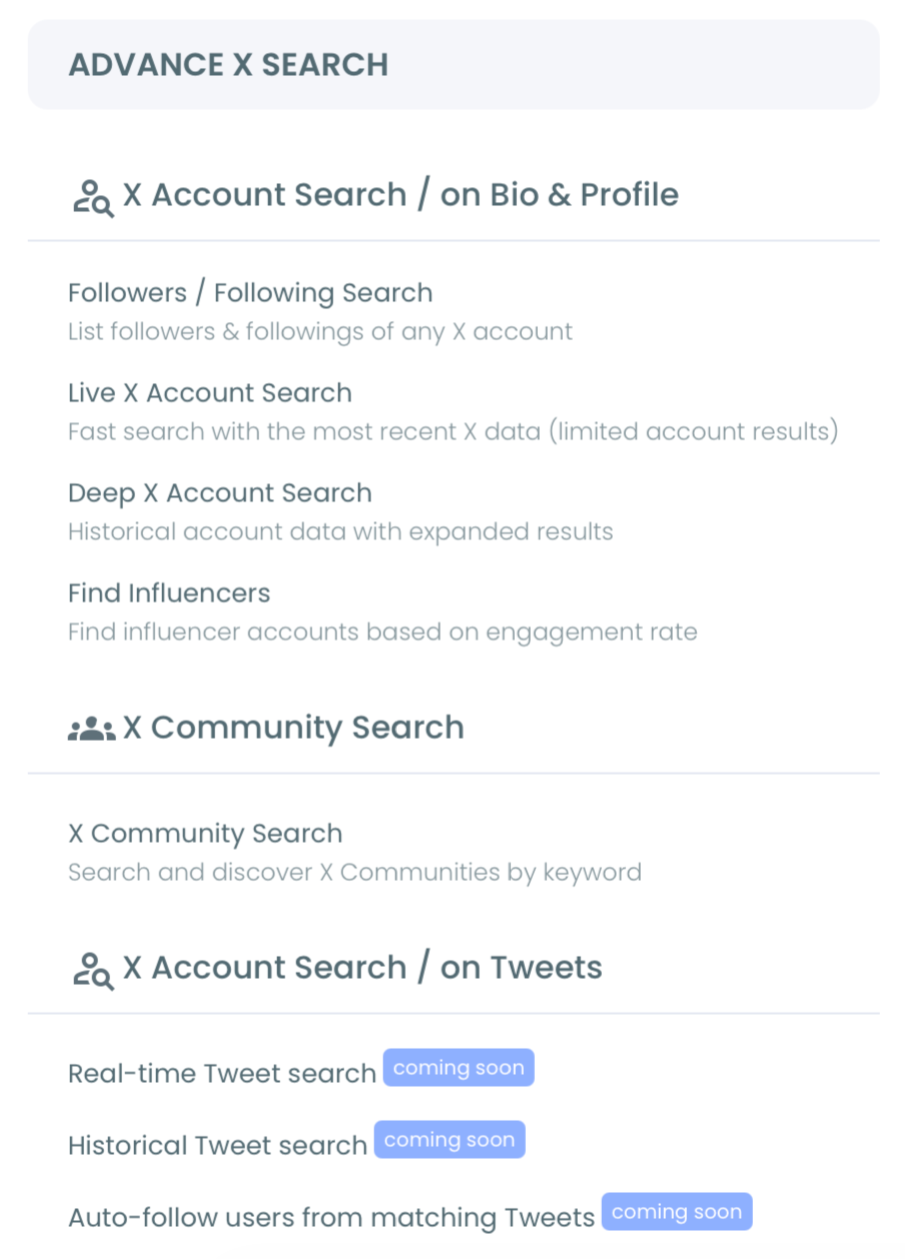
- Open the Advanced X Search menu and choose Deep X Account Search from the search options grouped there.
Search the keyword and narrow the bio match
- Enter one broad keyword that describes the role, niche, or interest you are hunting, then run the search. The results header reads "Listing N profiles who are interested in [keyword]" so you can see the pool size before you cut it.
- Open Filter Options and type your keyword into Find in Bio & Name. This is the step that converts a topic search into a bio search, because the free-text field matches display names and bio copy specifically.
- Stack the numeric filters that describe a real prospect. Follower Count, Following Count, Tweet Count, Follow Ratio, and Join Date all take minimum and maximum values, and every active filter combines with AND logic, so each one you add tightens the same list rather than widening it.
Review, act on, and export the result
- Sort the columns before you judge the pool. Every column header sorts ascending on the first click and descending on the second, so you can rank by follower count or by join date without leaving the table.
- Select the accounts worth keeping and act on them in bulk. Follow, Unfollow, Add to List (Twitter List, Mass Block List, Whitelist, or Blacklist), and Export to CSV all apply to your checkbox selection, and export consumes search tokens in proportion to result size.
That order holds up because each stage removes a different kind of noise. The keyword sets the topic, the bio filter drops people who mentioned it in passing, and the numeric filters cut accounts of the wrong size or age.
Skip the bio filter and you are back to reading tweets.
At a glance: connect, open Deep X Account Search, run the keyword, filter on bio, tighten by numbers, sort, then act or export.
Which filters actually narrow a bio keyword result
Filters are hypotheses, not switches.
Start moderate, then tighten based on what the first page of results looks like.
The Follower Quality group is the fastest cleanup pass. It flags Eggheads (no profile photo), Protected accounts, Fake/Spam behavior, Inactive accounts, and Overactive posters.
Each one maps to a different reason a result is not worth your outreach slot.
- Verification Status narrows to verified or unverified accounts.
- Filter by Location takes free text such as "New York" and reads the profile location field.
- Whitelisted and Blacklisted toggles hide accounts you already reviewed.
- Join Date brackets the account age with an earliest and latest date.
- Clear All Filters resets everything when a hypothesis fails.
An Active Filters bar shows what is currently applied, which matters more than it sounds when you are five filters deep and the result count suddenly drops to nothing.
Want a wider tour of what each control does? The reference on Twitter advanced search filters covers the same panel from the feature side.
→ Run a bio keyword account search
Account age deserves its own mention here. A bio keyword plus a tight Join Date window separates long-standing voices from accounts created last quarter.
The walkthrough on how to search Twitter accounts by join date shows that filter carrying a whole query on its own.
Cross-reference two bio keywords to sharpen the list
One keyword describes a topic. Two keywords describe a person.
Run a bio keyword search for "AI" and the pool fills to the ceiling, most of it irrelevant to whatever you are selling or studying. Run a second search for "sales operations" and you get a different crowd.
The accounts that appear in both lists are the ones whose self-description spans your actual target.
Deep X Account Search supports this directly, because you can run separate searches per keyword and export each result set.
Comparing the exported CSVs by @username gives you the intersection without any manual reading.
Three practical rules keep the cross-reference honest:
- Use one broad keyword and one narrow one, not two broad ones.
- Apply the same follower-count band to both searches so the pools are comparable.
- Export before filtering heavily, so the intersection is computed on full lists.
The intersection is usually small, and small is the point.
A hundred accounts that describe themselves with both of your keywords beat a full pool that mentions only one.
Who gets the most out of a profile-level search
Recruiters use it because job titles live in bios and almost nowhere else on X. A search for a niche role plus a location filter returns a candidate pool that no post-based search can reproduce.
Researchers use it for coverage. Mapping who occupies a subject area matters more than knowing who posted about it yesterday, and a historical scan returns the established voices alongside the currently loud ones.
Partnership and outreach teams use it for scale. A campaign that needs several hundred qualified accounts cannot be built from the dozens a live search returns, and the exportable result feeds straight into a CRM or an outreach sheet.
Anyone entering a new niche uses it as reconnaissance. Before redirecting a content strategy, one bio keyword search shows how crowded the space is, how the audience sizes are distributed, and which accounts have been there for years.
Is a bio keyword search safe for my X account?
Yes, because nothing in the search itself touches your account's standing. Reading public profile data through official API access is a permitted operation, and the query consumes search tokens rather than any platform quota tied to your profile.
The actions you take afterward are where care belongs.
X caps how quickly any tool may follow or unfollow, so Circleboom releases a bulk selection in paced batches that you approve before they run.
Two data caveats are worth carrying into any list you build. Account data reflects the state at retrieval time, so a follower count from a historical match may have moved since.
And an account that discussed a topic two years ago may have changed direction entirely, which is why reviewing before following beats trusting the row count.
At 5,000 results the volume can create a false sense of completeness. Cross-checking a slice against a live search is the cheapest way to tell current voices apart from historical ones.
There is one more habit worth building. Blacklist the accounts you reject as you review them, so the same irrelevant profiles stop reappearing in every future search you run on a neighboring keyword.
Building an outreach list on top of this? Read how to find Twitter influencers for your brand as well. The qualification bar for a partner sits well above the bar for a follow.
Why bio search belongs in your X workflow
A Twitter account search by bio is a profile-level query in a platform built around post-level ranking, and that mismatch is exactly why it finds people the feed hides.
Circleboom answers it from an authorized read of profile text and archived posts, handing back as many as 5,000 accounts spread over 50 pages. The filter set then cuts that pool down to the few hundred that fit.
The tool that runs it, Search Twitter Bios and Profiles, sits in the same Advanced X Search menu as the rest of the discovery features. One login covers the whole workflow.
Want the broader search context first? How to use Twitter advanced search sets up the vocabulary this article assumes.
Pull one keyword list this week, filter it hard, and see how many names you have never seen in your feed.
→ Start your Twitter account search by bio
Common questions about bio keyword search on X
Can I search someone's bio without following them?
Yes. Bio search reads public profile data, so following is irrelevant to whether an account appears in your results. Only protected accounts stay out of reach, because their profile and post data is not public.
How many accounts can one bio keyword return?
Up to 5,000 accounts per query, spread across as many as 50 paginated pages. Sort options can bring different accounts into the top of the ordering, but 5,000 is the display ceiling for a single search.
Does the search find accounts that stopped posting?
Yes, and that is often the point. Because the scan covers historical bio and tweet data, it returns accounts that built credibility in a topic and then went quiet. The Active, Moderate Active, and Inactive classification tells you which is which, and the Inactive filter removes them when you want only current voices.
Can I export the accounts I find?
Yes. Export downloads your selected rows as a structured CSV, and the export consumes search tokens in proportion to how many accounts you are pulling. Large exports cost proportionally more than a filtered slice of the same result.