
Most bio-search guides hand you a list of tools and stop there. The harder truth is that many of those tools only read current activity, so they quietly miss the accounts worth finding: the specialists who post rarely and the long-term voices who built authority years ago. A real Twitter bio search engine reads history, not just this week.
Native X search: finds posts and handles you can already name. Circleboom: finds people by the keywords in their bios and past tweets on X through official X Enterprise APIs.
→ Run the Twitter bio search engine and pull a keyword-matched list.
One keyword becomes hundreds of qualified accounts, filtered and ready to export.
Why most bio search tools fall short
X gives you powerful post search. It does not give you profile discovery. You can chain X's search operators to filter posts by phrase, date, or account, but there is no native way to type a descriptor and get back the strangers who wrote it in their bios. That missing capability is why a dedicated bio search engine exists at all.
The tools that try to fill the gap split into two camps. Scrapers grab whatever profile text they can reach, often incomplete and unauthorized. Live-only tools read current bios but ignore the accounts that stopped posting daily. Both leave gaps, and both can put a workflow at risk.
Clean data is not optional here. If you have ever tried to tell if a Twitter account is authentic, you already know why complete profile data matters before you act on a single result.
The fix is a keyword index built on full, authorized data. That is what a proper bio and profile search delivers, and it is the foundation for everything below.
How to search Twitter bios and profiles by keyword
Step-by-step guide: how to find verified accounts by topic and shape the results into a usable list.
The process runs in three phases, in order.
Connect your account to Circleboom
- Log in to Circleboom Twitter and connect your X account with official OAuth.
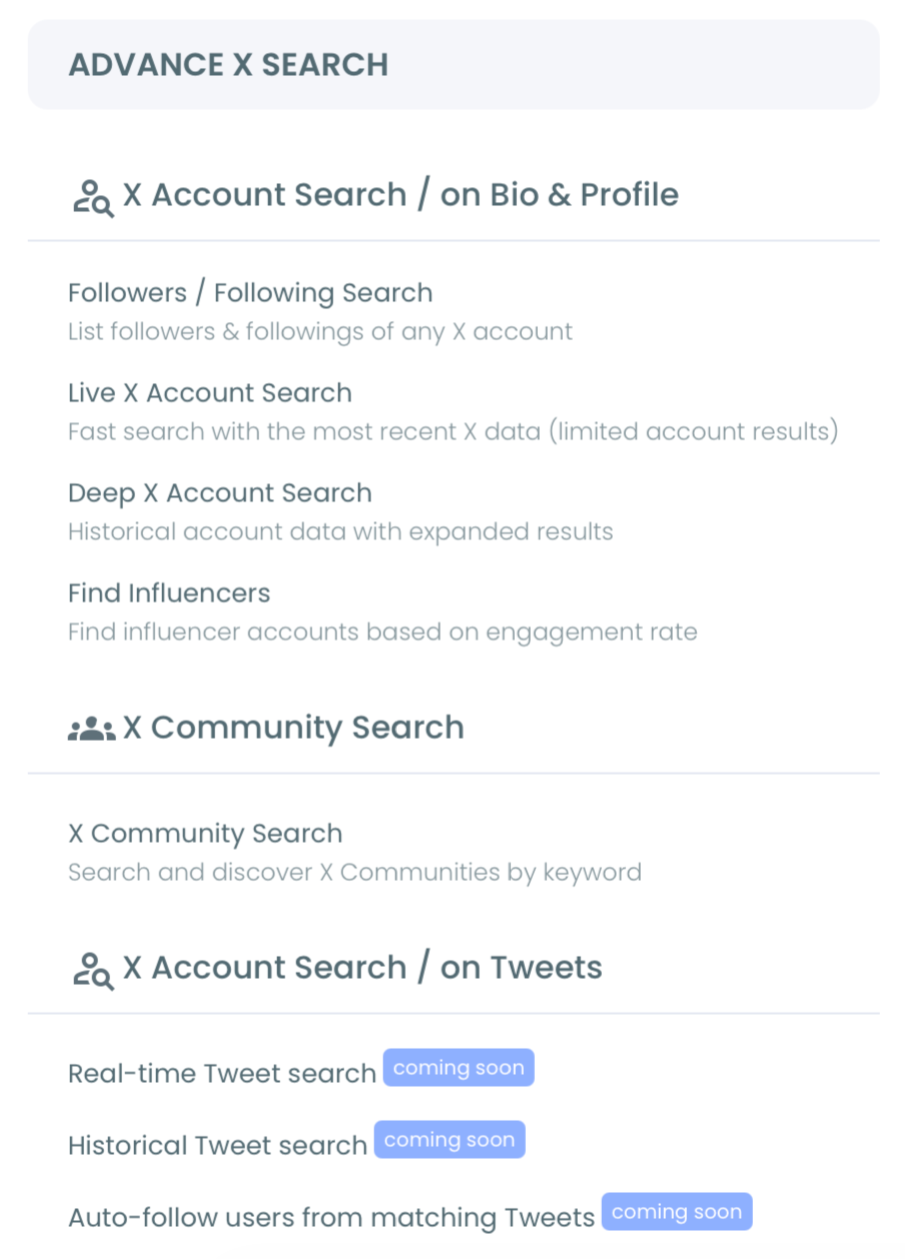
- Open the Advanced X Search menu and select Deep X Account Search.
Search and scope the results
- Enter your keyword. Circleboom matches it against account bios and historical tweets, returning up to 5,000 profiles interested in that term.
- Apply filters to narrow the pool so the segment matches your intent, using follower and following ranges, verification status, profile language, join date, location, and quality signals that hide Fake/Spam, Inactive, or Egghead accounts.
Act on the matches
- Select the accounts that pass and use per-row Open Profile to check any borderline ones.
- Convert the list into work. Follow the qualifying accounts, add them to a Twitter List, or export the full set as a CSV.
That sequence works because each phase protects the next. The login earns official-API access, the keyword produces coverage, and the filters cut coverage down to a segment you can defend before you follow or export it.
Quick recap:
- Connect your X account through official OAuth.
- Open Deep X Account Search and enter one keyword.
- Filter by followers, verification, join date, and location.
- Follow, list, or export Twitter accounts as a CSV.
Which filters actually matter
The filter panel is where a raw keyword pull becomes a usable list, and a few filters carry most of the weight. All of them combine with AND logic, meaning an account has to satisfy every active condition to appear, so each filter you add sharpens the result rather than widening it.
Follow ratio is the quickest bot signal. Accounts following tens of thousands while being followed back by almost no one are usually spam, and setting a minimum ratio removes them in one move. Join date does similar work against bot waves: filtering for accounts created in a narrow recent window exposes a coordinated cluster fast.
Verification status and language narrow by credibility and audience, while the follower-count range keeps you in the tier you actually want, whether that is micro-voices or established names. Quality signals for Fake, Inactive, and Overactive accounts strip the obvious noise before you ever review a profile.
An active-filters bar shows exactly which conditions are applied at any moment, so you can confirm the segment matches your intent before you select a single account. Used together, these filters are also how you improve the quality of your Twitter account, because you only ever connect with real, relevant people.
Use cases worth running
The same search powers several jobs, and naming the job first keeps your keyword and filters honest.
For lead lists, search the buyer's job title, cap the follower range to a realistic tier, and export the segment straight to your CRM. For recruiting or partnerships, search the skill or role, then sort by follower count to separate reach from relevance.
For niche mapping before you enter a space, run a broad keyword and keep the full historical set so you see every player, not only the loud ones. For competitor research, search the terms a rival's audience uses and cross-reference the accounts that appear across more than one query.
Each of these starts from the same place, a keyword against bios and history, and diverges only at the filter step. That is the real efficiency of a search Twitter bios and profiles engine: one search, many outcomes.
What separates a real bio index from a scraper
The difference is the data source, and it decides both accuracy and safety. Circleboom is a verified X Enterprise partner that uses official X (Twitter) Enterprise APIs, so every bio, follower count, and verification flag you filter on is complete and authorized. A scraper sells partial, unauthorized records and can put your account in policy trouble the moment you act on them.
Authorized data plus historical depth is what pulls in the credible-but-quiet accounts that a live scan and a scraper both miss. The expert who posts monthly still carries authority, and a keyword against historical bios and tweets pulls them into your list where recency-based tools never would.
Depth does carry one honest caveat. A pull of up to 5,000 accounts can feel entirely current when it is really historical, so a slice of the list will be historically active rather than active right now. Cross-referencing a deep search with a live one separates the two, and the activity classification on each row tells you which camp an account sits in before you reach out.
That depth feeds directly into strategy. Once you have a clean segment, you can decide who the must-follow influencers for your industry really are. The ranking comes from the metrics in the export, not from who happened to trend that week.
You can also layer post-level precision on top of profile matching. The full how to use Twitter advanced search workflow pairs well with bio discovery when you need to confirm what an account actually posts, and the Twitter advanced search view sits nearby for quick post filtering.
Your Next Move
Pick the path that matches your goal. If you already know the exact descriptor your ideal account uses, run one tight keyword and filter hard for a small, high-fit list you can act on today. If you are mapping a whole niche, run a broad keyword, keep the historical results, and export the segment to work through later. If you are auditing quality as you go, connect only with accounts that pass the filters and let the noise fall away.
Even a casual browse for interesting Twitter accounts to follow goes faster from a keyword than from an endless scroll. The search is where every one of those paths starts.
→ Open the keyword search for Twitter bios and profiles and build your first segment.
Bio Search Questions Worth Answering
What keyword should I search first?
Start with the exact phrase a target person would put in their bio, like "product marketer," "climate researcher," or "vegan chef." Concrete job titles and niche descriptors return cleaner matches than broad topics, and you can widen or narrow from there based on result quality.
How many results will I get?
Deep X Account Search returns up to 5,000 accounts per keyword, paginated, with sort options that expose more beyond the initial order. The high volume is a direct result of scanning historical bio and tweet data instead of only current activity.
Does the tool export lead data?
Yes. The CSV export includes username, display name, bio, location, follower and following counts, verification type, and account creation date. Exports run on a token balance set by your plan, so large pulls consume more tokens than small ones.
Is bulk searching and following compliant with X?
Yes. Circleboom runs through official, authorized API access and paces follow actions inside X's limits, about 50 every 15 minutes and up to 400 per day, resuming automatically after a daily cap. That is what keeps the workflow safe compared with scraping tools.
Can I filter out low-quality or fake accounts?
Yes. The filter panel includes quality signals for Fake/Spam, Inactive, Overactive, and Egghead accounts, all applied with AND logic alongside your follower, verification, and location filters, so you can strip noise before you act on the list.