
A Twitter bookmark viewer is any interface that lets you open, read, and organize the tweets you saved with the bookmark icon. X ships a basic one, but it hides your total count, drops older saves off the visible list, and locks search behind a paid plan.
Where can you see all your Twitter bookmarks in one place?
Inside a dedicated Twitter bookmark viewer, not the native tab. Circleboom loads every saved tweet on your X account into one searchable, filterable table and exports the whole set to CSV through the official X API.
→ Browse your saved tweets
Most people never think about their bookmarks until they need one and cannot find it. That gap between saving and retrieving is the whole problem, and it is why "viewer" turns out to be the wrong word for what X actually gives you.
What a Twitter Bookmark Viewer Actually Does
A real bookmark viewer does three jobs: it shows you everything you saved, it lets you find a specific save fast, and it lets you take that content somewhere useful. The native X tab does the first job partially and skips the other two.
Circleboom's bookmark tools pull your full saved-tweet history into a single structured view where each post is a row with its author, text, date, and engagement figures. From there you can filter by keyword, date, author, or media type, then export the matching subset. Circleboom retrieves that data through the official X API, so your account stays inside platform rules the entire time.
The distinction matters because a viewer you cannot search is closer to a shoebox than a filing cabinet. You know the receipt is in there somewhere. Finding it is another afternoon. A dedicated Twitter bookmark viewer collapses that afternoon into a single search box.
There is a second half to a real viewer that the native tab ignores entirely: control over the collection itself. A proper interface lets you not only read your saves but prune them, and the option to delete Twitter bookmarks in bulk is what turns a viewer into a manager. Reading and resetting belong in the same place.
Why X's Native Bookmark Viewer Falls Short
X's own bookmark page has three limits that show up the moment your collection grows past casual use.
- No counter. The tab never tells you how many bookmarks you hold, so you cannot see the collection growing until it is already unmanageable.
- A hidden display ceiling. In practice the timeline stops showing saves after roughly your most recent 800 to 1,000, and the API returns only the 800 newest.
- Search behind a paywall. Free accounts get no search bar, no filter, and no sort. You scroll, or you give up.
The part almost no guide mentions: older bookmarks that vanish from the tab are not deleted. They have aged off the visible list while still sitting on your account, invisible and unreachable. That is the single most important thing to understand about the native viewer, and it reframes the whole task. You are not managing a list. You are racing a display cap.
If you are still fuzzy on the mechanic itself, the explainer on what bookmarks are on Twitter sets the baseline before you start pulling saves out. Bookmarks were built as a private quick-save, not a retrieval system, and that origin is exactly why they buckle under research-scale use.
X's own help page on bookmarks confirms the feature is designed as a private, in-app save list rather than a retrieval or archive system. It was never built to be the research library people quietly turned it into.
This is where an export-capable viewer changes the math. Once the saves are in a spreadsheet, the ceiling stops mattering, because the content lives somewhere the platform cannot cap. The mechanics of pulling saves out are covered step by step in the walkthrough on how to export bookmarks from Twitter, and the short version is that the export happens through sanctioned API access, not a browser hack.
How to View and Manage Your Twitter Bookmarks with Circleboom
The process is short because the tool does the retrieval for you. Here is the flow, in order.
1. Log in to Circleboom Twitter and connect your X account with official OAuth.

2. Open the Essential Toolbox menu, where the bookmark and export tools live.
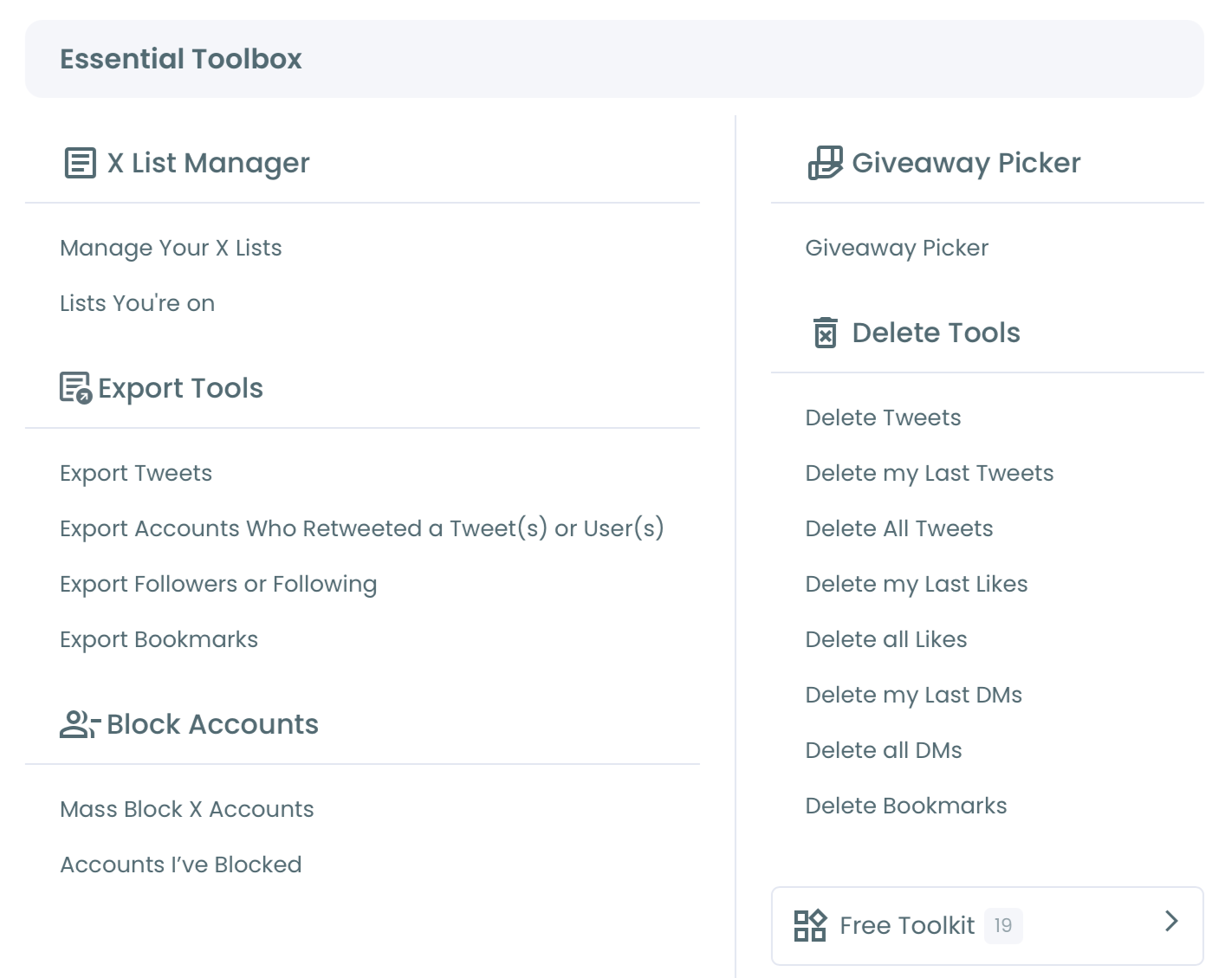
3. Load your bookmarks and click "Sync My X Data" so the table reflects your latest saved posts.
4. Apply Filter Options, then export. Narrow by keyword, date, author, or engagement, review the selection, and export the result to CSV.
That sequence works because the login earns official-API access first, the sync guarantees a current list, and the filter narrows scope before you commit. Skip the sync and you export a stale snapshot; skip the filter and you export noise.
See it live: how the full saved-tweet table loads and sorts inside one bookmark view instead of an endless scroll.
Once your saves are in a CSV, they become genuinely usable. You can sort by engagement to bring your most-saved references back to the top, group rows by topic for a content plan, or hand the file to a research project. If exporting is the main reason you came, you can jump straight to the dedicated flow to export your Twitter bookmarks to CSV and skip the manual scroll entirely.
The filters are what separate a data dump from a usable file. Instead of exporting everything, you can pull only the saves from a given month, only posts above a certain engagement level, or only tweets that contain a keyword or come from a specific author. That precision is the difference between a spreadsheet you actually open and one that joins the pile of files you meant to read.
That usable file is where bookmarks stop being clutter and start being capital. A marketer pulls saved competitor posts into a swipe file. A researcher groups saved threads by theme. A writer turns months of saved inspiration into a content calendar. None of that is possible while the saves are trapped behind an infinite scroll, and all of it is trivial once they are rows in a sheet you can sort and search.
Can You Search Your Twitter Bookmarks?
Not on a free X account. Search inside bookmarks is an X Premium feature, and even Premium reorganizes only the saves still visible under the display ceiling rather than restoring the older ones. A dedicated viewer sidesteps the paywall entirely by loading every retrievable save into a filterable table where keyword and author search are standard.
If search is your main need, the primer on how to search bookmarks on Twitter walks through both routes and where each one breaks down. The native search is fine for finding a save from last week and useless for finding one from last year.
There is also a scale question people rarely check. Before you assume you have room to keep saving, it helps to understand the practical Twitter bookmarks limit and how close you already are to it. A collection that feels manageable at 300 saves behaves very differently at 1,200, when a third of it has already dropped out of view.
Privacy is the quieter half of the same question. Your saves are visible to you alone, and it is worth confirming whether Twitter bookmarks are private before you export a collection that quietly reveals what you research and who you watch most closely.
Because Circleboom is an official X Enterprise Developer company, the retrieval runs through sanctioned API access rather than scraping, so nothing about viewing or exporting your saves puts the account at risk. That compliance is not a footnote when you are connecting a tool to an account you cannot afford to lose.
The Bottom Line
The native tab is a viewer in name only. It shows you a slice of your saves, hides the rest behind a silent ceiling, and refuses to let free users search. A proper Twitter bookmark viewer closes all three gaps by loading the full collection, making it searchable, and letting you export it before anything ages off. Your saved tweets are worth more as a portable archive than as a list you cannot query.
→ Open your Twitter Bookmarks Manager
Frequently Asked Questions About Twitter Bookmarks
How many Twitter bookmarks can I actually see?
The native tab reliably shows roughly your most recent 800 to 1,000 saves, and the API returns about 800. Older bookmarks stay on your account but drop off the visible list, which is why exporting them before they age off is the safe move.
Can other people see my Twitter bookmarks?
No. Bookmarks are private to your account, and no one else can view what you saved. Exporting them to CSV keeps that privacy intact, since the file lives on your own device.
Does viewing or exporting bookmarks with Circleboom break X's rules?
No. Circleboom accesses your saved posts through the official X API with your authenticated connection, so the operation stays fully policy-compliant and never touches scraping.
What format do exported bookmarks come in?
CSV. Each saved tweet becomes one row with the author, full text, date, and engagement figures, so you can open it in Excel, Google Sheets, or any data tool and search it instantly.