

A Twitter exporter is a tool that pulls an X account's tweet history out of the platform and hands it back as a structured spreadsheet you can sort, filter, and analyze. X itself gives you no clean way to do this. The answer sits below, then the mechanics behind it.
A Twitter exporter turns your tweet history into a downloadable CSV instead of scroll-only content locked inside the app. Circleboom's Twitter exporter downloads up to 3,200 of any public account's most recent tweets on X, complete with impressions, likes, retweets, and replies, through fully sanctioned official API access.
→ Start your Twitter exporter
Every row is one tweet, every column a metric you can pivot on.

What a Twitter Exporter Actually Does
A Twitter exporter reads an account's public timeline and writes each tweet into a spreadsheet row. That row carries the text, the post date, the post type, and the engagement numbers X measured while the tweet was live.
The value is the format shift. Inside X, your tweets are a scroll. You cannot sort them by impressions, filter them to a campaign window, or compare last quarter against this one. Once the same posts sit in a CSV, all of that becomes a two-click spreadsheet operation.
Circleboom's exporter downloads tweet data from any public account, not only your own. That single detail unlocks competitor benchmarking, influencer research, and content audits that native analytics cannot reach.
If your first goal is a clean backup or a working dataset, you can export your tweets to CSV in one pass. The file opens in Excel or Google Sheets the moment it lands.
The 3,200-Tweet Ceiling, Explained
Most exporter round-ups skip the one number that decides whether a tool fits your account. Here it is: any Twitter exporter built on the official API can retrieve a maximum of 3,200 of the most recent tweets from a public timeline.
That cap is not a Circleboom limit. It is a platform constraint X sets on the public timeline endpoint, and no plan upgrade or workaround extends it. For accounts under 3,200 lifetime posts, you get everything. For older, high-volume accounts, you get the most recent 3,200, and X's own archive request is the only route to anything older.
Knowing the ceiling before you export saves a wasted run. If you need posts beyond that window, plan for X's slower native path instead of expecting a live tool to reach them. The guide on how to retrieve archived tweets covers that native route in full.
Circleboom is an official X Enterprise developer, so the data it pulls within that 3,200 window is complete and accurate. It is not a partial scrape stitched together by an unofficial extension. That distinction matters most when the export feeds a report someone will act on.
The CSV Schema and What Each Column Unlocks
The gap in most "best Twitter exporter" lists is that they show you a download button and stop. What actually determines the tool's usefulness is the column set, because the columns decide which analyses you can run.
A Circleboom export writes 15 fields per tweet. The ones that carry the most analytical weight:
- CountImpression sorts your history by reach so top performers rise to the top instantly.
- CountLike, CountRetweet, CountReply build an engagement-rate column against impressions.
- TweetType separates original posts from retweets and replies for an output audit.
- CreatedAt filters any campaign window or before-and-after cleanup comparison.
- HasMedia tests whether image and video posts out-earn text on your account.
A raw archive is text. A columned export is a dataset you can question.
That is the real payoff of a Twitter exporter over X's HTML archive dump. The archive answers what you posted. The CSV answers what worked, when, and why. For a deeper read on the metrics themselves, the Twitter analytics metrics and insights guide maps each number to a decision.
The Analyses the Columns Make Possible
Columns are only useful if you know what to ask them. Here are the questions a filled-in export answers in a few clicks, with the math kept simple enough to run in any spreadsheet.
True engagement rate, not vanity counts. Divide the sum of likes, retweets, and replies by impressions for each row. A tweet with 40 likes on 2,000 impressions (a 2% rate) is outperforming a tweet with 100 likes on 20,000 impressions (a 0.5% rate), even though the raw like count looks worse. That reversal is invisible inside the app and obvious in a CSV.
Format audit. Filter by HasMedia and compare the average impression count of media posts against text-only posts. If a creator with 10,000 followers finds their image posts typically pull double the reach of plain text, that is a direct signal to shift the content mix.
Reply performance. Filter TweetType to replies. Many accounts discover their replies quietly out-earn their originals, which reshapes where they spend effort.
Time-window comparison. Filter CreatedAt to a launch week, then to the week before, and read the reach lift side by side.
Each of these is a documented use of the exact fields Circleboom writes, not a hypothetical. The point of a Twitter exporter is to make these questions answerable at all.
Export vs X's Native Archive
X does technically let you download your data, so it is fair to ask why a dedicated exporter exists. The difference is speed, structure, and scope.
The native archive is a multi-day request that returns HTML and JSON built for viewing, not analysis. There are no clean columns, no engagement sort, and no way to scope the file to a campaign before you download it. It also covers only your own account.
A Twitter exporter returns a analysis-ready CSV in minutes, already structured into sortable columns, and works on any public account. You choose which one matches your job: the native archive for a complete personal record older than 3,200 posts, the exporter for a fast, filterable, analyzable dataset. Most reporting and research work wants the second.
How to Export Tweet Data with a Twitter Exporter
To export tweet data, connect an account, enter the target username, confirm the tweet count, and receive a CSV by email and inside your Circleboom account. The flow runs in one sitting, and the file is ready for a spreadsheet the moment it arrives.
See it live: how a full public timeline downloads into one clean CSV, row by row.
- Log in to Circleboom Twitter and connect your X account with official OAuth.
- Open the Essential Toolbox menu and select the Export Tweets tool.
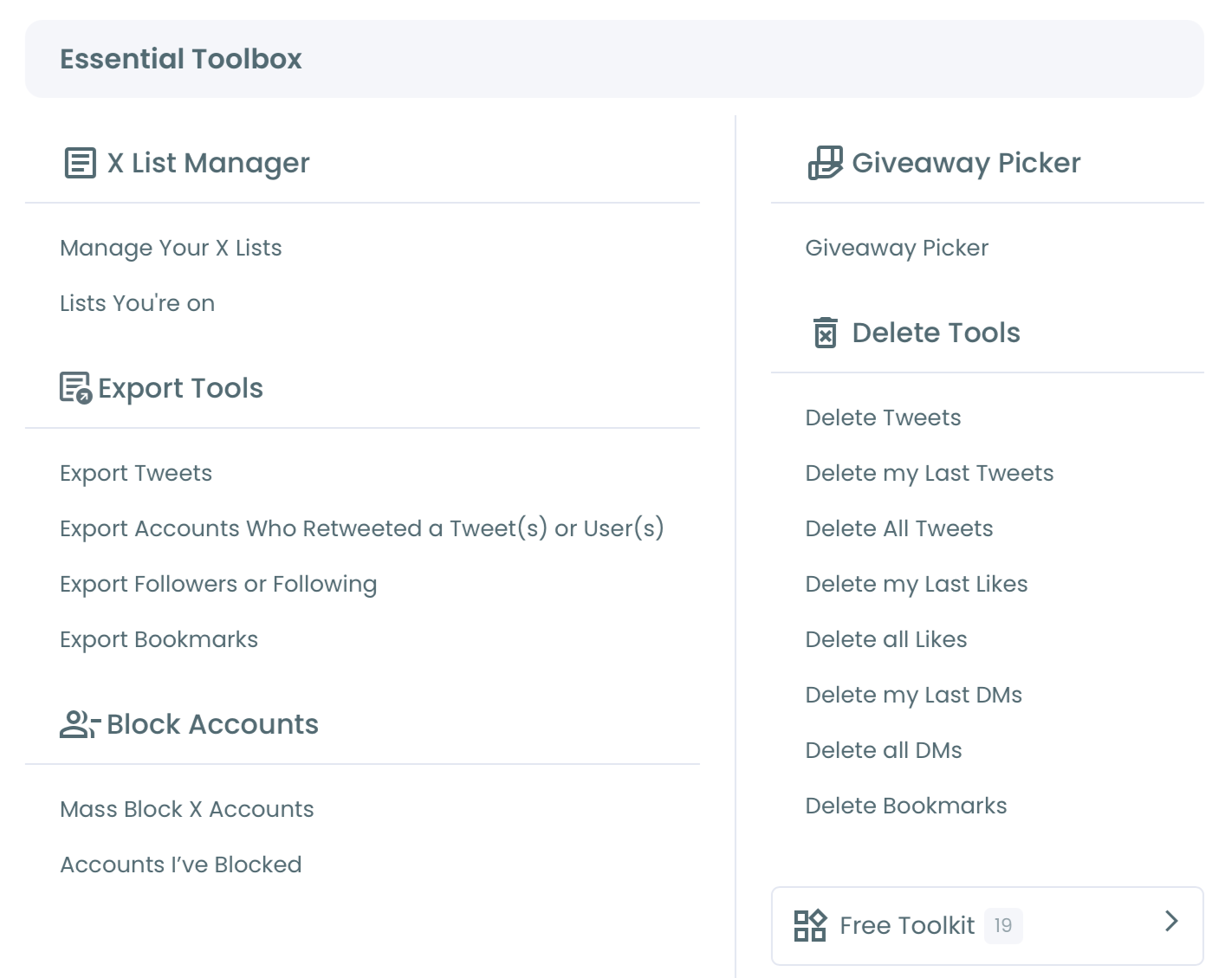
- Enter any public X username and let Circleboom fetch the account's tweet history and total count.
- Confirm the export, enter your delivery email, and download the CSV from your Circleboom account once it lands.
That order holds up because the login earns official-API access first, the username step scopes exactly whose data you pull, and the confirmation step keeps the export deliberate rather than accidental. At a glance: connect, target, confirm, download.
Is a Twitter Exporter Safe to Use on Your Account?
Yes, when the exporter reads data through official channels rather than scraping the site. Circleboom retrieves every field through sanctioned, official API access, which means your account stays inside X's rules and never trips the automation flags that unofficial browser extensions risk.
The safety question is really a data question. Scraper extensions pull whatever the page renders, which is often incomplete and always unauthorized. An official X Enterprise API partner pulls the sanctioned dataset, so what you export is both compliant and trustworthy enough to put in front of a client.
If you are comparing tools before you commit, the roundup of best export tweets extensions walks through which methods keep your account out of trouble.
Who Reaches for a Twitter Exporter
The tool tends to earn its place in four hands. Analysts and social managers use it to turn a quarter of posting into a reportable dataset. Agencies use it to deliver structured performance files a client can open without any Circleboom login.
Researchers and journalists use it to study a public figure's posting patterns at scale. And solo creators use it to stop guessing which of their formats actually carries their reach. In every case the job is the same: move the posts out of the scroll and into a file that answers questions.
Beyond Your Own Timeline
Because the exporter works on any public account, the same tool covers research you would otherwise do by hand. Pull a competitor's last 3,200 posts and sort by impressions to see which of their formats actually land. Export an influencer's timeline before a partnership to check whether their engagement is real.
You can also export all tweets of an X user to Excel or CSV and keep a dated snapshot. A CSV freezes the metrics at export time, so the record survives even if the account later deletes those posts.
Exporting is one node in a wider data-portability set. When you need to see who boosts a post, you can export retweeters instead of scrolling a like list by hand.
For context around a specific date range, pulling Twitter historical data gives you the surrounding activity rather than a single account's output. Each one turns a piece of X activity into something you can keep.
Remember the File Is a Snapshot
One property of a Twitter exporter is easy to forget and worth stating plainly. The CSV captures the account exactly as it stood at the moment you ran it. Impressions, likes, and retweets keep climbing on X after the export, but the file does not update.
That is a feature, not a flaw. A frozen snapshot is what makes a dated record trustworthy for reporting and before-and-after comparisons. If you want the current numbers, you run a fresh export and compare the two files. Two dated exports side by side show growth over a period more clearly than any live dashboard, because each one is a fixed point you can measure against.
The Takeaway
A Twitter exporter exists because X stores your posts as a scroll and gives you no button to turn that scroll into data. Circleboom fills the gap with a one-run export that hands you up to 3,200 tweets as a 15-column CSV, pulled safely through official, sanctioned API access and ready for any spreadsheet.
Keep the 3,200 ceiling in mind, decide whether you are auditing your own account or researching another, and the export does the rest. When you are ready to turn your timeline into a working dataset, you can download your full tweet history in a single pass.
→ Run your Twitter tweet exporter
Common Questions About Exporting Tweet Data
How many tweets can a Twitter exporter download at once?
Up to 3,200 of the most recent tweets from a public X account. That number is X's own public-timeline limit, so it applies to any tool built on the official API, not just Circleboom.
What file format does the export use?
CSV. It opens directly in Excel, Google Sheets, or any BI tool, and each of the 15 columns can be sorted or filtered like a normal spreadsheet.
Can I export tweets from an account I do not own?
Yes, as long as the account is public. You do not need the account's credentials, which is what makes competitor and influencer research possible.
Will the export include engagement numbers?
Yes. Impressions, likes, retweets, replies, quotes, and bookmarks all come through as their own columns, captured as a point-in-time snapshot at the moment you run the export.
Is exporting my tweets against X's rules?
No, provided the data comes through official channels. Circleboom pulls everything through sanctioned access rather than scraping, so the export stays fully compliant. You can back up your history the same way you would back up my tweets with any legitimate tool. For posts older than the 3,200 window, use X's own archive download instead.



)