
The honest "Twitter feed aggregator" already lives inside X, and it is the List. When you drop a set of accounts into an X List, you get a clean, single-topic feed of only those accounts, separate from the algorithmic home timeline that mixes everything together.
The catch is building and maintaining that feed. X lets you add accounts to a List one profile at a time, so a serious Twitter feed aggregator built from 80 competitors or 120 journalists becomes an afternoon of clicking. That is the bottleneck Circleboom removes.
A Twitter feed aggregator is a curated X List that pulls a chosen set of accounts into one filtered feed, independent of the main timeline. Circleboom's Manage Your X Lists builds and maintains that feed in bulk through official, sanctioned API access, adding, moving, and cleaning accounts in a single action instead of one profile at a time.
→ Twitter feed aggregator
Most guides on this topic point you at RSS readers or third-party dashboards. That is the wrong tool for aggregating accounts you already follow inside X. An RSS aggregator pulls articles from external websites; an X List aggregates X accounts, natively, with replies and quotes intact. The two solve different problems, and mixing them up is why so many people give up on the idea.
Why an X List Is the Real Feed Aggregator
An X List is the only account-level feed X gives you that the algorithm does not reshuffle. You choose the members, and the List shows their posts in order, so nothing important gets buried under whatever the home timeline decides to promote that hour.
That control is the whole point of aggregation. A Twitter feed built from Lists turns a noisy platform into several quiet, purpose-built channels: one for competitors, one for press, one for the niche you actually care about. If you are not sure how many of these you can run at once, it helps to know how many Twitter Lists you can have before you plan the set.
The home timeline optimizes for engagement, not for your monitoring needs. It shows posts that keep you scrolling, which is rarely the same as the posts you need to see for work. A List inverts that logic and puts you back in charge of the input.
There is a second, quieter benefit. Following an account changes your main feed and signals interest to the algorithm; adding an account to a private X List does neither. You can track a rival or a sensitive source without them knowing and without polluting your own timeline. If you have ever wondered whether Twitter Lists are public, the answer is that you choose, and private Lists are the backbone of discreet monitoring.
Three Custom Feeds Worth Building First
The strongest use of a feed aggregator is not one giant List, it is a few focused ones. Each becomes a channel you check with a clear intent instead of a bottomless scroll.
- The competitor feed. Every rival brand, their founders, and their loudest customers in one List. You see launches, complaints, and positioning shifts the day they happen. Pairing this with a proper Twitter competitor analysis workflow turns passive watching into a real intelligence loop.
- The journalist and press feed. The reporters and editors who cover your space, grouped so you can time a pitch to what they are already writing about. A private List keeps your media research invisible to the people on it.
- The niche-community feed. The 40 to 100 accounts that actually drive conversation in your corner of X. This is the feed that keeps you fluent in your own field without the noise of the global timeline.
A focused List of 50 accounts you read daily beats a following list of 5,000 you skim once a week. The value is in the tight curation, and tight curation is exactly what native X makes tedious to build.
Circleboom is an official X Enterprise Developer, so every account it reads and every List membership it writes moves through approved, policy-compliant access. Your feed gets built at scale without putting the account at risk.
How to Build a Twitter Feed Aggregator With Circleboom
To build a custom aggregated feed at scale, you find the accounts that belong in it, then bulk-add them to an X List in one action instead of visiting each profile on X. Circleboom's Manage Your X Lists handles the bulk write; a Circleboom search or follower segment supplies the accounts. The flow below runs that loop in three phases.
See it live: how a set of scattered accounts becomes one organized, custom X feed in a single List.
Connect your X account to Circleboom
- Log in to Circleboom Twitter and connect your X account with official OAuth.

Open the List Manager and choose your accounts
- Open the Essential Toolbox menu and select Manage Your X Lists.
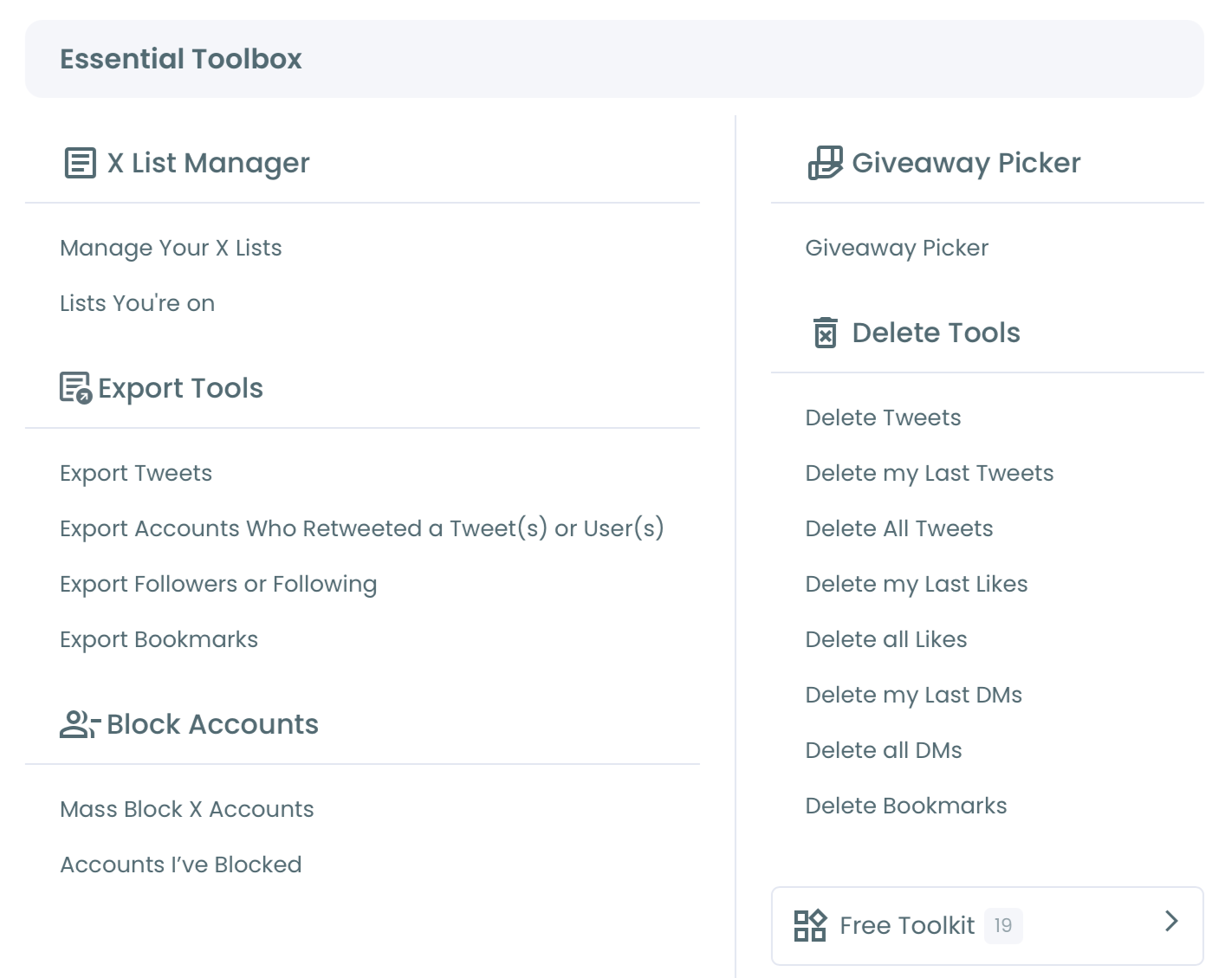
- Gather the accounts for the feed. Pull them from a search result, a filtered follower segment, or a list of usernames you type in directly. This is where you choose who belongs in the competitor, press, or niche feed.
Bulk-add, then keep the feed clean
- Add the whole set to a List in one action. Create a new List or add to an existing one, and set it public or private depending on whether the feed should be visible.
- Filter and maintain over time. Use the quality and activity filters to drop inactive or fake accounts, and move accounts between Lists as their category changes.
That order works because it front-loads the account selection before the write, so the List reflects a deliberate feed instead of a random grab. The bulk-add earns official API access first, the filter narrows scope, and the move action keeps each feed aligned with its purpose as your strategy shifts.
At a glance: connect, gather accounts, bulk-add to a List, filter, maintain. The one-by-one profile visits disappear.
X's native interface makes you add 80 accounts one profile click at a time. Managing your X Lists in bulk turns that whole feed-build into a single working session.
What You Gain From a Curated Feed Setup
A working set of Lists changes how you spend attention on X. Instead of one endless timeline, you have a handful of channels, each with a job, and each readable in minutes.
The monitoring gets sharper. A competitor feed means you notice a rival's price change or product complaint the day it lands, not a week later when it reaches the main timeline. That timing is often the difference between a reaction and a missed moment.
The discovery gets better too. When you can find the right influencers for your niche and drop them straight into a List, your niche feed stays current without manual upkeep. New voices go in, faded ones come out, and the channel keeps its signal.
There is a compounding effect on your own posting. Watching a focused feed of the accounts that matter shows you what your audience is actually talking about, which is the raw material for replies and posts that land. A feed aggregator is not just an input tool, it is a content-idea engine.
The Bottom Line
A Twitter feed aggregator is not a separate app you bolt onto X, it is a set of well-built Lists that give you filtered, single-topic feeds free of the algorithm's reshuffling. The concept is native; the friction is only in the building and maintaining, which is where a bulk tool earns its place.
Circleboom's Manage Your X Lists is that tool, turning an afternoon of one-by-one profile clicks into a single bulk action and keeping each feed clean as accounts come and go. When you are ready, set up your custom X feed and stop letting the timeline decide what you see.
→ Build your Twitter feed aggregator with Circleboom
Common Questions About Aggregated X Feeds
Is an X List the same as an RSS feed aggregator?
No. An RSS aggregator pulls articles from external websites into one reader, while an X List aggregates X accounts into a native feed inside the platform, with replies, quotes, and reposts intact. If you want to combine both, you would use an X List for on-platform accounts and a separate RSS tool for outside sources.
How many accounts can one aggregated feed hold?
A single X List can hold up to 5,000 members, and each account can own up to 1,000 Lists, so you can build many focused feeds well before hitting a ceiling. In practice a tight feed of 50 to 150 well-chosen accounts is more useful than one crowded List, because the whole value of aggregation is filtering signal out of noise.