
"We can get you to fifty thousand in six months."
That was the opening line of the pitch, and it worked on me for about a week.
It stopped working when I asked the follow-up question I should have asked immediately: fifty thousand of whom?
The answer came back as a description of a process rather than a description of people. Content cadence, engagement pods, targeted follows, community participation. All real tactics. None of them an answer.
A Twitter growth agency sells you a number going up.
What nobody explains at the pitch stage is that the number going up is also the denominator of every quality metric you report, and growing it carelessly makes your account look worse to the only audience that decides your reach.
Circleboom finds the genuinely influential accounts in your X niche by keyword and scores the quality of the followers you already have, so growth gets measured by composition rather than count.
The composition read is the part a growth pitch never shows you, and it is the only number that tells you whether more followers will help or hurt.
→ Find Twitter influencers
The arithmetic that killed the pitch for me
Engagement rate is a ratio. Interactions on top, follower count on the bottom.
Add ten thousand followers who never open the app and your interactions stay flat while your denominator grows by ten thousand. Your engagement rate falls.
X's ranking systems do not know why the ratio moved, and neither does anyone reading your analytics. The fall looks identical to a content problem, and that is how it gets read.
A growth campaign that adds the wrong followers does not just waste money. It actively suppresses the account it was hired to grow.
That is the mechanism, and it is why "how many" is the wrong question and "who" is the right one.
Run the numbers on your own account before anyone pitches you. If 30 percent of a 10,000-follower base is inactive or automated, then 3,000 accounts are sitting in your denominator contributing nothing to the numerator.
Every reported engagement rate you have ever looked at was computed against that number.
The audit that answers how many of your X followers are bots takes minutes and reframes the entire conversation, because it turns an abstract worry into a percentage you can put in a room.
The paid side has the same problem in different vocabulary. If you want the version with a quote attached, I priced one out at $3,000 a month against $20 of targeting, and the ratio of judgment to software came out roughly where it does here.
What a Twitter growth agency is genuinely good at
I want to be fair here, because I have been unfair about this before and it cost me.
Growth agencies are good at consistency. They post when you would not. They reply when you are busy. They maintain a cadence through the weeks where you would have gone quiet, and cadence compounds in a way that is very hard to replicate alone.
That is real value and I underrated it badly.
They are also good at pattern recognition across accounts. Someone who has run thirty accounts in your category knows which formats land and which topics stall, and that knowledge is expensive to acquire firsthand.
Where the model breaks down is audience identification. Finding the right accounts to reach is not a craft skill anymore.
You type a keyword, throw away most of what comes back, and keep the rest in a file. What used to make that hard was getting at X's account data in the first place, and that stopped being hard.
So the split looks like this:
- Cadence, formats, and reply discipline: worth paying for.
- Knowing which accounts matter in your niche: a query.
- Knowing whether your existing followers are real: a report.
Mapping the niche before anyone pitches you a number
The process I settled on, which runs in an afternoon and produces a file you keep.
Map who actually holds attention in the niche
- Authorize Circleboom Twitter against the account you are trying to grow. The follower-quality pass in step 5 needs your own account attached, so do this before anything else.
- From Advanced X Search, open influencer discovery. It runs the same keyword engine as account search with a different sort applied, which is worth knowing because one bad keyword poisons both.
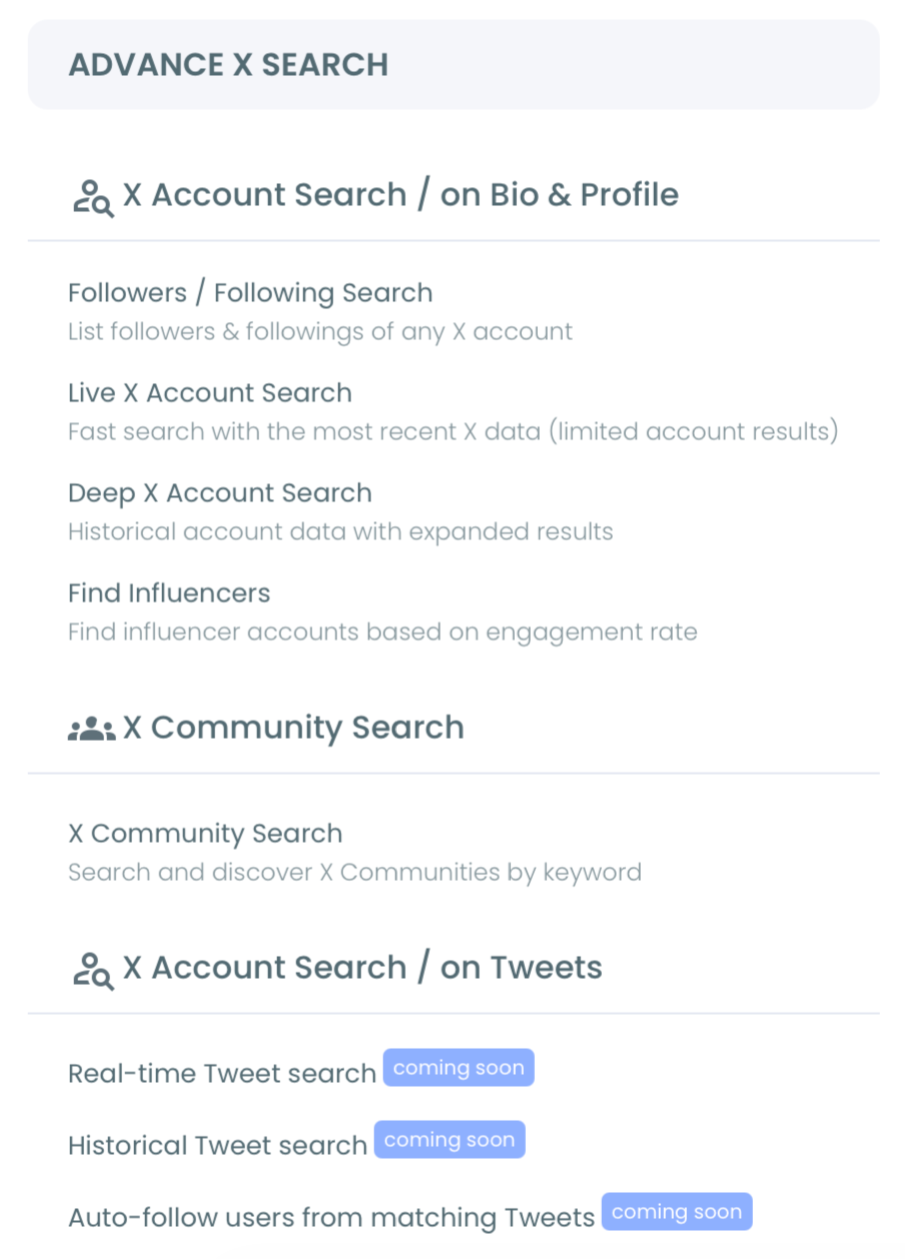
- Search the niche keyword as your buyers write it, then sort by follower count and engagement classification rather than by raw match. The accounts at the top of that sort are the ones whose attention is worth borrowing.
- Filter out the noise before you read a single profile. Exclude Fake/Spam, Inactive, Eggheads, and Protected accounts, then set a follow-ratio band so you are not looking at accounts that follow everyone back.
Audit what you already have before adding to it
- Run a follower-quality pass on your own account and record the share of inactive, spam-flagged, and photoless profiles. That percentage is your baseline and it is the number any growth proposal should be measured against.
- Identify the accounts inside your existing base that consistently retweet and quote you. They are usually a small group, and they are a better seed than anything a category persona produces.
- Export both sets as CSV and keep the files. The niche map tells you who to reach; the amplifier set tells you who to model.
The order you build in is not the order you act in.
The map comes first because the search menu already has you there, but nothing on it gets touched until the audit tells you whether your problem is acquisition or composition, and those two problems have opposite solutions.
Expanding a base that is 30 percent dead makes the ratio worse; cleaning it first makes every subsequent growth number honest.
Most people run these in the wrong order and then wonder why the new followers did not help.
If you want to see the sort order that separates influential from merely loud, it is easier to watch than to describe.
Your existing followers are the asset nobody prices
This is the part I did not see coming, and it is the reason I stopped shopping for growth agencies.
X supports building a Lookalike Audience from a seed you supply. The quality of everything downstream depends entirely on the quality of that seed.
Most people seed from their whole follower list, which means they are asking X to find more people like a group that is 30 percent dead. The output is exactly as good as the input, which is to say not very.
Seed from your amplifiers, not your followers.
The accounts that reliably retweet you, reply to you, and quote you are a behavioral signal rather than a demographic one, and there are usually far fewer of them than you expect.
The method for finding the hidden influencer among your X followers pulls that group out, and once you have it, the growth question changes shape entirely.
You stop asking an agency to find you an audience. You start asking them what to say to the audience you already proved you have.
The mechanics of building from that seed are covered in the work on Twitter follower lookalikes and how to use them. That is the paid-side application of the same organic insight.
There is a governance point hiding in here too. Whoever controls the seed controls every audience derived from it, and if the seed lives inside an agency's account rather than yours, the asset you have been paying to build walks out the door when the contract ends.
Keeping both the amplifier set and the influencer and niche map on your own side of the line is a five-minute decision with a multi-year consequence.
The mistake I made trying to prove the point
I got competitive about this and it went badly, so it is worth writing down.
Having decided that audience identification was a solved problem, I built an enormous niche map. Several thousand accounts, carefully filtered, sorted by influence. It was a genuinely good file.
Then I did nothing useful with it for two months, because I had no content strategy to attach it to. I had replaced the agency's cheapest deliverable and kept none of its expensive ones.
The account grew more slowly during those two months than it had while I was paying someone.
Owning the list is necessary and not sufficient, and I needed to learn that at my own expense before I believed it.
What eventually worked was a hybrid. I kept the file and the audit as my own, brought in help for cadence and formats, and used the composition data to argue about strategy from evidence rather than from taste.
Arguments that used to run a full call resolved in ten minutes, because we were disagreeing about evidence instead of taste.
The invoice shrank and nobody minded; what was left on it was the work they had wanted to be doing all along.
Circleboom's role in that arrangement sits entirely on the data side. It reads X through Enterprise-level API access, which on a follower audit is the difference between a number and a guess: a scraper that silently misses a slice of your base will always report you cleaner than you are.
On a quality audit that distinction is load-bearing. An incomplete dataset produces a flattering number, and a flattering number is worse than no number at all, because it ends the investigation instead of starting one.
For the free-tier version of the discovery step, the walkthrough on finding Twitter influencers step by step covers the same logic at smaller scale.
Two other checks help you hold a growth proposal to account. The Twitter follower checker gives you the quality baseline on your own base before anyone promises to expand it.
And comparing X accounts side by side lets you check an agency's claimed case studies against the accounts they name. That five-minute exercise has changed my mind about vendors more than once.
You do not need permission to start here
The reason most people hire a Twitter growth agency before doing any of this is that the work feels like it requires standing. Specialist access, a budget line, someone senior signing off.
It does not. The follower audit costs you an afternoon. The niche map costs you a keyword and some filter judgment.
Neither requires a contract, an ad budget, or anyone's approval, and both produce artifacts you own permanently regardless of who you hire afterwards.
Do that first and the agency conversation becomes a genuinely good one. You will know what your composition is, who holds attention in your space, and which of your existing followers actually carry you.
An agency arriving into that conversation gets to spend its time on the hard part, which is what you wanted from them anyway.
If you want a place to start that costs nothing, the niche influencer search is the one step that changes the conversation fastest, because it replaces an opinion about your market with a list.
Growth was never the number. It was always the composition of the number.
→ Find the influential accounts in your niche
What to know before you sign
Should I clean my follower list before or after a growth campaign?
Before, without exception. Growth against a diluted base makes every metric harder to read, and you will not be able to tell whether the campaign worked or whether the ratio simply moved. Clean first, record the baseline, then measure.
Is a smaller, cleaner following actually better?
For reach and engagement rate, yes, because both are computed against your follower count. For vanity and for pitch decks, no. Decide which of those you are optimizing for before you sign anything, because the two goals genuinely conflict.
How do I check an agency's case studies?
Ask for the account handles, then compare those accounts side by side yourself. Follower growth is public, engagement is public, and follower quality is measurable. An agency that will not name the accounts is asking you to take the results on trust.
Can a Twitter growth agency guarantee follower numbers?
They can promise them, and some do. Treat a guaranteed number as a warning rather than a reassurance, because the only reliable way to hit a follower target on schedule is to stop caring who the followers are, which is the exact failure mode this whole piece is about.
What should I keep in-house permanently?
The follower audit and the niche map. Both are cheap to re-run, both produce files you own, and both are the evidence you need to have a substantive argument about strategy. Everything else is negotiable.