

Most people searching for their likes on X hit the same wall. They find the Likes tab in two taps, then discover it has no search, no date filter, and no realistic way to reach anything more than a few hundred posts back. Finding recent likes is trivial. Working through a full history is where the native tab quits on you.
Here's what finding and clearing your X likes comes down to.Your likes live on the Likes tab of your own profile, newest first, on desktop and mobile.The tab has no search or date filter, so deep history is impractical to reach by scrolling.A tool that reads your whole like history, including your X archive, is what makes a real cleanup possible.
Built on Circleboom's Delete Likes tools and delivered through official, policy-compliant X (Twitter) API access, you can find and delete your X likes in one filtered pass.

Where Are Your Likes on X, Exactly?
Your likes sit under the Likes tab on your own profile. On desktop, open your profile and click Likes in the tab row next to Posts, Replies, and Media. In the mobile app, tap your avatar, then tap the Likes tab. Both show the same list in reverse-chronological order, and `x.com/i/likes` is a direct shortcut to it.
Two rules govern who sees that list. Your own likes are always visible to you. Other people's profile-level likes are not visible to you anymore, because X made the Likes tab private, as spelled out in X's help page on public and protected posts.
Private, though, is not the same as deleted. The record still exists, still influences your recommendations, and still deserves a cleanup if it has drifted from who you are now.
Why the Native Likes Tab Isn't Enough for a Cleanup
The tab is a viewer, not a manager. It answers "what did I like recently" and nothing more.
Scroll far enough and three limits show up fast:
- It loads likes in small batches and slows down the deeper you go.
- It offers no way to filter by keyword, date, or media type.
- It gives you no bulk action, so removing likes means one tap each.
For a handful of recent likes, that is fine. For a like history built over years, it is a dead end. This is the same structural gap that makes people ask how to download Twitter likes before they clear them, because they want the record preserved somewhere before it goes.
If a full reset is your aim, the reliable route is to clear your X likes in bulk from a tool that can read the whole history at once.
Get Your X Archive First (Why This Step Comes Before Anything)
The archive is the piece most guides skip, and it is the piece that makes a complete cleanup possible.
X exposes only a recent slice of your likes through its standard interface and data path. Your full lifetime record, every heart going back to the day you joined, lives in the data archive you request from X settings. That archive is the source of truth for deep history, and it is the only complete record you will have after the likes are gone.
Request it early for one practical reason: the archive can take 24 to 48 hours to generate. If you sit down to clear your likes without it, you will either stall or settle for clearing only the recent window. Ask for the archive first, let X prepare it, then do the cleanup once the file is ready.
How to Delete Your Likes on X (Step by Step)
The reliable path is to load your full like history into Circleboom, filter it, and remove the matching likes in bulk. Because the native API only exposes a recent slice of likes, the complete history comes from your X data archive, which is why this flow includes an archive upload. The process runs in three short phases.
Connect Circleboom and open the Delete Likes tools
- Log in to Circleboom Twitter and connect your X account with official OAuth.
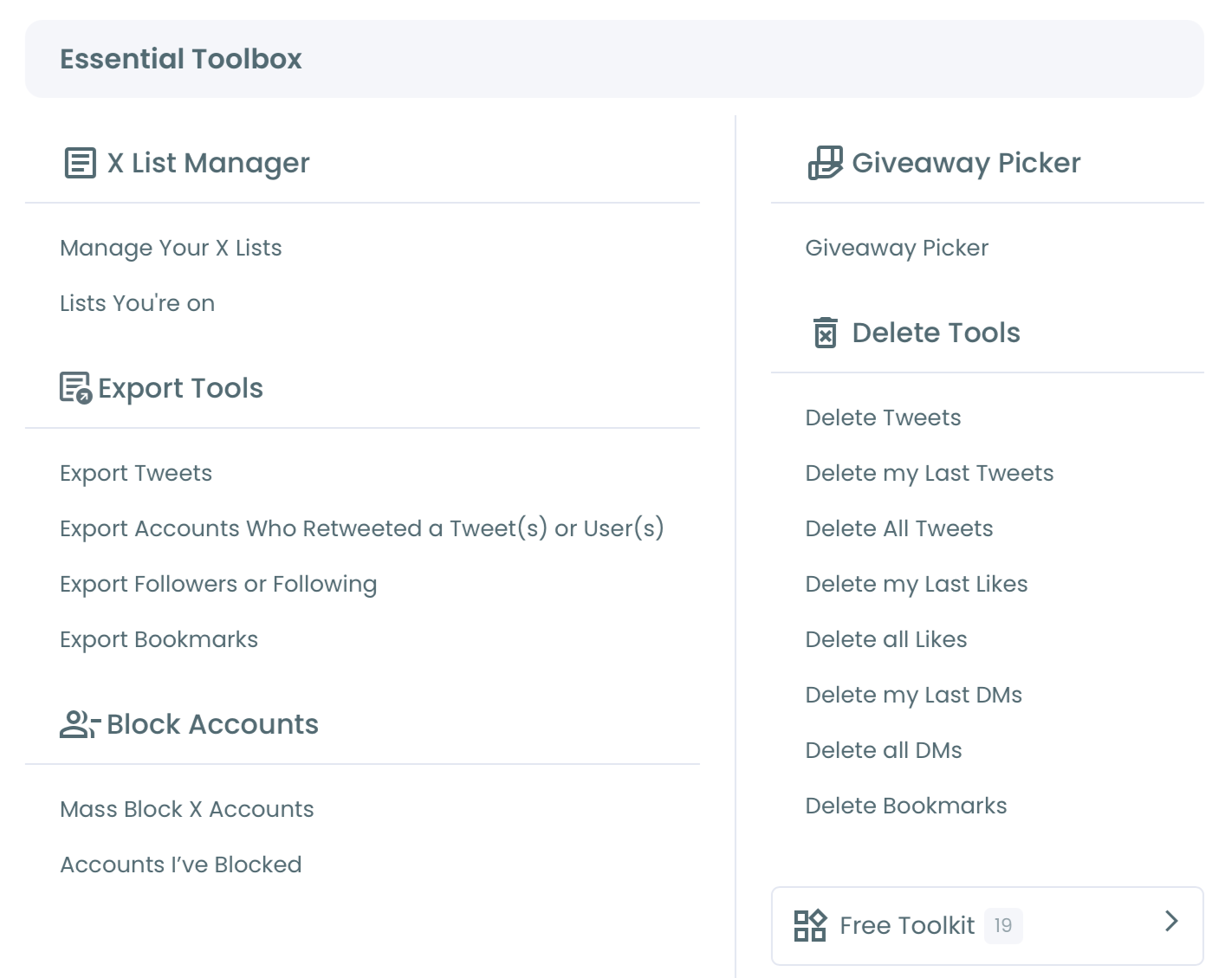
- Open the Delete Likes tools inside the Essential Toolbox menu.
Load your full like history from the X archive
- Download your X data archive from X settings under Account, then Your Archive, and locate the like.js file inside the archive folder. Upload the like.js file itself, not the full archive ZIP.
- Upload the like.js file in the wizard's upload step. Circleboom reads it and displays the total count of liked posts, including likes far older than the recent API window.
Filter, review, and remove
- Apply filters by date range, keyword, media type, or engagement so you are targeting the exact likes you want gone instead of the entire history. Add any endorsements you want to keep to the Protect List.
- Review the Approve & Delete count and confirm removal. The removal is permanent, and API rate limits apply during execution, so large runs take some time and the browser should stay open until they finish.
That sequence is what keeps the cleanup accurate. The login earns sanctioned access, the archive supplies the complete record, and the filter step narrows scope before anything is removed, so you never wipe more than you meant to. Circleboom runs all of this as one of the companies on X's official Enterprise developers list, so the deletion stays inside platform rules and your account is never put at risk.
Short demo: uploading the like.js archive and clearing a full X like history in one filtered pass.
Quick recap:
- Log in and open the Delete Likes tools.
- Upload the like.js file from your X archive.
- Filter, review the count, and confirm.
How the Filters Turn a Blunt Wipe Into a Precise One
The filters are the reason this beats a mass unlike. Each one scopes the run so you remove exactly the likes you mean to.
- Date range clears a specific period, like a single controversial year, and leaves the rest.
- Keyword targets likes on posts mentioning a topic, handle, or hashtag.
- Media type separates likes on image and video posts from text-only ones.
- Engagement lets you keep or clear based on how a post performed.
You can also re-upload the same like.js file in a later session to run a different filter. Already-removed likes are excluded automatically, so a second pass never double-processes. That means you can clear the obvious stuff today and come back for a narrower sweep next week without re-downloading anything.
Should You Delete All Your Likes or Just Some?
Not every like history needs a total wipe. The right call depends on why you are cleaning.
Go for a full reset when the whole record is misaligned: a rebrand, an account handover, or a privacy decision where the accumulated signal is the problem. Reach for a targeted trim when only a period or a topic is the issue, which is where the date and keyword filters earn their keep.
When you do want everything gone, delete your entire like history in one filtered pass and keep a Protect List for the few endorsements worth saving.
A quick sanity check helps before a full wipe: whether your likes were ever a metric you tracked. Understanding a good like-to-followers ratio on Twitter makes it easier to decide how aggressive to be.
Common Mistakes When Clearing X Likes
The biggest one I see is treating likes as disposable and only realizing afterward that they doubled as a bookmark system. If you saved posts by liking them, export or move that content before you wipe, because the removal is permanent.
The second mistake is skipping the archive and clearing only the recent window, then assuming the job is done. The old likes are still there; they are just out of the tab's reach. The third is running one giant unscoped wipe when a filtered pass would have kept the handful of posts you actually valued.
None of these are hard to avoid. Download the archive, use the filters, and lean on the Protect List. A few minutes of setup turns a risky purge into a controlled edit.
Where to Take the Cleanup Next
A likes cleanup rarely stays a likes-only cleanup. Once the history is loaded and filtered, the same discipline applies to the rest of your footprint.
If old posts are the bigger liability, Delete All Tweets uses the same archive-based approach for your tweet history. The companion walkthrough on delete tweets by date shows how the date filter scopes a run down to a single period.
Saved posts pile up too, so delete all bookmarks on X clears those in the same session before they become their own backlog.
Want the broader playbook for tweet removal? How to delete all tweets on X covers the full flow end to end. It uses the same connect, filter, and confirm rhythm you just applied to likes, so the learning curve is already behind you.
Still weighing whether a full wipe is even the right call? The best methods to delete tweets lays out when a targeted trim beats a total reset, which is the same judgment call likes deserve.
What Your Likes Tab Looks Like After the Cleanup
When the run finishes, your Likes tab reflects only what survived the filter. Clear everything and the tab is empty. Keep a protected set and the tab shows exactly those posts and nothing else.
The change is real at the platform level, not cosmetic. Each processed like is unliked on X itself, so your public like count drops and the posts leave your visible history. The only remaining full record is the archive file you downloaded, which is why saving it matters before you start.
One more practical note: if you re-upload the same archive later for a second, narrower pass, Circleboom automatically skips the likes it already removed. You never risk double-processing, and you can keep refining the record in stages until the Likes tab matches the account you want to present today.
What to Do Next
Here is the short version, in order:
- Find your likes on the Likes tab to see what you are dealing with.
- Download your X archive so the full history is available, not just the recent window.
- Load, filter, and remove in Circleboom, keeping a Protect List for anything worth saving.
Finding your likes on X takes seconds. Clearing a history the native tab can barely load is the part worth using the right tool for.
→ run your full X likes cleanup
What People Ask About Finding Likes on X
Why can't I find likes older than a certain point on X?
The Likes tab and the standard API only surface a recent portion of your likes. To reach the complete history, you upload the like.js file from your X data archive into Circleboom, which reads every like regardless of age.
Can I clear only some of my likes instead of all of them?
Yes. Circleboom's filters let you target likes by date range, keyword, media type, or engagement, and the Protect List keeps specific posts safe. You can wipe everything or trim a precise slice.
How long does deleting my full like history take?
It depends on volume. API rate limits apply during removal, so large histories process over time rather than instantly. Keep the browser open until the run finishes, and you can re-upload the same archive file later to apply another filter pass without redoing any of the likes you already cleared.
Does deleting a like remove the original post?
No. Unliking only removes your like relationship with the post. The original post stays live on its author's account, and the author receives no notification that you unliked it. Nothing you delete affects anyone else's timeline or content, only your own like record.


%3A%20a%20step-by-step%20guide)
%3A%20a%20step-by-step%20guide)