Deleted Twitter DMs can seem to return when another device refreshes, the thread receives a new message, or the conversation was only removed from your side. The useful question is not just whether the thread is visible again. It is which copy of the conversation X is showing and whether you need a targeted cleanup or a full inbox reset.
What you see: a familiar DM thread appears after you deleted it. What it usually means: X has refreshed a conversation that still exists for another participant, a device, or because new activity has revived the thread. Circleboom deletes selected or full Direct Message history on X using official Enterprise APIs and an archive-based workflow for older records.
→ deleted Twitter DMs keep coming back
The checks below separate a sync symptom from a deletion decision.
Why a deleted DM can appear again
A deleted thread is not the same thing as a deleted conversation everywhere. X explains in its Direct Messages help that deleting a DM or conversation removes it from your account only, while other people in the conversation can still see it. That one-sided rule is the starting point for most reports that deleted Twitter DMs keep coming back.
An inbox is also a live view, not a static filing cabinet. Your phone, browser, tablet, and X’s web interface can refresh at different moments.
If one session still has a cached view, it may briefly display a thread you believed was gone. If another person sends a new message, the conversation becomes active again and X can place it back in your inbox.
The old thread may look “restored,” even though the meaningful change was new activity.
The distinction matters because each cause needs a different response. Clearing local display data may help a stale view. Deleting a conversation handles your side of the record. Blocking or changing message-request settings deals with unwanted future contact. A complete historical cleanup calls for a more deliberate process.
For a compact walkthrough of the bulk option, watch:
Video: Delete all Twitter DMs at once
The three layers behind the “it came back” feeling
The phrase deleted Twitter DMs keep coming back covers several different events. Treating them as one bug can lead to a bad cleanup choice, especially when customer, legal, hiring, or partnership messages are mixed into the same inbox.
A refreshed view can look like a restored thread
X clients synchronize with the service and with each other. A conversation that lingers in an older browser tab or mobile app can be a display issue rather than proof that deletion failed. Sign out and back in, refresh the page, and check the same inbox from one current session before repeating a deletion action.
That short pause prevents panic-clicking. It also gives you a clean observation: did the old message content return, did only the conversation row return, or did a new message create fresh activity? Those are three different facts.
A new message can reopen the conversation
Deleting a conversation does not stop another person from sending another DM. X’s help center notes that deleting a request does not prevent the sender from messaging you later; blocking is the control that stops a blocked account from sending messages. If the thread reappears with a later timestamp, focus on future-contact controls rather than trying to delete the same history repeatedly.
For persistent spam or harassment, the next action is often to block Direct Messages on Twitter or report the content through X. Deletion tidies your view. It does not function as a contact restriction.
The other participant’s copy is not yours to erase
The other person can retain their copy after you delete yours. They may quote an earlier exchange, reply to it, or send a new message. None of that means your own account has recovered the old record. It means the conversation has more than one participant and more than one account-level view.
This is why can you delete Twitter messages from both sides is a useful boundary to understand before a large cleanup. A tool can manage the data you authorize from your own account. It cannot promise to erase another person’s inbox, screenshots, exports, or memories.
Diagnose the symptom before deleting more
The fastest safe response is a short diagnosis, not another broad wipe. Capture what you are seeing, then choose the narrowest control that solves it.
Use this checklist:
- Check whether the returned thread contains an old message, a new message, or only a conversation row.
- Compare the timestamp on X web and one mobile client after refreshing both.
- Identify whether the sender is known, a recurring spam account, or a group conversation.
- Save any business, legal, support, or safety record you may need outside X before permanent deletion.
- Decide whether the goal is display cleanup, historical removal, or preventing future messages.
The archive you download before a larger deletion is more than a technical requirement. It is your chance to create a retention boundary. Teams often discover too late that an old DM contained a delivery promise, a customer resolution, or a recruitment decision. Preserve what has a real business purpose before clearing the inbox.
If the returned thread is a group conversation, also check the participant state. Leaving or deleting a group thread and deleting a single message are not interchangeable actions. X’s DM help describes group conversations as shared spaces where other participants can continue the conversation. That makes a reappearing group thread less surprising than a single, inactive DM.
When a local fix is enough
A local fix is appropriate when the thread looks stale and you do not need to erase a broad history. Refreshing, reopening the app, and deleting the conversation again from a single current session can resolve an inconsistent display.
Keep the scope small when there is a chance the thread is operationally useful. If the issue is notification noise rather than content retention, X offers snooze controls for a conversation. That choice keeps the record available while stopping repeated alerts. It is a better fit than irreversible deletion when you may need the context later.
If the issue is a new unwanted message, delete the conversation only after deciding whether to block or report the sender. A clean inbox without a future-contact decision is temporary. The next DM can repopulate the same row immediately.
When a full history cleanup is the better answer
Full cleanup makes sense when your goal is not merely to hide one thread. It is appropriate for an account handover, a privacy reset, a security response, or a long-running inbox that no longer has a valid reason to hold years of private history.
Circleboom’s Delete All DMs feature is built for that higher-impact job. It uses the X archive rather than relying only on a recent API window, so you can review eligible history beyond the usual recent-access limitation.
Circleboom’s status as an official X Enterprise developer matters here because the deletion action works through authorized platform access, not by asking you to hand over your password.

The workflow does not change X’s one-sided deletion rule. It removes matching messages from your inbox side. Other participants can keep their copies. That is not a caveat to hide in the fine print; it is the main safety fact to understand before you make an irreversible choice.
The broader cleanup family can also help you decide scope
Delete all tweets is useful when an account reset includes public posts.
Delete all bookmarks on X covers a separate saved-content trail. Each category should be reviewed on its own terms rather than treated as one switch.
How to stop the cycle with a deliberate DM cleanup
The point of this workflow is to make the next appearance understandable. You will know whether the item was kept, deleted on your side, or replaced by a new incoming message.
Prepare the record you may need
Download your X archive from X settings and save any message records that have a genuine retention purpose. Look for the direct-messages.js file inside the archive’s data folder. Do not upload the whole ZIP file to the cleanup flow.
If the file is larger than 100MB, use the preparation guidance on the Delete All DMs page before upload. This is also the time to list accounts whose conversations must survive the cleanup, such as active clients, legal contacts, or a current support channel.
Upload the DM history and inspect the scope
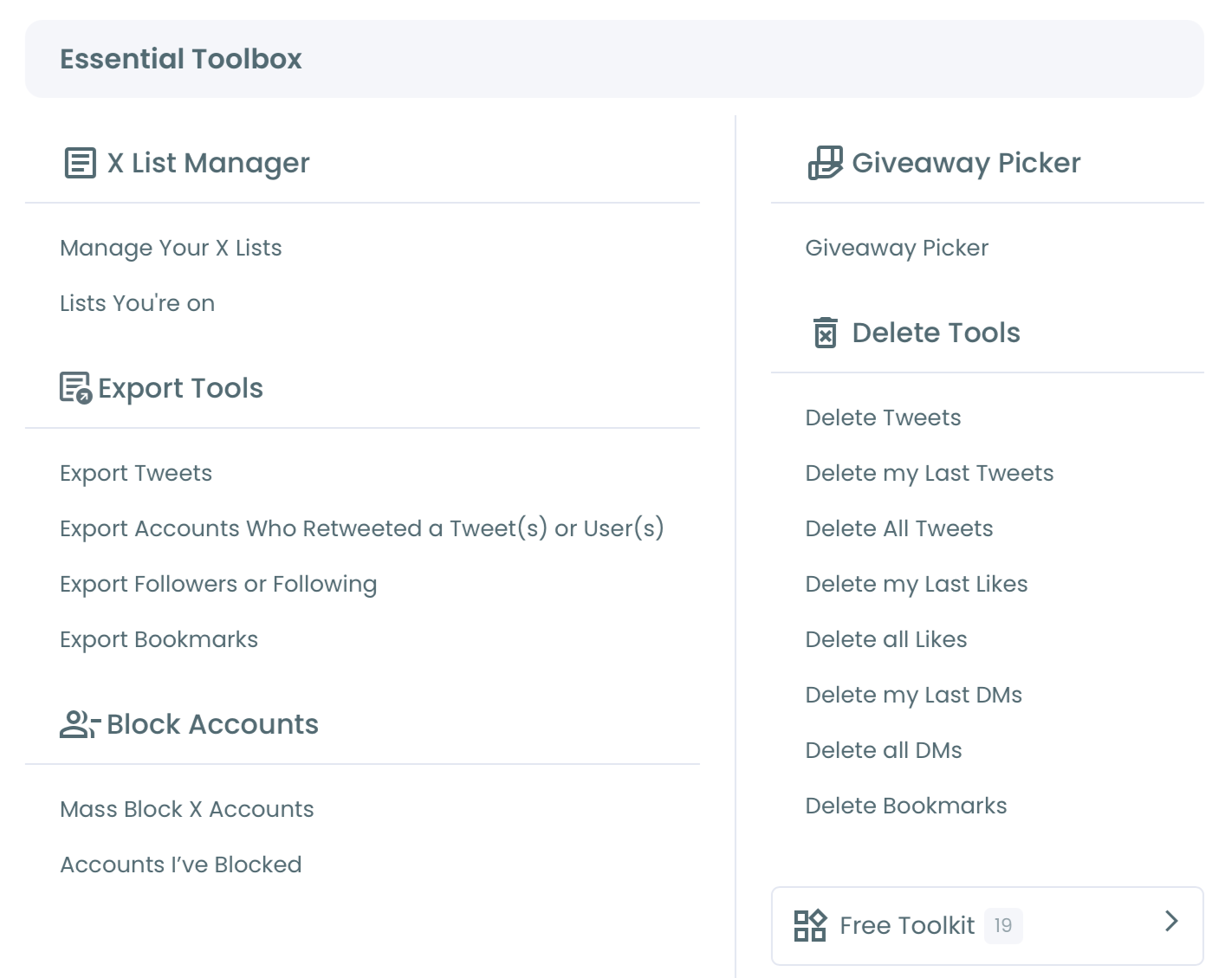
Open Circleboom Twitter and choose Essential Toolbox, then open Delete All DMs. Upload direct-messages.js; Circleboom reads the history and presents the DM count for review.
The feature supports a full reset, but it is not all-or-nothing. You can set an inclusive date range, search message text with Any Keyword, select DMs with media or URLs, and exclude named accounts. That means the phrase deleted Twitter DMs keep coming back can lead to a precise experiment: remove a defined set, observe the inbox, and keep accounts that still need continuity.
Filter for the reason you are cleaning
Choose filters that express your actual policy. A date cutoff helps when an account changed hands. A keyword filter helps remove a finished campaign or a sensitive topic. Media and URL filters help find messages that hold attachments or outbound links. Account exclusions protect the people whose conversation history still has a live purpose.
There is a practical difference between “old” and “unneeded.” Old messages may still be evidence or context. Unneeded messages are the ones your policy has reviewed and approved for removal.
Confirm only when the count matches your intent
Review the count in the Approve & Delete panel and read the date range before selecting Delete my DMs. The confirmation warns that processed items are not recoverable. Circleboom automatically excludes already-deleted items when you re-upload the same archive, so later filter runs can remain focused rather than undoing earlier work.
Use deleted Twitter DMs keep coming back as the starting point when the real goal is a clean, reviewable inbox history rather than another manual deletion attempt.
What deletion can and cannot control
Deletion controls your account-side access to the matching Direct Messages. It can reduce the private history visible in your inbox and remove selected conversations from the account you manage. It cannot remove copies held by other participants, stop a sender from messaging again, or erase files a recipient saved elsewhere.
That boundary points to a sound sequence: preserve necessary records, delete the history you control, and set future-contact protections for accounts that should not return. It is more defensible than treating inbox cleanup as a universal eraser.
For a walkthrough of archive-led cleanup, how to delete all DMs on Twitter X explains the bulk path.
If your situation is limited to one side of a conversation, consider does deleting a Twitter DM remove it completely. It explores the same one-sided boundary from a privacy perspective.
A cleaner inbox needs a future-contact plan
A bulk cleanup is most useful when it changes what happens after the cleanup. Review message-request permissions, block repeat spam accounts, and tell teammates where customer conversations should live if DMs are no longer the system of record. Those decisions reduce the chance that a privacy reset turns into another full cleanup six months later.
For accounts that keep a controlled DM workflow, create a simple operating rule: export or log commitments elsewhere, keep active support conversations, and remove closed or unwanted threads on a scheduled review. That turns deletion from a reaction into data hygiene.
If the inbox is already too crowded for that manual approach, use deleted Twitter DMs keep coming back. It gives you an archive-based way to review, filter, and remove the messages you control.
Common questions about deleted X DMs
Does deleting a DM on X delete it for the other person?
No. X says a deleted DM or conversation is removed from your account only, and other participants can still see their copy. Circleboom follows that platform boundary when it removes DMs from your inbox side.
Why did a deleted conversation return to my inbox?
The thread may have refreshed on another client, or someone may have sent a new message that revived it. Check the timestamp and message contents before deciding whether you need display troubleshooting, deletion, blocking, or a full history cleanup.
Can I remove older DMs, not only recent ones?
Yes. Circleboom Delete All DMs uses the direct-messages.js file from your X archive to work with historical DM records beyond the recent-access window. Review and filter the upload before you confirm deletion.
Can I protect a few conversations in a bulk cleanup?
Yes. The feature lets you exclude specific accounts, so their DMs do not match the deletion run. Save crucial records externally as well because completed deletions are permanent on your side.
Does deleting DMs stop someone from contacting me again?
No. Deletion removes history; it is not a block. Use X’s blocking or reporting controls when the problem is future contact, spam, or harassment.