
Lose access to your X account, through a suspension, a hack, or a quiet rebrand, and years of posts can go with it. X keeps your writing on its servers, not yours. An X post exporter is how you keep your own copy.
An X post exporter downloads your posts from X into a structured CSV you control, so a lost account never means lost content. Circleboom's X post exporter backs up to 3,200 of any public account's most recent posts on X, every engagement metric attached, through official, sanctioned API access.
→ Start backing up your X posts
One run, and your posts live somewhere X cannot delete them.
What you actually lose without a backup
Your posts feel permanent because they are always there when you scroll. They are not yours to keep. A suspension, a forgotten password, or a platform change can pull the whole timeline out of reach in an afternoon.
The content inside those posts is often work you cannot rebuild. Threads you spent hours drafting. Announcements with the engagement numbers that proved they landed. Replies that seeded a following. None of it survives if the account does not.
The gap is that X treats your posts as content on its platform, not files in your possession. There is no folder to zip, no local copy syncing quietly in the background.
Until you export them yourself, the only copy that exists is the one X is holding, on terms X can change without warning.
X does offer a way to access your X data, but the native route is slow and built for viewing, not analysis. A faster path is to back up your X posts into a clean file the day you decide the content matters, rather than the day you lose it.
What an X post exporter saves
The file is not a screenshot folder. It is a spreadsheet where each row is one post and each column is a piece of data you can sort.
Circleboom writes 15 fields per post: the post ID, the account name and username, the profile ID, the exact date and time, the language, and the full text. Alongside those sit the numbers that show how the post performed: impressions, likes, replies, retweets, quotes, and bookmarks.
Two more columns flag the post type and whether it carried media.
That column set is the difference between a keepsake and a working record. A screenshot proves a post existed.
A row proves what it said, when it went out, and how far it reached. It is also searchable, sortable, and small enough to keep for years, none of which is true of an image.
Export versus X's built-in data download
X does technically let you download your data, so it is fair to ask why a separate exporter exists. The answer is speed, structure, and scope.
The native archive is a request you file against your own account. You wait, often a full day or more, and X returns a bulk package of JSON and HTML built to be read, not sorted.
There are no clean columns and no way to scope the file before it builds.
It covers one account: yours.
An X post exporter returns a spreadsheet in one sitting, already split into sortable columns, and it works on any public account. If your goal is simply to read old posts, a Twitter archive viewer opens the native dump.
If your goal is to sort, filter, and report, the structured export is the file you want.
See each filter applied before the download, so the CSV comes out already scoped.
How to back up your X posts
The run has two parts: connect the account, then scope and collect the file. Five steps in total, and the whole thing finishes in a single session.
Connect the account you want to export
- Log in to Circleboom Twitter and connect your X account through official OAuth.

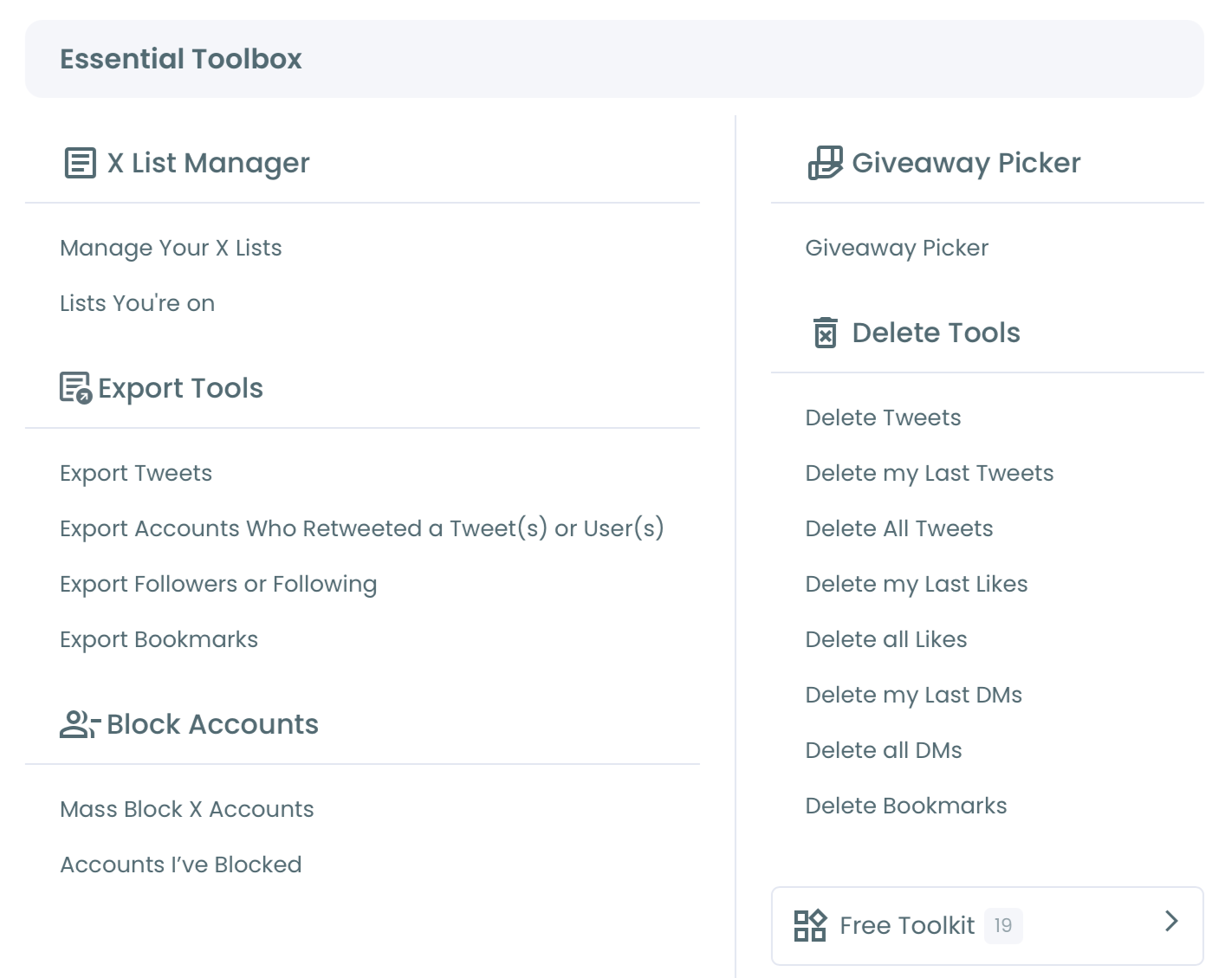
- Open the Essential Toolbox menu and select the Export Tweets tool.
- Enter the public X username you want to save, and let Circleboom fetch the account's post history and total count.
Scope the file and collect it
- Set your filters for date range, post type, engagement, language, or keyword so the file arrives already trimmed to what you need.
- Confirm the export, add your delivery email, and download the CSV from your Circleboom account once it lands.
Those five steps run in order for a reason: the login earns official-API access, the username scopes exactly whose posts you pull, and the filter step decides the file before you spend a download on it.
Filters that decide what lands in the file
The step most people skip is the filter screen, and it is the one that saves the most time. Setting a filter before the export means the CSV comes out scoped instead of raw.
A date range trims the file to a launch, a quarter, or a single campaign. An engagement threshold keeps only posts above a chosen number of likes or impressions, which builds a best-of file in one pass.
A post-type filter drops retweets and replies when you only want originals. A language filter isolates one language on a multilingual account.
A keyword filter narrows the file to a product name or campaign tag.
Pick the filter that matches the report you are about to write. The X post exporter then hands you a file you can use on arrival, not one you clean for an hour first.
Send the file where you actually work
A CSV is portable by design, which is the whole point of getting your posts out of the app. The file opens in Excel, Google Sheets, or any tool that reads a spreadsheet.
If your workflow lives in a browser, you can save your Twitter data on Google Sheets. From there you build formulas, pivot tables, and charts on top of the raw rows.
For the performance side of the same account, you can export Twitter analytics as its own file and set the two datasets side by side. One holds the posts, the other holds the account-level trend, and together they answer more than either does alone.
What to do with the file once it downloads
A CSV of posts is only worth the export if you open it and ask it something. Three moves cover most of the value, and none of them needs anything beyond a spreadsheet.
Sort by CountImpression to push your widest-reaching posts to the top. The formats sitting there are the ones worth repeating, and they are usually not the posts you would have guessed.
Reading them in one view is impossible inside the app, where the same posts are scattered across months of scroll.
Filter by a date column or a like count to isolate a slice: a campaign week, a launch, or every post above a set threshold. A filtered view answers one specific question without the noise of the full timeline dragging on it.
Build a single new column for engagement rate. Add likes, retweets, and replies, then divide by impressions.
A post with a small audience and a high rate is often a better model to copy than a viral one, and that comparison stays hidden until the numbers sit in columns you can divide.
The 3,200-post ceiling
One number decides whether an exporter fits your account, and most guides leave it out. Any tool built on the official API reaches a maximum of 3,200 of an account's most recent posts.
That ceiling belongs to X, not to Circleboom. X sets it on the public timeline endpoint, and no plan or workaround extends it.
Accounts under 3,200 lifetime posts come back whole. For older accounts, you get the most recent 3,200, and the native archive is the only route to anything older.
Knowing the cap up front saves a wasted run. If you are new to the process, this step-by-step on how to download tweets from Twitter walks the full flow before you start.
Who should keep an X post backup
The habit pays off for four kinds of account, each for a different reason.
A creator keeps a backup so a suspension never erases years of writing in one afternoon. A social manager keeps one so every client account has a portable record that lives outside any single tool.
An analyst keeps one to turn a quarter of posting into a dataset a spreadsheet can question. A researcher keeps one to study a public figure's output at scale without scrolling a timeline by hand.
The thread through all four is the same. The posts matter more than the platform, so the record of them should not depend on the account staying online.
A backup moves that record somewhere you own, which is the only version X can never revoke.
Back up more than your own posts
Because the export reads any public account, the same run doubles as research. Pull a competitor's most recent 3,200 posts and sort by impressions to see which formats carry their reach.
Export an influencer's timeline before a partnership to check that the engagement is real.
When your job is the audience rather than the posts, you can export Twitter accounts into a separate file and study who is following or engaging instead.
For your own account, treat the export as insurance. Running it on a schedule means you always hold a recent copy, which is the simplest way to backup my tweets without depending on X keeping the account online.
Before you rely on the file
Two things are worth knowing before you treat the export as a record of record.
First, it is a snapshot. The metrics freeze at export time and do not climb with the live post.
For a report that needs current numbers, run a fresh export rather than trusting an old file. Two dated exports side by side also show growth more clearly than any live dashboard.
Second, safety depends on the method. Circleboom pulls every field through official, sanctioned API access rather than scraping the page, which keeps your account inside X's rules.
As a verified Enterprise partner of X, Circleboom retrieves only the sanctioned dataset, so the file is both compliant and safe to hand a client or a manager.
Your X post backup checklist
Run through this once and your posts are safe.
- Log in and connect the X account you want to save.
- Set filters for the date range, post type, or engagement you actually need.
- Confirm the on-screen post count matches the account before you export.
- Download the CSV from email and keep the copy stored on your account.
- Re-run the export after any major cleanup so the record stays current.
When those five are done, your writing lives in a file X cannot reach. You can run your first export now and treat everything after it as a repeat, not a scramble.
→ Download your X posts as a CSV
What to know before you archive your posts
How often should I back up my X posts?
Regularly, and always before a big change. A fresh export before any bulk delete, rebrand, or account handoff means you keep a clean record of what existed first.
Does the backup include my engagement numbers?
Yes. Impressions, likes, replies, retweets, quotes, and bookmarks each land in their own column, captured as a snapshot at the moment you run the export.
Can I back up posts from a private account?
No. Only public posts are accessible through the official API, so protected accounts cannot be exported regardless of your follow relationship.
What happens to the file if my email delivery fails?
Nothing is lost. Circleboom stores the CSV on your account page as well as sending it by email.
You can start a backup of your X posts and pull the file from your account even if the email never arrives.