
How would you actually find out whether the accounts you follow on Twitter are bots? Not the ones following you. The ones you picked, one click at a time, over however many years you have had the account.
X gives you no audit view for that side of the graph, so most people have never once checked.
Am I following bots on Twitter, and how would I know?
Almost certainly yes, and X will not tell you. Circleboom reads your full following list on X through official API access and flags every account where several automation signals overlap: no profile photo, near-zero posting against account age, an extreme follow ratio, a very recent join date.
→ Twitter Bot Checker
Why the bots you follow are a different problem from the bots that follow you
The two problems share a word and almost nothing else.
Bots that follow you arrive uninvited, in waves, usually within days of each other, and they damage a number: your engagement rate, computed against a follower base padded with accounts that will never read anything.
Bots you follow arrived because you clicked follow. That changes the detection problem completely.
Most bot-detection advice is written for the follower side, so it optimizes for one signal above all others: account age. A wave of accounts created last month, all with default avatars, all following four thousand people, is easy to spot precisely because it is fresh.
That heuristic works when you are looking at strangers who showed up yesterday.
It fails on your following list, because many of the automated accounts sitting there were not automated when you followed them. They were real accounts that got abandoned and later repurposed, or handed to a growth service, or quietly converted into a repost farm.
Filtering your following list by join date sorts the genuinely old accounts to the bottom and hides the exact accounts most worth removing.
The right question for the following side is not "when was this created." It is "what is this account doing now."
State, not origin.
That is why you need a view that reads current behavior across the whole list at once, which is what no native X screen offers. Circleboom lets you check whether you are following bots on Twitter in one pass instead of profile by profile.
There is a second reason this side matters more than people assume. Your following list is public. Anyone evaluating you, a potential partner, a client, a hiring manager, can open it and read it as a judgment sample.
Nobody blames you for who follows you. Everyone reads who you follow as a choice. Worth pairing with who to unfollow on Twitter once you start deciding what stays.
What a bot in your following list actually looks like
No single signal proves anything.
A photo-less account with three posts might be a cautious private person; a high-volume poster might be a genuinely prolific writer. Classification here is probabilistic, and treating any one flag as a verdict is how you end up unfollowing a real customer.
What matters is overlap. Circleboom flags an account in your following list when several weak signals stack in the same profile:
- No profile photo and no bio, the classic egghead pattern.
- Almost no posts relative to how long the account has existed.
- A following count in the thousands against a follower count in the dozens.
- A join date very recent compared to the rest of your list.
- An activity classification of inactive or low engagement.
Two of these together is noise. Four of them in one profile is a pattern.
That stacking logic is also why the line between a bot and a legitimate automated account gets blurry.
Circleboom's Twitter quality score is the broader lens on the same data. Use it when an account is weak without being obviously fake.
There is a third category people forget: the account that is fine, posts constantly, and floods your timeline with scheduled output you stopped caring about years ago.
That is not a bot, it is a mismatch, and cleaning it is a separate pass. Reading the difference between bots and automated accounts on X keeps those two piles apart before you start selecting rows.
How to check if you are following bots on Twitter, step by step
What does a following-side bot scan actually look like on screen?
https://www.youtube.com/watch?v=nIeKns5Y4R4
Three phases, run in this order: open the right side of your graph, narrow the segment, then act on what is left.
Open the following side of your account, not the follower side
- Log in to Circleboom Twitter and authorize the X account whose following list you want audited. The handshake runs on X's own domain, so nothing you type goes to Circleboom and nothing is read until you approve it.

- Open the Follower and Following management menu. The views for accounts you follow are grouped separately from the views for accounts following you, and that split is what the next step turns on.
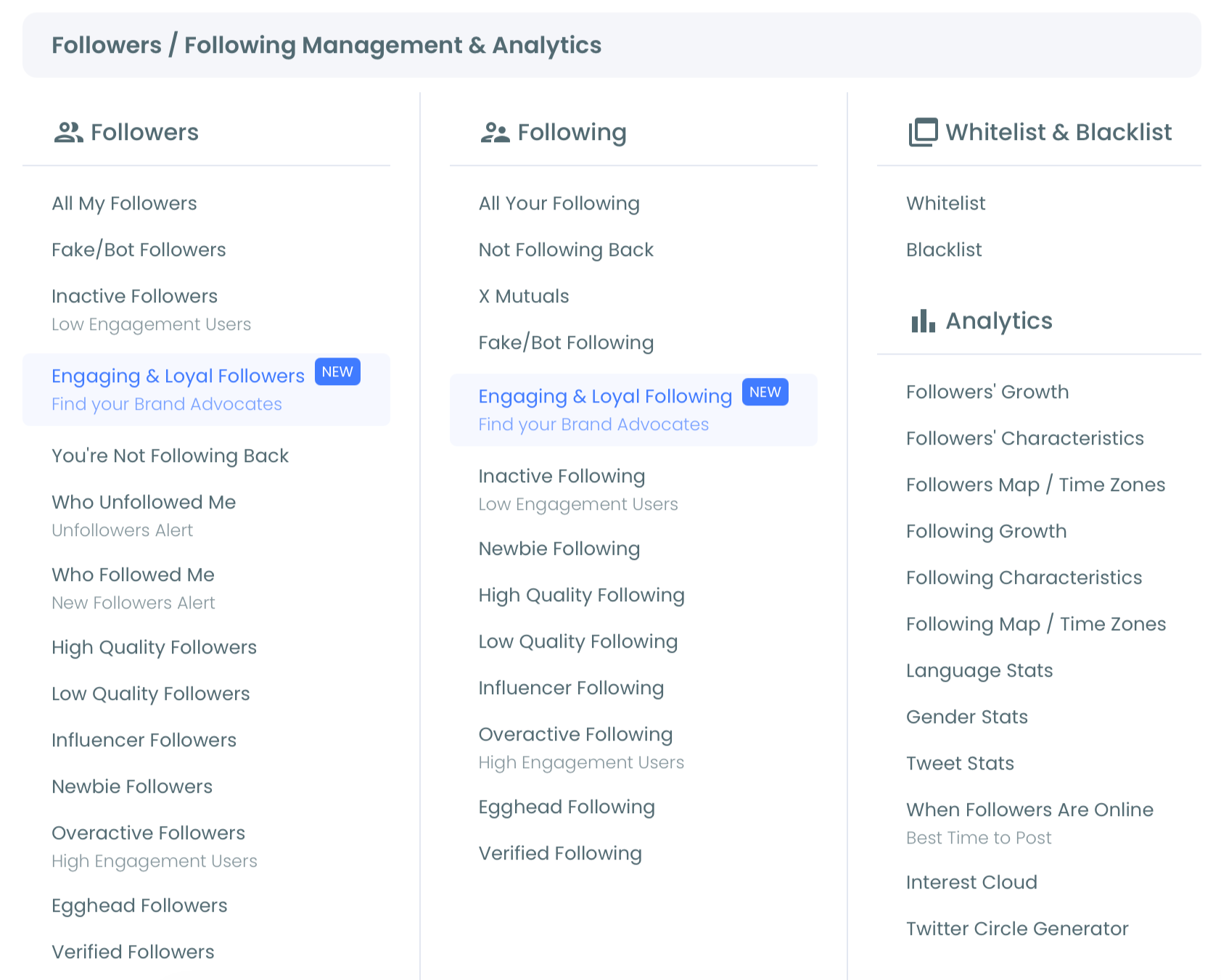
- Choose Fake/Bot Following from the Following group. The Followers group has a near-identical entry, and picking the wrong one is the most common misstep here. You want the list of accounts you follow, not the list of accounts following you.
Narrow the list before you select a single row
- Open Filter Options and set Fake/Spam to show only that classification. The panel opens as a side drawer and every filter you apply stacks as an AND condition.
- Add the supporting numeric filters: a low maximum on Tweet Count, a low maximum on Follow Ratio, and an Eggheads filter for missing profile photos. Each active filter appears as a removable tag above the grid, so you can always read the exact segment you are looking at.
- Sort the result by Followers descending and skim the top rows. A genuinely well-followed account near the top of a fake/spam segment is usually a misclassification, and Open Profile lets you check it on X before you act.
Protect, record, then unfollow in review-sized batches
- Whitelist anything you recognize. A partner with an empty bio, a support handle that never posts, a client who joined last month: whitelisted accounts are excluded from every bulk action across the platform, permanently, until you remove the label.
- Export the filtered segment as CSV before you remove anything. The export consumes tokens and gives you a dated record of exactly which accounts left your following list and why.
- Select the reviewed rows and run Unfollow. Circleboom processes 50 unfollow actions every 15 minutes, up to 800 per day, and pauses automatically when the quota is reached.
That order is what keeps the operation safe.
The login earns official API access. The filters narrow the segment before any selection exists. The whitelist protects the accounts you cannot afford to lose, and the export makes a mistake recoverable. Reverse any two of those and the cleanup becomes a thing you regret.
If you only remember five things from this section:
- Authorize the account, then open the Following side rather than the Followers side.
- Stack fake/spam with the numeric signals so no single flag decides anything.
- Shield the contacts you recognise before a single row is ticked.
- Pull the CSV while the accounts are still in the list.
- Work in batches and let the pacing finish on its own.
Is it safe to unfollow bot accounts in bulk on X?
Yes, when the pace is controlled and the actions run through the official API rather than a browser script.
The ceiling Circleboom works inside is 50 unfollows per 15 minutes and roughly 800 per day, and the practical recommendation sits well below that: 100 to 150 accounts in a sitting. Unfollow limits vary account to account, and if X returns a rate-limit response the request is not fulfilled immediately rather than retried aggressively.
The failure mode people hit is speed, not volume.
Clearing 800 accounts across a week is unremarkable. Clearing 800 in twenty minutes through a browser script is the behavior X's own automation rules exist to catch.
That is also what gets accounts temporarily locked. For the longer version, unfollow Twitter accounts without getting suspended covers the pacing question directly.
One distinction to hold onto: unfollowing is not blocking. An unfollowed bot can still see your posts, reply to them, and follow you back tomorrow.
If an account is scammy or harassing rather than merely automated, Add to Mass Block List is the right escalation.
Because Circleboom is one of the companies on X's official Enterprise developers list, the pacing is enforced by the same system that publishes it. When X returns a rate-limit response, the queue stops and waits for the window to renew instead of retrying against a closed door.
That is the difference between a cleanup that finishes quietly over a few days and one that stalls halfway through with a locked account. The Twitter rules to remember before unfollowing are worth a skim before a large first pass.
What changes after you clean your Twitter following list
Your timeline changes first, and faster than you expect. Scripted accounts post at volume, so they take up a share of your feed far larger than their share of your following count.
Remove a hundred of them from a list of two thousand and you have not cut five percent of your feed. You have cut whatever percentage of daily posts those hundred accounts were producing, which is usually much higher.
The public read changes second. A following list without obvious junk in it signals that you chose the accounts in it, which is the impression you want anyone auditing your profile to take away.
The third change is the one people notice last. Once the automated noise is gone, the accounts you actually want to hear from stop competing with it. Circleboom can scan your following list for bots in a single pass, which makes this a quarterly habit rather than a project.
Bots are one layer. Dormant real accounts are the other, and they need a separate pass through the tools built to unfollow inactive Twitter accounts.
For a large segment, the mass unfollow path handles the volume. Running both in sequence covers the two distinct kinds of dead weight: accounts that are not real, and accounts that are real but gone.
Your next move
Pick the branch that matches where you are.
If you have never audited the following side at all, start with the fake/bot pass and nothing else. One filter and one review, and you will learn more about your own list in ten minutes than a year of scrolling taught you.
If you have already cleaned bots and the feed still feels heavy, the problem is dormancy rather than automation, and the inactive pass is the one to run next.
If the accounts you found are actively scammy rather than merely automated, do not stop at unfollowing.
Stage them for Mass Block so they cannot re-follow and keep interacting, and budget a minute for setup: bulk blocking is not something X's API exposes, so Circleboom runs it through the Twitter X Mass Blocker Chrome extension, which has to be installed and left running in an open browser while the list processes.
And if you are not sure which of the three you are in, run the scan and let the numbers decide. Ten minutes gets you the answer.
→ Run a bot check on the accounts you follow
Loose ends and leftover questions before the first batch
Will the bot account know I unfollowed it?
X sends no notification when you unfollow someone, so there is no alert and no visible signal on their end. An account can only work it out by checking your profile or its own follower list manually, which automated accounts do not do.
Can I undo a bulk unfollow if I remove the wrong accounts?
Not in bulk. Circleboom cannot reverse an unfollow batch automatically, which is why exporting the filtered segment as CSV before you act matters. With the export you can re-follow the accounts you want back manually, using the usernames in the file.
How many accounts can I unfollow on X in one day?
Circleboom processes 50 unfollow actions every 15 minutes and up to 800 per day, then resumes automatically the next day. Staying between 100 and 150 in a single sitting is the safer working pace, since per-account limits on X vary and aggressive bursts are what trigger temporary locks.
What if an account is flagged as fake but I know it is real?
Whitelist it before you run any bulk action. Classification is probabilistic rather than certain, and a real person with no avatar, no bio, and few posts scores badly on every signal without being a bot. The whitelist label persists across every following and follower view in Circleboom, so one click protects that account in all future cleanups.