

Are you supposed to follow back on Twitter when someone follows you? No. Nothing on the platform requires it, and sound Twitter follow back etiquette is to follow back accounts that are real and relevant to you.
The old habit: follow everyone back, then live with a crowded feed and an open inbox. The better habit: Circleboom lists every account that follows you on X without a follow back, so you can return the follow only where it is earned, through official Enterprise APIs.
→ Twitter follow back etiquette
A follow back is free to give, but it changes four things on your account.
What a follow back changes on your X account
A follow back changes your feed, your inbox, your following count and your relationship with that account, and it stays in place until you unfollow.
Most advice on Twitter follow back etiquette stops at opinion. The table below sets out the consequences instead, so the decision rests on what happens next.
| What changes | What it means for you | How it is undone |
|---|---|---|
| Your feed | The other account's posts start appearing in your timeline. | Unfollow the account. |
| Your inbox | The account can now send you a direct message. | Unfollow, or change who can message you. |
| Your following count | The number on your profile goes up by one. | Unfollow the account. |
| Your relationship | You and the account become mutuals. | Either side unfollows. |
Two points in that table surprise people.
The first is permanence. A follow back does not expire, and nothing reverses it except an explicit unfollow.
The second is that the costs land on you, not on the other account. They gain a follower. You gain their posts, their messages and one more account to keep track of.
A follow back is a small decision that you then live with every time you open your feed.
The table's last row has its own vocabulary. Two accounts that follow each other are mutuals, and if the slang is new to you, here is what moots on Twitter are.
Why Twitter has no rule that you must follow back
Twitter has no follow-back rule because following on the platform is one-way by design. Someone can follow you to see your posts, and that choice does not create a duty on your side.
X's own help page on following on X describes following as a way to receive another account's posts. Nothing in that description requires a return follow.
So where does the feeling of obligation come from? It comes from habit, and from follow back etiquette that was formed on much smaller networks.
Common follow-back habits on X and what each costs
In practice, accounts fall along a line. At one end are those that return every legitimate follow as a thank-you. At the other are those that return a follow only when they want the posts, and most people sit somewhere between the two.
No point on that line breaks a rule, and none is rude. The difference is in what each one costs.
There are sensible exceptions to any habit. Most people follow back friends, colleagues and the local organisations they want to support, whatever their general approach. Those follows need no test, because the relationship came first.
The courtesy habit builds mutual connections quickly, but it fills the feed with accounts you did not choose. The selective habit keeps the feed readable, but it leaves some relevant followers unanswered unless you check.
The courtesy habit also has an organised form, where accounts agree in advance to trade follows. One version of it is covered under follow for follow with verified Twitter accounts.
Why selective follow back etiquette is hard to practise on X
The catch with being selective is visibility. X shows your followers as one long list and offers no way to pull out the ones you have not followed back, so the relevant ones are easy to miss.
Circleboom closes that gap on X by putting everyone who follows you without a follow back in one place.
Who is worth following back on X?
An account is worth following back on X when it passes three checks: it is real, it is active, and its posts are relevant to you.
Each check screens out a different kind of follower:
- Real screens out bots, spam profiles and empty shells.
- Active screens out accounts that went quiet long ago.
- Relevant screens out genuine people whose posts have nothing to do with you.
Friends, colleagues, customers and peers in your field usually pass all three without effort. Follow them back, because the relationship already exists and the follow confirms it.
How the three checks sort strangers
Strangers are where the checks do real work. A stranger who posts about your field every week is relevant. A stranger with no posts, no bio and a default avatar is none of the three.
Follow back etiquette on Twitter is a question of relevance, and relevance can be checked.
That is the practical difference from older advice. Etiquette that says "be polite" gives you nothing to apply to follower number four hundred. Etiquette that says "real, active, relevant" gives the same answer every time you ask.
I apply the checks in that order for a reason. Real and active are quick to judge from a profile's numbers, and they remove most of the list before the slower relevance call begins.
For accounts that sit on the line, there is a third option between following and ignoring. Add the account to a list and read its posts there, which Twitter List Manager can do for a whole group at once.
How to see who you have not followed back on Twitter
To see who you have not followed back on Twitter, you need a list of accounts that follow you minus the accounts you follow. X does not produce that list, and Circleboom does.
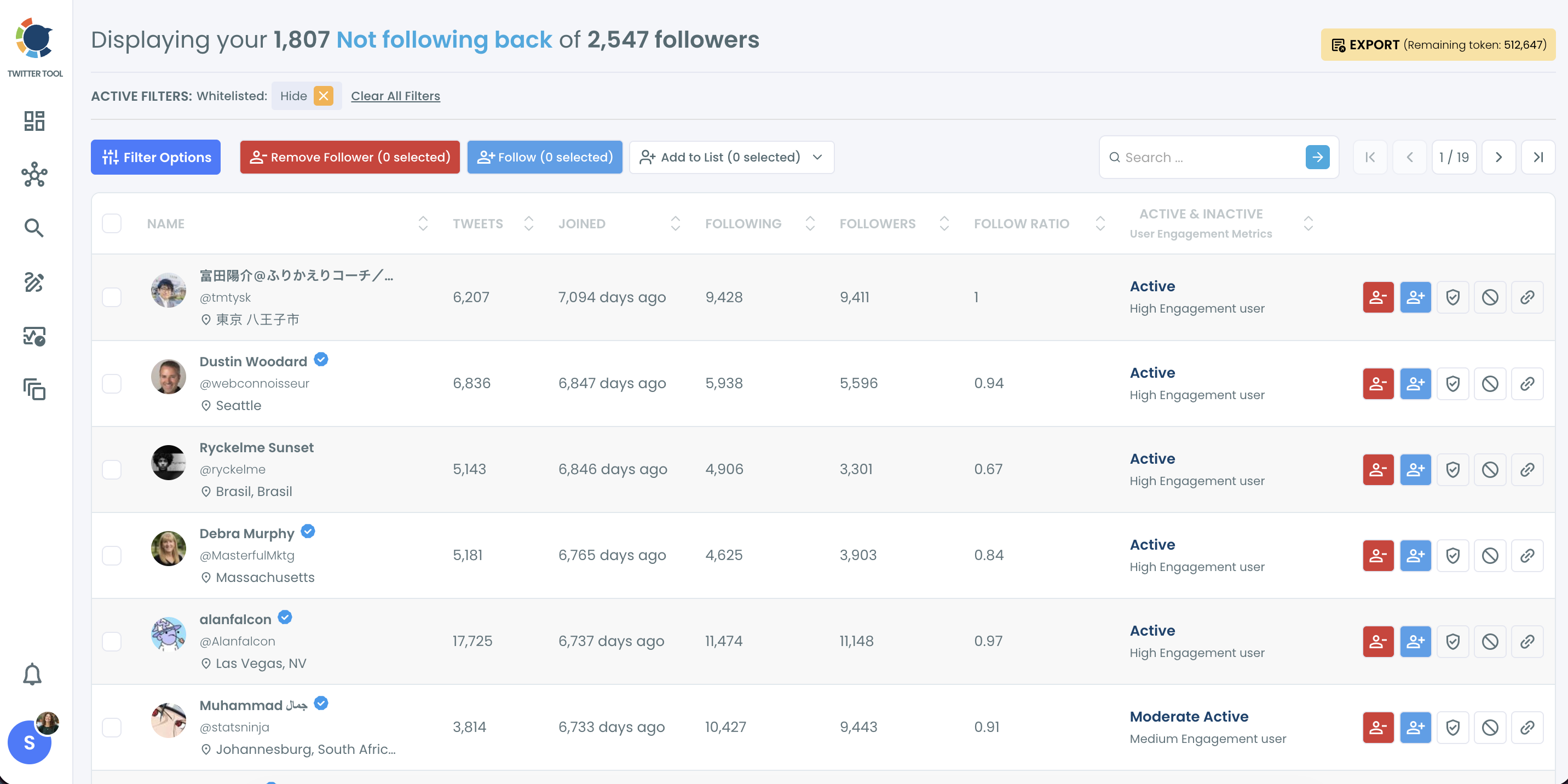
Circleboom takes your X follower list, sets aside every account you already follow, and shows what is left in a table named You Are Not Following Back. Each account in it followed you first.
The heading above the table states the size of the gap, in the form "Displaying your N Not following back of [total] followers".
What each row tells you about a follower
Each row carries enough to judge an account without opening its profile. You see how much it has tweeted, how long ago it joined, how many accounts it follows and is followed by, and its follow ratio.
The last column is an activity label. It sorts each follower into Active, Moderate Active or Inactive, which answers the second check at a glance.
A Filter Options panel narrows the table before you choose anyone. You can hide Fake/Bot and Inactive accounts, search bios for a keyword, and filter by verification, language or location.
Every column can be sorted. Sorting by Followers from high to low brings the highest-reach accounts among your unreturned followers to the top, which is a fast way to spot a partner or a journalist you overlooked.
From there, three actions sit above the table: Follow, Remove Follower and Add to List. You tick the accounts, pick the action and confirm it. Nothing is followed until you approve the selection.
Add to List also holds a Whitelist option. Use it for followers you will not follow back but never want caught in a later cleanup.
Why official X data matters for a follow-back review
Circleboom is an official X Enterprise developer, so the follower data comes from X's own API and the follows are sent the same way. For you, that means no scraping and no risky workaround touching your account.
This table is where your Twitter follow back etiquette turns from a principle into a short, repeatable review.
A note on removing: skipping a follower and removing a follower are different acts. X lets you remove a follower yourself, one account at a time, and Circleboom's Remove Follower action handles a selected group through its Chrome extension.
If you follow someone back on Twitter, can they message you?
Yes. Following an account lets that account send you direct messages, so every follow back also opens your inbox to one more sender.
X explains the mechanics on its page about Direct Messages, including the settings that control who else can reach you. Those settings change, so read the page for the current options.
This consequence cuts both ways, and it is the part of follow back etiquette that advice columns leave out.
For a peer, a customer or a possible partner, the open channel is the point. A relevant account that followed you first may have no way to start a private conversation until you follow back, and that barrier goes when you do.
For an account you know nothing about, the same channel is a risk you accepted without thinking. A courtesy follow to a stranger is also an invitation to pitch you.
Following back decides who can reach you in private, which makes it a privacy choice as well as a social one.
Two practical habits follow from that:
- Follow back relevant accounts when you would welcome a message from them.
- Hold off on accounts whose first message you can already predict.
If messages from accounts you already follow have become a problem, you can keep the follow and close the channel. The options are laid out under how to block direct messages on Twitter.
Should you unfollow people who do not follow you back on X?
Not automatically. Unfollow an account that does not follow you back only when you no longer want its posts, because a missing follow back is not a reason on its own.
The same three checks apply in reverse, so your Twitter follow back etiquette works in both directions. If the account is real, active and relevant to you, keep following it.
Journalists, analysts and large creators rarely follow back, and they are often the accounts most worth reading.
The case for unfollowing is different. It applies when you followed in the hope of a return and the account's posts never interested you.
Two lists on X that are easy to confuse
Direction matters here, and the two lists are easy to confuse:
| List | Who is in it | The decision |
|---|---|---|
| You Are Not Following Back | Accounts that follow you, unreturned | Follow back or not |
| Not Following Back | Accounts you follow, unreturned | Keep or unfollow |
Circleboom keeps them as separate views. The second one, Not Following Back, covers the accounts you follow that have not returned it.
The reverse view in motion: finding the accounts you follow on X that have not returned the follow.
Before a large cleanup, weigh what you would lose. There is a fuller discussion of whether to unfollow those who don't follow back on Twitter.
My own practice is to review that view a few times a year. I unfollow the accounts I followed for the wrong reason and keep the ones I read.
What selective following back does for an X account
Selective following back keeps your feed readable, your inbox quieter and your mutual connections meaningful. It is follow back etiquette judged by results instead of by manners.
What changes first when your follow-back etiquette gets selective
The feed benefit comes first. Every account you follow back competes for space in your timeline, so a short, chosen following list shows you more of what you came for.
The relationship benefit is less obvious. When you follow back with a reason, the follow can be paired with a reply or a later message, and that pairing builds a stronger connection than the follow alone.
A chosen set of mutuals is also easier to look after. You can see your Twitter mutuals in one view and recognise most of the names in it.
There is a timing benefit too. The best moment to review unreturned follows is right after a growth period, while you still remember why those accounts arrived.
Compare that with the courtesy habit at scale. An account that follows back everyone it gains ends up with a following count that grows as fast as its audience and a feed no person could read.
Accounts used mainly for publishing feel this most. If you post far more than you read, a selective follow-back etiquette protects the one timeline you do read, and it keeps your following list a fair picture of your interests.
Summary: follow back on Twitter by choice
You are not supposed to follow back on Twitter. Following is one-way, no rule demands a return, and skipping a follower is not rude.
What a follow back does is concrete: it adds an account's posts to your feed, lets that account message you, raises your following count and lasts until you unfollow. Good Twitter follow back etiquette means giving that follow to accounts that are real, active and relevant.
Circleboom makes the review practical by showing every follower you have not followed back on X, with the signals needed to decide.
→ Find the X followers still waiting on your follow back
What people ask about X follow-back manners
Do people unfollow if you don't follow back?
A share of them will, and that is the cost of selective Twitter follow back etiquette. Followers who get a follow back are the ones who tend to stay. The practical answer is to follow back the relevant ones, since their staying is what matters to you.
What happens to my feed if I follow everyone back?
Your feed fills with posts from accounts you did not choose, and the posts you care about get harder to find. To quiet an account without unfollowing it, you can mute it on X, or keep your most valued accounts in a list and read that list as a separate timeline.
How do I undo it if I followed back too many accounts?
Unfollow them, because a follow back is reversed only by an explicit unfollow. Circleboom's daily safety limit for unfollows is 800, released 50 every 15 minutes, and whatever is left carries over to the next day. The accounts you unfollow can still follow you and see your posts.
How many accounts can I follow back in one day with Circleboom?
Up to 400. That is Circleboom's daily safety limit for follows, and they go out 50 every 15 minutes. If you select more than that, the rest of the queue resumes the following day without a manual restart.




%20Follow%20Back%20All%20My%20Followers%20on%20Twitter%20(X)%3F)
