No, fake followers do not trigger a shadowban on X by themselves, because X's rules are written about what an account owner does, not about who follows the account. A large bot cluster can still contribute to visibility limits and quietly drain reach, which is why it is worth measuring rather than ignoring.
Can fake followers get your X account shadowbanned?
Not directly: X's rules target the owner's behaviour, such as buying followers, while bots that follow you uninvited mainly weaken the first audience each post reaches and can contribute to visibility limits. Circleboom flags fake and bot followers on Twitter for your review through X's official Enterprise API access.
→ Check your followers for fake accounts before a Twitter shadowban scare
The answer splits in two, and the split decides what you should do next. A follower base full of bots you bought is a different problem from a follower base that bots joined on their own, even when the profiles look identical.
This page separates the two, explains how bots still cost reach on X, and shows how to measure and clean them without creating a new risk.
Why X treats bought followers and bot followers differently
X's rules on authenticity are written around the account owner's conduct:
- Buying accounts.
- Coordinated engagement.
- Aggressive follow churn.
Buying followers is something you do. A bot that follows you after a viral post is something that happens to you. That is the distinction most fake followers shadowban Twitter advice skips.
X has also written publicly about bot or not, the facts about platform manipulation on Twitter, drawing a line between manipulation and ordinary automated accounts.
Not every automated account is a violation, and not every bot in your list is evidence against you.
Bought followers and uninvited bots, side by side
The table puts the two situations next to each other, with the next step each one calls for:
| Situation | Whose act | What it changes | Next step |
|---|---|---|---|
| You bought followers | Yours | Rule exposure plus a hollow count | Stop buying, then audit and remove |
| Bots followed you uninvited | Not yours | Weaker reach signals and engagement rate | Measure, protect real contacts, clean |
| Both at once | Partly yours | All of the above | Clean first, then rebuild with real growth |
The bots look the same in your follower list. The risk they carry depends on how they got there.
When the followers were bought
Bought followers are the harder case for anyone worried about a fake followers shadowban on Twitter. They break the owner-behaviour rules X writes about, and the services that sell thousands overnight almost always deliver bots or fake accounts that inflate the count, lower engagement rate, bring spam and drift away later.
The reasons not to buy Twitter followers go beyond the policy question.
If you bought followers once, removing them fixes the audience you show the world.
It does not erase the purchase, and X does not publish a threshold or a timeline for how it weighs past behaviour. Anyone quoting one is guessing.
There is also a slower cost. Purchased accounts rarely stay, so the count you paid for tends to shrink on its own, and what remains keeps pulling your engagement rate down every time you post.
The cleanest recovery is the same for both cases:
- Measure the flagged share.
- Remove it in reviewed batches.
- Let growth from real people replace it.
The difference is that the buyer also has a habit to break.
How fake followers can still hurt your reach on X
Uninvited bots are not a rule violation, but they still change how your posts perform. Circleboom's own guidance on the feature puts the risk carefully: large bot clusters make an account look inauthentic to brands and visitors and can contribute to visibility limits.
The seed group is where bots cost you
The mechanism behind most fake followers shadowban Twitter symptoms runs through the first audience a post reaches. X shows a new post to a small seed group of followers first, and if that group engages, the post travels further. Accounts that never interact are more likely to land in that seed group, so the early signal stays weak.
Circleboom's Shadowban Test checks this directly as Early Engagement Seed.
Here is how that plays out for a creator, as a worked illustration rather than measured data:
- The creator has 100,000 followers, and 25% of them are bots.
- Bots are not Premium users, so their likes and views never count toward creator payouts.
- Their silence weakens the early engagement that pushes posts into For You.
- After removal, every post's first audience is made of people who can react.
A bot cluster does not need a penalty to cost you reach. It only needs to take up space.
Engagement rate, partner trust and ad spend
The same arithmetic distorts engagement rate, since bots add to follower count and never to interactions. A post reaching 10,000 followers has a very different effective reach if 3,000 of them will never interact.
To compare your corrected number against a benchmark, see what counts as a good engagement rate on Twitter.
Bots also shape how outsiders read you. A brand checking a creator with 50,000 followers, of whom 30% are bots, may walk away, while the same creator with a clean audience looks like a safe partner.
And if 20% of an audience used as an ad seed is bots, part of the budget goes to accounts that will never click.
Neither cost involves a penalty from X.
Before acting, it helps to know how much of your audience is in that position. That is the point where it makes sense to spot fake followers dragging down your X reach instead of guessing from a few odd profiles.
How many of your X followers are bots?
The fastest honest answer is a ratio: flagged accounts divided by total followers. Circleboom's Fake/Bot Followers page states it in its header, "Displaying your N Fake/Bot of [Total] followers," so the share is visible before you scroll a single row.
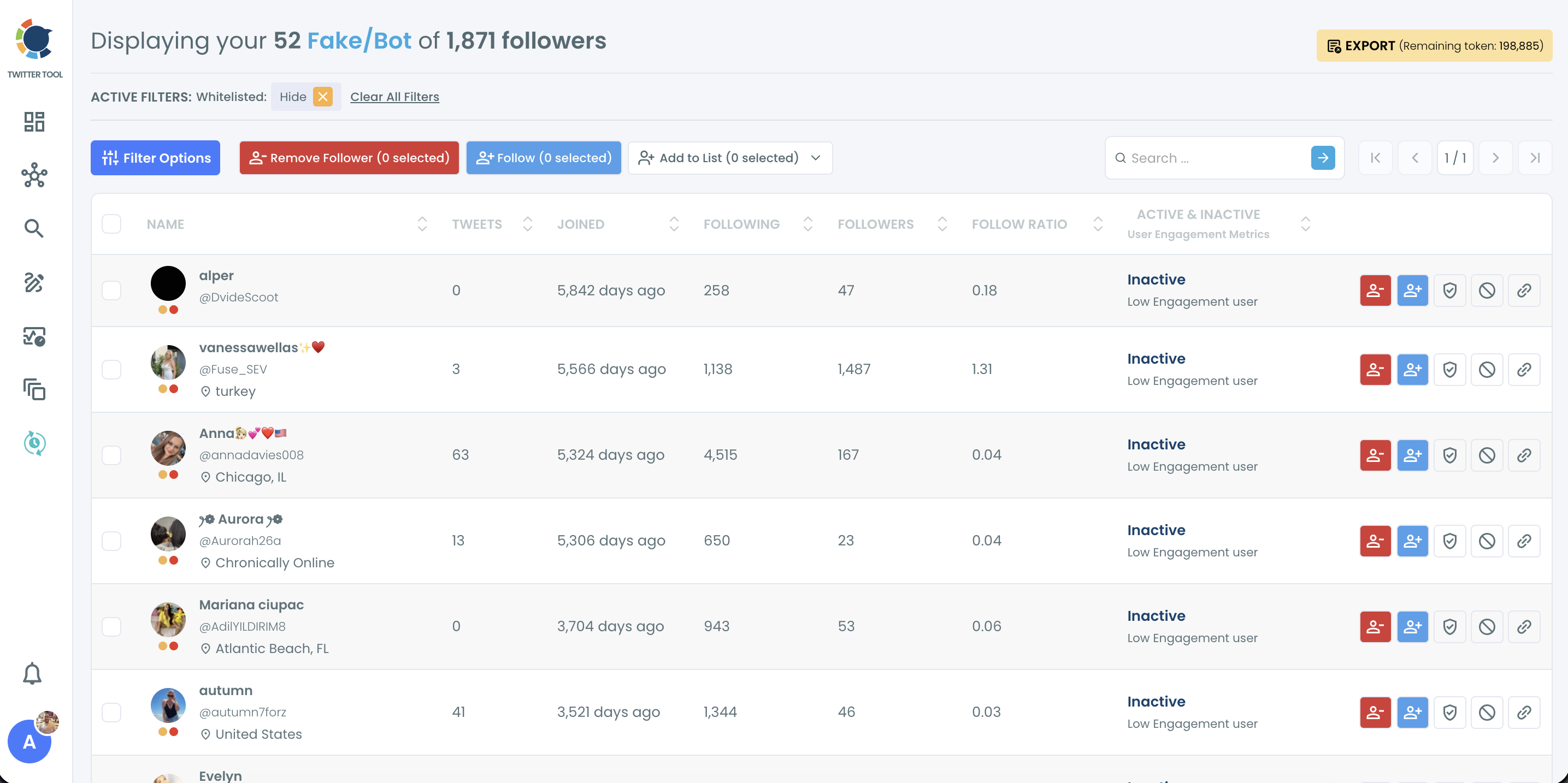
In the sample screen above, 52 of 1,871 followers are flagged, under 3%.
How you read a share depends on how it moves: a small, steady one calls for upkeep, while a share that jumps after a spike, or clusters around brand-new accounts, is the pattern worth acting on.
Timing changes what the ratio tells you. Run the check within the first week after a follower spike, while the suspicious accounts are still concentrated among recent arrivals, and filter by a very recent join date to see the wave on its own.
Run it again every quarter even without a trigger, because bots also pile up slowly during normal platform use, and a single snapshot cannot show that drift.
What the classification looks at
The count only means something if the classification is sound. Circleboom combines signals instead of trusting one:
- Follower-to-following ratio, where a value below 0.05 is a common suspicion threshold.
- Tweet activity relative to account age.
- Account age, especially very recent join dates.
- Profile completeness: photo, bio and username pattern.
- Engagement classification, with Inactive or Low Engagement adding weight.
For a wider read on how many of my X followers are bots, the ratio is the place to begin, not the end.
Two lighter checks sit next to the full list. The Twitter Follower Checker sorts your followers into Fake, Inactive, Low Quality and Loyal tabs for a quick health read.
When one specific profile looks wrong, the Twitter Bot Checker checks a single username and returns a verdict on whether it shows bot-like traits.
Is it safe to remove fake followers in bulk?
Yes, when the removal is gradual and reviewed. Circleboom does not delete anyone the moment you click. Remove Follower stages the selected accounts in a queue, and the Circleboom Remove Twitter/X Followers Chrome extension processes them one by one while your browser stays open.
When X's rate limit is near, the extension pauses on its own for between 1 and 20 minutes and shows that the process will continue. That pause is designed to keep activity paced like a careful person, not a burst.
How many accounts a day the queue clears is a separate question; the point here is that nothing runs at full speed.
The data side matters as much as the pacing. Circleboom reads your follower records as an official X Enterprise Developer company. The review therefore runs on X's own data, not a scraped approximation that can miss accounts or misread fields.
Keeping the run safe on your side
A few practical rules keep the process safe on your side too:
- Confirm your whitelisted accounts are in place before you stage anything.
- Keep the browser open until the queue finishes, because closing it interrupts the run.
- Remember that a staged account is not yet a removed one; the extension does the removing.
Two limits keep the claim honest. Removing followers changes who follows you; it does not guarantee more engagement, more reach or immunity from X restrictions. And the classification is a candidate list, so a real but unusual account can appear in it.
For the wider safety picture, see is Circleboom safe.
How the fake follower review works in Circleboom
Circleboom reviews fake followers on X in three moves: it measures the bot share, lets you protect the accounts you trust, and removes the rest gradually through its Chrome extension.
To start, open Circleboom Twitter, connect the account, and go to Fake/Bot Followers in the Followers section.
Measure the bot share and rank it
Sort by Follow Ratio ascending to put the most suspicious structures on top. Sorting Tweets ascending brings near-silent accounts forward, and sorting Joined from newest pulls up the accounts created most recently.
Then narrow the list with Filter Options: very recent Join Date, very low Tweet Count, Eggheads and low Engagement together isolate the clusters that matter most.
A cluster of new, photo-less, high-following accounts is a stronger signal than any single odd profile.
Protect the accounts you trust
Open any borderline profile in a new tab before you decide on it. Unusual but legitimate accounts, such as company help desks, parody profiles or people who never set a photo, can match several signals and still be worth keeping.
Whitelist customers, partners, employees and community members before any bulk action. Whitelist status follows those accounts across every Circleboom feature, so a later cleanup cannot catch them by accident.
Clean gradually and keep a record
Select the confirmed segment and stage it for removal. Accounts you are unsure about can carry a Blacklist label instead, which keeps them flagged for a later session without forcing a decision today.
If you may need to explain the cleanup to a client or partner, export the list first, since removals are permanent through Circleboom.
With the review done, this is where you clean out fake Twitter followers in reviewed batches. The native route on X handles a single follower per action and never shows the full list in one view, which is why bulk review needs a tool.
The full flow, from a loaded list to the hand-off to the extension, takes a few clicks. The list loads, you select the rows, click Remove Follower, and the Chrome extension takes over the queue.
Screen tour: how Circleboom lists the fake followers on a Twitter account in one sortable table before you decide anything.
What a fake follower cleanup can and cannot promise
A cleanup can correct the picture:
- Your follower count reflects more real accounts.
- Your engagement rate is measured against people who can engage.
- Partners checking your audience see a genuine one.
It also cuts spam at the source, since spam DMs and scam replies mostly come from bot accounts in the follower list.
It also gives you a cleaner baseline for the next question. Once the flagged share is down, a later spike stands out on its own, and the next audit compares like with like instead of mixing old bots with new ones.
A cleanup cannot reverse a restriction that came from your own behaviour, and it cannot make weak posts strong.
If you bought followers, the useful change is to stop. If bots arrived on their own, the useful habit is a scan after every giveaway, viral post or campaign, and a routine check in between.
That is the honest version of the fake followers shadowban Twitter story: the bots are not a rule you broke, but they can be the reason a healthy account underperforms.
I treat the result the way I treat any audit: measure the posts that come after, not the follower number. A smaller number is not a result by itself.
The short answer on bots and X visibility
Fake followers are not what X restricts accounts for; how you got them, and what you let them do to your reach, is where the risk lives.
→ Audit your fake followers and protect your Twitter reach
Fake follower FAQ for worried account owners
Should I remove fake followers or block them on X?
Remove them when the problem is low-quality audience, and block them when the accounts are abusive, scam-like or part of a coordinated network. Remove Follower ends the follow but lets the account follow again, while Mass Block, which runs through its own Chrome extension, prevents re-following and interaction.
How do I confirm my visibility after removing bots?
Run the shadowban test after the cleanup and compare it with earlier results. It checks Search Suggestion Shadow, Total Search Blackout, Reply Lock, Reply Visibility Filter and Early Engagement Seed; a pass is a diagnostic baseline, not a guarantee of reach.